Taijiquan: Nine Keys & Eighty-One Forms
Phần 1
Page cover
(Cover)
An Annotated Edition of the Nine Formulas and Eighty-One Postures of Taijiquan (Taijiquan Series, No. 3)
People's Sports Publishing House (Title page)
An Annotated Edition of the Nine Formulas and Eighty-One Postures of Taijiquan People's Sports Publishing House
Phần 2
Publisher's Note
This book contains an annotated edition of the Nine Formulas of Taijiquan and an annotated edition of the practice methods for the Eighty-One Postures. Both the Nine Formulas and the Eighty-One Postures were handed down by the celebrated taijiquan master Yang Banhou. Wu Mengxia demonstrates the movements and annotates them one by one, so that the reader may study and take reference from taijiquan's martial applications.
The book was first published in 1958. At the request of readers it is now reprinted from the original plates, without alteration.
Unified Book Number: 7015·573 An Annotated Edition of the Nine Formulas and Eighty-One Postures of Taijiquan Compiled by Wu Mengxia and Wu Zhaofeng * Published by the People's Sports Publishing House Tiyu Street, Beijing Printed by the Nanchang Xiaofang Printing Works Distributed by the Xinhua Bookstore Beijing Distribution Office * 787×1092 1/32 65,000 characters Printed sheets 3 4/32 First edition, March 1958 Third printing, August 1983 Print run: 37,001–287,000 copies Price: 0.27 yuan
Phần 3
Contents
- Preface1
- The Main Requirements for Practising Taijiquan3
- Chapter One The Essential Formulas of Taijiquan5
- Section 1 The Original Text of the Nine Essential Formulas of Taijiquan5
- (1) The Formula of the Great Function of the Whole Body
- (2) The Formula of the Thirteen-Character Action
- (3) The Formula of the Thirteen-Character Practice
- (4) The Formula of the Eight-Character Method
- (5) The Formula of Empty and Full
- (6) The Formula of the Chaotic Ring
- (7) The Formula of Yin and Yang
- (8) The Formula of the Eighteen Presences
- (9) The Formula of the Five-Character Classic Section 2 The Original Text of the Five Key Points of Taijiquan8
- (1) The Six Harmonies Strength
- (2) The Thirteen Methods
- (3) The Five Methods
- (4) The Eight Requirements
- (5) The Five-Force Method Chapter Two An Annotation of the Nine Formulas of Taijiquan9
- Section 1 The Formula of the Great Function of the Whole Body9
- Section 2 The Formula of the Thirteen-Character Action19
- Section 3 The Formula of the Thirteen-Character Practice21
- Section 4 The Formula of the Eight-Character Method24
- Section 5 The Formula of Empty and Full25
- Section 6 The Formula of the Chaotic Ring26
- Section 7 The Formula of Yin and Yang28
- Section 8 The Formula of the Eighteen Presences31
- Section 9 The Formula of the Five-Character Classic33
- Chapter Three An Annotation of the Practice Methods for the Eighty-One Postures of Taijiquan (with 245 figures)36
Phần 4
Preface
The author has loved the martial arts, and takes particular pleasure in boxing methods such as taijiquan, xingyiquan and baguazhang. Thirty years ago I learned taijiquan from my teacher Niu Lianyuan. Master Niu was a leading disciple of the celebrated taijiquan master Yang Banhou, and received the secret transmission of the Nine Formulas of taijiquan from the Yang family. Master Niu passed these nine formulas on to me. I treasured them for many years and would not lightly disclose them to anyone. In 1940, in Kunming, through the introduction of Mr. Jin Yiming I became acquainted with a fellow enthusiast, Mr. Wu Zhiqing. We talked and took to each other at once, and I told him three of the formulas — namely "The Formula of the Thirteen-Character Action", "The Formula of the Eight-Character Method" and "The Formula of Empty and Full". These he afterwards included, in 1943, in his second edition of The Authentic Taijiquan. In that book Mr. Zhiqing praised these formulas, saying: "Each character has its own use, each sentence has its own method; every character is a pearl, every sentence a brocade."
In recent years I have received the education of the Party and the government, and have been deeply moved by the Communist Party's spirit of selflessness and whole-hearted service to the people; this has further aroused my enthusiasm to contribute my small share to the people's work of health care. Accordingly, in the leisure left me by my medical practice in acupuncture and moxibustion, I have compiled this manuscript on the Nine Formulas and Eighty-One Postures of taijiquan: on the one hand, bringing the Nine Formulas secretly transmitted by the Yang family fully into the open, with a simple annotation for the reader's study and reference; and on the other, setting out the practice methods of the Eighty-One Postures in words, for the reader to imitate and practise. This set of eighty-one postures was formerly called the "Great Function Frame"; its postures and movements are largely the same as, with small differences from, the Great Frame handed down by Yang Chengfu. Unfortunately the author's skill is impure, and the demonstrated movements are not as ideal as they might be.
It should be explained that the meaning of the nine formulas is entirely concerned with the applications of martial technique; therefore, in There is no contradiction; on the contrary, through complex methods of martial technique the training value of the martial art is actually enhanced. It must be made clear that our aim in practising taijiquan lies in strengthening the constitution, not in striking people or defending ourselves. The martial technique we speak of is likewise subordinate to this aim. Only the author is limited in his level; the annotation may not be exhaustive, and I respectfully hope that readers will point out its defects and offer their opinions, so that we may study it together.
Wu Mengxia December 1957
Phần 5
The Main Requirements for Practising Taijiquan
The main requirements of taijiquan as a physical exercise are: relaxation (松, sōng), steadiness (稳, wěn), slowness (慢, màn), evenness (匀, yún), together with unbroken continuity (连贯不断) and calm, expansive breathing (平气舒展). Here we shall discuss in particular the four words relaxation, steadiness, slowness and evenness.
Relaxation (松, sōng): both within and without, the organism must be loose and comfortable. First relax the brain — commonly called "calming the heart and settling the breath"; the heart is the intent, and before and after beginning the practice one must cast out all distracting thoughts, concentrating wholly on the meaning of "movement born of stillness", so that the higher nerve centres of the brain are not tense but rest and readjust in a pleasant looseness, giving free play to their power of governing the body's various systems and thereby attaining the effect upon the internal organs.
Steadiness (稳, wěn): in practice the postures must be steady, centred and upright, fulfilling "the tailbone centred and the spirit threading the crown". "The tailbone centred" means holding the spine and cervical vertebrae vertical, and using the moving power at the centre to employ the supporting power of the centre of gravity, avoiding any leaning to one side, so that the whole body obtains balanced activity. "The spirit threading the crown", also called "suspending the head-top", means leading the spirit and vital breath to the crown; it is the expression of the spirit having something to hold to and the intent having something to think upon — that is, gathering up the dispersed power of the higher nerve centres, causing it to concentrate upon a single imagined aim.
Slowness (慢, màn): in practice the movements must be slow, directed by the intent and expressed in the limbs; the movement born of the utmost stillness is the utmost movement, and the speed born of the utmost slowness is the utmost speed. Therefore in practice one must be neither hurried nor rash: within this activity that seems to move yet moves without haste, seems still yet is not purely still, one completes the whole set of practice methods, so that the joints of the whole body obtain a transcendent activity beyond their ordinary range. Yet though the outside moves, it does not disturb the inside. Practice of this kind not only does not harm the qi but can nourish it, and can prevent the sinews, bones, joints and muscles of the whole body from undergoing violent compression. Owing to the rising, falling, turning and folding of the movements, one may gradually attain the goal of a healthy constitution. Hence for the aged and the weak, this bodily training that proceeds from the shallow to the deep is suitable.
Evenness (匀, yún): in the postures of practice, what should be extended should be extended as far as possible, and what should be compact should likewise be compactly and appropriately so; there must be no movements of huddling-up or of stagnant qi, and both the breathing and the postures must be even, uniform and calm. In this way one not only aids the circulation of the blood but can also gradually strengthen the vital capacity of the lungs.
Within this relaxation, steadiness, slowness, evenness and unbroken continuity, one completes the whole set of taijiquan's practice methods, and in time naturally obtains the effect of improving one's state of health.
Phần 6
Chapter One The Essential Formulas of Taijiquan
"Infinite are the subtleties of the taijiquan method; From ward-off, roll-back, press and push the sparrow-tail is born. Walking obliquely, single-whip occupies the chest; Turning the body, raise the hand and seal the technique. Scooping the moon from the sea-bottom, the bright wing changes; Flick up and strike the soft ribs, showing no mercy. Brush-the-knee twist-step seeks within the oblique; Hand-plays-the-lute pierces and transforms with fineness. Clinging close to the body, the horizontal elbow rises; Guarding the centre, striking back, one again plays the champion. Advancing, deflection-block intercepts beneath the ribs; Like-seal-like-close guards the centre squarely. The cross-hand method changes without end; Embrace-the-tiger, return-to-the-mountain — pluck and rend complete. Elbow-bottom look-at-fist guards the centre hand; Retreat three steps and reverse the forearm. Sinking the body, retreating, pull and draw back with strength; The oblique-flying technique must not be used in vain. Sea-bottom needle requires bowing the body to reach it; Fan-through-the-back is a lifting and propping work. Twist-body hammer strikes with a flash-transforming form; Crossing the body and advancing, the technique is accomplished. Within the wrist there is in fact a closing and seizing method; Cloud-hands thrice advance to attack upon the arm. High-patl-the-horse intercepts the hand and pierces; Left and right separate-the-foot, the hands must seal. Turn the body and kick with the heel, occupying the belly; Advancing, plant-the-hammer, charging head-on. Reverse the body as the white snake spits its tongue and changes; Pluck the enemy's hand and take his two pupils. Right heel-kick upward at the soft ribs; Left and right drape-the-body, the tiger-taming essence. Above, strike the true chest; below, use at the ribs; Twin-wind-pierces-the-ears, the technique is wondrous. Left heel-kick, kick the right heel form; Turning the body, kick with the heel to meet the knee-bone. Wild-horse-parts-its-mane attacks beneath the armpit; Jade-maid-works-the-shuttles seals the four corners. Shaking and transforming, single arm props the hand up; Left and right, the use is generally the same. Single-whip, lower-the-posture, enter with the edge of the blade; Golden-rooster-stands-on-one-leg takes the upper wind. Lift the knee and strike high at the vital spot; Below, injure the two feet, sparing nothing. The cross-leg method breaks the soft bone; Point-to-the-crotch hammer, leaning down, is the blade. Step-forward-seven-stars, the frame-hand form; Step-back-ride-the-tiger dodges to the centre. Turn the body swing-the-lotus, guard the leg and advance; Bend-the-bow-shoot-the-tiger, flick and strike the chest. Like-seal-like-close, watch and settle; The taiji closing-hand form is complete. The great function of the whole body takes intent as its master; The body relaxed, the qi solid, the spirit must be congealed."
1. The thirteen characters: "Ward-off (掤), roll-back (揽), press (挤), push (按), pluck (采), rend (挒), elbow (肘), shoulder (靠), advance (进), retreat (退), look (顾), expect (盼), settle (定)."
2. The oral formula: "With the ward-off hand both arms must roundly prop; Still or moving, empty or full, attack at will. Joining hands, roll-back opens, the press-palm is used; The enemy wishes to answer the technique, but his momentum is hard to bring off. With the push-hand technique he seems to topple; Seize the second hand and do not let it go. If his force is fierce, use the rending hand; Elbow and shoulder, at any moment, act at will. Advance, retreat, reverse, turn aside — walk according to the moment; Why fear that the enemy's art is refined? Meeting the enemy, step up and press close to strike; Guard the three-fronts and look to the seven-stars. If the enemy presses close to strike me, Dodge to the centre and strike within the cross. In the method of the thirteen characters of taiji, Ponder the essential meaning with care, and the wonder will be reborn."
"Meeting a hand, on encountering ward-off do not enter the coil; Sticking and adhering without separation, to gain the technique is hard. To close the ward-off one must use the pluck-and-rend method; If the second hand is secured, he has no time for aid. Push firmly on the four cardinal and four corner directions, then change; Touch the hand and at once occupy the first of the first. Roll-back and press, the two methods, seize the moment to use; Elbow and shoulder attack at the front of the foot. Meeting the moment and gaining the advantage, advance and retreat; The three-fronts and the seven-stars lie between look and expect. The whole body's real strength is settled within the intent; Listening, probing, yielding and transforming are the gate of spirit and qi. Seeing the real but not attacking, one gains no striking hand; What day will one's skill be complete in body and use? Practising without applying according to the body, One may cultivate to the end and still the art will not be fine."
"Three exchanges, two roll-backs, one press and push; Joining hands, on meeting ward-off do not yield precedence. Within the soft there is the hard, and attack cannot break it; Within the hard with no soft, it is not firm. Evading the man's attack and guard, use pluck and rend; The force lies in startling snap and in walking the spiral. Press the advantage and advance, close to the body with the elbow; Shoulder, forearm and knee strike, with shoulder as the first."
"Empty and full, full and empty, meet within the spirit; Empty and full, full and empty, the hand performs the work. Practising the boxing without understanding empty and full, One wastes one's effort and in the end achieves nothing. Guard the empty, issue the full — exhaust it in the palm; If the centre is full but one does not issue, the art is hard to refine. Empty and full have their own emptiness and fullness; Solid-solid, empty-empty, and the attack is never in vain."
"The chaotic-ring technique is the hardest to penetrate; Above and below following and joining, its wonder is endless. Lure the enemy deep into the chaotic ring, And the technique of four ounces moving a thousand catties is accomplished. Hand and foot advance together, seeking horizontally and vertically; The chaotic ring in the palm never falls in vain. If you would know where the method within the ring lies, When issuing and landing the point is right, then success is achieved."
"Few are those who cultivate the yin and yang of taiji; Swallowing and spitting, opening and closing, ask of the hard and soft. Cardinal and corner, gathering and releasing, let the lord walk where he will; Stillness and movement, transformation — why need one worry? The two methods of generation and overcoming are used as occasion serves; Dodging and advancing lie wholly in seeking within movement. How does one tell light from heavy, empty from full? When lightness appears within heaviness, do not linger a moment."
"Ward-off is in the two arms; roll-back is in the palm; press is on the back of the hand; push attacks at the waist; pluck is in the ten fingers; rend is in the two forearms; the elbow is in bending and using; the shoulder is on shoulder and chest; advancing is in cloud-hands; retreating is in turning the forearm; looking is at the three-fronts; expecting is at the seven-stars; settling is in the gap; the centre is in gaining the horizontal; stagnation is in double-weighting; penetration is in single lightness; the empty is in guarding as it should; the real must surely thrust."
"Casting aside, enter from the side; dodging and unfolding leave no total gap; shoulder the force of the opponent and transform it; rub and grind to test his power; with reserve, holding and storing force, apply it; sticking and adhering never leave the source; follow advancing and retreating and go; restrain the intent and never let it slack; seize and close off the enemy's blood vessels; pull and draw back, sealing with the momentum; soft does not mean using clumsy force; the ward-off arm must roundly prop; rolling in with round, lively force, break the hard and pierce the enemy's point; shield and cover as the enemy plunges fiercely in; pinch and dot in a vital attack; sink and walk with a pulling, drawing momentum; continue unbroken and never lose the gap; press upon the emergence of his empty and full; spread him open — and at once success is achieved."
Phần 7
Section 2 The Original Text of the Five Key Points of Taijiquan
"Propping and wrapping; drilling and overturning; the spiral; bursting and shattering; startling snap; shaking and shuddering."
"Ward-off and roll-back; press and push; pluck and rend; elbow and shoulder; advance and retreat; look and expect; settle (the centre). Cardinal and corner; empty and full; gathering and releasing; swallowing and spitting; hard and soft; single and double; heavy (and light)."
"The method of advancing; the method of retreating; the method of looking; the method of expecting; the method of settling."
"Ward-off must prop; roll-back must be light; press must be horizontal; push must attack; pluck must be solid; rend must startle; the elbow must thrust; the shoulder must burst."
"The front foot seizes the rear foot's place; the rear foot stands in the front foot's track; front and rear form a straight line; the five elements attack with main force. Striking a man is like kissing him; when the hand arrives the body must press in; stand on one side to left or right, and one arm overcomes the work of two."
Phần 8
Chapter Two An Annotation of the Nine Formulas of Taijiquan
"The Great Function of the Whole Body" sets out the practice method for the entire Great Function Frame of taijiquan, and contains within it both body and use. The "body" is the main substance within the boxing; the "use" is the application of the postures within the boxing. Its substance has thirteen characters — namely ward-off (掤), roll-back (揽), press (挤), push (按), pluck (采), rend (挒), elbow (肘), shoulder (靠), advance (进), retreat (退), look (顾), expect (盼), settle (定) — and their use is the martial-technique method of the whole set of postures in practice, together with the principle of the harmony of body and use. The annotation proceeds line by line as follows:
Infinite are the subtleties of the taijiquan method; from ward-off, roll-back, press and push the sparrow-tail is born. Beyond its function of training the body and strengthening the constitution, taijiquan has its own special subtleties in its methods of both practice and use. Within its opening posture, roll-back-the-sparrow's-tail, there are contained the four movements of ward-off, roll-back, press and push, forming the essence of the thirteen characters of the substance.
Walking obliquely, single-whip occupies the chest; turning the body, raise the hand and seal the technique. "Walking obliquely, single-whip occupies the chest": explained according to the practice method, in the martial sense, if the opponent strikes straight at me with his left hand, I quickly hook and hang his incoming hand with my right hand, and at the same time strike his chest with my left hand — this is a use that combines defence with striking, taking defence as attack. At the same moment as my left hand advances, my left leg must drive straight in toward the opponent's crotch; that is, the left hand and left leg must attack together, and the opponent will of himself be struck and sent falling out (the use on left and right is the same).
"Turning the body, raise the hand and seal the technique" is used in the joining-hands method when the two parties come into contact. For example, when the left arm takes the raise-the-hand posture, the left hand must firmly shield the middle part of the right elbow and right hand, in order to seal off the opponent's incoming hand and his advancing technique. Scooping the moon from the sea-bottom, the bright wing changes; flick up and strike the soft ribs, showing no mercy. The scoop-the-moon-from-the-sea-bottom posture takes the strength of the waist as the main pivot of the whole body's activity: that is, when the opponent kicks with his foot, one must quickly lower the body and scoop up his incoming leg, and at the same moment change into the white-crane-spreads-its-wings posture.
Flicking up and striking the soft ribs is a use of white-crane-spreads-its-wings. If the opponent strikes at one's head with his right hand, I quickly use my left hand and arm to flick upward to meet it. At the same moment as the flicking and propping, I advance my right hand and strike horizontally straight at the opponent's soft ribs; the movement must be swift, so that the opponent has no time to answer with his own hand and is struck and sent out.
Brush-the-knee twist-step seeks within the oblique; hand-plays-the-lute pierces and transforms with fineness. If the opponent kicks with his foot, and it comes no higher than my knee, I quickly bend the body and brush it downward with my hand. When brushing in this posture one must "brush big". What is called "brushing big" is a defensive method that guards the whole front of the body and at the same time has regard for below the knee. For while brushing, the opponent may strike at the same moment at my chest and belly or straight at my face, so one cannot use the single method of guarding against the kick alone: while brushing and meeting the opponent's incoming force with the left hand, one must at the same time send the right hand driving straight at the opponent's right shoulder to strike it. The line of advance is diagonal, because "seeking within the oblique" can make the opponent lose his centre of gravity and be struck and sent falling out.
The use of hand-plays-the-lute is this: if the opponent strikes at my true chest with his right hand, I at once ward it aside to the right with my left hand, and at the same time quickly thrust my right hand out from below upward, meeting and holding the opponent's incoming hand, waiting for movement and watching his transformation before advancing a technique.
Clinging close to the body, the horizontal elbow rises; guarding the centre, striking back, one again plays the champion. A proverb says: "At long range the fist, at close range the elbow, on the body the shoulder and hip" — that is, when one is close to the opponent one should use the method of striking with the elbow. For example: while I hold the opponent's hand and arm with both hands and apply the roll-back, the opponent takes advantage of the pull and drag of my force, steps in, and drives his shoulder at my chest in a following-on charge; at this moment I quickly bend my elbow and strike outward horizontally, and the opponent will of himself be sent falling out. Because the opponent charges with his shoulder, his incoming force is straight — or one may say vertical — and I meet it with a bent elbow, meeting it in a horizontal line, so that the opponent's incoming force is discharged outward. This technique occupies one character, "elbow", among the thirteen characters of taijiquan's substance.
Guarding the centre and striking back is a method of using the elbow. It is entirely different from the horizontal-elbow use. For example: when my right hand is in contact with the opponent's right hand, I parry and meet his incoming hand with my left hand from below my right wrist, and at the same time step forward and drive my right elbow-tip at the opponent's chest. The opponent must shield with his left hand; at this moment I use my left hand to follow my right wrist downward and meet it with a brushing, shielding the middle part of the elbow. While brushing and shielding, and taking the elbow-tip as the centre of the circle, I quickly fling my right fist in a circular shape, issuing it back out from in front of my chest to strike at the opponent's face.
Advancing, deflection-block intercepts beneath the ribs; like-seal-like-close guards the centre squarely. If the opponent strikes at the very centre of my chest with his right palm or fist, I quickly use my left hand to deflect and block his elbow, and at the same time advance my right hand, taking the momentum of his attack, to strike beneath his ribs; at the same moment as the right hand advances, the right foot must step up and act in unison with the hand. If the opponent attacks with his left hand, then I deflect and block with my right hand, step up with the left foot, and strike beneath the opponent's ribs with my left hand.
The use of like-seal-like-close is this: if my elbow and wrist are caught by the opponent, I must quickly put out my other hand, meeting straight from the elbow to the wrist, taking the form of covering and parrying. In this way I can withdraw the caught elbow or wrist, and also look for the opportunity to advance a technique and strike. The meaning of "guarding the centre" is to use the form of like-seal-like-close to protect the chest and the bent-elbow portion.
The cross-hand method changes without end; embrace-the-tiger, return-to-the-mountain — pluck and rend complete. The methods of the taijiquan hand can all be produced by change from the crossing of the two hands. The cross-hand method is nothing more than one opening and one closing; there is a method in opening and a method in closing too — that is, the method of one look and one advance. Advance and look must be used at the same moment, with no fast or slow, or else one may be caught unprepared.
"Embrace-the-tiger, return-to-the-mountain" occupies the two characters pluck and rend among the thirteen characters of taijiquan's substance. Pluck means to take, that is, the grasping and rolling-back method: with the strength of the ten fingers, a single hand grasping and rolling back is called pluck; both hands grasping and rolling back is called rend. For example: when my right hand is in contact with the opponent's right hand, I roll his wrist with my right hand and at the same time put out my left hand to strike at his face. The opponent will certainly use his left hand to intercept the left hand I have sent out; at this moment I take the opportunity to roll his left wrist with my left hand, and quickly put out my right hand to grasp and roll his left elbow, pulling and dragging it outward with force, so that the opponent stumbles and falls out.
Elbow-bottom look-at-fist guards the centre hand; retreat three steps and reverse the forearm. "Elbow-bottom look-at-fist" pays attention to guarding the middle joint of the arm. In the martial sense what matters most is guarding the middle joint; as the proverb says, "If the middle joint is not clear, the whole body is empty". For example: when my left arm extends forward, the right hand must be made into a fist and placed beneath the left elbow, so that, should the opponent use a grasp-and-roll, I can use my right hand to grasp and roll and pluck his hand away, thereby attaining the effect of guarding the middle joint.
The posture of reversing the forearm occupies one character, "retreat", among the thirteen main characters of taijiquan.
Sinking the body, retreating, pull and draw back with strength; the oblique-flying technique must not be used in vain. The first line explains the meaning of retreating and turning the two forearms. "Forearm" refers to the arm. If my wrist is grasped and rolled by the opponent, I at once hollow the chest and sink the elbow, and at the same time reverse the wrist, turning the palm upward, so that the opponent's hand is robbed of its power; then, using the strength of the waist and the method of sinking the body, I draw it backward. If the opponent does not advance, well and good; if he wishes to advance, I put out my other hand to intercept and strike him head-on — this is the method of luring the opponent deep and then advancing a technique. In sinking the body and retreating one must use a straight step.
"The oblique-flying technique must not be used in vain": when joining right hands with the opponent, one must roll his wrist, and at the same time step forward behind the opponent and thrust my left hand and the whole arm obliquely upward along the underside of the arm I have rolled, so as to use the oblique propping force of shoulder and arm to rush and prop against the opponent's shoulder and armpit, so that by my oblique propping his body is sent falling out sideways.
Sea-bottom needle requires bowing the body to reach it; fan-through-the-back is a lifting and propping work. "Sea-bottom needle requires bowing the body to reach it": if the opponent attacks downward at my leg, I at once using the strength of the waist, bow the body downward and shield with the hand; with the strength of the waist bow the body down to guard the middle of my leg. Thus one has the stored potential to follow up and advance a technique.
"Fan-through-the-back is a lifting and propping work": in joining and taking up the right hand with the opponent, to use the advancing method that strikes first — that is, at the same moment as joining the right hand, one must swiftly send out the left hand, thrusting it up from below along the underside of the opponent's right arm, and must use the left elbow to issue the force of lifting and propping, propping the opponent's right arm up. When his right ribs are thus exposed, one quickly uses the right palm and the left palm, with the tiger-mouths facing each other, to drive straight in and strike between the opponent's chest and ribs.
Twist-body hammer strikes with a flash-transforming form; crossing the body and advancing, the technique is accomplished. The use of the twist-body hammer is this: if the opponent, using a dodge-and-transform (an extremely swift turning) attacks toward my flank, I counter with the method of the cross-body twist-body hammer, to prevent the opponent from gaining the moment to advance his hand.
"Crossing the body and advancing, the technique is accomplished": this says that if the opponent dodges and transforms my hand aside and strikes toward my flank, I step forward, cross my body, and strike the opponent's chest with the twist-body hammer.
Within the wrist there is in fact a closing and seizing method; cloud-hands thrice advance to attack upon the arm. "Within the wrist there is in fact a closing and seizing method": for example, when my right wrist is seized and rolled by the opponent's right hand, I must quickly use my left hand to press down with force the opponent's right hand that is rolling mine; at the same time I sink the body and pull the opponent's hand downward, making his body bend forward and downward. At this moment I turn the seized right wrist up and out, and immediately drive it beneath the opponent's chin to prop and strike. In turning out the right wrist, the left hand must press the opponent's hand firmly.
"Cloud-hands thrice advance to attack upon the arm": when joining right hands with the opponent, one uses the left hand to thrust up from below the opponent's right arm, and with the left shoulder props straight against the opponent's right armpit. When the opponent's right arm is slightly propped up, one quickly uses force in a reverse shake, and my left hand sweeps outward horizontally. Note that in this hand method the point of force lies in the reverse shake; it occupies one character, "advance", among the thirteen characters of taijiquan.
High-pat-the-horse intercepts the hand and pierces; left and right separate-the-foot, the hands must seal. "High-pat-the-horse intercepts the hand and pierces": if the opponent strikes at the very centre of my chest with one or both hands, I use my left hand and arm to sweep horizontally downward from above, intercepting the incoming hand, and at the same time pierce straight at the opponent's face with my right palm (palm upward).
"Left and right separate-the-foot, the hands must seal": that is, when I am about to kick the opponent's ribs with my foot, I must first intercept the opponent's hand with my own hand before making the technique; in this way I can guard against the danger of my leg being scooped up by the opponent.
Turn the body and kick with the leg, occupying the belly; advancing, plant-the-hammer, charging head-on. "Turn the body and kick with the leg, occupying the belly": when crossing hands with the opponent, if there is no opportunity to use a hand technique, one quickly turns the body and puts out the leg, driving straight at the opponent's belly to kick and stamp upon it. This is also a technique of luring the enemy deep and turning defeat into victory.
"Advancing, plant-the-hammer, charging head-on": the use described in this line is much the same as the method of high-pat-the-horse, except that the method of striking out the hand differs. For example: if the opponent strikes at my true chest with his hand, I quickly use hand and arm to sweep horizontally downward from above against the opponent's incoming hand; at the same time the other hand swings up from below backward and turns into a fist, driving straight from behind the calf at the opponent's face. When swinging the fist out from behind the calf, one must lower the head and bend the waist to follow and increase the strength of the arm; and one must take note that when using this hammer it must be used while facing the opponent, so that it does not fail to strike whether to left or right.
Reverse the body as the white snake spits its tongue and changes; pluck the enemy's hand and take his two pupils. In the practice forms there is a hand method in which the body reverses and the white snake spits its tongue: when joining right hands with the opponent, one plucks his right hand and rolls it downward, and quickly sends out the left hand to pierce straight at the opponent's eyes. This hand method is "pluck the enemy's hand and take his two pupils".
Right heel-kick upward at the soft ribs; left and right drape-the-body, the tiger-taming essence. "Right heel-kick upward at the soft ribs": after I have sealed the opponent's hand with my own, I quickly put out my leg and kick straight at the opponent's ribs.
"Left and right drape-the-body, the tiger-taming essence": for example, when joining right hands with the opponent, one slightly plucks and rolls the opponent's wrist, then quickly withdraws the hand and turns it into a fist, and steps with the leg to the opponent's right side, striking the opponent's breast with the fist. While stepping forward to the opponent's right side, one circles up the left arm and strikes with the fist at the lower-right side of the opponent's rear arm; the left fist and right fist must cross and strike against each other. Left and right use the same method, and so it is called "left and right drape-the-body, the tiger-taming essence".
Above, strike the true chest; below, use at the ribs; twin-wind-pierces-the-ears, the technique is wondrous. "Above, strike the true chest; below, use at the ribs": this explains the use of drape-the-body and tiger-taming — that is, upward one may strike the opponent's breast, and downward one may strike the soft ribs.
"Twin-wind-pierces-the-ears, the technique is wondrous": when I use the press form upon the opponent, if he uses both hands to press down from between my two hands, I follow the force of his downward press, turn both hands upward and make them into fists, and drive straight at the opponent's ears, striking fiercely with the two fists held opposite each other.
Left heel-kick, kick the right heel form; turning the body, kick with the heel to meet the knee-bone. "Left heel-kick, kick the right heel form": the left foot's heel-kick is the same as the right foot's heel form.
"Turning the body, kick with the heel to meet the knee-bone": when crossing hands with the opponent, if his attacking momentum comes too close and there is no time to answer with a technique, I turn the body to evade at once, and quickly use the foot in a flat-kick manner to kick and stamp at the soft cartilage below the opponent's knee.
Wild-horse-parts-its-mane attacks beneath the armpit; jade-maid-works-the-shuttles seals the four corners. "Wild-horse-parts-its-mane attacks beneath the armpit": when joining hands with the opponent, if my hand is seized and rolled by him, I quickly draw my body slightly back, and at the same time use my other hand (palm upward), following the momentum of the forward step, to prop and strike straight along the underside of the opponent's arm into his armpit.
"Jade-maid-works-the-shuttles seals the four corners": this hand method is used when pushing hands with the opponent. If the opponent's ward-off form is very tight, and I cannot gain the moment of empty and full to advance my hand, I must use my right hand to press the opponent's left elbow, follow his neutralizing force, thrust through beneath the elbow, then with the tiger-mouth upward prop the opponent's upper arm up, and quickly step forward and strike between the opponent's ribs with my left hand. In the practice form one walks in the four corner directions, and so it is said that the jade maid works the shuttles and seals the four corners.
Shaking and transforming, single arm props the hand up; left and right, the use is generally the same. This line explains the use of jade-maid-works-the-shuttles: the emphasis must be on taking the opponent's single arm, and using the passing method to pluck, transform and prop his single arm up, then striking in at the ribs. The use on left and right is the same.
Single-whip, lower-the-posture, enter with the edge of the blade; golden-rooster-stands-on-one-leg takes the upper wind. The application of single-whip and lower-the-posture takes the joints of the three parts — waist, hip and knee — as the main force of initiation. For example: if the opponent strikes at me with a technique from above downward, I quickly follow his incoming momentum downward and cling to it, waiting until the opponent's downward strike falls empty; then I use the clinging hand (at the same time using the strength of the three joints — waist, hip and knee — to drive forward) to flick and strike the opponent's genitals or belly.
The golden-rooster-stands-on-one-leg hand method is used when the struggle with the opponent has already become locked together. With this technique it may be said that if one issues, one must hit. It has two aspects in use: for example, when locked together with the opponent, my hand lifts the opponent's hand and arm from above, or scoops and presses his waist, I may quickly raise one leg and drive the knee straight at the opponent's crotch; or again, when locked with the opponent and unable to separate, I may quickly lift one leg, aim the heel at the opponent's instep and stamp down with fierce force, at the same time lifting the other leg up, in order to increase the force of the downward stamp, so that the whole body's weight is dropped onto one heel (that is, stamp down with the right foot, quickly lift the left leg, and bring the whole body's force down in the stamping blow — also called "the thousand-catty drop").
Lift the knee and strike high at the vital spot; below, injure the two feet, sparing nothing. This line explains that the method of golden-rooster-stands-on-one-leg is very fierce in use. If one drives the raised knee at the opponent's crotch, the opponent is in danger of his life; if one uses the technique of the heel's downward stamp, the opponent is in danger of injury to both feet.
The cross-leg method breaks the soft bone; point-to-the-crotch hammer, leaning down, is the blade. In the use of the cross-leg method, when using it one takes the sole of my foot and cuts straight up from below at the soft cartilage below the opponent's knee; when cutting, the height must not exceed the knee portion of the opponent.
If I use the point-to-the-crotch hammer hand method and the opponent seizes and rolls my arm and drags it downward, I follow the opponent's rolling momentum, quickly step forward and drive my shoulder straight at the opponent's chest with force, leaning to strike. This technique occupies one character, "shoulder", among the thirteen characters of taijiquan's substance.
Step-forward-seven-stars, the frame-hand form; step-back-ride-the-tiger dodges to the centre. The use of step-forward-seven-stars is the same as that of the cross-hand, being for the sake of taking up a defensive form; the hand methods used are all produced by change from within the cross. The seven stars refer to the seven striking points: shoulder, elbow, knee, hip, head, hand and foot. In use, apart from the head, which must not be used at random, the hand may strike, the elbow may thrust, the knee may ram, the foot may kick, and shoulder and hip may lean and strike. Therefore when crossing hands with the opponent one must be carefully on guard against these seven points, lest the opponent seize the gap and attack. The frame-hand form explains that when the opponent and I join hands and cross frames, one must use the above seven points as the most essential parts of attack and defence.
"Step-back-ride-the-tiger dodges to the centre": when drawing near to the opponent, if his advancing momentum is too fierce and there is no time to answer with the hand, I quickly step back from the centre point and dodge out of the way, and then take advantage of the opponent's incoming momentum to strike at the point where he may be attacked.
Turn the body swing-the-lotus, guard the leg and advance; bend-the-bow-shoot-the-tiger, flick and strike the chest. "Turn the body swing-the-lotus, guard the leg and advance": this explains the points to note when using the leg. For example, when joining hands with the opponent, one must first use both hands to wrench the opponent's left arm open to the right, and then quickly kick with the right foot at the opponent's left ribs. If one does not wrench it open, there is the danger that my leg will be scooped up by the opponent.
"Bend-the-bow-shoot-the-tiger, flick and strike the chest": for example, when the opponent attacks with his right hand, I use my left arm to flick up the opponent's incoming arm, and at the same time step forward and drive out the right fist to strike straight at the opponent's chest. If the opponent's hand form strikes from above downward, one may also use this method to counter-strike.
Like-seal-like-close, watch and settle; the taiji closing-hand form is complete. In applying the like-seal-like-close hand method, one must watch over one's own three-fronts: the front of the hand, the front of the foot, the front of the eye; and expect the seven stars — that is, pay attention to the opponent's seven striking points: shoulder, elbow, knee, hip, head, hand and foot. Settling is central settling — that is, steadying the spirit and mind, and remaining calm and composed. When taijiquan reaches the taiji closing-hand form it is already complete. In practising the boxing one must not only know the practice method but also understand the application, and train with body and use combined; only then can one attain the great accomplishment of taijiquan.
The great function of the whole body takes intent as its master; the body relaxed, the qi solid, the spirit must be congealed. "The great function of the whole body takes intent as its master": this line explains that the whole set of taijiquan practice takes intent as its main substance. Intent means using consciousness to govern the movements — in physiological terms, the leading role of the central nervous system. One may also say that practising taijiquan is to strengthen the reflex actions that the central nervous system produces within the body and its sensitive employment against outside stimuli. The boxing formula says: "In practice it is present within the feeling; in use the form contains it." Both "present within the feeling" and "the form contains it" are the work of intent: "present within the feeling" is the manifestation of the leading activity of the nerve centres; "the form contains it" is the employment that completes a unified activity — that is, the process of practice that forms a conditioned reflex.
"The body relaxed, the qi solid, the spirit must be congealed": this points out the three main essentials and stages of practising taijiquan. Body relaxed means that in practice the whole body, high and low, uses no clumsy force (deliberate stupid strength) but moves easily and naturally; on the other hand one must open the joints and make the postures expansive. Such loosening activity can naturally produce a strength in the sinews and bones; when this strength is issued it is generally called startling force, or elastic force. And because the joints are loosened, one can also extend the length of the four limbs. Qi solid means that in practice the breathing is natural, one must not hold the breath, and the movements and the breathing naturally coordinate, attaining the respiratory function of "changing the breath according to the posture". When strength and qi are joined and the intent guards the elixir field, so that they are not scattered without limit — only thus can the qi be solid.
"The spirit must be congealed" means the intent must be concentrated and the spirit must have something to look at: the movement of each posture must have a point on which to gaze. To attain this stage is inseparable from the employment of the hand methods of "the great function of the whole body". If one does not know the use of each posture and the meaning within the movement, then it is not easy to attain the joining of intent and qi with a methodical exit and entry. In practising taijiquan, if one receives the transmission of these three great essentials and perseveres in training, one can attain definite results.
Phần 9
Section 2 The Formula of the Thirteen-Character Action
This formula sets out the methods of ward-off, roll-back, press, push, pluck, rend, elbow, shoulder, advance, retreat, look, expect and settle.
With the ward-off hand both arms must roundly prop; still or moving, empty or full, attack at will. In the ward-off posture both arms must prop roundly, at a height level with the shoulders, forming a circle. There are single ward-off and double ward-off: in single ward-off the left or right arm is raised level with the shoulder, forming a semicircle, with the fingers level with the shoulder-tip; in double ward-off both arms move at once as described above. The main meaning of propping is this: beneath the armpits of the two shoulders it is as though two springs were placed, and the two arms as though upon those springs, propped up by the force of the springs — press them and they fall, lift them and they rise, rising as the opponent rises and lowering as he lowers. On attack they can issue a spring-like elastic force: that is, with a vigilant driving power they snap and spring outward. This is called elastic force. Such elastic force must be contained and not revealed when still, and issued when moving; one must be able to issue the moment the opportunity comes, and to guard when the opportunity does not come. Once the employment of this force-road has been made one's own, in grappling with an opponent there is at all times a reflex action of force. As the proverb says: when the force is not being issued it is like cotton wrapped around iron — soft within and hard, attaining the state of being soft yet able to be hard, and of hard and soft aiding each other. This spring-like propping vitality can be applied within stillness, movement, emptiness and fullness.
Joining hands, roll-back opens, the press-palm is used; the enemy wishes to answer the technique, but his momentum is hard to bring off. This line explains the use of the press hand method. When joining right hands with the opponent, one presses his right wrist with the right hand, and at the same time presses his elbow with the left hand, rolling his incoming momentum toward the side. This deprives the opponent's ward-off form of its effect. At this moment one quickly turns out the left hand and strikes with the back of the left hand beneath the opponent's right shoulder, and presses the left wrist with the right hand, adding an assisting force to the issuing strike — that is, using the strength of both hands issued together. In this way one makes it hard for the opponent to answer with his hand.
With the push-hand technique he seems to topple; seize the second hand and do not let it go. "With the push-hand technique he seems to topple": pushing out with both hands together is called push in taijiquan. The use is to push both hands toward the opponent's chest above and belly below, or to use it after his ward-off form has already been closed off. In use, the two hands push in, one quickly steps forward and drives into the opponent's crotch, and at the same time uses the form of the body's plunging forward to multiply the pushing force — that is, applying the strength of the whole body upon the opponent's body.
"Seize the second hand and do not let it go": this explains that when joining hands with the opponent, if one has grasped and rolled his arm, one must not loosen it, must not let the opponent's wrist come free, so as to be able to use one's own hand method to advance and take.
If his force is fierce, use the rending hand; elbow and shoulder, at any moment, act at will. "If his force is fierce, use the rending hand": in the rending hand method, if the opponent's advancing momentum is too fierce, I quickly use one hand to seek his wrist and one hand to seek his elbow; and if I get hold, I quickly drag with force to the side and rear.
"Elbow and shoulder, at any moment, act at will": that is, if I use the rending method and roll and drag the opponent's body over, but the opponent takes advantage of the force of my rolling and drag to charge and lean toward me with his shoulder, I quickly take the hand that has seized the opponent's elbow, follow the momentum of his leaning strike, and strike outward horizontally with the bending-elbow technique, and turn the body sideways to increase the force of the horizontal elbow, so that the opponent is struck and falls out by the elbow and shoulder.
Advance, retreat, reverse, turn aside — walk according to the moment; why fear that the enemy's art is refined? This line explains that once pluck, rend, elbow and shoulder can all be used with skill, then when crossing hands with the opponent one can do as one's hand wills. Though the opponent's art be high, one has nothing to fear.
Meeting the enemy, step up and press close to strike; guard the three-fronts and look to the seven-stars. The boxing formula says: "Against a nearby man, first advance the body; only when body and hand arrive together is it true." That is, since one does not fear the enemy, one does not avoid him. To fear and hesitate is the greatest defect in martial technique. Therefore, when crossing hands with the opponent, one must be able to step up and press close; only when one can press close to the opponent can one issue a technique and advance the hand, striking first to overpower. But in pressing close one must guard one's own three-fronts and pay attention to the seven parts the opponent uses to attack (guarding the three-fronts and looking to the seven-stars were explained earlier).
If the enemy presses close to strike me, dodge to the centre and strike within the cross. If the opponent, striking first to overpower me, presses close to my body and strikes, I quickly turn the body and dodge out of my own centre portion, so that the opponent's technique falls empty; at the same time I quickly strike at the opponent's flank — that is, I take the opponent's transverse line and, seizing his transverse line, use it as my own central line for attack.
In the method of the thirteen characters of taiji, ponder the essential meaning with care, and the wonder will be reborn. This line explains that the body-and-use method of taijiquan has thirteen characters as its substance. Each of these thirteen characters has its method, and each method has its use. One must cut and polish, chisel and grind, and put in the effort before one can obtain its wondrous use.
Phần 10
Section 3 The Formula of the Thirteen-Character Practice
Meeting a hand, on encountering ward-off do not enter the coil; sticking and adhering without separation, to gain the technique is hard. In pushing hands, if one meets an opponent whose ward-off form is very tight and whose spring-like sensitivity beneath the armpits is very keen, and whose skill in following movement is also very strict, then the only course is to adopt the method of entering the hand, so that the opponent cannot answer with his hand. If one merely sticks and adheres without separation (listening to force), it is not easy to gain the advantage.
To close the ward-off one must use the pluck-and-rend method; if the second hand is secured, he has no time for aid. In joining with the opponent, if one meets a ward-off form that is not easy to penetrate, one must use the pluck-and-rend hand method; and if one has already grasped and rolled him, one must quickly drag him backward or seize the moment to advance another hand method. For delay brings change and doubt brings slowness, and either way it is easy for the opponent to seize the moment and attack in.
Push firmly on the four cardinal and four corner directions, then change; touch the hand and at once occupy the first of the first. The four cardinals are the four square directions; the four corners are the four diagonal angles. In crossing hands with the opponent, on the one hand I must actively hold and control the four cardinals, and on the other I must seek the opponent's four corners — the purpose being to shift the opponent's cardinals and first break the force at his centre. If the opponent guards his four cardinals, I then contrive to change my own cardinals and seek out the opponent's four corners to attack. In sum: using my front to exchange for the opponent's side — and so it is called "push firmly on the four cardinal and four corner directions, then change". "Touch the hand and at once occupy the first of the first" explains the manner of striking first to overpower, not the manner of awaiting movement in stillness. If the opponent is too far from me, then of course one awaits movement in stillness; but if he has already come near, or one happens to have joined hands, then one should strike first to overpower.
Roll-back and press, the two methods, seize the moment to use; elbow and shoulder attack at the front of the foot. In taijiquan, roll-back and press are counted as one method, for where there is roll-back there must be press: for example, having rolled the opponent's ward-off form open, one may take the momentum to use press and attack. "Elbow and shoulder" explains that when using elbow, shoulder, or hip to lean and ram against the opponent, one must attack in front of the opponent's heel: if on the opponent's left side, advance the right foot; if on his right side, advance the left foot.
Meeting the moment and gaining the advantage, advance and retreat; the three-fronts and the seven-stars lie between look and expect. This line explains that in attack and defence with the opponent, one must apply advance and retreat according to the moment: advance when one should advance, retreat when one should retreat — one must have a method in advance and retreat. How then does one advance? Advancing means advancing the body, advancing the step, advancing the hand; it is the manner of striking first to overpower and not being controlled by the opponent. Retreating is dodging, unfolding, rising and shifting; one must observe the opponent's incoming momentum and transform flexibly — it is the manner of taking the defensive. In walking one must achieve turning and transformation, moving through without obstruction. (The three-fronts and the seven-stars between look and expect were explained earlier.)
The whole body's real strength is settled within the intent; listening, probing, yielding and transforming are the gate of spirit and qi. "The whole body's real strength is settled within the intent": this explains the method of issuing the vertical strength of the whole body. The greater part of the whole body may be divided into three sections: the heel is the root section, the waist and hip are the middle section, and the head, neck and shoulder are the tip section. These three sections are the key points for issuing the whole body's real strength. As the proverb says: "When the root section moves, the tip section and the three sections arrive together, increasing the force." When the three sections move together, the intent must surely be placed on the waist — that is, the mastery of the three sections' force lies in the waist. If the waist does not move, then though the root and tip sections move, they cannot issue a whole force but only a local force. Therefore in martial technique the waist must be the main force, and only then can one issue the whole body's real strength.
"Listening, probing, yielding and transforming are the gate of spirit and qi": the "listening force" in taijiquan is a perception produced by the rubbing and grinding of the wrist, elbow and arm; it is a method convenient for both attack and defence. On joining hands with the opponent, one senses where the opponent's force is hard or soft and the direction of the movement of each part, and can then neutralize the opponent's incoming momentum and, seizing the moment, follow the momentum to issue a technique and strike at him. This is the manner of attack by means of adhering, sticking, following and connecting. The listener is not one who wholly awaits movement in stillness: he is within the movement, responding with composure and seizing the moment to advance. Probing is, within composed response, to discern the opponent's empty and full: if he can be attacked, one strikes with the force of a thunderclap that leaves no time to stop the ears; if one should guard, one stores the intent and awaits the moment. Yielding is not to resist the opponent's incoming momentum head-on; within following and yielding one keeps the intent of secretly pulling him: one may say one follows his momentum and takes his method. Following the rising and falling, advancing and retreating of the opponent's incoming momentum, one transforms with the momentum — this is the meaning of neither abandoning nor resisting, making it so that the opponent cannot do as he pleases, and attaining that which I take is without obstruction. Transforming is the method of dividing and turning the opponent's incoming momentum and taking the initiative: to neutralize his incoming momentum and advance my own technique; meeting the empty to become full, meeting the full to become empty; using softness to neutralize hardness, with hardness following closely behind; using hardness to drive softness, with softness not losing its firmness (firmness is steadiness and firmness, the very substance of softness, not weakness without power).
The meaning of "the gate of spirit and qi" is that, in the course of employing listening, probing, yielding and transforming, one must concentrate the whole spirit and not be indolent, so that one does not miss the moment or fall into confusion, and so that one may respond with ease. Without settling the qi, this cannot be: if one is tense and panicky, the qi must float upward, and once the qi floats up the movements err, and one is easily taken by the opponent. What the taijiquan treatises call "the intent is lord, flesh and blood are ministers", "use the intent to move the qi, use the qi to thread the spirit", and "the spirit threads the crown" — this is the same principle.
Seeing the real but not attacking, one gains no striking hand; what day will one's skill be complete in body and use? In the employment of empty and full, if one has already gained the entry — that is, when the hand has already gained the real — one must at once release the hand and issue the technique, and must not miss the opportunity. If one has the real but does not immediately issue the technique, then it becomes a falling-empty, with body but no use.
Practising without applying according to the body, one may cultivate to the end and still the art will not be fine. One who practises taijiquan must understand body and use. When practising the boxing one obtains the effect of health and a force-road that arises of itself — this may count as having obtained the fundamental skill of this boxing. Only when one can further give play to the meaning of the boxing and apply it in martial technique may one count as having gathered its great accomplishment. As the proverb says, "Skill is easy to train, but force is hard to obtain", and "Better to lengthen the sinews by one inch than to thicken the flesh by one inch" — there is reason in this.
Phần 11
Section 4 The Formula of the Eight-Character Method
Three exchanges, two roll-backs, one press and push; joining hands, on meeting ward-off do not yield precedence. "Three exchanges, two roll-backs, one press and push": that is, in the course of three exchanges of hands in pushing hands, there must be the hand methods of two roll-backs and one press-and-push, to break the opponent's guarding form of ward-off and facilitate advancing the hand and issuing the technique. If in three exchanges of hands one still cannot reach the point of two roll-backs and one press-and-push, then one knows the opponent is a difficult one to overcome.
"Joining hands, on meeting ward-off do not yield precedence": in pushing hands with the opponent, if one meets a ward-off form that is hard to overcome, one must attack it by another method, and advance the hand in the manner of striking first to overpower. One must not let the opponent take precedence and control me.
Within the soft there is the hard, and attack cannot break it; within the hard with no soft, it is not firm. "Within the soft there is the hard, and attack cannot break it": the softness of taijiquan is softness with hardness within. True softness is shown in this: press it and it goes down, raise it and it goes up — one can follow upward and downward. Only then is there hardness within softness, soft without and hard within. With this skill of true softness, one is not easily broken by attack.
"Within the hard with no soft, it is not firm": for example, when one attacks the opponent's empty form with hard force, there must be soft force following closely behind it before it is called true hardness. If within the hard there is no force of softness in support behind, this hardness is easily broken — and so it is said, "within the hard with no soft, it is not firm". Here the principle of hard and soft aiding each other is pointed out.
Evading the man's attack and guard, use pluck and rend; the force lies in startling snap and in walking the spiral. Evading the man's attack and guard, one must use pluck and rend: for example, if the opponent comes too close to my contact, and I wish to close off his incoming momentum or break his ward-off hand, I must first use the pluck-and-rend hand method to dissolve the point of his advance, so that the opponent loses his moment for attack or guard.
"The force lies in startling snap and in walking the spiral": if in grappling with the opponent it is hard to tell who has the better of it, or the force-roads are tangled and indistinguishable, then one uses startling snap force to shoot outward, or uses a turning-ring force to unload his incoming momentum, so as to dissolve the opponent's momentum for gaining the hand and advancing a technique.
Press the advantage and advance, close to the body with the elbow; shoulder, forearm and knee strike, with shoulder as the first. If, crossing hands with the opponent, one can advance the body but the fist and hand have no time to advance and strike, then one may bend the arm and thrust with the elbow to strike him. Or if the opponent's incoming momentum is fierce and I have no time to answer with my hand and dodge, I may follow his incoming momentum and strike with the elbow. If one is so close to the opponent that the elbow cannot be used, then one strikes with the shoulder's leaning, the hip's striking, and the knee's ramming. These are all reserve techniques for when there is no time to answer with the hand; they must be used when one is close to the opponent. If one rushes to use them rashly, there is the danger of being taken by the opponent.
Phần 12
Section 5 The Formula of Empty and Full
Empty and full, full and empty, meet within the spirit; empty and full, full and empty, the hand performs the work. In pushing hands one relies wholly on concentrating the spirit, so that the changes of empty and full are adroit, and one must probe and listen to the opponent's force-road of empty and full, so as to respond according to the moment. If one would know the opponent's empty and full, one must use the sensing power of the arm's movement, carefully testing and listening.
Practising the boxing without understanding empty and full, one wastes one's effort and in the end achieves nothing. One who practises taijiquan, if he does not know the principle and function of empty and full, will depart from the training principles of taijiquan. Empty and full are one empty and one full — that is, one attack and one guard. If one does not understand this principle, one cannot attain the stage of the unity of body and use.
Guard the empty, issue the full — exhaust it in the palm; if the centre is full but one does not issue, the art is hard to refine. This line explains that in rolling hands with the opponent one must obtain the essential force of the opponent within the palm, and listen and probe to discover the truth of his empty and full: meeting the empty, one guards; meeting the real, one issues. If the centre has obtained the real but one does not know how to issue, that is to sit and lose a good opportunity.
Empty and full have their own emptiness and fullness; solid-solid, empty-empty, and the attack is never in vain. In rolling hands with the opponent, one must oneself be able to have the real within the empty and the empty within the real, and must also master the opponent's situation of empty and full. Though one should follow the principle of guarding when meeting the empty and issuing when meeting the real, yet having obtained the opponent's real one must all the more not overlook that the opponent's empty still exists, lest one fall into his trap of luring one in and letting one fall empty. If I meet the opponent's real with my empty while my real follows close behind, or if I break the opponent's empty with my real — though the real takes precedence, the guard of the empty still does not leave my body. Only when one can master the principle of the change of empty and full is there no danger of falling empty or of being controlled by the opponent.
Phần 13
Section 6 The Formula of the Chaotic Ring
issued; but as soon as one touches any part of the opponent, it is shown that this principle is driven by spiral force. Owing to the leading role of this spiral force, one can follow the opponent's incoming hand up and down, advancing and retreating, and within the following and yielding can seize the moment to give play to the spiral force in order to gain the hand and overcome the enemy.
Lure the enemy deep into the chaotic ring, and the technique of four ounces moving a thousand catties is accomplished. This line explains luring the opponent into my formless circle. Once the opponent has lost his active force and is checked by my chaotic-ring spiral force, he may at any time reach the point where I do as my heart wills and my hand responds. And at this time only the force of "four ounces" is needed to move the opponent's force of "a thousand catties". The common saying "four ounces moves a thousand catties" means using a small force to overcome a great one; it is not that a pure four ounces moves a true thousand catties. The boxing formula says: "Train a thousand catties of force, spend only the work of four ounces" — that is, to have a thousand-catty harvest, one needs only four ounces of force to achieve it. For example, when the opponent strikes at me with the whole-body force of a thousand-catty momentum, because I use the ring-and-circle method, sliding away his incoming force and making him lose his centre of gravity, I can use the force of four ounces to move the thousand-catty momentum and attain the aim of controlling the enemy. But if the four ounces of force does not succeed, there is still the force of a thousand catties behind to answer and turn about — and this too is not the saying that a pure four ounces opposes a true thousand catties.
Hand and foot advance together, seeking horizontally and vertically; the chaotic ring in the palm never falls in vain. This line explains the method of issuing whole force when using the chaotic ring. By force issued, one may divide whole force and local force: whole force is issuing the whole-body force; local force is the force issued singly by the four limbs. If one would issue the whole-body force, hand and foot must surely advance together. The boxing formula says: "When the hand arrives the foot also arrives, striking a man is like cutting grass; when the hand arrives but the foot does not arrive, the strike cannot be wonderful." That is, to issue whole force in striking the opponent, hand and foot must arrive together, and only then can the greatest effect be achieved.
Seeking horizontally and vertically: to seek the opponent's transverse and flanking side in order to advance my own vertical and square, that is, to strike at the opponent's transverse side so that he loses his centre of gravity and cannot guard his own centre. When I use the chaotic ring, though the opponent is caught within my ring, I must strike at the opponent's transverse line, using the force of my true straight line, and adding the method of hand and foot advancing together — only then can one uses a small force to overcome a great one, so that the technique does not fall empty.
If you would know where the method within the ring lies, when issuing and landing the point is right, then success is achieved. How exactly does one employ the chaotic-ring method so as to use it with the heart and hand responding? For example, when I issue a strike at the opponent's transverse side, the point at which I advance and strike is the issuing point; and one must also find accurately the opponent's falling point, and from the issuing point drive with whole force straight at the opponent's landing point to strike fiercely — only then can one reap the whole achievement.
Phần 14
Section 7 The Formula of Yin and Yang
Within this formula, the latter six and a half methods of the thirteen methods of taijiquan are explained. The former six and a half methods were already explained within the formula of the thirteen-character action, namely: ward-off and roll-back, press and push, pluck and rend, elbow and shoulder, advance and retreat, look and expect, settle. The latter six and a half are proper to this formula: cardinal and corner, gathering and releasing, swallowing and spitting, hard and soft, empty and full, single and double, heavy (with settle and heavy joined as one method). The former six and a half plus the latter six and a half make thirteen methods in all.
Few are those who cultivate the yin and yang of taiji; swallowing and spitting, opening and closing, ask of the hard and soft. Yin and yang contain two opposed natures and phenomena: for example, forward and reverse, soft and hard, hard and soft, extending and bending, up and down, left and right, front and rear, and so on. Many practise taijiquan, but few study this principle even now.
Swallowing-and-spitting and hard-and-soft occupy two methods among the thirteen methods of taijiquan. These two methods are employed within the opening and closing movements. For example, in pushing the four hands level, called the closing hand, one takes the spitting method as primary and the swallowing method as secondary, with softness in the lead and hard force following closely behind, using the pushing method as much as possible. This pushing method is like spitting out: it must be crisp, swift, cold and urgent. If from pushing hands the two separate, departing from the principle of the four level-pushing hands, this is called the loosened hand: that is, one takes the swallowing method as primary and the spitting method as secondary, advancing with hard force and giving play to the striking method as much as possible. This swallowing method is like a snake drawing in its food, and likewise requires the cold, urgent, swift and crisp quality of a surprise attack. This line explains that after crossing hands with the opponent, by the division of opening and closing one employs the methods of swallowing and spitting and gives play to the forces of hard and soft. Hard and soft are yin and yang: the hard belongs to yang, the soft to yin. That is, the division of opening and closing, swallowing and spitting, accords with the principle of yin and yang, empty and full.
Cardinal and corner, gathering and releasing, let the lord walk where he will; stillness and movement, transformation — why need one worry? Cardinal-and-corner and gathering-and-releasing occupy two methods among the thirteen methods of taijiquan. The cardinals are the four square directions, the corners are the four angles. To attack from my cardinal toward the opponent's corner is the necessary path in hand technique. If cardinal meets cardinal there will be collision (also called committing double-weighting), and the two will resist each other with force; if corner meets corner one commits the fault of "light meeting light and all falling empty". One must strike the light with the heavy and avoid the heavy with the light, and only then does one not lose the road to victory.
Gathering and releasing: first to lure the opponent deep — that is, the common saying "to seize, first let go". Gathering is first to bring in toward the bosom; releasing is to take the momentum and let the hand strike out. This line explains that in crossing hands with the opponent one must make use of the opportunities of the cardinal and the corner directions to advance and retreat, and then strike in according to the methods of gathering and releasing, dealing with him calmly amid the changes of stillness and movement, and responding according to the moment.
The two methods of generation and overcoming are used as occasion serves; dodging and advancing lie wholly in seeking within movement. In using hand methods there is the generating hand — that is, the hand method of striking first to overpower; and there is the overcoming hand — that is, the hand method of guarding against the opponent's advance and strike. Generating hand and overcoming hand must be applied in close coordination.
If the opponent's incoming momentum is fierce and there is no time to answer with a technique, one must first dodge his point of advance; but though it is a dodge, one must not lose the room to answer with the hand. One must achieve "on meeting a dodge, one must advance; on meeting an advance, one must dodge". The boxing formula says: "What is called striking, what is called looking? Striking is looking, looking is striking — issuing the hand is it. What is called dodging, what is called advancing? Advancing is dodging, dodging is advancing — one need not seek far." This explains that dodging-and-advancing and looking-and-striking are a single action and must not be cut apart and used separately. These all require constant attention within movement.
How does one tell light from heavy, empty from full? When lightness appears within heaviness, do not linger a moment. In the wrestling methods and striking methods of the martial arts, the employment of force and strength comes to no more than three forces: light, heavy, and empty. These three force-roads of light, heavy, and empty are also small force, great force, and empty force. It is said that great force can overcome small force; but taijiquan stresses the skill of overcoming great force with small force — that is, the skill of using small force to cunningly overcome clumsy force. The key problem here lies in the change of light and heavy, empty and full.
The change of light and heavy in the martial arts is inseparable from empty and full. If, crossing hands with the opponent, one perceives that lightness has appeared within heaviness, one should at once issue the hand; so long as one does not resist the force, one must follow the direction of the force and advance, and thus the strike is never but hits. And so it is said: "When lightness appears within heaviness, do not linger a moment." To attain this stage one must be wholly skilful in the employment of light and heavy, empty and full.
As to the direction of the employment of light and heavy force, there is the distinction of single-weighting and double-weighting. For example, in practising the boxing when the incoming hand comes, if the front leg is empty and the rear leg full (that is, the centre of gravity on the rear leg), it is called single-weighting; if both legs stand on the ground with the force evenly divided, it is called double-weighting. In actual use, the meaning of single-weighting and double-weighting does not lie in whether the centre of gravity is placed on the front leg or the rear leg, but in the starting point of the employment of force. What is called "following the heavy to use the light, following the light to employ the heavy" — only thus can the efficacy of light and heavy be given play. The boxing formula says: "Double-weighting will not get through; single-weighting succeeds instead." That is: double-weighting is force against force, locked in a stand-off; I wish to go, you wish to come, and the result is that the greater force overcomes the smaller. Single-weighting is this: when I strike out with force, I make the opponent lose his power of resistance and attain my aim of issuing a technique and using the hand. To achieve this kind of skill one must have the wholly skilful skill of "following". If single-weighting is used well, one can make the opponent fall into emptiness. And so it is said: "Better to use the heavy than the light, but better to use the light than the empty." To be able to cause the opponent to fall empty everywhere — in the martial art this is the highest master of all.
The light and heavy spoken of here are the distinguishing of single and double. Single-and-double and empty-and-full occupy two methods among the thirteen methods of taijiquan, and the other half-method is the character "heavy" (and centre). Heavy and settle are counted as one method, because settle and heavy are closely connected: settle is stability, and heavy and centre cannot depart from settle — and so it is often said, "meeting the centre, one must surely settle". The force spoken of in taijiquan is central force and the force of the centre of gravity. In martial use, it is using my centre-of-gravity force to strike at the opponent's centre. The centre of gravity is the point at which I aim at the opponent and may strike him (settle) — that is, concentrating the whole body's force upon the palm or the fist. This palm and fist are the centre of gravity of my issuing force, and the point of landing of my hand is the opponent's centre point. To put it briefly: strike the centre with the heavy, use the hand with settle.
To sum up the thirteen methods of taijiquan: they are all unities of two different and mutually opposed contradictions, in accord with the principle of taiji's yin and yang. This is the law of change possessed by taijiquan in its employment.
Phần 15
Section 8 The Formula of the Eighteen Presences
Ward-off is in the two arms: the function of ward-off force is given play in the round propping strength of the two arms. This kind of propping force must be actively used in every movement.
Roll-back is in the palm: roll-back is the hand method that breaks ward-off. The perceptive power of the left and right roll-backs lies wholly in the two palms: by the perceptive power of the palms one probes and listens to the opponent's light and heavy, empty and full, and can then follow the roll-back form to advance a technique.
Press is on the back of the hand: press is a striking-out hand method. After rolling the opponent's guarding ward-off form open, one follows with the press hand and advances to attack. In joining hands one must use hand and arm to press and push upon the opponent's gap-points; if both hands are used together the striking force is increased.
Push attacks at the waist: push is the form of pushing out with both hands. In issuing the force of advance and strike, the waist is wholly the main force.
Pluck is in the ten fingers: pluck is to take hold firmly with the hand, and so the force of the ten fingers must grip firmly.
Rend is in the two forearms: the rend form is to take the opponent's whole arm: with one of my hands seizing the opponent's elbow and the other seizing his wrist, one rolls and drags it downward with force. The two forearms are the two arms.
The elbow is in bending and using: the elbow is the employment of elbow force to strike the opponent. Whether in attack or in counter-attack, in use one must bend back the small arm and ram or strike horizontally with the elbow-tip.
The shoulder is on shoulder and chest: the shoulder method is to strike the opponent's chest with the shoulder-head, or to strike his waist and ribs with the hip. Advancing is in cloud-hands: the cloud-hands hand method occupies one character, "advance", in taijiquan — that is, entering a hand method upon the opponent; cloud-hands is one of them.
Retreating is in turning the forearm: in taijiquan the walk of "reversing the forearm" occupies one character, "retreat". It is used in dodging the opponent's incoming momentum and when there is no time to answer with the hand; it is one of the methods of retreating.
Looking is at the three-fronts: looking means attending to and protecting. That is, when joining hands with the opponent one must first attend well to the three aspects of the front of one's eyes, the front of one's hands and the front of one's feet, lest one be struck by the opponent.
Expecting is at the seven-stars: expecting is to pay attention and watch, and may also be said to mean vigilance. The seven stars refer to the seven places of the body's main parts: shoulder, elbow, knee, hip, head, hand, foot. These seven parts, when joining hands with the opponent, whether in stillness or in movement, must be carefully attended to at every moment.
Settling is in the gap: settling is finding the opponent's gap. In crossing hands with the opponent one must not rush in; having gained the opportunity to advance the hand, one issues the hand at once without cease, attaining the aim of striking first to overpower.
The centre is in gaining the horizontal: centre is to strike the centre. If one would strike the opponent's centre, one must gain the opponent's horizontal. Horizontal means that, crossing hands with the opponent, I turn my body to seek the opponent's flank; the opponent's flank before me is called the horizontal. Having gained the opponent's horizontal, one at once issues a technique and advances to strike.
Stagnation is in double-weighting: double-weighting is the meeting of the two centres of gravity — that is, force against force. In this way there can be no nimble changes of dodging, turning, rising and shifting; therefore double-weighting must be avoided.
Penetration is in single lightness: single lightness is the meaning of avoiding the heavy and taking the light; that is, only by advancing with single-weighting can one make the opponent lose his power of resistance.
The empty is in guarding as it should: "empty" is when, crossing hands with the opponent, one has not gained the hand or cannot gain the opportunity to attack, and should take the posture of defence.
The real must surely thrust: "real" is when, crossing hands with the opponent, one has already gained the hand, and can take to come in empty; at this moment one strikes at once — this is called gaining the real.
Phần 16
Section 9 The Formula of the Five-Character Classic
(This is a formula of twenty characters, set as a heading, with five characters to each line.)
Casting aside, enter from the side: "casting aside" is to advance a technique by way of the opponent's flank — that is, to seek the opponent's transverse line and attack with my vertical line (the squared body).
Dodging and unfolding leave no total gap: "dodging" is the meaning of dodging open; "unfolding" is transforming my body method and hand method. Both dodging and unfolding are means of shifting when one has not gained the hand; but in the releasing hand of dodge-and-unfold there must be a following form to answer, or a concealed hand method within the dodge-and-unfold. Only with such dodge-and-unfold response will one not fall into a "total gap". In martial technique there can be no phenomenon of a total gap.
Shoulder the force of the opponent and transform it: "shouldering" is the meaning of bearing. That is, using the spring force of my arm to neutralize the opponent's incoming momentum, so that the opponent loses his centre and his centre of gravity, in order that I may issue the hand and advance a technique.
Rub and grind to test his power: rubbing and grinding is: on crossing hands with the opponent, one must first neither abandon nor resist. Not abandoning is following the opponent's incoming momentum; not resisting is not using force to block the opponent's incoming momentum. Within sticking and adhering, one tests out the opponent's situation of empty and full.
With reserve, holding and storing force, apply it: "reserve" is the meaning of insufficiency; "holding" is force stored within, held and not revealed; "storing" is the meaning of accumulating. That is, on crossing hands with the opponent, first use a part of one's strength to make a test, keeping the greater part as reserve force; and when the test has discovered an opportunity to advance a technique against the opponent, then issue the stored holding force with full strength. This is the meaning of storing force and awaiting the moment.
Sticking and adhering never leave the source: sticking and adhering is adhering, connecting and not separating. That is, on crossing hands with the opponent one adheres to him by the sticking-and-adhering method, advancing and retreating and turning about, so that the opponent, wishing to advance, cannot gain the hand, and wishing to retreat, cannot free himself — taking neither close attachment nor separation as the guiding principle.
Follow advancing and retreating and go: "following" is to follow along; that is, using the sticking-and-adhering method, to advance and retreat as the opponent advances and retreats. If the opponent advances, I retreat; if he retreats, I advance — and within the following momentum one may seek the moment and find the advantage to advance and attack him.
Restrain the intent and never let it slack: "restrain" is the meaning of grasping and taking. That is, in the advancing and retreating and turning about with the opponent, and in employing sticking and adhering, one must at all times be prepared with the hand methods of grasping, rolling back, and plucking. If one gains the opportunity to use the hand, one may at once use the grasping hand method to roll and drag him.
Seize and close off the enemy's blood vessels: seizing and closing is one of the locking-and-seizing hand methods in martial technique. If the opponent's incoming momentum is insidious and poisonous, one may use the seize-and-close hand method to bind and check him, or make him suffocate and lose his power of movement.
Pull and draw back, sealing with the momentum: "pulling" is to reverse and check; "drawing back" is the meaning of confining and not letting go. If I am about to meet the opponent's pulling-and-drawing hand method, I must follow his incoming momentum and seal off his incoming hand, not letting him have his way.
Soft does not mean using clumsy force: soft means outwardly like silk, soft and not hard, while the hard is truly stored within. The softness spoken of in taijiquan is not a softness that uses no force and has no force, but the softness that does not use clumsy force. The soft is in front, but the hard follows closely behind: the purpose being that the soft in front makes it easy to test the opponent's incoming momentum, and once the moment is gained, to issue the hand with hard force.
The ward-off arm must roundly prop: ward-off is the ward-off hand; in use the arm must be propped up roundly.
Rolling in with round, lively force: the force of rolling in takes round livingness as its main quality. Round living force is a primal mixed force that has force in both the horizontal and the vertical — that is, each of the directions horizontal, vertical, up, down, left and right possesses stored force. Otherwise, if there is horizontal force but no vertical force, or vertical force but no horizontal force, one is easily controlled by others. As the common saying has it: taijiquan takes the ball as its example — there must be a primal mixed sinking force, and this force, like a ring without end, is the meaning of hard and soft showing no tip or clue. In employment one must be neither leaning nor tilting, round, whole and lively.
Break the hard and pierce the enemy's point: "breaking" is to block and intercept — that is, to pierce and close off the opponent's firm and sharp incoming momentum, not letting him break in. Shield and cover as the enemy plunges fiercely in: shielding and covering is to use method to screen off the enemy's point of advance — first seeking to protect oneself, and only then looking for the moment to attack.
Pinch and dot in a vital attack: "pinch and dot" is the meaning of pinching and pointing with the fingers. This line says that if the opponent attacks viciously and I have no time to shield, I may use the pinching-and-dotting vital-point hand method to avoid his ferocity.
Sink and walk with a pulling, drawing momentum: "sinking" is the momentum of falling from high to low. This line explains that if my hand or arm is grasped and rolled by the opponent, the opponent will certainly use a pulling-and-drawing hand method to pull me down, or twist and break my arm. At this moment one must not try to release it by the method of letting the hand go and answering; one must answer with the forms of sinking the shoulder and dropping the elbow, and of sinking the body and retreating.
Continue unbroken and never lose the gap: this line continues from the previous one: that is, at the very moment of retreating, one must take the opportunity to advance and strike with a hand method — the meaning of sticking and adhering without break, so that no form is empty.
Press upon the emergence of his empty and full: "press" is the pressing method. Here it is explained that the use of the pressing method carries the meaning of luring and teasing. One uses the pressing method to press upon the opponent, making him reveal his empty and full, in order to decide the technique with which I shall answer.
Spread him open — and at once success is achieved: "spreading open" is the meaning of letting go and opening out. That is, after the pressing method has forced out the opponent's gap, one at once swiftly advances and strikes with the opening-out technique. Spreading open is the hand method of great expansion and great unfolding, cutting straight to the bottom, so that the opponent cannot answer with his hand, and success is achieved in one move.
Phần 17
Chapter Three An Annotation of the Practice Methods for the Eighty-One Postures of Taijiquan
(with 245 figures)
At the beginning of practice, one must first loosen and broaden the brain and cast out distracting thoughts; at the same time close the mouth and set the teeth, touch the tip of the tongue to the upper gum, close the eyes and gather the spirit, stand with the two legs together, let the two hands hang down, and lightly lift the crown of the head — commonly called "suspending the head-top". The cervical vertebrae and the spine are held vertical, and no part of the whole body uses force. One must reach the state of no outward movement, no inward imagining, a quiet mind, and no thought and no care (figure 1).
First, in thought, raise the idea of beginning to practise the boxing. All one's spirit attends to the beginning of the practice posture: open the eyes and focus the spirit, place the intent on the elixir field, and let the movement arise naturally out of stillness — this is also called the Youji Form. The movements are as follows: the upper body does not move; sit the body and bend the knees; shift the weight onto the right foot; step the left foot half a step across to the left, its width the same as the two shoulders; then shift the weight onto both feet, and with the crown-strength slowly stand the body up, standing naturally (figure 2).
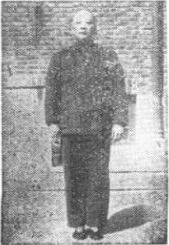
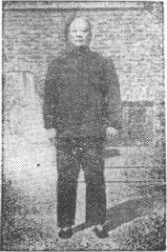
Practice method: the main movements of this posture are ward-off, roll-back, press and push. Their postures and movements are described separately below:
(1) From the posture with the hands hanging down, and governed by the intent, the two hands lift slightly upward — one must not use force. At the same time hollow the chest, loosen the shoulders, let the two arms straighten naturally, and raise the two hands level to the height of the shoulders (figure 3).
(2) The two elbow-tips point straight at the knees and bend downward (dropping the elbow). At the same time the buttocks sit down and the knees bend into a slight squat; the head must not tilt back. Let the breathing be natural, place the intent on the elixir field, and keep the upper body straight — it must not lean forward and down (figure 4).
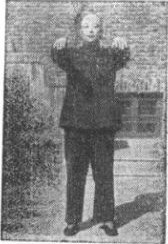
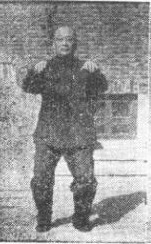
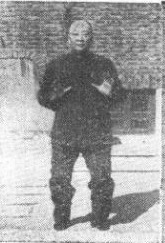
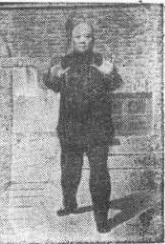
(3) When the elbow drops down and descends, the elbow-tip withdraws backward and the two hands come to the level below the breasts. The palms face outward, and the tiger-mouths and the tips of the ten fingers all point upward (figure 5). From this posture the movements of extension and bending, high and low, up and down begin: that is, the movements of opposed postures are distinguished, and this is called taiji. For once there are opposed and different ceremonial move— movements, it may also be called the two modes (liangyi).
(4) Step the left foot forward; the two hands push out level from below the breasts, pushing until the two arms are slightly straight, and the two legs form the left-bow-right-thrust form (figure 6). During the movement the head must be upright, the crown must not tilt back, the chest must not thrust forward; when pushing forward do not use force — the intent is in the palm of the hand; let the breathing be natural and the two eyes look level. This form is called "push".
(5) The previous form does not stop: the right foot shifts a small step to the left to line up with the left foot and stands firm; at the same time the two palms turn slightly outward to left and right, and the distance between the two hands is much as if pressing upon the opponent's elbow and wrist — that is, the left hand in front as if pressing on the point of the opponent's elbow, the right hand behind as if pressing on the opponent's wrist (figure 7).
(6) Sit the body backward; as the elbows bend the two hands withdraw downward to the right, withdrawing to the level of the right ribs; the tip of the left foot lifts (figure 8). This form is called "roll-back".
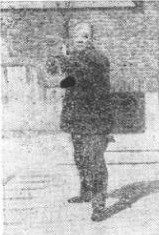
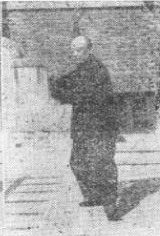
(7) The previous form does not stop: the left palm turns inward, the left elbow is raised, and the back of the hand and the arm are bent (figure 9).
(8) The upper body turns slightly to the left following the movement of the left hand, turning slightly into the true central form; at the same time as the turn, the right hand presses straight down from the ribs, the fingers taking the pressing force forward; the left arm bends, with the fingers level with the right shoulder, and the two legs form the left-bow-right-thrust form (figure 10). This form is called "ward-off".
(9) The previous form does not stop: step up with the right foot, the right foot in a straight line with the left; at the same time the right hand passes from the ribs across the front of the chest and extends forward in a circular shape, with the left hand closely following behind, and the two palms facing outward (figure 11).
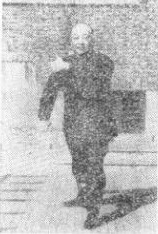
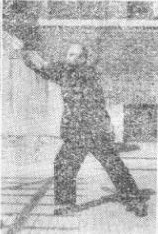
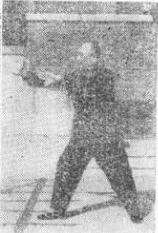
Still taking the ward-off form, with the intent in the palms, the shoulder and neck force sinking downward, the shoulders loosened, and the body twisted to the left in unison with the movement of the two hands (figure 12).
Continuing the ward-off form, ward off downward toward the left ribs and chest, the palms facing outward, the tip of the right foot lifted (figure 13).
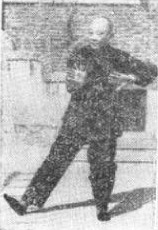
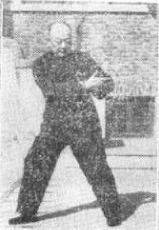
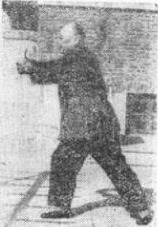
The back of the right hand faces outward, the left palm rests on the pulse of the right wrist, and the tip of the right foot is flattened (figure 14).
Both hands press out together toward the right front, pressing until extended straight; straighten the body toward the right front; when pressing out one must issue waist force, the chin must not lift, and the two eyes look straight ahead. The legs form the right-bow-left-thrust form (figure 15). This form is called "press".
(10) The previous form does not stop: the left hand draws a small circle on the right wrist, the two hands and arms extend level forward with the palms facing down, and the shoulders must be loosened (figure 16).
At the same time the two hands drop the elbows and withdraw, sitting back with waist force, and the right leg, following the momentum of the withdrawal, forms an empty step in front of the left foot; the right heel touches the ground and the weight is on the left leg (figure 17).
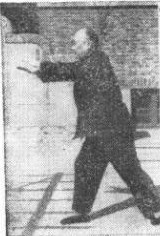
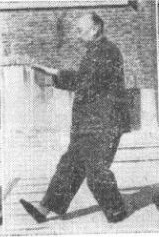
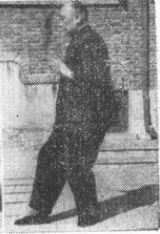
The two hands withdraw to below the breasts, and at the same time the right leg is drawn back half a step with the right toe touching the ground, the weight still on the left leg (figure 18).
The previous form does not stop: step the right foot forward, and the two hands take the outward pushing form. When pushing, the two hands move in unison with the feet, elbows and knees, with the waist as the main force, pushing until the two arms are not straight; take care that the head does not lean or tilt back. The two legs form the right-bow-left-thrust form (as in figure 19). Continuing from the previous form, the two palms turn slightly outward to the left, the waist sits downward, the weight shifts onto the left leg, and the tip of the right foot lifts.
The two hands take the ward-off form (figure 20), warding off toward the rear of the left ribs, then bend the elbows and turn the two hands to ward off toward the right ribs (figure 21).
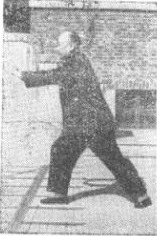
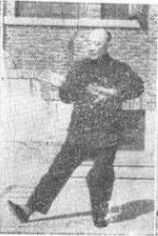
From the left ward-off to below the right ribs, the right arm is bent level, the weight on the right leg, and the tip of the left foot lifts (figure 22).
The right hand changes into a hook hand and lifts up, and the left hand turns up along with it, palm inward, its height level with the elbow and the shoulder. At the same time the left foot, following the movement of the two hands, withdraws to the side of the right foot and touches the ground with the toe in an empty step, the weight on the right leg, the eyes looking at the palm, the breathing natural, the intent on the elixir field (figure 23). This form is the closing form of roll-back-the-sparrow's-tail.
1. Practice method:
Continuing from the previous form, with the left palm turned inward, pass it over the top of the head, and with the hollow of the left elbow aimed at the tip of the nose, sweep it across toward the left diagonal. When the sweep reaches the left diagonal, the palm turns to face outward and extends out toward the left diagonal, and the left leg follows by advancing toward the left diagonal, forming the left-bow-right-thrust form. The left arm forms a semicircle with the fingers and tiger-mouth pointing upward; the right arm is extended straight in the upper right rear with the right hand in a hook shape; the face turns toward the left hand and the eyes look at the tiger-mouth (figure 24).
2. Technical meaning:
Ward-off is to make the left or right arm into a semicircle in front of the chest. If the left hand makes the form, then the fingers are aimed at the right shoulder-tip and the other hand guards the middle joint of the ward-off arm, serving to shield the true chest and to avoid the opponent's advancing hand method.
Roll-back is to roll the opponent's elbow with one hand and his wrist with the other, rolling them diagonally downward following the direction of his incoming force: it is the use of breaking the opponent's ward-off form and luring him in and letting him fall empty.
Press is to press my left hand upon the inner pulse of the right wrist while striking out straight with the back of the right hand at the opponent's below-shoulder above-elbow; the force of the two hands is joined and issued together.
Push is the method of aiming both hands at the opponent's ward-off form, and at the moment when my hands have gained a firm purchase, pushing out with force and advancing the step.
The formula (the Formula of the Great Function of the Whole Body — the same below) says: "From ward-off, roll-back, press and push the sparrow-tail is born" (see the earlier note).
Oblique single whip is: when the opponent strikes with one hand, I hook and roll his wrist with my hand, and at the same time step forward and strike at his true chest with the other hand. The formula says: "Walking obliquely, single-whip occupies the chest" (see the earlier note).
1. Practice method:
(1) Continuing from the closing form of single whip, the body sits down onto the right leg, the weight shifts onto the right leg, the left elbow is bent back and placed below the left ribs with the palm slanting upward, and the right hand still makes the hook unchanged. At the same time as the elbow bends, the left foot is drawn back half a step, the heel touching the ground and the toe lifted; take care that when the waist sits the tailbone is straight (figure 25).
(2) Continuing from the previous form, turn the body to the right rear. The left hand, following the momentum of the turn, guards in front of the left ribs; the body still sits down, the weight shifts onto the left leg, and the right leg is extended straight with the heel touching the ground and the toe pointing upward. As the body turns, the right hand opens out of the hook shape, and the right arm, still extended straight, withdraws slightly with the momentum of the turn, the right palm facing down (figure 26).
The left hand passes by the left ribs and thrusts forward out from below the right ribs, while the right arm bends the elbow and withdraws (figure 27).
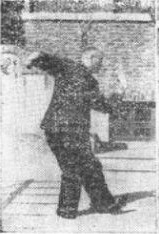
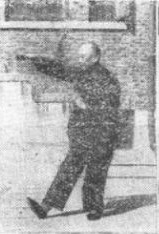
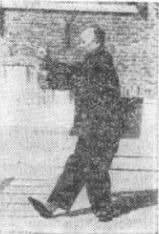
The left arm thrusts out, and the right hand pushes down toward the underside of the left arm; take care to hollow the chest, loosen the right shoulder and drop the left elbow (figure 28).
The right hand then thrusts out from below the left forearm, the left elbow bends back, and the two forearms pass in front of the chest, crossing in an X (figure 29).
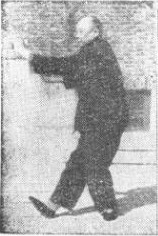
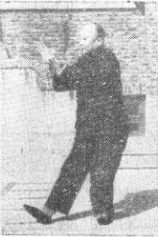
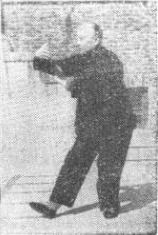
The right arm thrusts out and circles into a semicircle, making the ward-off form; the left hand withdraws in front of the chest and guards the middle joint of the right forearm, serving as an elbow-guard, with the eyes looking straight ahead (figure 30).
2. Technical meaning: this form is the hand method used to evade the enemy and to attack when meeting the opponent head-on and joining hands and taking his hands. The formula says: "Turning the body and raising the hands seizes the closure" (see the earlier note).
1. Practice method:
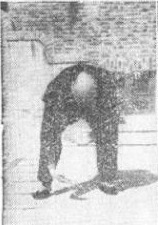
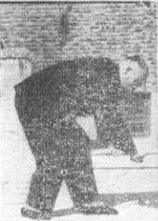
Continuing from the previous form, bend the body and lower the waist, turn the body to the left and take the centred upright form. The right hand, following the sinking momentum of the bending waist, scoops from below upward, the left palm facing down and the right palm facing up. This movement is commonly called "scooping the moon from the seabed" (figure 31).
Continuing, raise the body and lift the waist, place the left foot in front of the right foot in an empty step, the left hand pressing down with the palm turned sideways, and the right hand changing into a fist and striking down (figure 32). Then the waist and body rise, the right hand changes into a palm, passes in front of the chest and reverses above the top of the head with the palm facing outward, turning into the lifting form, the weight on the right leg, the tip of the left foot touching the ground in an empty step (figure 33).
The key point of this form is that, from the "scooping the moon from the seabed", the joints of the whole body rise upward: the head, the neck and the spine of the back must straighten up in a straight line; the left hand braces outward with the palm turned sideways and the right hand lifts back from below upward, extending the shoulder and elbow joints; the eyes look straight ahead and the breath must sink (figure 34).
2. Technical meaning: the use of "scooping the moon from the seabed" is that when the opponent kicks with his foot, I quickly bend the body and scoop his leg upward with my hand, making him fall over backwards on his face.
The use of white crane spreads its wings is that when the opponent strikes down from above with his hand straight at my face, I sweep and lift with one hand at the back of the arm and elbow of his incoming strike, while the other hand at the same time cuts straight down into his soft ribs with the palm turned sideways and strikes. The formula says: "Lifting and striking the soft ribs admits no mercy" (see the earlier note).
1. Practice method:
Continuing from the previous form: the right hand goes from above the head straight toward the left shoulder-tip taking the brushing form, and at the same time, crouching slightly, turn the body to the left and twist the hips; the left hand also, from below, lifts backward to form a straight level line with the left shoulder, the weight on the right leg, the left foot in an empty step (figure 35).
The right hand brushes past the left shoulder and hangs down; the body and hips twist toward the right; the left hand lifts from the left side, brushing and dissolving upward and turning to the right along with the body; the hand rises past the head and face and takes the brushing form outside the right shoulder, the weight on the right leg, the left foot in an empty step (figure 36).
The right hand lifts from the lower rear to form a straight level line with the right shoulder, and at this moment the left hand passes through the brushing and dissolving posture (figure 37).
Lift the right leg, and the left hand brushes past the front of the left knee (figure 38).
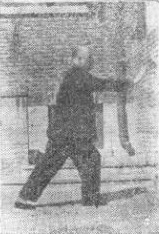
The left hand brushes past the left knee and hangs down, and at the same time the left foot touches the ground (figure 39).
At the same time the right hand pushes forward from behind the head past the side of the ear, the palm facing outward (figure 40).
The right hand strikes forward from beside the right ear, the left hand is placed at the side of the left hip taking the brushing posture, and the two legs form the left-bow-right-thrust form, the eyes looking straight ahead (figure 41).
2. Technical meaning: it is the method of screening one's own true chest, face and legs and knees, while at the same time the right hand advances and strikes toward the opponent's right shoulder on the right diagonal. The formula says: "Brush the knee and twist the step — seek within the oblique" (see the earlier note).
1. Practice method: continuing from the previous form, from the right hand that has struck out, sweep a small circle sideways toward the left outside; the left hand then lifts from below upward in the bent-elbow form, the fingers of the left hand and the tiger-mouth both pointing upward, moving together with the right hand as it circles to the left, the left hand taking the posture of thrusting upward from below. After circling, the right hand drops from the left elbow and is placed below the left elbow for use as an elbow-guard. At the same time the right rear leg shifts forward half a step and bends the knee, the weight on the right leg; the left leg is extended straight, the tip of the left foot pointing upward, and the eyes look straight ahead (figure 42).
2. Technical meaning: the use of this form is that when the opponent strikes straight at my true chest with his right hand, I quickly deflect it outward to the left with my right hand, and at the same time quickly thrust upward from below with my left hand to ward off, serving as a guard. The formula says: "Hand plays the pipa — the refinement of piercing and dissolving" (see the earlier note).
The movement of this form is first to brush the knee on the left, then to brush the knee on the right, and then again to brush the knee on the left. The practice method is the same as the sixth posture (figures 43, 44, 45, 46, 47, 48, 49, 50, 51, 52, 53, 54).
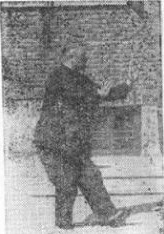
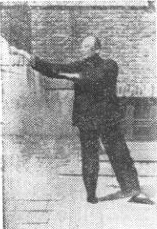
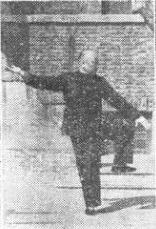
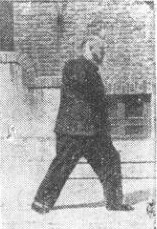
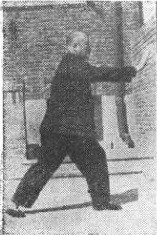
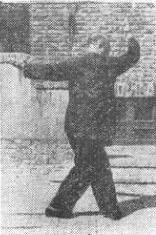
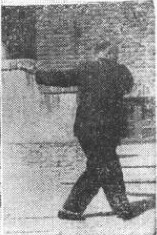
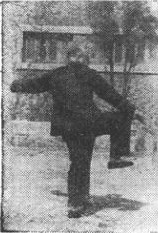
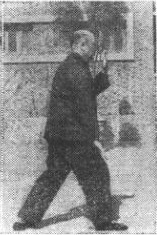
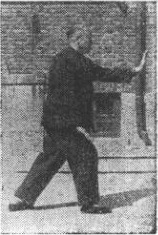
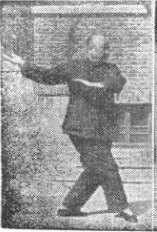
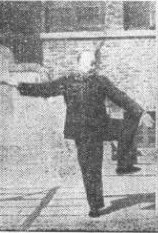
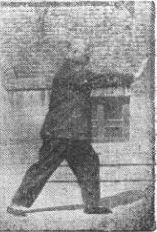
The practice method is the same as the seventh posture, hand plays the pipa (see figure 42 earlier).
1. Practice method:
(1) Continuing from the previous form, the left hand withdraws and bends in front of the belly; the right hand bends back and presses onto the right hand, the right arm bends, with the elbow-tip pointing outward, taking the horizontal-elbow deflect-and-lift posture (figure 55).
The right hand turns over with the back of the hand forward and the elbow downward; the left hand draws down from the back of the right fist along the right elbow, and at the same time the right leg is raised (figure 56).
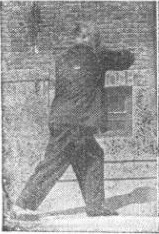
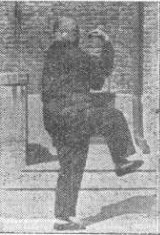
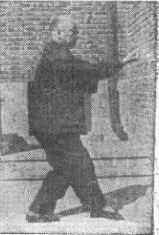
The right hand strikes forward, turning over as a fist, and at the same time the right foot takes a slightly sideways form and strikes with the sole, landing in front of the left foot (figure 57).
Step the left foot forward, forming the left-bow-right-thrust form; the left hand extends from the inner side of the right elbow and strikes with the palm upright, and the right fist withdraws to the waist. So much for the horizontal-elbow and reverse-strike practice method (figure 58).
The right fist strikes straight forward from below the right ribs, and the left palm is at once placed at the middle joint of the right elbow (figure 59).
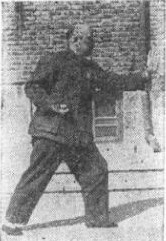
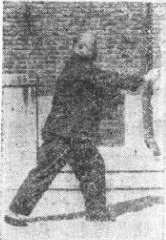
2. Technical meaning:
(1) When joining right hands with the opponent, the left hand thrusts out from below the right hand, and the right arm bends the elbow and strikes straight at the opponent's true chest with the elbow-tip. Or, when the opponent, while I roll and lead with both hands, takes the opportunity to lean and strike at my true chest with his shoulder, I quickly use the horizontal elbow and follow the momentum to deflect outward. The formula says: "Sticking close and drawing near, the horizontal elbow rises" (see the earlier note).
(2) The use of the "reverse strike" is: I strike the opponent's true chest with the elbow-tip. If the opponent props up my elbow with his hand, then I quickly use the left hand that guards the middle joint to deflect downward, and at the same time the right hand forms a fist and, pivoting on the elbow-tip, strikes back from the chest at the opponent's face. The formula says: "Guarding the centre and striking back is called heroic" (see the earlier note).
(3) The use of deflect, parry and punch is: if I take hands with the opponent, and on joining right hands I at once, without a moment's delay, use my left hand to block the middle of the opponent's right elbow, and then quickly drive my right fist straight at his ribs, at the same time pursuing the step and advancing the body. The formula says: "Advancing the step, deflect and parry, employ below the ribs" (see the earlier note).
1. Practice method:
Continuing from the previous form, the left hand (palm facing down) sweeps a small circle level above the right elbow and then opens out, its width the same as the shoulders (figure 60).
The two hands then withdraw and circle to be placed in front of the chest, the fingers pointing upward and the palms facing outward. While withdrawing, the waist is the main force, the shoulders are loosened and the elbows dropped, the weight on the right leg, and the left leg is drawn back to form an empty step, as in (figure 61). The previous form does not stop: push out again into the "push" posture, the right leg thrusting straight, the left leg forming a bow; the shoulders and elbows must sink and be firm, the cervical spine must be upright, and you must not tilt the head back or bend the neck. The eyes look at the two hands (figure 62).
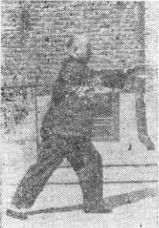
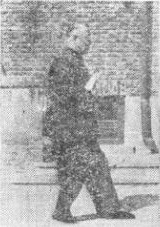
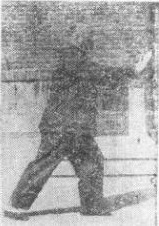
2. Technical meaning:
If my right wrist and elbow are seized and pinned by the opponent, I then use the left hand with a circling force to sweep and deflect his hand from the middle of the elbow-gate, so as to free the right hand; then take the pluck and push methods and drive straight at the outside of the opponent's right shoulder or at his exact centre and strike and release. The formula says: "As if sealing, as if closing, guard the exact centre" (see the earlier note).
1. Practice method: the left foot steps back half a step, and the body turns to the right; at the same time the right arm is raised back and upward to form a circle with the left arm, the two tiger-mouths facing each other, the palms facing up, the upper body upright, the two hands forming the supporting-heaven posture, and the eyes look between the two hands (figure 63).
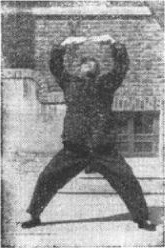
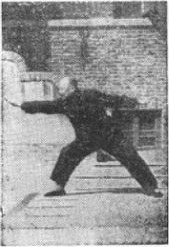
The two hands part from the top of the head to left and right, the upper body leans right, the left hand extends straight to the left, the two arms form parallel lines, the palms face down, and the eyes look at the right hand (figure 64).
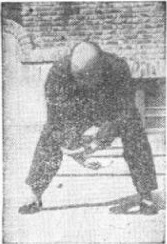
The two hands each pass down from left and right and come together, crossing in front of the crotch, forming the posture of scooping upward posture (figure 65). The upper body then straightens up along with it, the right leg shifts a small half-step toward the left, the two feet are shoulder-width apart, the two hands cross in the shape of a cross and are placed in front of the chest, the two arms circle into a ring, and the eyes look straight ahead (figure 66).
2. Technical meaning: every hand method of taijiquan can be developed out of the cross-hands method. The formula says: "The cross-hands method transforms without end" (see the earlier note).
1. Practice method: continuing from the previous form, the left foot turns in slightly, the right foot retreats one step to the right rear, and the upper body at once turns slowly to the right rear; the crossed cross-hands are at the same time turned to the left ear, and the right hand changes into the plucking hand (that is, the grasping and rolling form) (figure 67).
The right hand rolls downward from the left ear toward the lower right and comes to rest beside the right hip, while the left hand extends straight forward to the right (palm facing outward), forming the right-bow-left-thrust form (figure 68). (See figure 69 — that is, the front view of figure 68.)
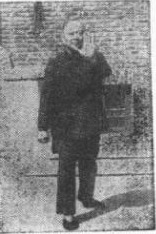
Change the left hand into the plucking form, and raise the right hand upward from beside the hip as if rushing at the opponent's elbow (figure 70). (See figure 71 — that is, the front view of figure 70.)
Both hands at the same time lead back toward the left ribs, the weight on the left leg, the right leg extended straight (figure 72).
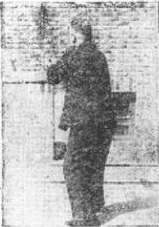
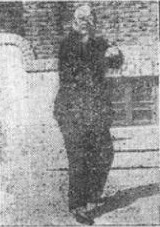
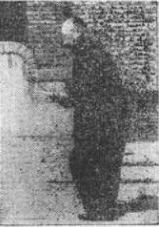
Thereupon the left hand changes into a palm and presses on the inner side of the right wrist, the right leg bends, and the left leg extends straight (figure 73).
2. Technical meaning: when joining right hands with the opponent, I roll his right wrist downward with my right hand, and my left hand at once rushes straight at his face and strikes. If he blocks with his left hand, I change my left hand into the plucking and rolling form, pluck his left wrist, and at the same time pin his left elbow with my right hand, rending straight toward below my left ribs. If he withdraws his hand backward, he runs into my press hand, and following his withdrawing form I press and strike straight at below his left shoulder. The formula says: "Embrace the tiger and return to the mountain — plucking and rending are complete" (see the earlier note).
1. Practice method: continuing from the previous form, make the right press form as in (figures 74, 75), and the push form as in (figures 76, 77, 78); the practice method is the same as before.
Continuing from the previous form, make the left ward-off form (figure 79), then make the right ward-off form (figure 80), warding off to the upper right side, the left foot withdrawing in front of the right foot to form an empty step, the right hand forming a hook in the upper right, and the left hand following below the right wrist (this form is the closing form of roll-back-the-sparrow's-tail; see figure 23 earlier).
1. Practice method:
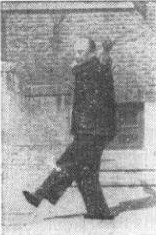
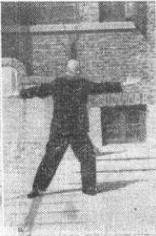
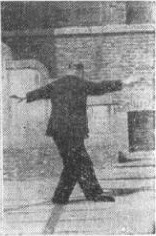
Continuing from the previous form, the left hand passes from below the right hand across the face and circles to the left, while the right palm turns upward and extends to the left so that the two arms are level and sideways like a balance; at the same time the left foot sweeps a semicircle toward the left diagonal and extends out to step down (figure 81). After the left foot touches the ground, the right foot steps out to form a straight line with the left foot; the two arms are still extended level, and the waist twists to the left, the left arm in front, the eyes looking straight ahead (figure 82).
Next turn the body further to the left, the two legs forming a crossed posture, the two palms facing down, and the body leaning slightly forward (figure 83).
The left hand sweeps a small circle from between the left ribs, twists the wrist, and bends the elbow to extend out from the chest; at the same time the right hand follows with a sideways ward, and the left and right arms move in unison (figure 84).
When the left hand extends from the chest, the tiger-mouth points upward and the palm faces outward; it passes up from below to the front of the face, the eyes look at the tiger-mouth, the shoulders sink and the elbows drop. As the left arm passes up, the right hand passes in front of the left hand and comes to rest below the left elbow as a fist; the weight is on the right leg, the left leg is extended straight, the heel touches the ground, and the toe lifts (figure 85).
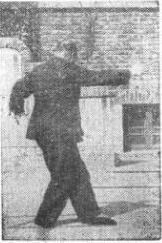
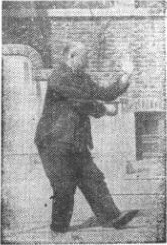
2. Technical meaning: the use of this form is that when my left elbow is seized and rolled by the opponent, I at once use my right hand to cut downward along the momentum from the back of the left hand, in order to guard the left elbow. The formula says: "Elbow-base watches the punch — the hand that guards the centre" (see the earlier note).
1. Practice method: continuing from the previous form, the right fist changes into a palm and is raised level backward from below with the palm facing up; the left palm turns back upward and extends level forward, the weight still on the right leg; the left foot is set flat, the two shoulders loosen downward, the chest is hollowed, and the breath sinks (as in figures 86, 87).
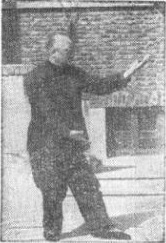
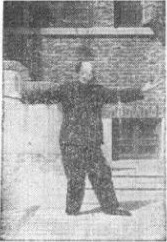
The right palm extends forward from the rear past the side of the right ear, and at the same time the left leg is raised into the bent-bow form, the eyes looking in front of the fingers of the left hand (figure 88).
The right hand extends level forward from beside the ear with the palm facing down, while the left arm turns the palm over downward and extends straight back from below; at the same time the left leg, from the bent-bow form, retreats a step backward and lands behind the right foot, the two arms level and straight, the two shoulders loosened and spread, and the weight shifts onto the left leg (figure 89).
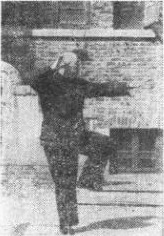
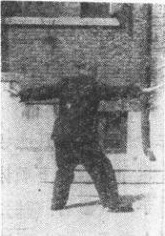
The left palm bends the elbow and strikes forward from beside the left ear, and the right leg is raised taking the bent-bow form (the movement as in the method of the previous form) (as in figures 90, 91, 92). Then one must again make a left reverse-the-arm (see figures 37, 88, 89 earlier).
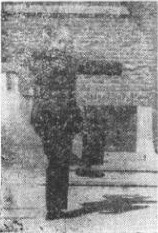
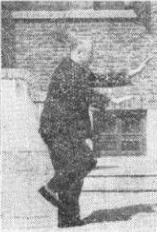
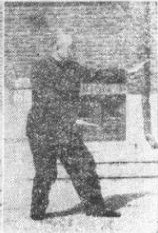
2. Technical meaning: the use of this form is that when the opponent seizes my wrist with his hand, I at once retreat a step backward, dropping the seized hand with my body, and if he takes the momentum and advances, I then meet and strike his elbow joint with the other hand. The formula says: "Dropping the body and retreating, walk away with the levering and pulling force" (see the earlier note).
1. Practice method: continuing from the closing form of the left reverse-the-arm, the two arms extend level and the two legs part.
Both palms face down and the legs bend slightly (figure 93); the left arm bends back with the hand in front, and the right arm bends back with the hand below the ribs (figure 94).
The right foot is withdrawn backward, and the upper body then turns slowly to the right, while the two hands cross in front of the chest, the left palm facing down and the right palm facing up (figure 95).
Next the right arm sweeps out toward the upper right and the left arm is raised obliquely toward the lower left, the two arms extending straight and opening out; the upper body forms a half-slanting shape, the right leg bows and the left leg thrusts, and the eyes look straight ahead (figure 96).
2. Technical meaning: the use of this form is that when joining right hands with the opponent, I use my left hand from below the opponent's right arm, rushing straight up obliquely past the left shoulder-tip; I must place my right arm below his right armpit in the posture of carrying on the shoulder, and at the same time rise and lengthen the waist, turning the right arm over to strike obliquely toward the left front. When this form is used it is not easy to miss. The formula says: "The method of the oblique flying form is never used in vain" (see the earlier note).
Practice method: the body turns to the right, the weight on the left leg, the right arm makes the ward-off form, and the left hand guards the right elbow (see figure 30 earlier).
Practice method: the movement is the same as before (see figures 31, 32, 33, 34 earlier).
Practice method: perform the left brush-the-knee-and-twist-the-step once (see figures 35, 36, 37, 38, 39, 40, 41 earlier).
1. Practice method: continuing from the left brush-the-knee-and-twist-the-step without stopping, the right foot follows forward a small step, the left foot advances obliquely to the right a small step with the toe lifted; at the same time the right hand withdraws slightly, and the left hand is raised level with the right hand, the tiger-mouths facing each other; then, following the movement of bending the waist, it is thrust down to the outside of the left anklebone (as in figure 97).
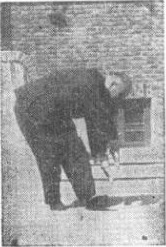
(also called Flash Through the Back, 闪通背)
1. Practice method:
Continuing from the previous form, step the left foot up obliquely to the right, taking the bow step; the two hands rise along with it, the left and right arms making arcs with the palms both facing up and the tiger-mouths facing each other; the upper body, following the bow of the left leg, slants to the left, and the right leg forms the thrust form (figure 98).
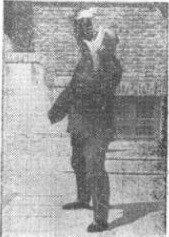
2. Technical meaning: the use of this form is that when joining left hands with the opponent, the right hand thrusts out from below his left hand, and I use my right upper arm to lift and prop up his left arm, while the left hand rushes and strikes below his left ribs; at the same time, the advancing step and the palm take a coordinated movement. The formula says: "Fan through the arm — the work of lifting and propping above" (see the earlier note).
1. Practice method:
Continuing from the previous form, extend the right hand straight forward, and at the same time raise the left arm and place it in front of the forehead with the palm facing outward (figure 99).
The left hand falls and guards above the right elbow (figure 100).
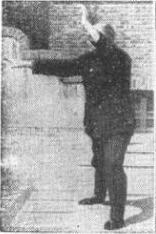
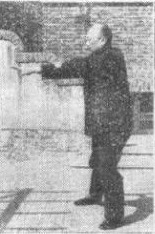
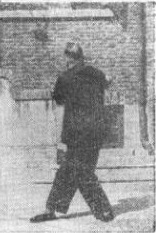
With the elbow-tip as the centre of the circle, the right hand grips a fist and draws a large circle from inside the left arm across the chest, rushing straight out to the right side with the arm held sideways; the upper body turns to the right along with it, the left foot withdraws behind the right foot, and the eyes look at the right fist (figure 101).
The right arm is still extended straight and the left hand still guards the right elbow; using waist force, bring the right arm and the left hand back to face straight ahead, the weight on the left leg, and the eyes look at the right hand (figure 102). Raise the right leg and turn the body to the right; at the same time the right fist changes into a palm, the arm turns over upward and the elbow bends, and the left hand still does not leave the right elbow (figures 103, 104).
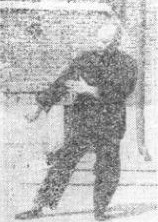
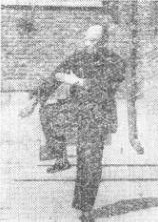
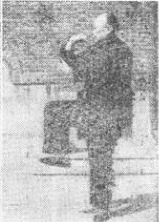
The right foot lands, and the right hand changes into a fist and smashes back, the left hand still guarding the right elbow (figure 105).
After the right foot lands, the left arm immediately extends forward from the inner side of the right arm, making the deflect-and-parry form, and the right fist withdraws to the waist (figure 106).
2. Technical meaning: the use of this form is: when in contact with the opponent, if he flashes and dissolves my hand and advances and strikes toward my right side, I then turn my body sideways and use my right arm to strike sideways at his true chest. The formula says: "The twist-the-body punch strikes the flashing-and-dissolving form; the sideways body advances and the method is complete" (see the earlier note).
(this form contains the method of reversing the wrist and closing the lock — not listed as a separate posture name)
1. Practice method: continuing from the previous form, step the right foot forward and then the left foot, forming the left-bow-right-thrust form; the right fist strikes forward from below the right ribs, with the left hand guarding the middle joint of the right arm (figures 107, 108). Below follows the method of reversing the wrist and closing the lock.
Open out the right fist that has struck, place the left hand on the right hand, and step the right foot forward with the front leg slightly bent (figure 109).
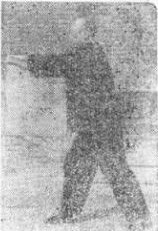
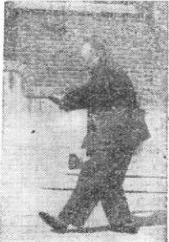
Step the left foot forward with the tip of the left foot lifted, the weight on the right leg, the chest hollowed and the elbows dropped, sitting slightly backward (figure 110).
The tip of the left foot touches the ground; using the force of sitting and pressing with the waist, draw the two hands to the front of the belly, while the right wrist turns back upward and the left hand is below the right wrist, both palms facing up, and the front foot settles flat (figure 111).
Advance the right foot, and as it advances the two hands move to the front below the chin and strike out with a lifting push (figures 112, 113).
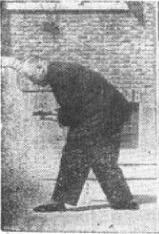
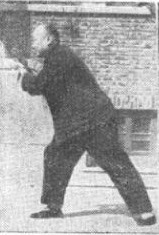
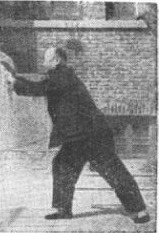
2. Technical meaning: the use of this form is: if the opponent presses and holds my right wrist that has struck out, I then bring my left hand up and press and hold his wrist, quickly sit the body and press down, drawing down the hand that holds his, while reversing the right wrist. This is a small locking method, used in the method of breaking the opponent's wrist. If he pulls his hand out, I quickly follow the momentum and drive the tiger-mouth part of my right hand straight at below his neck, taking the form of closing and sealing the enemy's throat and lifting it out; that is, I follow his departing form and strike and take it. The formula says: "Within the wrist, conversely, there is the closing and locking method" (see the earlier note).
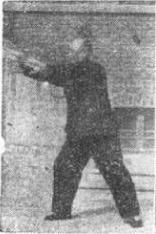
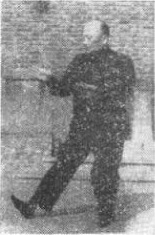
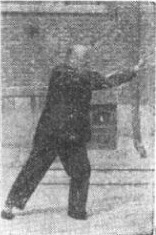
(the left and right ward-off forms; the practice method as in figures 114, 115, 116, 117, 118, the explanation as before)
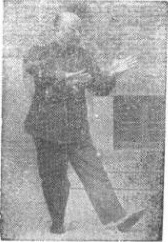
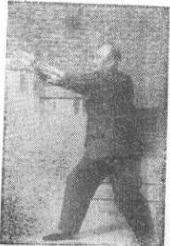
(the practice method as in figures 119, 120; the explanation as before)
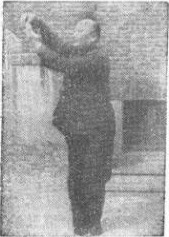
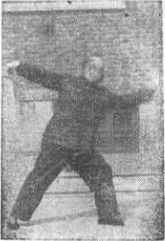
1. Practice method:
Continuing from the single whip form without stopping, draw the right leg back level with the left leg, the two legs bending at the knees into a half- bow shape, the upper body upright, the weight on both legs; when the legs come together the right hand withdraws and hangs down, and the left hand is raised level on the left side, the palm containing and storing power (figure 121).
The right hand then draws a large circle from below upward, passing the left shoulder-tip, and from near the left wrist rises and passes up over the head, with the hollow of the elbow aimed at the nose and mouth as the measure; the shoulder must not lift, the fingers point upward and the palm faces inward, while the left palm faces down and sinks as the right hand circles up (figure 122). The right hand circles from the head toward the right, the upper body turns along with it, and the weight shifts onto the right leg (figure 123).
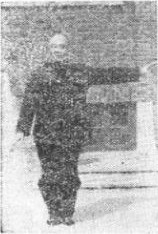
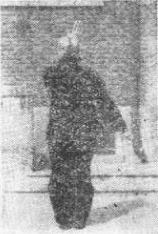
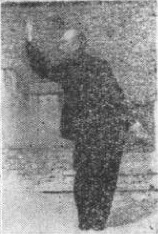
The right hand sinks, and at the same time the left hand draws a large circle from below upward, the movement of the two arms forming a cross; at the same time the left leg steps one step sideways to the left, and the eyes look at the left hand (figures 124, 125).
The left hand passes in front of the face and turns toward the left, the eyes fixed on the palm; the upper body turns left, the left leg bows and the right leg thrusts (figure 126). So far this is one right cloud hand and one left cloud hand; do this twice more, three times in all.
2. Technical meaning: the use of this form follows the same advancing-hand route as the oblique flying form. When the hand has thrust close below the opponent's arm and I have come near his armpit, if I wish to deflect the hand outward, I must quickly turn the thrusting hand downward and reverse it, striking out with a snapping force — that is, changing the spiral force into a snapping force and is issued. The formula says: "Cloud hands advance three times and attack above the arm" (see the previous form).
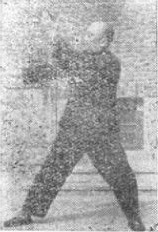
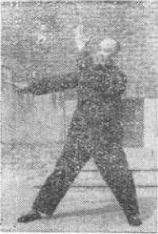
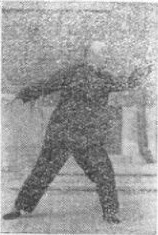
(see figures 119, 120)
1. Practice method: continuing from the single whip form without stopping, raise the right hand from the right rear upward, passing over the top of the head, and let it fall toward the chest in the horizontal-elbow form, while the left palm turns back upward and withdraws inward (figure 127).
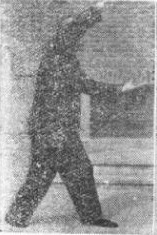
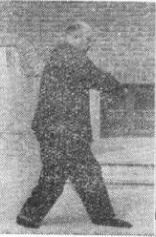
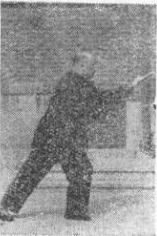
The right arm falls with the horizontal elbow to the chest, the left hand withdraws, and the weight is on the right leg (figure 128).
The left hand thrusts straight forward and upward from above the right forearm, and the right hand moves from below the left elbow to below the left ribs; the upper body leans forward with the momentum of the upward thrust, forming the left-bow-right-thrust form, the eyes looking at the left fingers (figure 129).
2. Technical meaning: the use of this form is that when the opponent drives straight at my chest with a middle-level hand, and there is no time to defend, I quickly use my right hand to press and cut his hand from above downward, taking the posture of warding off horizontally downward, while drawing in the body and driving my left hand from below upward straight at his face to thrust and pierce. When using it, one must advance the body and send the hand out. The formula says: "High pat on the horse — intercept the hand and thrust upward" (see the earlier note).
1. Practice method: continuing from the previous form, the two hands sink and fall from the left toward the lower side and draw a large circle to the right, while the left leg is raised (figure 130).
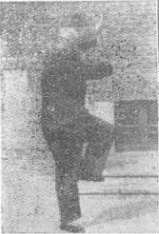
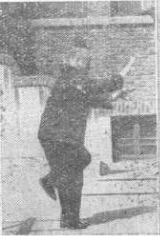
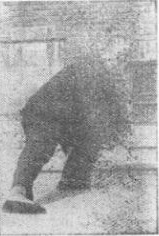
The left foot falls to the left rear as the body sinks along with it (figure 131); the left knee bends, the waist is lifted, and the two hands follow to press and draw downward in front of the left knee (figure 132).
The hand that pressed downward circles upward to the side of the left ear, and the two hands form a cross shape (as in the cross-hands form), and at the same time rise into the left-bow-right-thrust form (figure 133).
The crossed hands form loose fists, the right leg bends at the knee level with the hip, the right fist outside and the left fist inside, and the eyes look toward the right diagonal (figure 134).
The right leg is sent out and thrusts toward the right diagonal with the heel; at the same time the right fist changes into a palm and extends along the right leg, and the left fist changes into a palm and extends backward with the palm facing outward (figure 135).
The right leg is drawn back and the knee bent, the foot falls to the left rear, the waist is lifted and the body bent; the body weight is on the right leg, and at the same time the two hands gather and ward upward, then, following the momentum of sitting the body, press and draw downward in front of the right knee with the palms facing down (figures 136, 137).
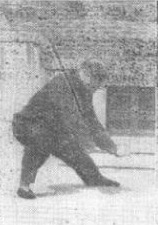
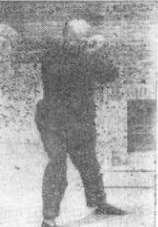
The hand that pressed downward circles upward to the right to the side of the right ear, and the two hands change into fists and cross, the right fist inside and the left fist outside; at the same time rise to the right into the right-bow-left-thrust form (figure 138).
The left leg is raised and thrusts toward the left front; at the same time the two fists change into palms, the left hand extends along the left leg and the right hand extends level backward, the palms both facing outward (figures 139, 140).
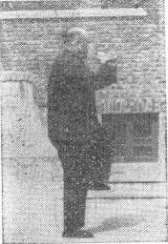
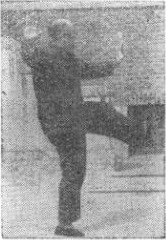
2. Technical meaning: this form may be used with either the left or the right hand: when one has plucked and held the opponent's wrist, advance a step to the side and drive the heel straight at his soft ribs. When using it, one must first pluck and hold the opponent's hand, to guard against the leg being caught. The formula says: "Left and right separate the feet — the hands must seal" (see the earlier note).
1. Practice method: continuing from the left thrust-foot form without stopping, the left foot is drawn back, the knee bent, and the two hands also draw back and form fists crossed in front of the forehead in the cross-hands form (figure 141).
Lift the tip of the right foot and pivot on the heel to turn to face exactly left, standing firmly; the left leg is still bent level with the hip (figure 142).
Thrust the left foot out, and at the same time extend the two arms straight with the palms facing outward; the movement is the same as the left separate-the-foot (figure 143).
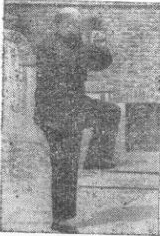
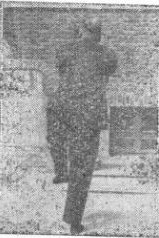
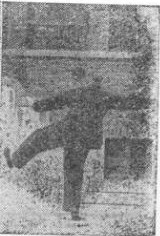
2. Technical meaning: the use is the same as the left and right separate the feet, except that this form thrusts at the opponent's abdomen. The formula says: "Turning the body and thrusting the foot, occupy the abdomen" (see the earlier note).
1. Practice method: the same as before. Continuing from the previous form, first draw the left foot back and bend the knee, and bend the left arm at the elbow to make the left brush-the-knee form (figure 144).
Then brush the right knee once more, and then brush the left knee once more (figure 145). In all, two left and one right; see the earlier annotation to the left and right brush-the-knee-and-twist-the-step.
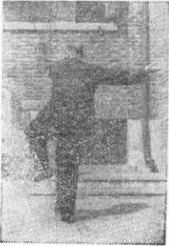
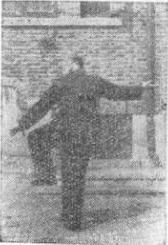
1. Practice method: the left foot lands on the left front; the left arm extends straight with the left hand pressing down, and the right hand grips a fist and, from the right rear past the top of the head, strikes the fist out with waist force (figure 146).
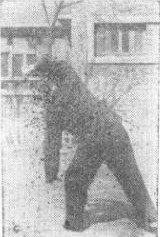
2. Technical meaning: the use of this form is that when the opponent attacks with a middle-level hand, I intercept downward and deflect with my left hand, and at the same time drop the body and bend the waist, flinging the right fist out from behind and driving straight at the opponent's face. The formula says: "Advancing the step and planting the punch — charge head-on" (see the earlier note).
1. Practice method:
Turn the body to the right; the right fist changes into a palm and, from above and following the momentum of the turn, reverses out together with the arm, the palm facing up, and the eyes look straight ahead (figure 147).
The right hand grips a fist and grasps and rolls downward, while the left hand thrusts out forward from below the right ribs (figure 148).
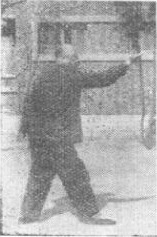
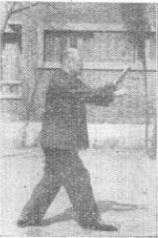
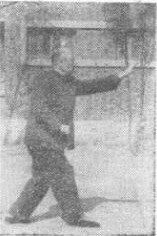
The upper body turns half a face to the right, the right hand rolls to below the hip, the left arm extends straight, and the hand thrusts forward and pierce (figure 149).
2. Technical meaning: the use of this form is that, when joining right hands with the opponent, or when he strikes with his right hand from above downward, I use my right hand, reversing it into the plucking form, pluck and roll his right wrist downward; at the same time I pierce straight at the enemy's two eyes with my left hand. The formula says: "Reverse the body, the white snake spits its tongue, transforming; pluck the enemy's hand and take both pupils" (see the earlier note).
1. Practice method: continuing from the previous form, let the left hand that thrust out sink slightly downward with the fingers pointing upward, taking the deflect-and-parry form (figure 150).
Advance the left foot, and the right fist strikes out level from below the right ribs, with the left hand guarding inside the elbow (figure 151).
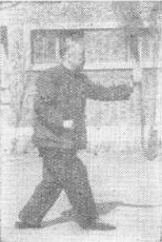
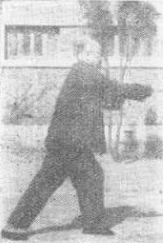
1. Practice method: continuing from the previous form, the two hands are raised and circle down from above the head to left and right, and the two arms level out (figure 152).
Without stopping, continue circling into a round shape, coming to the crossed cross-hands form in front of the chest below the chin; raise the right leg and bend the left leg slightly (figure 153).
The right foot thrusts out toward the right diagonal, and at the same time the two arms extend out with the palms facing outward (figure 154).
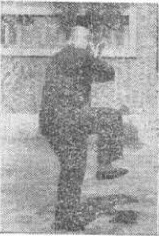
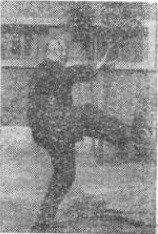
1. Practice method:
Let the right leg fall level with the left leg and stand, the eyes still looking at the fingers of the right hand (figure 155).
The right hand falls, moving together with the left hand, and circles from left to right over the head (figure 156).
While it passes over the head, the left foot steps out toward the left diagonal, and at the same time the two hands fall, the waist is lifted, and the weight is on the left leg (figure 157).
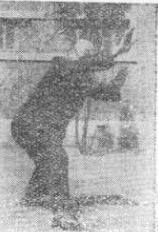
The upper body turns to the left along with the two hands, the left leg bowing and the right leg thrusting; the two hands are lifted from below, the left arm bends at the elbow to form a fist taking the upper semicircle, and the right arm also bends, taking the lower semicircle; the two fists' tiger-mouths face each other above and below, the left fist's centre facing outward and the right fist's centre facing inward, the height of the left arm level with the shoulder, the left leg bowing and the right leg thrusting, and the high-low distance of the two fists is measured by the opponent's above-the-breast below-the-ribs (figure 158).
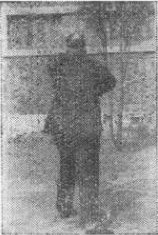
Without stopping, the two fists change into palms and sink, the palms facing down, while the right foot shifts to the left to form a straight line with the left step; the upper body bends downward and moves with the two hands toward the right, the weight on the right leg (figure 159).
Turning the body to face exactly right, the two hands are lifted upward along with the body, the two arms still taking the semicircle, the right fist above and the left fist below, the tiger-mouths facing each other above and below, the right fist's centre facing outward and the left fist's centre facing inward, the distance the same as described for figure 158 (figure 160).
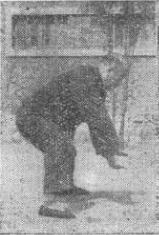
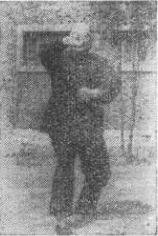
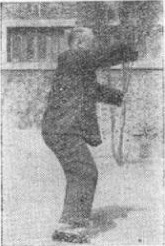
The previous form does not stop: with the fists and arms in the original form, brace the shoulder outward to the left; when the turn reaches the left side the two legs form the horse-riding form (figure 161); turn further left, and the left leg bows and the right leg thrusts, forming the left drape-the-body and mount-the-tiger as in figure 158 earlier.
2. Technical meaning: the use of this form is that when joining left hands with the opponent, I seize his arm slightly with my hand, and my right hand changes into a fist and drives straight at his right breast; at the same time the left fist drives at his back and strikes out below the right ribs, the two fists moving in unison, and the left and right uses are the same. The formula says: "Left and right drape the body and mount the tiger, refined; above, strike the true chest, below, the ribs" (see the earlier note).
1. Practice method: part the two hands to left and right, each drawing a large circle, and come to the crossed cross-hands at the chest; at the same time turn the body to the right, forming the horse-riding form, and from the horse-riding form wheel around into the left-bow-right-thrust form (figure 162).
Raise the right leg and thrust it out, and at the same time extend the left and right palms; the movement is the same as the earlier right thrust-the-foot (as in figures 163, 164).
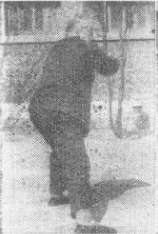
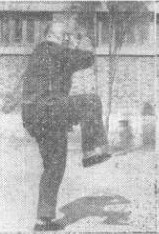
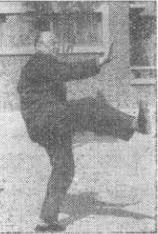
1. Practice method:
Continuing from the previous form, the upper body turns to face straight ahead with the right thrust, the right leg is drawn back, the knee bent and the chest hollowed, and the two arms sink with the left hand level with the right hand, the palms facing up, the eyes looking straight ahead (figure 165).
The two hands sink from beside the left and right knees and circle upward, changing from palms to fists midway, and the two fists with the palms facing outward, circle to the front to form the posture of striking each other; at the same time the right foot lands, forming the right-bow-left-thrust form (figures 166, 167).
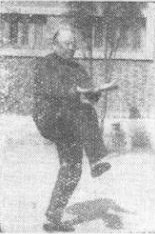
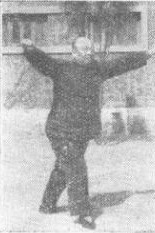
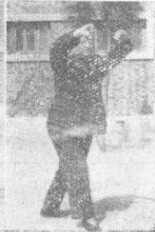
2. Technical meaning: the use of this form is that I press and strike with my two hands at the opponent's chest. If he parts and deflects my hands with his own two hands from above downward, I then follow his deflecting momentum and sink, and quickly reverse the two fists to strike his two ears from left and right. The formula says: "Twin winds pierce the ears — the method is efficacious" (see the earlier note).
1. Practice method:
Continuing from the previous form, the upper body turns slightly to the right and the two fists change into palms crossing in front of the forehead (figure 168).
The left and right hands part to left and right with the palms facing down, the eyes looking to the left (figure 169).
The two hands circle downward to the chest to form the cross-hands, the left hand inside and the right hand outside, and the weight shifts onto the right leg (figure 170).
The left leg is raised, the knee bent level with the hip, the eyes looking toward the right front, storing power ready to issue (figure 171).
The left foot thrusts out toward the left, and at the same time the two arms extend and stretch, the left palm facing outward (figure 172).
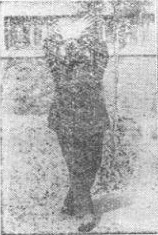
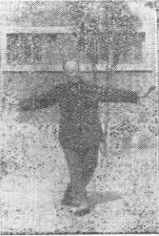
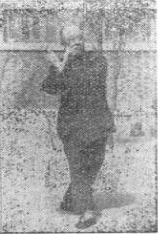
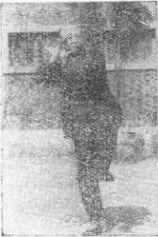
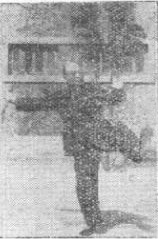
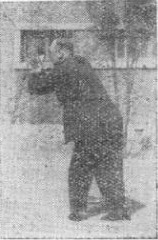
1. Practice method: continuing from the previous form, draw the two hands back from below to the chest to form the cross-hands, and at the same time turn the body to the right, turning the left step in and closing it in front of the right foot (figure 173).
Immediately raise the right leg and thrust the right foot forward, the two arms extending out to left and right with the palms facing outward (figure 174).
1. Practice method: continuing from the previous form, the right leg that thrust out is drawn back and the knee bent, while the right hand falls past the front of the knee and circles inward and upward to the front of the forehead, the elbow bent, with the back of the hand facing outward; the left hand reaches forward and supports the inner side of the right elbow (figures 175, 176).
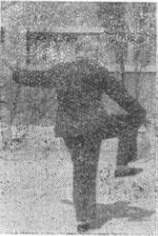
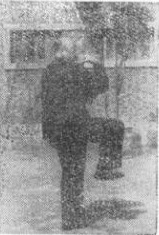
The right foot lands, the left hand extends out with the palm upright (fingers pointing upward), and at the same time the right hand changes into a fist and smashes forward and back, then withdraws below the ribs (figure 177). Immediately step the left foot forward and strike out the right fist, with the left hand guarding the inner side of the right elbow; see figure 151 earlier.
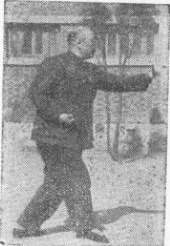
Practice method: continuing from the previous form, take the left hand of the deflect-parry-punch, pass it from above the right arm across the right fist and sweep a small circle to the left; the right fist changes into a palm, and the two hands at the same time withdraw to below the breasts in front of the chest with the palms facing outward. At the same time the left leg, following the momentum of the two hands withdrawing, is also drawn back in front of the right foot to form an empty step; immediately step the left foot forward, and the two hands accordingly press out (that is, the push form), the same as the earlier "as if sealing, as if closing".
Practice method: continuing from the previous form (see the twelfth posture — cross hands).
Practice method: continuing from the previous form (see the thirteenth posture — embrace the tiger and return to the mountain).
Practice method: continuing from the previous form (see the fourteenth posture — oblique-step roll-back the sparrow's tail).
Practice method: continuing from the closing form of roll-back-the-sparrow's-tail, the right hand changes into a hook hand, and the left hand sweeps out from in front of the face straight toward the left diagonal (figure 178); at the same time the left foot also steps up toward the left diagonal, forming the left oblique single-whip form (figure 179), the same as the earlier single-whip form.
1. Practice method: continuing from the previous form, sit the waist backward and shift the weight onto the right leg; the left hand's fingers extend straight forward, and at the same time the right hand extends out from between the right ribs toward below the left arm, with the tiger-mouth facing outward (figure 180).
Next step the right foot toward the right front (figure 181). The right hand strikes sideways toward the right front from below the left elbow with the palm facing up; the left hand swings toward the left rear and stops above the left leg; the two legs form the right-bow-left-thrust form. This is the right part-the-mane (figure 182).
The upper body sits back, the weight shifts onto the left leg and bends slightly; the right arm turns the palm over downward with the palm facing down, and at the same time the left hand arcs from below past the front of the chin toward the upper right and stops below the right arm, the eyes looking straight ahead (figure 183).
Step the left foot forward into the left-bow-right-thrust form; the left hand strikes sideways toward the left front from below the right elbow with the palm facing up; the right hand swings toward the right rear and stops above the right leg, the eyes looking at the left hand. This is the left part-the-mane (figure 184).
Then make the right part-the-mane once more; the movement is the same as figures 181, 182 (see the earlier note).
2. Technical meaning: the use of this form is that if my wrist is rolled and held by the opponent's right hand, I then sit the body backward to reduce his force, and immediately use my left hand (palm facing up) to thrust out along below my right arm, driving straight at the opponent's below the right armpit and strikes; the advancing step and the attacking hand take a coordinated movement. The formula says: "Part the wild horse's mane and attack below the armpit" (see the earlier note).
Practice method: continuing from the right part-the-mane, the left hand sweeps a small circle on the right wrist, and the two hands at the same time withdraw and are placed below the breasts (that is, the as-if-sealing-as-if-closing form); immediately press forward, then make the practice method of the left and right ward-off, the same as the earlier roll-back-the-sparrow's-tail (see the earlier note).
Practice method: continuing from the closing form of roll-back-the-sparrow's-tail; the movement as in the earlier note (figure 185).
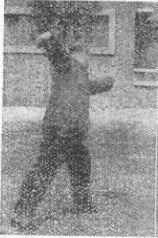
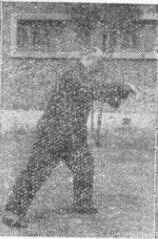
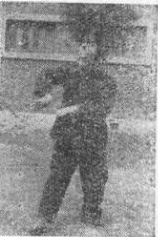
1. Practice method:
The right hand sweeps a large circle level forward and aligns with the right hand, while the left hand turns its palm inward into the ward-off form, the left hand outside and the right hand inside (figure 186).
The upper body sits back, and the body turns to the right, the body weight on the left leg, the right leg extended straight into an empty step; on turning, the right hand sweeps a small circle and then parts from the left hand and faces it, about a foot apart (figure 187).
The two hands turn up toward the upper right with the tiger-mouths pointing upward and the two arms extended straight, the right hand taking the supporting form above and the left hand taking the pushing form below (as if pushing at the opponent's ribs); at the same time the upper body moves forward, the body weight on the right leg (figure 188).
The left and right hands take the embracing form inward and aim at the chest, the two hands about a foot apart, the chest hollowed and the elbows dropped, and the weight shifts onto the left leg (figure 189).
The right leg is straight and the toe points upward; the left hand sweeps a small circle downward and circles to the outside of the right hand (figure 190).
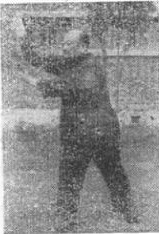
The two hands turn up toward the upper left with the tiger-mouths pointing upward and the left arm extended straight, the left hand taking the supporting form above and the right hand taking the pushing form below (figure 191).
The right hand is embraced back, the left hand is outside, and the body turns to the rear, the weight on the left leg (figure 192).
Step the right foot forward, and the right hand takes the supporting form above and the left hand takes the pushing form below; the practice method is the same as before (figure 193).
The left hand is embraced back, and the right hand follows closely behind (figure 194).
Step up toward the left diagonal, and the left hand takes the supporting form above and the right hand takes the pushing form below (figure 195).
The right hand withdraws and the left hand follows closely behind, and the body turns to the right, the weight on the left leg; the right hand circles upward in support and the left hand pushes forward (figures 196, 197).
The directions of this form's practice method head toward the four corners; each corner completes one shuttle form.
2. Technical meaning: this form is useful in push-hands or in single-hand joining. If, with the opponent two join right hands with each other, I advance my right hand to the opponent's elbow, neither grasping nor rolling; instead I take my left hand along the outside of his elbow with the palm pressed against his elbow, and using the fingers of the left hand toward the inner side of the elbow, I quickly change the tiger-mouth upward and lift his elbow up, and my right hand, following the lifting momentum, rushes to below his elbow and pushes and strikes. The left and right uses are the same. When the two arms rotate, the two hands must have a rolling-and-dissolving function, so as to make it easy to take and lift the opponent's arm, and may also dissolve his resisting force. The formula says: "Shake and dissolve the single arm and lift the hand above; the left and right uses are generally the same" (see the earlier note).
Practice method:
Continuing from the closing form of the jade maiden works the shuttle, the left hand is drawn back and the right hand extended straight; sit the body backward, the weight on the left leg, the right leg extended straight and the tip of the left foot pointing upward, and the left hand moves along the right arm to in front of the right armpit (figure 198).
The left hand, with the tiger-mouth facing outward, extends forward, and the right hand sinks backward; at the same time step the left foot forward into the left-bow-right-thrust form, with the two hands extended straight front and back, the left palm facing up and the right palm facing down (figure 199).
Continuing from the previous form, sit the body; the right hand is drawn back from behind and wards out forward from below the left arm, and the left hand is withdrawn slightly. When the right hand wards out, press on the inner side of the right wrist taking the press form, and at the same time step the right foot forward into the bow shape (figure 200).
Continuing from the previous form, change into "as if sealing, as if closing", then make the two-ward-off practice method, the same as before (see the earlier note).
The practice method is the same as the previous practice method.
The practice method is the same as before; perform the cloud hands three times in succession.
1. Practice method: first change from the cloud hands into the single whip form; then from the single whip form bend the right leg and squat down into the left crouch step, with the left leg extending out sideways to the left; at the same time the left hand bends the elbow and is drawn back and placed in front of the left ribs with the tiger-mouth pointing upward, and the right hook hand is unchanged (figure 201).
The left hand thrusts out forward along the left leg, and the left leg immediately bows up while the right leg extends straight; the upper body leans forward following the momentum of the left leg bowing up (figure 202).
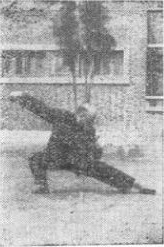
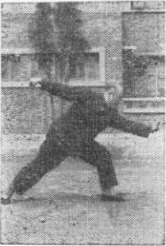
2. Technical meaning: the use of this form is that if the opponent attacks from a low posture, I then lower my body downward and follow the momentum to close off his incoming form, and then find the opportunity to enter with my hands and counterattack. The formula says: "Single whip and the low form — enter along the point" (see the earlier note).
1. Practice method: continuing from the previous form, the upper body straightens up from the forward-leaning posture; the right hand changes into a palm and, from the rear past between the right ribs, is lifted along with the body, the elbow bending and the palm upright in an upward support; at the same time the right knee follows the right hand and is raised from the rear toward the front, with the elbow-tip facing the knee, the left hand pressing at the side of the left hip, and the eyes looking at the right hand (figure 203). The right foot lands, the two legs bend slightly, and the two hands press at the sides of the two hips, the whole body holding the momentum of an upward charge (figure 204).
The left hand bends the elbow upward with the palm upright in an upward support, and at the same time the left leg is raised with the knee level with the hip, the right hand still pressing at the side of the right hip, and the eyes looking at the left hand (figure 205).
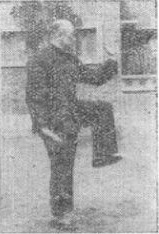
2. Technical meaning: the use of this form is: below, to tread on the opponent's instep with the heel; above, to ram the opponent's crotch with the knee. If one is locked in a tangle with the enemy and cannot employ hand methods, one may take the opportunity to use it; then the opponent, if lightly, will surely be injured, and if gravely, will surely die. Therefore the user must be cautious. The formula says: "The golden rooster stands on one leg and holds the upper hand; lifting the knee, strike upward at the vital spot; below, injure his two feet without mercy" (see the earlier note).
Practice method: continuing from the previous form, the left knee is still bent and unmoving, and the left and right arms extend straight with the palms both facing up (figure 206).
Then change into the reverse-the-arm; the practice method is the same as before (see the earlier note).
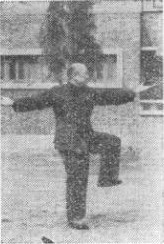
Practice method: continuing after three reverse-the-arms, take the two hands crossing into a flat cross shape; the right leg withdraws backward into a right bow and left push stance, and at once the right hand separates up to the right and the left hand down to the left, the left palm centre down and the right palm centre up, the practice method the same as before (see the earlier note).
Practice method: the reverse-wrist form (repeated form) (figures 207, 208, 209, 210). Roll back (figure 211) and the practice method below are the same as before (see the earlier note).
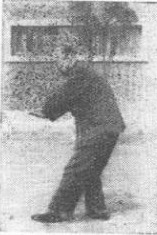
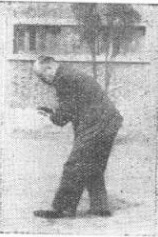
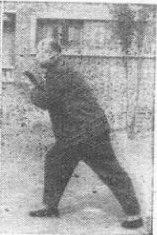
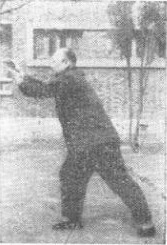
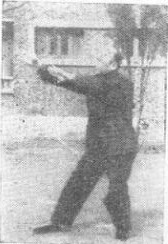
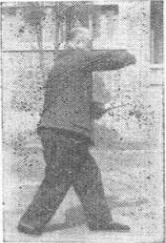
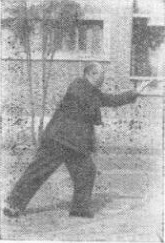
1. Practice method: continuing without pause from the high pat on horse, the extended left hand is turned palm outward and framed horizontally above the head, the right palm guarding the left ribs palm down, while the body turns to the right-rear, the weight on the left leg, the right leg extended straight (figure 214).
The right toe is hooked up and kicks up into an upper-intercepting form, the eyes looking straight ahead (figure 215).
2. Technical meaning: the use of this form is to defend against the opponent's incoming attack with the hand and to intercept-kick the opponent's leg below.
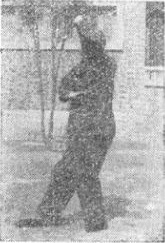
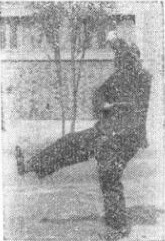
1. Practice method:
The right leg is drawn back with the knee bent, the right arm bends its elbow upward, and the left hand drops down to guard the outer side of the right elbow (figure 216).
The right foot stamps down, and the right hand closes into a fist and, passing in front of the chest by the mouth and nose, swings out forward (figure 217).
The left hand strikes out from the inner side of the right elbow, fingers pointing up, taking the deflect-and-parry form, and the right hand is drawn back below the right ribs (figure 218).
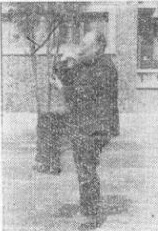
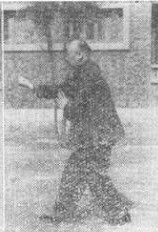
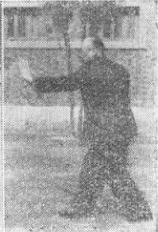
The left hand sweeps a large circle toward the right shoulder (figure 219).
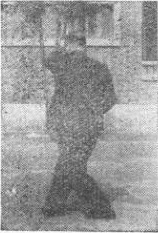
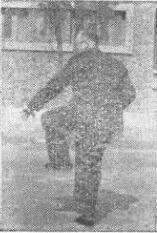
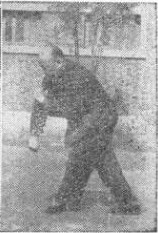
Continuing from the previous form, the left leg is raised with the knee bent and the left hand brushes out past the left knee (figure 220).
The left foot sets down, the right hand closes into a fist and strikes down and forward toward the front of the left foot, while the left hand guards the inner side of the right arm from below with the fingers pointing up, the upper body leaning slightly forward with the momentum of the right fist's downward strike, the two legs in a cross-brace stance (figure 221).
2. Technical meaning: the use of this form is that if my arm is seized by the opponent's two hands, I at once advance and, with the seized hand, strike straight downward to shed the opponent's two-handed pulling force, and at the same time use the seized shoulder to lean in and butt out straight against the opponent's chest. The formula says: "Below the crotch-punch, the lean is the edge" (see the earlier note).
Practice method: continuing from the reverse-wrist form (repeated form), the right fist that struck downward in the crotch-punch changes into a palm and scoops back upward from below, the left hand at the same time guarding the back of the right wrist, the two palm centres both facing up (figure 222).
Both hands pass below the chest and chin, the tiger mouths turned outward, held out straight, while the right foot steps up into a right bow and left push stance (figure 223); then continue into roll back (the left and right ward-off forms), the movement the same as before (see the earlier note).
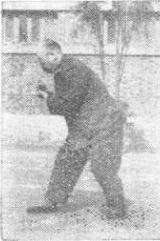
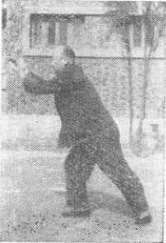
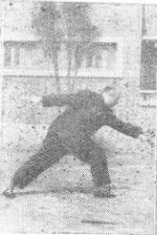
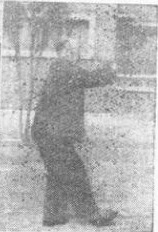
Practice method: from the closing form of single whip, continue into the single whip and the low form (figures 224, 225) (see the earlier note).
1. Practice method: continuing from the single whip and the low form, the upper body straightens up and the right leg steps forward in front of the left foot into an empty step; the two palms change into fists, and the right hand, as the right leg steps forward, swings out forward along it and crosses with the left fist in front of the chest in a cross shape, the two shoulders sunk, the two fists' centres both facing outward, and the eyes looking straight ahead (figure 226).
2. Technical meaning: the use of this form is the same in meaning as the cross-hands. If the opponent Striking down from above with the hand: when there is no time to dodge, one crosses the two hands to intercept the blow, so as to change form and enter with a technique. The formula says: "Step forward to the seven stars, the framing-hands form" (see the earlier note).
1. Practice method: continuing from the previous form, the crossed fists change into palms and sink downward (figure 227); then they separate to left and right, and from below sweep upward in a large half-circle until they face each other above the head, the two palm centres turned up; at the same time the right foot withdraws a step backward, the right leg slightly bent, and the left foot becomes an empty step (figure 228).
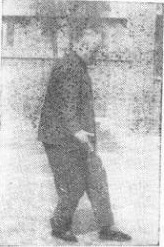
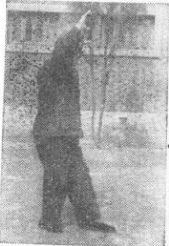
2. Technical meaning: the use of this form is that if the opponent's attack cannot be withstood, one withdraws and dodges to the front to evade it. The formula says: "Retreat a step and bestride the tiger, dodge to the centre" (see the earlier note).
1. Practice method: continuing from the previous form, the right hand guards the left elbow and the left hand turns its wrist outward to the right (figure 229).
Thereupon the body turns to the right-rear (figure 230).
The right leg is raised and swung horizontally outward to the right, while the two hands sweep and slap from the top of the right foot toward the left (figure 231).
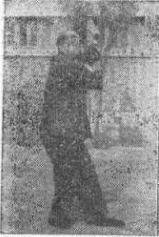
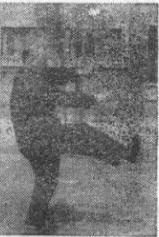
2. Technical meaning: the use of this form is to control the opponent's arm with my two palms and kick the opponent's ribs with a horizontal leg; thus, if one sweeps the opponent's left arm outward to the side with the two hands, one then sends out the right leg to kick the opponent's right ribs.
1. Practice method: continuing from the previous form without pause, the right leg is drawn back with the knee bent, and at the same time both hands are drawn back in front of the face, the two hands' tiger mouths facing each other, the eyes looking at the right hand, taking the posture of being about to issue (figure 232).
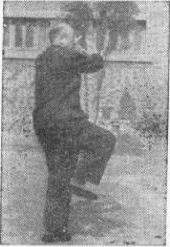
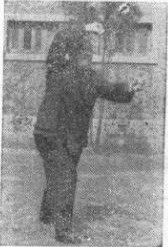
The right foot steps down to the right-diagonal into a right bow stance, the left foot becoming a horizontal push stance; at the same time the two hands close into fists; the right arm is bent and raised from the chest upward in a horizontal lift, and the left fist thrusts straight forward from beneath the right elbow, forward, the eyes looking straight ahead, the body upright and the weight on the right leg (figure 233).
2. Technical meaning: the use of this form is to lift and frame the opponent's wrist upward with my right arm while thrusting out the left fist to strike the opponent's centre of the chest. The formula says: "Bend the bow and shoot the tiger, lift and strike the chest" (see the earlier note).
1. Practice method: continuing from the previous form, both hands change into palms, the right palm in front and the left palm behind; passing over the head, they sink and sweep downward from the right, the weight on the left leg (figure 234).
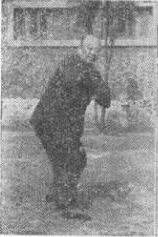
When the sweep reaches the chest, the right leg is raised, the right hand goes forward brushing past the right knee, and the left hand guards the right elbow (figure 235).
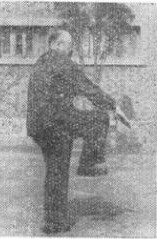
After the right hand has brushed past the right knee, it circles from below and passes over the chest, bending the elbow upward, the left hand guarding the right elbow (figure 236).
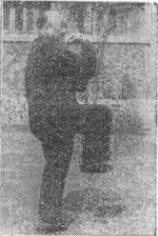
The right foot stamps down; the right hand changes into a fist and smashes down and forward in a reverse blow, the left hand still guarding the inner side of the right elbow, the eyes looking straight ahead (figure 237).
The right fist is drawn back below the right ribs; the left hand then extends forward past the inner side of the right elbow, standing the palm up forward, taking the deflecting-and-parrying momentum (figure 238). step up, forming a left bow and right push stance; the right fist again thrusts forward, the left hand guarding the inner side of the right forearm (figure 239).
Practice method:
Continuing from the previous form, the right fist changes into a palm and the left hand traces a small circle on the back of the right hand (figure 240).
Both hands are drawn back at the same time and placed below the breasts, and at the same time the left step is drawn back with the two hands, becoming an empty step (figure 241).
Then one steps up again with the left foot, and at the same time the two hands push forward slowly (figure 242). The practice method is the same as before.
Practice method: continuing from the previous form, the right foot shifts half a step backward and the body turns to the right and squares up into a horse-riding stance; the two hands that had pushed forward are at the same time raised and framed above the head, the palm centres up, the eyes looking up at the backs of the two hands (figure 243).
The two hands separate to left and right, the right hand pressing down, the weight leaning to the right, the eyes looking at the right hand (figure 244).
The two hands continue to fall and circle, cross below the crotch, and then scoop upward into the cross-hands, while the right leg is drawn back, the distance between the two legs the same as shoulder width, the eyes looking straight ahead (figure 245).
Practice method: continuing from the previous form, the two palm centres turn inward and slowly separate; the palms are turned over to face downward and sink down to the sides of the two shoulders, the eyes looking straight ahead as in the first figure at the beginning, restoring the starting posture of the wuji form. The formula says: "The tai chi closing-hands form is complete" (see the earlier note).