sun_style_taijiquan_sun_jianyun_en_full
Phần 1
Preface
Guided by the Party's policy of "letting a hundred flowers bloom, a hundred schools of thought contend," the editor drew on the posthumous work of her late father, Mr. Sun Lutang — The Study of Taijiquan (《太极拳学》) — and on the way he practiced in his later years, and compiled Sun-Style Taijiquan (《孙式太极拳》), published in 1957. To meet the needs of the broad masses in their physical training, the editor has now revised the 1957 edition. The movement descriptions have been amended and expanded, the movement photographs have been retaken, and the applications of certain principal movements have been added, while the original structure has been retained in the main. Although the editor received instruction from her late father in person from early childhood, she is conscious that her own skill falls short of depth and purity; still, for the convenience of those who love Sun-style Taijiquan and wish to practise it, she has done her best.
Confined as it is by the editor's level, the book will inevitably contain errors; readers are earnestly asked to point them out.
— The Editor
Note: the printed page number is 前言; the scan page is 4.
Phần 2
Contents
A Brief Introduction to Sun-Style Taijiquan ················· 1 General Explanation of Taijiquan ····························· 2 PART ONE (上编) ············································· 5 1. Names of the Movements ··································· 5 2. Explanation of the Movements ····························· 6 3. Diagrams of the Directions and Routes of Sun-Style Taijiquan Movements PART TWO (下编) ··········································· 51 1. Sun-Style Taijiquan Push-Hands Method ··················· 51 2. Taijiquan Fighting Technique ····························· 55 Appendix: Reference Materials ····························· 57 1. Wang Zongyue: Treatise on Taijiquan ····················· 57 2. Wu Yuxiang: Treatise on Taijiquan ······················· 58 3. Mental Explanation of the Thirteen Postures in Action ····· 58 4. Song Formula of the Thirteen Postures ····················· 59 5. Song Formula of Push-Hands ······························· 59 6. Li Yishe: Formula in Five Characters ····················· 60 7. Secret Formula on Releasing ······························· 61 8. Essential Words on Practising the Form and Striking Hands · 61 Note: this is the printed table of contents; the scan page is 5.
Phần 3
Brief Introduction to Sun-Style Taijiquan
The founder of Sun-style taiji (太极, tàijí) quan was Sun Fuquan (孙福全, Sūn Fúquán), courtesy name Lutang (禄堂, Lùtáng), late sobriquet Hanzhai (涵斋, Hánzhāi), a native of Wanxian in Hebei. From childhood he was passionately fond of martial arts. He studied Xingyi Quan (形意拳, Xíngyì Quán) under Li Kuiyuan (李魁垣, Lǐ Kuíyuán), and then studied under Li's own teacher Guo Yunshen (郭云深, Guō Yúnshēn), from whom he received the true transmission. He also studied Baguazhang (八卦拳, Bāguàzhāng) under Cheng Tinghua (程廷华, Chéng Tínghuá). After several years of study and polishing his skill ran deep. He later studied taijiquan under Hao Weizhen (郝为真, Hǎo Wéizhēn). Sun Lutang (孙禄堂, Sūn Lùtáng) devoted his whole life to the study of martial arts; he was proficient in Xingyi, Baguazhang and taijiquan, and gathering the essential meaning of the three schools into one, he created Sun-style taijiquan.
The characteristics of Sun-style taijiquan are: advance and retreat follow one another; when stepping forward one must follow, when stepping back one must withdraw. The movements are extended, rounded and lively, nimble and natural. In practice the two feet are clearly distinguished as empty and full (虚实, xūshí). The whole set, once begun, is like drifting clouds and flowing water, continuous and unbroken. At every turn of the body "opening" and "closing" (开合, kāihé) join, and so it is also called kaihe huobu taijiquan (开合活步太极拳, kāihé huóbù tàijíquán). It is suitable for people of any age and any constitution to practise.
Phần 4
General Explanation of Taijiquan
Taijiquan is one of the martial arts peculiar to our country. It is an exercise of "cultivating both within and without" (inwardly it governs calming the mind and nurturing the nature, outwardly it governs training the body); it takes suppleness and curvature as its substance and firmness and straightness as its function. Without suppleness and curvature one cannot neutralize; without firmness and straightness one cannot apply. In substance and function it is the fighting method of "using softness to overcome hardness, drawing aside four ounces to deflect a thousand catties." In practising this quan one should sink the qi to the dantian (丹田, dāntián), neither lean nor incline, so that inner and outer join; one must on no account use clumsy strength. One should move the strength by the intent (意, yì) — where the intent arrives, the strength arrives.
As to the method of practising taijiquan, my late father often said: Mr. Hao Weizhen spoke of three levels of mental state in practising taijiquan. At the first stage of practice it is as though the body were in water, both feet treading the ground, and the movements meet the resistance of the water. At the second level it is as though the body were in water with both feet floating up, like a swimmer drifting in the water, able to move freely. At the third level the body is light and nimble, the two feet as if walking on the surface of the water — treading on the brink of the abyss, on thin ice — with the spirit and qi gathered inward, not daring to let there be the slightest scattering or disorder. Then the quan is accomplished.
The postures and movements of taijiquan all have definite essential points, and each has its own meaning. The essentials are introduced in summary below:
Head: The head should push up, but one must not use strength. The chin is naturally drawn in, the top of the head upright, the spirit concentrated. The whole body is relaxed and open; in lifting, pressing, extending and contracting one always uses intent and does not use clumsy strength, and the mind is naturally empty and numinous. This is what is called "empty and numinous, suspending the head-top" (虚灵顶劲, xūlíng dǐngjìn).
Mouth: The mouth should be loosely closed, the tongue touching the upper palate, breathing through the nose.
Chest: The chest should be contained and must not be thrust out. When the chest is contained the qi sinks to the dantian. When the chest is thrust out the qi surges into the chest region, the upper is heavy and the lower light, and the heels float — a thing taboo to the martial practitioner. When the chest is contained the qi clings to the back, and strength issues from the spine — this is true strength. The above is what is called "containing the chest and raising the back" (含胸拔背, hánxiōng bábèi).
Shoulders: Both shoulders must be relaxed and hanging down. One must especially avoid hunching the shoulders, otherwise the qi surges upward.
Phần 5
General Explanation of Taijiquan (continued)
Elbows: The two elbows should hang loosely downward, the two arms naturally bent. This is the meaning of "seeking the straight within the curved, storing and then issuing."
Hands: The five fingers are spread, the wrist sunk (塌腕, tāwàn), the tiger's mouth slightly rounded, the palm slightly drawn in, as though grasping and holding a ball.
Waist: The waist must be sunk (塌, tā). For the waist is the pivot of the whole body's movements and the source of strength. A person's turning, advancing and retreating, and the changes of empty and full all depend on the waist strength running through them.
Legs: The two legs are bent, and one must clearly distinguish empty and full — that is, the body's centre of gravity is placed on one leg. If the centre of gravity moves onto the right leg, then the right leg is full and the left leg is empty. Conversely, the left leg is full and the right leg is empty. Distinguishing empty and full is the essential meaning of taijiquan; moving thus, the turning is light and nimble. Otherwise the stepping is heavy and sluggish, and one is easily led about by others.
Breathing: What is called "sinking the qi to the dantian" (three inches below the navel) means deep and long abdominal breathing. But one must on no account use strength to press the qi downward; one must simply let the breathing be entirely natural (呼吸, hūxī).
Intent and strength: One of the characteristics of taijiquan is that it uses intent and does not use strength. For taijiquan requires the use of living strength; the whole body must be relaxed and open, not allowing the least bit of clumsy strength to linger between sinews, bones, blood and vessels. It requires being extremely soft and yet extremely firm and hard, extremely heavy and yet extremely nimble. Where the intent arrives the strength arrives, applied with ease. If clumsy strength is used, then it is sluggish and not nimble. If the strength floats on the outside, it does not accord with the requirements of taijiquan. What is meant by using intent and not using strength, and how does living strength arise of itself? It is because where the intent goes the qi arrives; thus the qi and blood flow and pour, day by day infusing and circulating through the channels and network vessels of the whole body, never for a moment stagnating. With long practice true inner strength (内劲, nèijìn) is then produced.
Movement and stillness: The quiet sitting of qigong is seeking movement within stillness; boxing art is seeking stillness within movement. In practising the quan the mind must be still and the spirit concentrated; only then can the movements be rounded and lively.
The above has discussed the essentials of movement separately. But the student must certainly note that taijiquan is an exercise of the whole body, and what is trained lies in the spirit. The spirit is the commander, the body is the servant; if the spirit can be raised, then the movements are naturally light and nimble. Only when mind and intent are in harmony with the movements of the form can inner and outer join as one. In practice one must take care that above and below follow one another, and that all parts of the body are complete and unified. If there is one place where the movement is not whole, the spirit and qi will be scattered and disordered. Furthermore, in practising the quan one should move the strength by the intent, linked without interruption, "like the long Yangtze River, rolling on without cease." "In movement, like drawing silk" —
Phần 6
General Explanation of Taijiquan (continued)
— such is the meaning.
To make it easy for the reader to remember, these essential points are now put into a mnemonic verse as follows:
Taijiquan is originally an inner-school boxing (内家拳, nèijiāquán);
do not use clumsy strength — intent comes first.
Empty and numinous, suspending the head-top (顶头, dǐngtóu), the spirit concentrated;
draw the chin back and it is then natural.
Containing the chest, one can naturally raise the back;
on no account form "hunchback shoulders."
In practice sink the shoulders and drop the elbows;
with shoulders hunched and elbows suspended it is not the quan.
Sinking the waist (塌腰, tāyāo) can raise the strength of the whole body;
if the waist is not sunk, nimbleness is difficult.
The two legs bent distinguish empty and full;
here lies the essential meaning of taiji.
Breathing (呼吸, hūxī) sinks down to the dantian point;
let it be purely natural, do not force it.
Above and below follow one another and become one body;
the movements, continuous and unbroken, are forever linked.
Seek stillness within movement, movement within stillness;
in practice the spirit and qi must be complete in every part.
Be sure to remember these points and not forget them;
with lasting practice the benefit will show of itself.
Phần 7
Part One (上编, Shàngbiān) — 1. Names of the Movements
| No. | Name | No. | Name |
|---|---|---|---|
| 1 | Qishi (起式, qǐshì) — Starting Posture | 24 | Dao Nian Hou (倒撵猴, dào niǎn hóu), right form — Driving Back the Monkey |
| 2 | Lan Zha Yi (懒扎衣, lǎn zhā yī) — Lazily Tucking the Robe | 25 | Shou Hui Pipa (手挥琵琶, shǒu huī pípá), right form — Hands Playing the Pipa |
| 3 | Kai Shou (开手, kāi shǒu) — Opening the Hands | 26 | Bai He Liang Chi (白鹤亮翅, bái hè liàng chì) — White Crane Spreads Its Wings |
| 4 | He Shou (合手, hé shǒu) — Closing the Hands | 27 | Kai Shou (开手, kāi shǒu) — Opening the Hands |
| 5 | Dan Bian (单鞭, dān biān) — Single Whip | 28 | He Shou (合手, hé shǒu) — Closing the Hands |
| 6 | Ti Shou Shang Shi (提手上式, tí shǒu shàng shì) — Raising the Hands, Upper Posture | 29 | Lou Xi Ao Bu (搂膝拗步, lōu xī ào bù), left form — Brushing the Knee and Twist Step |
| 7 | Bai He Liang Chi (白鹤亮翅, bái hè liàng chì) — White Crane Spreads Its Wings | 30 | Shou Hui Pipa (手挥琵琶, shǒu huī pípá), left form — Hands Playing the Pipa |
| 8 | Kai Shou (开手, kāi shǒu) — Opening the Hands | 31 | San Tong Bei (三通背, sān tōng bèi) — Three Penetrations of the Back |
| 9 | He Shou (合手, hé shǒu) — Closing the Hands | 32 | Lan Zha Yi (懒扎衣, lǎn zhā yī) — Lazily Tucking the Robe |
| 10 | Lou Xi Ao Bu (搂膝拗步, lōu xī ào bù), left form — Brushing the Knee and Twist Step | 33 | Kai Shou (开手, kāi shǒu) — Opening the Hands |
| 11 | Shou Hui Pipa (手挥琵琶, shǒu huī pípá), left form — Hands Playing the Pipa | 34 | He Shou (合手, hé shǒu) — Closing the Hands |
| 12 | Jin Bu Ban Lan Chui (进步搬拦捶, jìn bù bān lán chuí) — Step Forward, Deflect, Parry and Punch | 35 | Dan Bian (单鞭, dān biān) — Single Whip |
| 13 | Ru Feng Si Bi (如封似闭, rú fēng sì bì) — As if Sealing, as if Closing | 36 | Yun Shou (云手, yún shǒu) — Cloud Hands |
| 14 | Bao Hu Tui Shan (抱虎推山, bào hǔ tuī shān) — Embrace the Tiger and Push the Mountain | 37 | Gao Tan Ma (高探马, gāo tàn mǎ) — High Pat on Horse |
| 15 | Kai Shou (开手, kāi shǒu) — Opening the Hands | 38 | You Qi Jiao (右起脚, yòu qǐ jiǎo) — Right Kick with Toe |
| 16 | He Shou (合手, hé shǒu) — Closing the Hands | 39 | Zuo Qi Jiao (左起脚, zuǒ qǐ jiǎo) — Left Kick with Toe |
| 17 | Lou Xi Ao Bu (搂膝拗步, lōu xī ào bù), right form — Brushing the Knee and Twist Step | 40 | Zhuan Shen Deng Jiao (转身蹬脚, zhuǎn shēn dēng jiǎo) — Turn Body and Heel Kick |
| 18 | Lan Zha Yi (懒扎衣, lǎn zhā yī) — Lazily Tucking the Robe | 41 | Jian Bu Da Chui (践步打捶, jiàn bù dǎ chuí) — Treading Step and Punch |
| 19 | Kai Shou (开手, kāi shǒu) — Opening the Hands | 42 | Fan Shen You Qi Jiao (翻身右起脚, fān shēn yòu qǐ jiǎo) — Turn Over Body and Right Toe Kick |
| 20 | He Shou (合手, hé shǒu) — Closing the Hands | 43 | Pi Shen Fu Hu (披身伏虎, pī shēn fú hǔ) — Drape the Body and Subdue the Tiger |
| 21 | Dan Bian (单鞭, dān biān) — Single Whip | 44 | Zuo Qi Jiao (左起脚, zuǒ qǐ jiǎo) — Left Kick with Toe |
| 22 | Zhou Xia Kan Chui (肘下看捶, zhǒu xià kàn chuí) — Look at the Fist below the Elbow | 45 | Zhuan Shen You Deng Jiao (转身右蹬脚, zhuǎn shēn yòu dēng jiǎo) — Turn Body and Right Heel Kick |
| 23 | Dao Nian Hou (倒撵猴, dào niǎn hóu), left form — Driving Back the Monkey | 46 | Shang Bu Ban Lan Chui (上步搬拦捶, shàng bù bān lán chuí) — Step Up, Deflect, Parry and Punch |
Forty-seventh posture: As if Sealing and Closing (如封似闭, Rú Fēng Sì Bì) — Seventy-third posture: Opening the Hands (开手, Kāi Shǒu)
Forty-eighth posture: Embracing the Tiger and Pushing the Mountain (抱虎推山, Bào Hǔ Tuī Shān) — Seventy-fourth posture: Closing the Hands (合手, Hé Shǒu)
Forty-ninth posture: Opening the Hands (turning right) (开手(右转)) — Seventy-fifth posture: Brush the Knee and Twist the Step (left form) (搂膝拗步(左式), Lōu Xī Ào Bù)
Fiftieth posture: Closing the Hands (合手) — Seventy-sixth posture: Hands Play the Pipa (手挥琵琶, Shǒu Huī Pí Pá)
Fifty-first posture: Brush the Knee and Twist the Step (right form) (搂膝拗步(右式)) — Seventy-seventh posture: Three-Way Back Penetration (三通背, Sān Tōng Bèi)
Fifty-second posture: Lazy Tucking the Robe (懒扎衣, Lǎn Zhā Yī) — Seventy-eighth posture: Lazy Tucking the Robe (懒扎衣)
Fifty-third posture: Opening the Hands (开手) — Seventy-ninth posture: Opening the Hands (开手)
Fifty-fourth posture: Closing the Hands (合手) — Eightieth posture: Closing the Hands (合手)
Fifty-fifth posture: Diagonal Single Whip (斜单鞭, Xié Dān Biān) — Eighty-first posture: Single Whip (单鞭, Dān Biān)
Fifty-sixth posture: Wild Horse Parts Its Mane (野马分鬃, Yě Mǎ Fēn Zōng) — Eighty-second posture: Cloud Hands (云手, Yún Shǒu)
Fifty-seventh posture: Lazy Tucking the Robe (懒扎衣) — Eighty-third posture: High Pat on Horse (高探马, Gāo Tàn Mǎ)
Fifty-eighth posture: Opening the Hands (开手) — Eighty-fourth posture: Crosswise Swing Lotus (十字摆莲, Shí Zì Bǎi Lián)
Fifty-ninth posture: Closing the Hands (合手) — Eighty-fifth posture: Step Forward and Strike the Crotch (进步指裆捶, Jìn Bù Zhǐ Dāng Chuí)
Sixtieth posture: Single Whip (单鞭) — Eighty-sixth posture: Step Back Lazy Tucking the Robe (退步懒扎衣, Tuì Bù Lǎn Zhā Yī)
Sixty-first posture: Right Back-Penetrating Palm (右通背掌, Yòu Tōng Bèi Zhǎng) — Eighty-seventh posture: Opening the Hands (开手)
Sixty-second posture: The Jade Maiden Works the Shuttle (玉女穿梭, Yù Nǚ Chuān Suō) — Eighty-eighth posture: Closing the Hands (合手)
Sixty-third posture: Lazy Tucking the Robe (懒扎衣) — Eighty-ninth posture: Single Whip (单鞭)
Sixty-fourth posture: Opening the Hands (开手) — Ninetieth posture: Single Whip Lower Posture (单鞭下势, Dān Biān Xià Shì)
Sixty-fifth posture: Closing the Hands (合手) — Ninety-first posture: Step Up Seven Stars (上步七星, Shàng Bù Qī Xīng)
Sixty-sixth posture: Single Whip (单鞭) — Ninety-second posture: Step Back and Bestride the Tiger (退步跨虎, Tuì Bù Kuà Hǔ)
Sixty-seventh posture: Cloud Hands (云手) — Ninety-third posture: Turn the Corner and Swing the Lotus (转角摆莲, Zhuǎn Jiǎo Bǎi Lián)
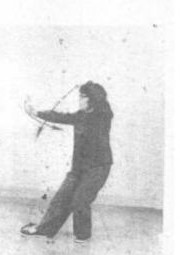
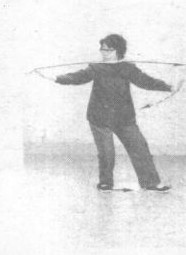
Sixty-eighth posture: Cloud Hands Lower Posture (云手下势, Yún Shǒu Xià Shì) — Ninety-fourth posture: Bend the Bow and Shoot the Tiger (弯弓射虎, Wān Gōng Shè Hǔ)
Sixty-ninth posture: Golden Rooster Stands on One Leg (金鸡独立, Jīn Jī Dú Lì) — Ninety-fifth posture: Double Striking Hammer (双撞捶, Shuāng Zhuàng Chuí)
Seventieth posture: Step Back and Repulse the Monkey (倒撵猴, Dào Niǎn Hóu) — Ninety-sixth posture: Yin and Yang Blended into One (阴阳混一, Yīn Yáng Hùn Yī)
Seventy-first posture: Hands Play the Pipa (right form) (手挥琵琶(右式)) — Ninety-seventh posture: Closing Posture (收式, Shōu Shì)
Seventy-second posture: White Crane Spreads Its Wings (白鹤亮翅, Bái Hè Liàng Chì)
Phần 8
Part One. Two: Explanation of the Movements
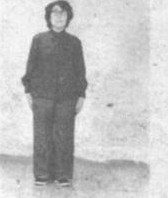
- ① The body stands upright, both hands hang down, both shoulders relax; the tips of the two feet are separated by about 90°; the eyes look straight ahead, the mind is quiet, and one pauses briefly. (图 1)
The eyes look straight ahead, the mind is quiet, and one pauses briefly. (图 1)
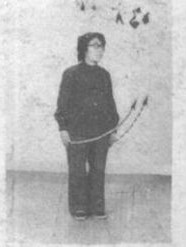
- ② The tip of the right foot lifts, and pivoting on the heel the foot turns half a face-width to the left to form 45° with the left foot; at the same time the body turns slightly to the left and faces diagonally forward-left; the eyes look straight ahead. (图 2)
Key points (要点, yàodiǎn): the whole body relaxes, the waist sinks (塌腰, tāyāo), but it must not become rigid and stiff; the tongue rests against the upper palate, and the breathing is natural.
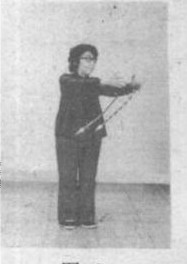
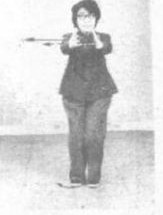
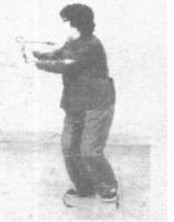
- ① Both arms slowly rise forward and upward to the height of the shoulders, the two palms facing each other and drawn slightly inward, about 18 cm apart, the fingertips pointing forward, as if holding a ball; the two legs do not move; the eyes look at the space between the two hands. (图 3)
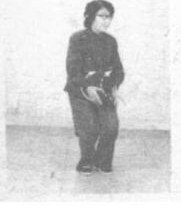
- ② Both hands drop to the front of the abdomen, and at the same time both legs slowly bend and the left heel slowly rises in accompaniment. (图 4)
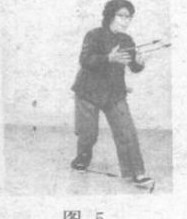
- ③ The left foot steps forward, the heel touching the ground first; at the same time both hands slowly extend upward and forward, the two hands still as if holding a ball, the arms slightly bent; as the two hands extend, the right foot follows with a step forward to the inner side of the left ankle, about 10 cm apart, the toe touching the ground; the eyes look at the space between the two hands. (图 5、6)
- ④ Both hands rotate horizontally to the right; when the turn has brought the practitioner to face directly forward, the right hand rotates outward with the palm facing up; the left hand rotates inward with the palm facing down and, supporting the right wrist, rotates to the right along with it; at the same time the right heel comes to the ground and the tip of the left foot lifts and rotates to the right, and the tip of the right foot thereupon swings outward by about 90°; the eyes look at the right hand. (图 7、8)
- ⑤ The right hand draws a half-circle to the right and backward while the left hand follows the movement of the right hand; when the right hand has turned to the front of the right shoulder with the forearm upright and the palm turned diagonally upward, it then turns toward the front, the left hand supporting
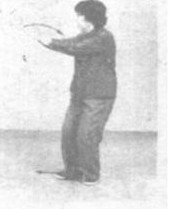
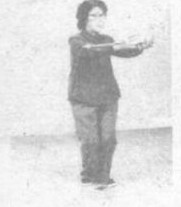
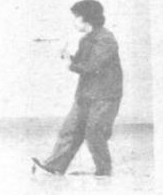
The right wrist pushes forward together with it, both arms slightly bent; at the same time the right foot steps forward, the heel touching the ground first and gradually settling; the left foot thereupon follows behind the right foot, about 10 cm apart, the toe touching the ground; the eyes look at the right hand, and one pauses briefly. (图 9、10)
Key points (要点, yàodiǎn): the movement must run through in a single continuous flow and must not be interrupted.
Application (用法, yòngfǎ): Lazy Tucking the Robe is composed of warding off, rolling back, pressing and pushing (掤捋挤按, péng lǚ jǐ àn). ① Ward-off (掤, péng): when the opponent strikes with the hand, one presses his wrist down with the front hand and draws it backward, The rear hand quickly seeks out his elbow. If the opponent's attacking hand comes high, then both hands lift his arm from below and drive it backward and downward, or one may also drive it level toward the side and rear.
- ② Press (挤, jǐ), that is, squeezing the opponent out. The intent is that the forearm grates against the opponent's arm like a file. If one can make his body lean to one side and lose its central equilibrium, and his arm is then wrapped by one's arm and pressed against his body so that he cannot raise it to fend or prop, then this is the best moment for pressing. In application, press is squeezed out diagonally forward and upward from in front of the chest. If applied skilfully, it can send the opponent up off the ground. If the press is to have power, the wrapping strength of both arms is the key: once the opponent is wrapped, one must rapidly advance the step and bring the body up, closely adhering to him.
- ③ Ward-off (掤, péng), that is, propping (not dead propping with brute resistance). When the opponent rushes at one with both hands, one sticks both arms upward to his hands, sits the waist back and withdraws the left step, turns the waist slightly to the right, pats to the right with the left hand and hangs to the right with the right hand; at this moment the opponent's force has already been neutralized, and one issues at the appropriate instant. The subtlety of the ward-off method lies in "sticking": neither letting go nor resisting, the two arms like springs, so that what the opponent touches seems both present and absent. Ward-off may be done with both hands or with one; if one wards off the opponent's two hands with a single hand, one gains the more advantageous position.
- ④ Push (按, àn): if the opponent attacks toward one, one lightly presses down both of his arms with both hands and immediately pushes out forward. Push may be done with one hand or both, with opening energy or closing energy as the situation determines, but one must stick to the opponent's arms so that he cannot turn and move freely.
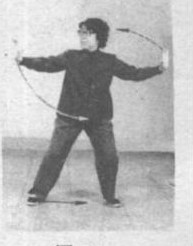
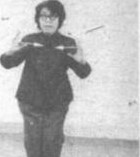
Following on from the previous posture, the left heel comes to the ground and the tip of the right foot lifts, [The left foot] buckles inward to the left by about 90°, and the body turns to the left along with it; at the same time, with the two palms facing each other and the fingertips pointing upward, [the hands] separate to left and right (as if holding a balloon whose air expands outward, opening until the tiger's mouths of the two hands face the two shoulders), the two hands about 10 cm apart, and one pauses slightly. (图 11)
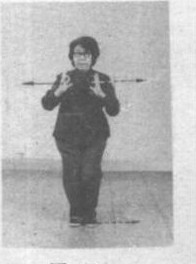
Following on from the previous posture, with the two palms facing each other the hands slowly close inward; when they have come to about a face-width apart, one pauses slightly; at the same time both legs bend, the right foot is on the ground, the left heel lifts with the toe touching the ground; the eyes look at the space between the two hands. (图 12)
Key points (要点, yàodiǎn): the whole body must relax; there must not be the slightest forced strength.
Application (用法, yòngfǎ): Opening and Closing the Hands — if the opponent suddenly embraces one's two arms from behind with both hands, one immediately props against his two arms with the elbows, quickly presses downward, and following the momentum turns the body to the left or turns the body to the right.
Following on from the previous posture, the two hands rotate inward and, as if driving a long pole, slowly separate to left and right, the two arms reaching a level-raise position, the two palms facing outward, the palm upright, at the height of the eyes; at the same time the left foot steps sideways to the left, the leg slightly bent; the right leg slightly straightened; the eyes look at the right hand, and one pauses briefly. (图 13)
Key points (要点, yàodiǎn): the upper body must be straight, the two shoulders must be relaxed, the breathing must be natural, and one must not use clumsy strength to press qi (气) down into the dantian (丹田, dāntián).
Application (用法, yòngfǎ): ① Single Whip deals with opponents on both the left and right sides. Although the two hands separate at the same time, one must be empty and the other full (虚实, xūshí); which is full and which is empty depends on how near or far the opponent's attacking force is. If the left hand ...a solid strike. The centre of gravity must fall on the left leg, while one keeps watch to the right; at the same time the right foot may be raised to kick an opponent on the right.
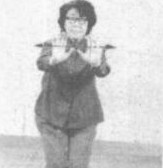
- ② If two opponents on either side stand very close, or have already caught and held both of one's arms, one immediately strikes with the elbow or leans in with the shoulder, and at the same time may kick with the foot on the other side.
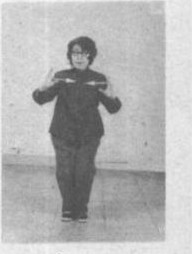
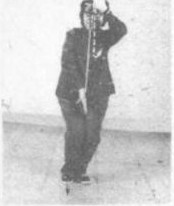
Following on from the previous posture, the body's centre of gravity shifts onto the left leg; the left hand then traces an arc in front of the face up to in front of the forehead, palm facing outward; the right hand traces an arc downward to in front of the abdomen, fingers pointing down, palm facing right; at the same time the sole of the right foot draws in close to the left leg, the tip of the foot touching the ground level with the tip of the left foot, both legs slightly bent; the eyes look forward. (图 14)
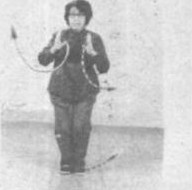
要点 (yàodiǎn) Key points: the body must be kept steady and level, and the waist sunk (塌腰, tā yāo).
用法 (yòngfǎ) Application: if the opponent grips one's two wrists with both hands, one turns both arms outward in opposite directions, one upward and one downward, at the same time; this is certain to free them. If the opponent is very close, one may lift the knee of the empty leg and strike at his abdomen.
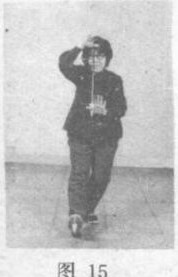
- ① Following on from the previous posture, the left hand moves down from in front of the forehead to in front of the left chest, the elbow held close against the ribs, palm facing outward; the right hand is lifted from in front of the abdomen up above the forehead, the back of the hand close against the forehead; at the same time the right foot steps forward and the heel touches the ground, the distance between the two feet being such as not to disturb the body's centre of gravity. (图 15)
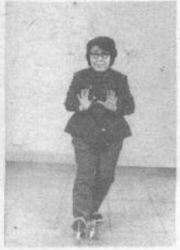
- ② The right hand moves downward past the right side of the face (almost touching but not touching) to in front of the right chest, the tip of the elbow hanging down, palm facing outward, at the same height as the left hand; both hands push forward together; at the same time the tip of the right foot slowly comes to the ground and the body's centre of gravity shifts forward onto the right
...leg; the left foot then follows up to the inside of the right foot, the tip of the foot touching the ground; the eyes look between the two hands. (图 16, 17)
要点 (yàodiǎn) Key points: sink the waist (塌腰, tā yāo); the two arms are slightly bent; pause briefly.
用法 (yòngfǎ) Application: ① I strike the opponent with my right hand. If he presses my right wrist downward with his left hand, I at once advance the step, withdraw the right hand and let it sink loosely downward, while the left hand sticks to his right wrist and plucks it downward; the right hand then rotates and strikes upward at his chest or head.
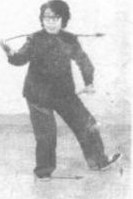
- ② If the opponent attacks with both hands, I separate his hands, one upward and one downward, and at the same time swiftly advance the step and strike his chest with both hands.
The movement is the same as the Third Posture, "Opening the Hands". (图 18)
The movement is the same as the Fourth Posture, "Closing the Hands". (图 19)
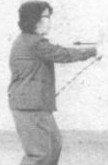
- ① Following on from the previous posture, the left hand brushes to the right and downward to the outside of the left hip, the thumb about 10 cm from the hip; at the same time the left foot steps diagonally forward to the left, the right hand rotates outward, arcs upward and down to the right, and is raised to the height of the right shoulder, palm facing upward; the eyes look at the right hand. (图 20)
- ② The right hand pushes out level toward the left front, the arm slightly bent, the wrist sunk, palm facing forward; at the same time the right foot follows up to the side of the inner ankle of the left foot, the tip of the foot touching the ground, and the centre of gravity shifts onto the left leg; the eyes look at the tip of the index finger of the right hand; pause briefly. (图 21)
要点 (yàodiǎn) Key points: the forward push of the right hand and the following step must be coordinated as one; the right elbow must be bent and the wrist sunk.
用法 (yòngfǎ) Application: if the opponent strikes at me with his right fist, I brush to the left with my left hand and strike his chest with my right hand.
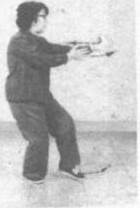
Following on from the previous posture, the fingers of both hands are straightened, the tiger's mouths facing upward; the right foot steps back, the tip of the foot touching the ground first (the distance stepped back being such as not to disturb the body's centre of gravity), and the whole foot then settles slowly to the ground; at the same time the right hand pulls back and the left hand extends forward, both elbows hanging down; the left foot steps back to in front of the right foot, the tip of the foot touching the ground; the eyes look straight ahead. (图 22)
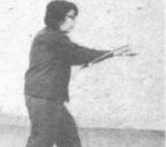
用法 (yòngfǎ) Application: if the opponent strikes with his right fist, one's right palm presses his wrist and the left hand presses his elbow, and following the momentum one seizes (攫) or breaks (撅) it.
- ① Following on from the previous posture, the left hand rotates inward and brushes downward and to the left to in front of the ribs, palm facing down; the right hand rotates outward and upward, extends forward past beneath the left hand, palm facing up; at the same time the left foot steps forward, the tip of the foot turned slightly outward. (图 23)
- ② The right hand rotates inward and brushes back to in front of the right ribs, palm facing down, while the left hand rotates outward and extends forward, palm facing up; at the same time the right foot steps forward, the tip of the foot turned slightly outward as it comes to the ground. (图 24)
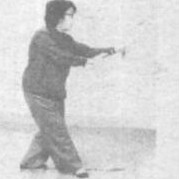
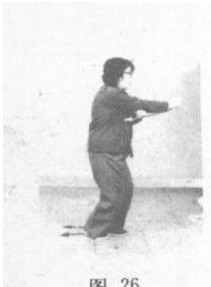
- ③ Without pausing from the movement above, the left foot steps forward one pace; at the same time the right hand rotates outward and inward and forms a fist, striking straight out over the left wrist, the fist level with the chest, the eye of the fist facing up; the left hand rotates inward and closes into a fist, drawn back, the centre of the fist facing down; the right foot follows up to the inside of the left ankle, the tip of the foot touching the ground; the eyes look at the middle joint of the index finger of the right hand. (图 25, 26)
用法 (yòngfǎ) Application: if the opponent strikes at one's chest with his left hand, one hooks his wrist with one's left hand (the tiger's mouth facing oneself), plucks and holds it, drawing it backward and to the right, and at the same time strikes at the opponent with the right hand.
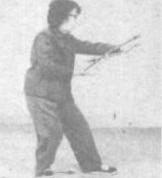
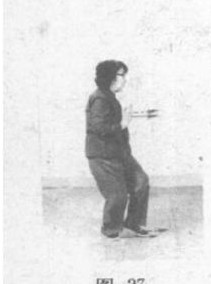
Following on from the previous posture, the right fist draws back; the left fist extends slightly forward from beneath the right arm, and when the two fists come level it changes into a palm, both palms facing forward; as the right hand withdraws, the right foot steps back (the distance stepped back being such as not to disturb the body's centre of gravity); immediately the two hands and the left foot withdraw together, the left foot coming to in front of the right foot, the tip of the foot touching the ground, and the two hands coming in front of the chest; the eyes look forward. (图 27)
用法 (yòngfǎ) Application: I strike some part of the opponent with my right hand. If he pushes my wrist or elbow sideways with his left hand, I sit the waist back and my left hand cuts across his wrist from outside my right arm, leading it to the right along with his force, while at the same time my right hand presses his elbow, issuing according to the momentum.
Following on from the previous posture, the two hands push forward together, level with the chest, the two arms slightly bent; at the same time the left foot steps forward and the right foot follows, about 10 cm from the left foot; the eyes look between the two hands; pause briefly. (图 28)
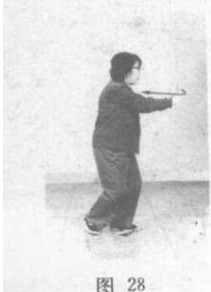
用法 (yòngfǎ) Application: if the opponent's hand is on the inside and one's hand on the outside, one wraps inward around his hand and issues; or if his hand is on the outside and one's hand on the inside, one props his hand out with opening energy (开劲) and issues. In all cases one must stick to the opponent's hand so that he cannot move freely, for otherwise, if one only knows how to lunge fiercely forward, one will certainly be taken advantage of by him. This posture is best used to strike at the opponent's trunk.
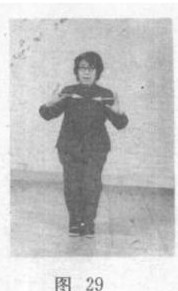
Following on from the previous posture, the tip of the left foot lifts and the foot turns in toward the right; the body then turns about 90° to the right and the right foot settles firmly to the ground; the two hands separate horizontally until the tiger's mouths of the two hands are the width of the shoulders apart, the five fingers spread; pause briefly. (图 29)
The movement is the same as the Fourth Posture, "Closing the Hands". (图 30)
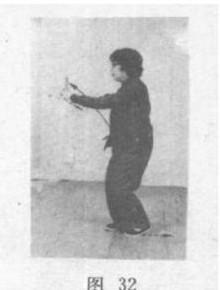
The movement is the same as the Tenth Posture, "Brush the Knee and Twist the Step", only the direction is reversed. (图 31, 32)
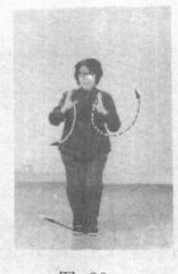
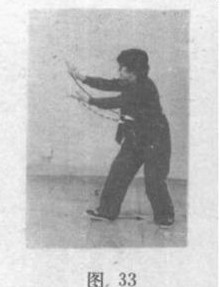
- ① Following on from the previous posture, the left hand rotates outward and inward, palm facing up, the right hand extends forward, palm facing down, the two hands forming the shape of holding a ball; at the same time the left foot steps back, coming to the ground at an angle of 45°; immediately the two hands trace an arc downward together to in front of the abdomen, and the right foot withdraws to in front of the left foot, the tip of the foot touching the ground. (图 33, 34)
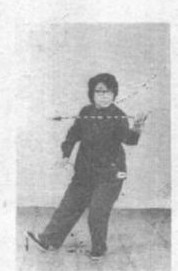
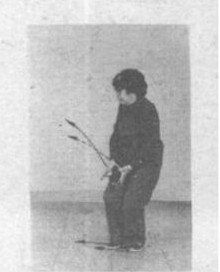
- ② The right hand rotates inward, the left hand rotates outward and is lifted to in front of the chest, the left hand supporting the right hand...
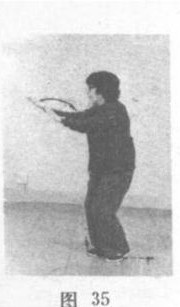
The hands push out forward together from above the wrist, the right palm facing upward and the left palm facing downward; at the same time the right foot steps forward, the left foot following up to the side of the right ankle with the toe touching the ground. (图 35)
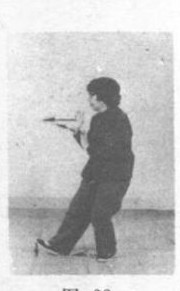
- ③ The left foot then withdraws to the rear; at the same time both hands draw back level to a half-circle in front of the right shoulder, the palms facing outward; the body's weight sits back and the right toe lifts. (图 36)
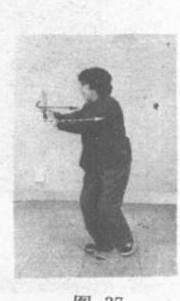
- ④ Both hands push out forward together from in front of the right shoulder, the arms slightly bent, while the right toe gradually comes to the ground and the left foot immediately follows to about 10 cm behind the right foot; the eyes look at the right hand. (图 37)
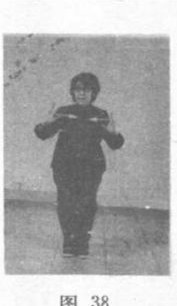
The movement is the same as the Third Posture, "Opening the Hands". (图 38)
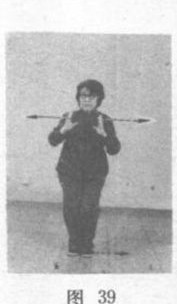
The movement is the same as the Fourth Posture, "Closing the Hands". (图 39)
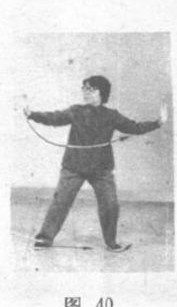
The movement is the same as the Fifth Posture, "Single Whip". (图 40)
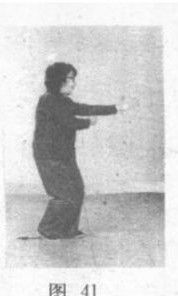
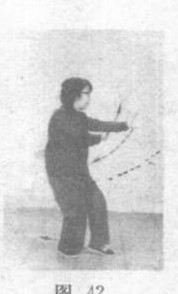
Following on from the previous posture, the left hand turns downward with the thumb pointing up, and the right hand becomes a fist, the arm bending so that it passes down through the region in front of the abdomen and extends out below the left elbow with the eye of the fist facing upward; at the same time the right foot steps forward to behind the left foot, the toe touching the ground. The right foot then withdraws to the rear, and the left foot withdraws to in front of the right foot, the toe touching the ground; the two hands do not move; the eyes look forward. (图 41、42)
Application (用法): one strikes some part of the opponent with the left hand; the opponent uses ward-off (掤, péng). At this moment one relaxes the shoulders and drops the elbows, wrapping strength is turned inward through the arm, and at the same time one advances the step and strikes the opponent's chest with the right fist from below the left elbow.
The right fist strikes the opponent's chest from below the left elbow.
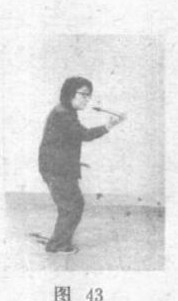
- ① Following on from the previous posture, the left hand rotates inward and is drawn back to in front of the chest, then sweeps to the left in an arc to the outside of the left hip, the palm facing downward and the fingertips pointing forward, the thumb about 8 cm from the hip; the right hand rotates outward to the right and downward and is then raised up to shoulder height with the palm facing upward; at the same time the right toe lifts and hooks inward, the toe touching the ground; the left foot steps diagonally to the left with the heel coming to the ground; the eyes look at the right hand. (图 43)
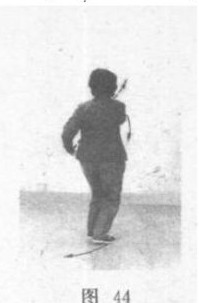
- ② The right hand pushes out forward to the left, passing in front of the corner of the mouth, the arm slightly bent and the palm facing left; at the same time the right foot follows forward to behind the left foot at a distance of about 10 cm, the toe touching the ground. (图 44)
Key points (要点): the movements of the hands and feet must run through as a single continuous flow, without interruption.
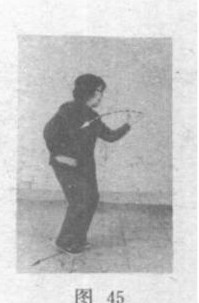
- ① Following on from the previous posture, the left toe lifts and the heel turns inward; the right hand sweeps diagonally to the right to the outside of the right hip (the thumb about 8 cm from the hip) with the palm facing downward; the left hand rotates outward and upward to the level of the left shoulder with the palm facing upward; the eyes look at the left hand. (图 45)
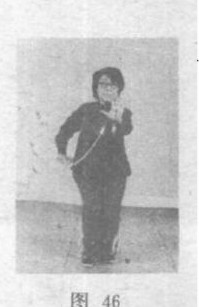
- ② The left hand then pushes out forward to the right, passing in front of the corner of the mouth; all other movements are the same as in the left form, only the direction is reversed. (图 46)
Key points (要点): practice the left and right forms in alternation; the number of repetitions is not fixed, but must be an even number.
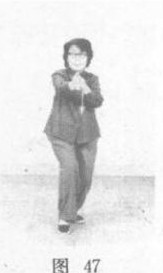
The movement is the same as the Eleventh Posture, "Hands Play the Lute", only the direction is reversed. (图 47)
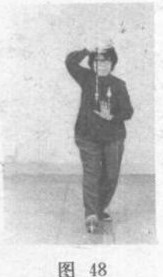
The movement is the same as the Seventh Posture, "White Crane Spreads Its Wings". (图 48)
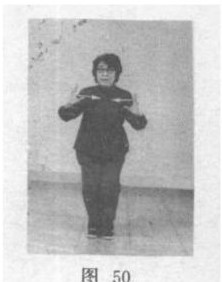
The movement is the same as the Third Posture, "Opening the Hands". (图 49、50)
The movement is the same as the Fourth Posture, "Closing the Hands". (图 51)
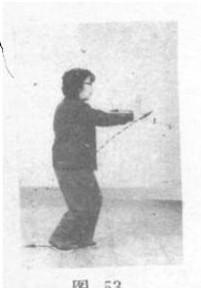
The movement is the same as the Tenth Posture, "Brush the Knee and Twist the Step". (图 52、53)
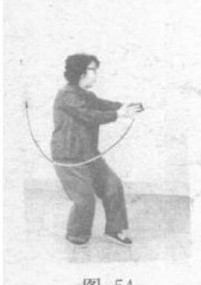
The movement is the same as the Eleventh Posture, "Hands Play the Lute". (图 54)
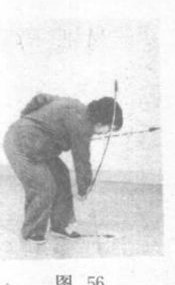
- ① Following on from the previous posture, the right hand rotates outward (palm facing upward), sweeps in an arc downward and backward, and when it reaches the forehead rotates inward and presses straight down to the front of the left fibula, about 30 cm from the left toe; as the right hand sweeps backward, the left hand is drawn back to the outside of the left hip with the palm facing downward; while the right hand presses down, the left foot withdraws to in front of the right foot with the toe touching the ground, both legs slightly bent; the eyes look at the right hand. (图 55、56)
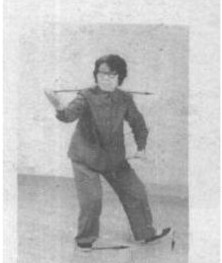
- ② The right arm is raised, the back of the hand resting against the forehead, the body straightening up with it, the weight inclined toward the right leg, and the left hand from the side of the hip—
—extends forward, level at chest height, the palm facing forward and the wrist sunk; at the same time the left foot steps forward, the distance between the two feet being such that the body's central equilibrium is not disturbed; the eyes look at the index finger of the left hand. (图 57)
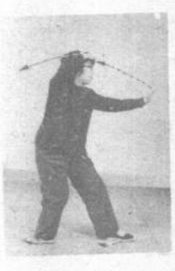
- ③ The left toe lifts and hooks to the right through about 120°, while the body turns right and the right toe lifts and swings outward through about 120°; the left hand sweeps in an arc upward to the forehead; the right hand pushes out forward level at shoulder height, the palm facing forward with the wrist sunk; the eyes look at the right hand. (图 58)
- ④ The left hand extends forward from the forehead until it is level with the right hand, the two palms facing each other and the fingertips pointing forward; at the same time the right foot withdraws to directly behind the left foot and lands on a diagonal. (图 59)
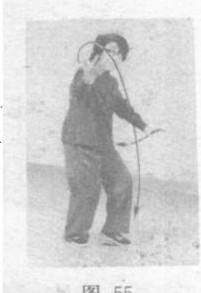
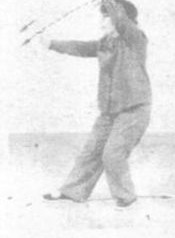
- ⑤ The two hands, held as loose fists, sweep downward in an arc to in front of the abdomen; at the same time the left foot withdraws to in front of the right foot, the toe touch-
...to the ground; the eyes look straight ahead. (Fig. 60)
- ⑧ Both fists, kept close to the body, are raised to the front of the chest and then extended forward and upward, to the height of the eyebrows; at the same time the left foot steps forward and the ball of the foot lands with the toes turned outward, the weight of the body still on the right leg, with a brief pause. Immediately the fists travel in an arc downward to the front of the abdomen; the right foot steps straight forward past the left foot and the ball of the foot lands; the eyes look straight ahead. (Figs. 61, 62)
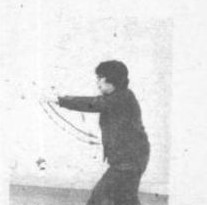
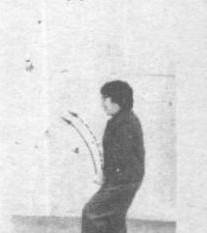
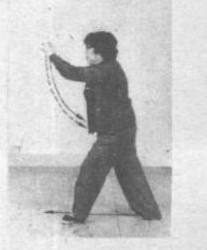
Key points (要点, yàodiǎn): above and below must move in coordination; when the left foot withdraws to a position in front of the right foot, the waist sinks downward.
Application (用法, yòngfǎ): ① If the opponent attacks with his left hand, one intercepts his wrist with one's left hand and presses his elbow with one's right hand, withdraws the step backward, and pulls him down.
- ② If the opponent attacks one's head with his right hand, one then intercepts his wrist from below upward with one's right hand, supports his elbow with one's left hand, draws the left foot in and turns the waist to the right, and seizes and throws him off behind from above.
- ③ If the opponent sinks his shoulder and draws in his arm, one then continues to turn the waist until facing backward, withdraws the right foot to behind the left foot, and, following the momentum of the opponent's withdrawing hand, pulls him downward and backward.
- ① Following the preceding posture, both hands open and lift upward (the right palm facing upward, the left palm facing downward) to the front of the right shoulder; at the same time the right foot steps forward, the left foot immediately follows to behind the right foot and the ball of the foot lands, with a brief pause, and then the step is withdrawn backward; both hands travel in a level arc backward to the front of the right shoulder, the palms facing outward; the weight of the body shifts back onto the left leg, the ball of the right foot lifts; the eyes look at the right hand. (Figs. 63, 64)
- ② Both hands push forward together from in front of the right shoulder, the two
...the arms slightly bent, the left hand supporting the right wrist; at the same time the ball of the right foot gradually comes to the ground, and the left foot immediately follows to a position about 10 centimetres behind the right foot; the eyes look at the right hand. (Fig. 65)
The movement is the same as in the third posture, "Opening the Hands". (Fig. 66)
The movement is the same as in the fourth posture, "Closing the Hands". (Fig. 67)
The movement is the same as in the fifth posture, "Single Whip". (Fig. 68)
- ① Following the preceding posture, the left hand travels downward and in an arc to the right to below the right armpit, the palm slanted downward; at the same time the left foot moves
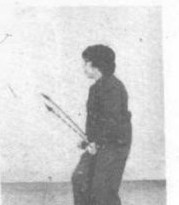
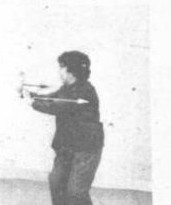
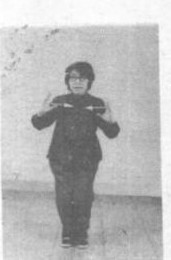
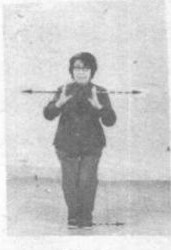
...the right foot draws in close, the ball of the foot lands, the eyes look at the right hand, with a brief pause. (Fig. 69)
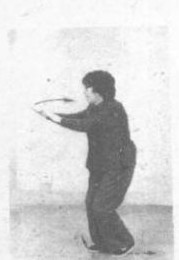
- ② The left hand travels upward and in an arc to the left side of the body, the palm facing left and the fingertips pointing up; the right hand travels downward and in an arc to below the left armpit, the palm slanted downward; at the same time the left foot steps sideways to the left, the ball of the foot turned slightly outward, and the right foot draws in close to the left foot and lands at a distance of about 10 centimetres from it (both balls of the feet slanting slightly to the left); the eyes look at the left hand, with a brief pause. (Fig. 70)
- ③ The right hand travels upward and in a downward arc, and the left hand travels downward and in an upward arc; the left foot steps sideways to the left and the right foot draws in close to the left foot. The cycle is repeated three times; see Figs. 69, 70.
Key points (要点, yàodiǎn): when the left and right hands travel upward in an arc, both palms face outward and rise no higher than the eyebrows; the body turns with the hands.
Application (用法, yòngfǎ): if the opponent strikes from the left or right, one immediately turns the waist and intercepts with the arm, and, following his momentum, seizes and throws him out.
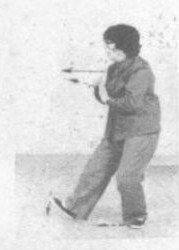
- ① Following the preceding posture, while the two hands move from left to right in cloud-hands, the left hand travels in an arc downward to the front of the chest and is lifted slightly, the elbow kept close to the body and the tiger's mouth (虎口, hǔkǒu) facing upward; the right hand, having moved in an arc to the level of the face, drops and extends forward, the tiger's mouth facing upward, the height level with the chest, both arms slightly bent; at the same time the left foot withdraws backward and the right foot, following the right hand, lands forward in front of the left foot, the ball of the foot landing and forming a "T" shape with the left foot, both legs slightly bent; the eyes look at the right hand. (Fig. 71)
- ① Following the preceding posture, the left hand rotates outward, the palm facing upward; the right hand rotates inward toward the body to the front of the chest, the palm facing downward; the two hands
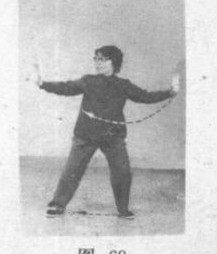
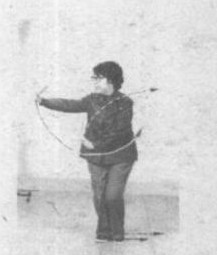
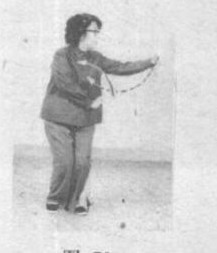
...the palms about 10 centimetres apart, and the two hands about 6 centimetres from the chest; at the same time the ball of the right foot turns inward and the ball of the foot lands, facing the ball of the left foot; the eyes look at the right hand. (Fig. 72)
- ② The two hands twist together, the fingertips pointing upward, and the wrists sink (the same as in the closing-the-hands posture); at the same time the heel of the left foot lifts and turns slightly to the right until it is level with the right foot, with a brief pause. (Fig. 73)
- ③ The two hands separate as in the single-whip posture; at the same time the right leg lifts, the ball of the foot pointing upward, until it touches the right hand; the eyes look at the right hand, and the waist sinks slightly. (Fig. 74)
- ④ The movement does not stop; the right foot comes down and turns slightly inward; the left foot then draws in close to the right foot, the ball of the foot landing; the two hands close inward (the same as in the closing-the-hands posture), the eyes look to the left, with a brief pause. (Figs. 75, 76)
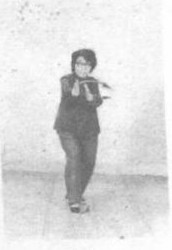
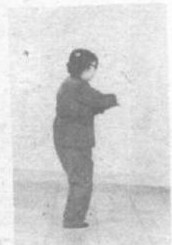
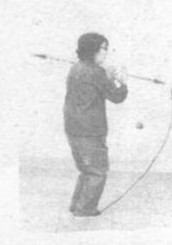
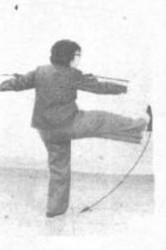
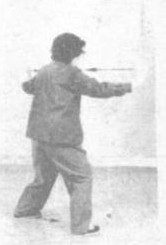
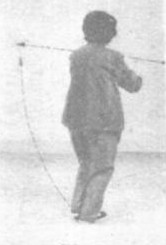
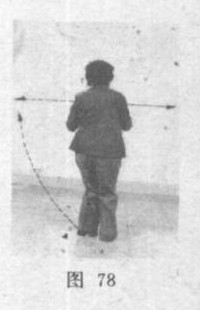
Following the preceding posture, the two hands separate as in the single-whip posture, and the left foot lifts to the left front diagonally until it touches the left hand, then immediately returns to its original position with the ball of the foot landing; at the same time the two hands perform the closing-the-hands movement, with a brief pause. (Figs. 77, 78)
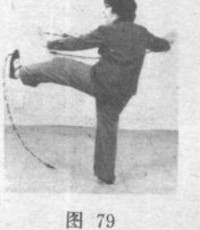
Following the preceding posture, the right foot and the body turn slightly to the left, and the left foot immediately kicks upward, the toes hooked back, thrusting out forward and to the left; the two hands separate so that hand and foot meet; the eyes look at the index finger of the left hand. (Fig. 79)
- ① Following the preceding posture, the left foot lands forward with the ball of the foot turned outward; at the same time the left hand sweeps back in front of the left hip, the palm facing downward; the right hand extends downward and forward, the palm facing upward, with a brief pause. (Fig. 80)
- ② The right foot steps forward past the left foot, the ball of the foot turned outward; at the same time the left hand extends forward, the palm facing upward; the right hand draws back to the front of the chest, the palm facing downward, with a brief pause. (Fig. 81)
- ③ The left foot steps forward, the ball of the foot turned inward; at the same time the left hand rotates inward and changes into a fist, pulling down to the front of the left hip; the right hand rotates outward and changes into a fist, travels in an arc backward, upward and forward, and strikes out past the forehead toward the inside of the left ankle; the body follows downward, the left leg bending at the knee and the right leg slightly bowed; the eyes look at the right hand. (Figs. 82, 83)
Key points (要点, yàodiǎn): the movements must run through in one continuous flow; the waist must be kept sunken; the eyes follow the hands.
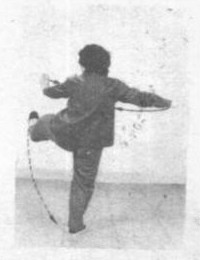
Application (用法, yòngfǎ): if the opponent crouches and strikes one's lower body, ...such as advancing the step and striking the crotch with the fist (进步指裆捶, jìn bù zhǐ dāng chuí), or grabs my left foot, then I immediately sweep it aside with my left hand and strike down from above with my right fist.
- ① Following the preceding posture, the left foot turns inward; at the same time the right fist travels upward past the forehead and then carves an arc forward, the centre of the fist facing upward, and the body turns 180° to the right along with it; the left fist is then withdrawn downward and backward to the front of the right hip; the right foot turns slightly outward. (Figs. 84, 85)
- ② The left hand travels from the side of the left hip upward past the face and sweeps downward in front of the chest, stopping at the outer side; the right fist changes into a palm and extends upward and forward, the palm facing outward; at the same time the left foot steps forward, the toes turned slightly outward; the right foot lifts and kicks forward, the right hand slaps the top of the right foot, at the height of the chest; the eyes look at the right hand. (Figs. 86, 87)
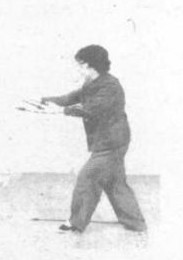
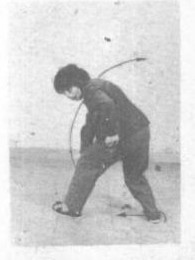
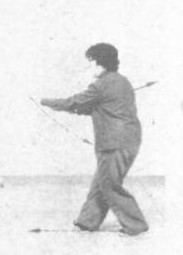
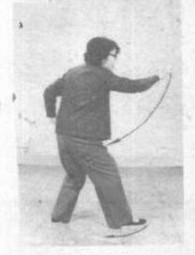
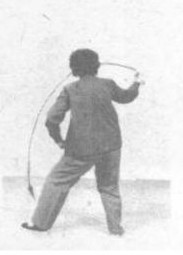
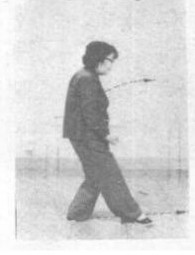
Application (用法, yòngfǎ): if the opponent ...strikes at me from the right, then I immediately turn the body to the right and intercept the opponent's hand with my right hand, and at once kick at him with the left foot; at the same moment that the left foot lands I raise the right foot and kick, and this is why it is called the "two raises" (二起, èr qǐ).
- ① Following the preceding posture, the right foot withdraws a step to behind the left foot; at the same time the left hand extends forward, the two palms facing each other as though cradling a ball, and the waist sinks downward, with a brief pause. (Fig. 88)
- ② The left foot withdraws one step backward; the two hands change into fists, draw back downward, and pass by the side of the left hip, carving an arc backward, upward and then downward to the front of the abdomen, with a brief pause; at the same time the tip of the right foot lifts and swings straight to the left; the left foot turns slightly inward. (Figs. 89, 90)
Key points (要点, yàodiǎn): the two hands are drawn back without stopping.
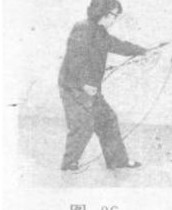
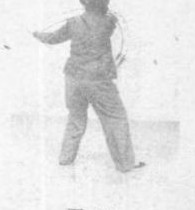
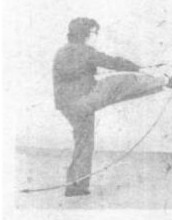
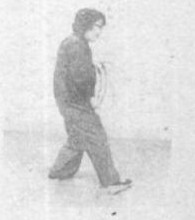
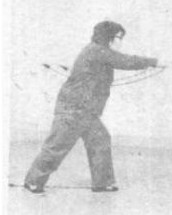
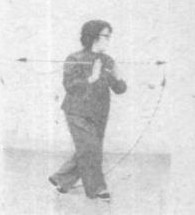
Application (用法, yòngfǎ): if the opponent grips both my wrists with both hands, ...I withdraw the step to the left, and turning the waist to the right swing both arms free. This posture is likewise a kind of throwing method. If the opponent grips both my wrists, or I grip both of his wrists, I withdraw the right foot backward and draw his two arms backward and downward; then hook the left foot inward, turn the body to the right, and swing both hands upward above the head, so that the opponent's two arms pass over my left shoulder and his body is carried on my back.
- ① Following the preceding posture, the two fists change into palms and are lifted to the front of the chest as in the closing-the-hands movement; at the same time the right leg lifts slightly, the toes turned outward, and lands obliquely; the left knee bends slightly and comes close to the inner side of the right leg, the tip of the foot touching the ground; both legs are bent; the eyes look straight ahead, with a brief pause. (Fig. 91)
- ② The two hands separate as in the single-whip posture; at the same time the left
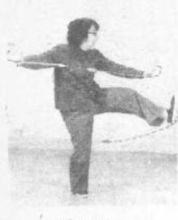
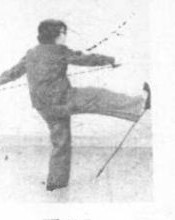
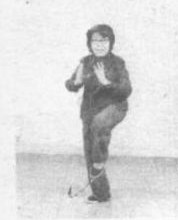
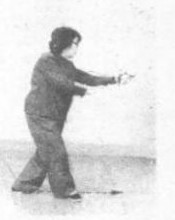
...foot lifts to the left side until it touches the hand; the eyes look at the index finger of the left hand. (Fig. 92)
- ① Following the preceding posture, the left foot is drawn back and the knee raised, and the body turns 270° to the right; then the left foot descends to the outer side of the right foot; the right heel lifts and twists round until it faces the tip of the left foot; at the same time the two hands come together as in the closing-the-hands movement. (Figs. 93, 94)
- ② The body then turns slightly to the right, the right foot turns slightly outward, and the two hands separate left and right as in the single-whip posture; at the same time the right foot thrusts out in a heel kick; the eyes look at the index finger of the right hand. (Fig. 95)
Application (用法, yòngfǎ): if the opponent strikes at my head with a hook punch (single peak pierces the ear, 单峰贯耳, dān fēng guàn ěr), I raise my hand to intercept it, and at the same time lift the foot and kick at the opponent's abdomen. Hand and foot must issue together before the opponent can be subdued.
- ① Following the preceding posture, the right foot descends to the front of the left foot, the toes turned outward; at the same time the left hand extends downward and forward, the palm facing upward; the right hand sweeps back to the front of the right ribs, the palm facing downward. (Fig. 96)
- ② The left foot steps up, the tip of the foot kept straight; at the same time the left hand rotates inward, the palm facing downward, and the two hands immediately change into fists; the right fist strikes out forward, the eye of the fist facing upward, and the left fist is drawn back beneath the right elbow, the centre of the fist facing downward; the right foot follows up to behind the left foot, the tip of the foot touching the ground; the eyes look at the right fist. (Figs. 97, 98)
The movement is the same as that of the thirteenth posture, "as if sealing, as if closing". (Fig. 99)
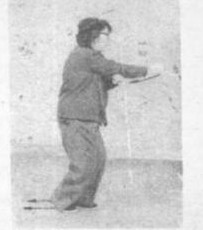
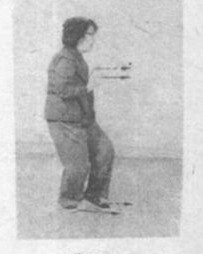
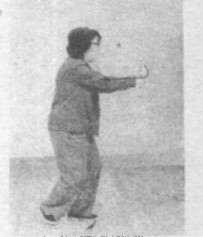
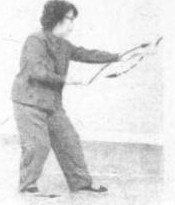
(This page is a plate page and carries no body text.)
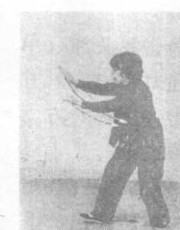
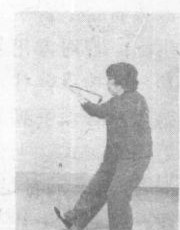
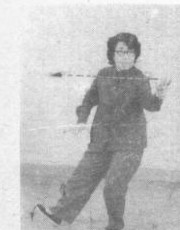
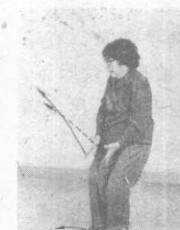
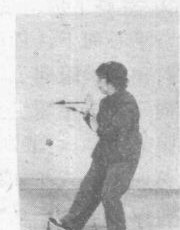
The movement is the same as that of the fourteenth posture, "Embrace the Tiger and Push the Mountain" (抱虎推山, Bào Hǔ Tuī Shān). (Fig. 100)
The movement is the same as that of the fifteenth posture, "opening the hands". (Fig. 101)
The movement is the same as that of the fourth posture, "closing the hands". (Fig. 102)
The movement is the same as that of the seventeenth posture, "brush the knee and twist the step". (Figs. 103, 104)
The movement is the same as that of the eighteenth posture, "lazily tucking in the robe". (Figs. 105, 106, 107, 108, 109, 110)
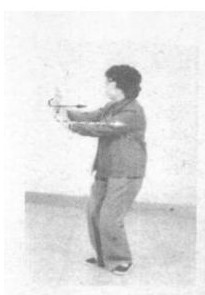
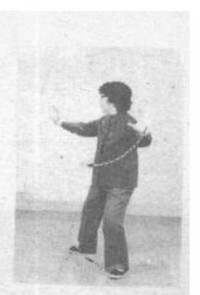
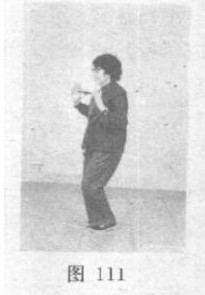
The movement is the same as that of the third posture, "opening the hands", except that the direction is 45° to the right.
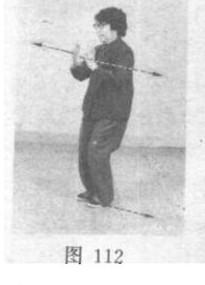
The movement is the same as that of the fourth posture, "closing the hands", except that the direction is 45° to the right. (Fig. 112)
Following the preceding posture, the left foot steps out to the left front, and the two hands separate level. (Fig. 113)
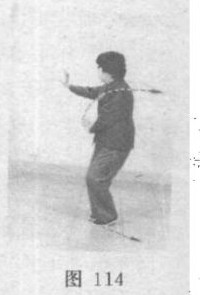
- ① Following the preceding posture, the left foot draws in beside the right foot, the whole sole on the ground; at the same time the left hand sweeps downward in an arc to the front of the abdomen; the eyes look at the right hand. (Fig. 114)
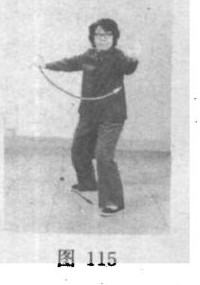
- ② The left hand goes upward past the chest and then sweeps in an arc to the left to the left side of the body; at the same time the left foot steps out to the left, the tip of the foot turned slightly outward; the eyes look at the left hand. (Fig. 115)
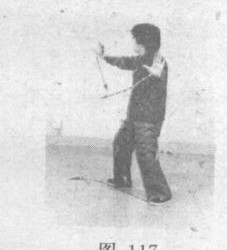
- ③ The right hand sweeps downward in an arc to the front of the abdomen, then upward past the face and in an arc to the right to the right side of the body; at the same time the right foot draws in beside the left foot (the tip of the foot touching the ground, the two feet about 10 cm apart), and then steps out one pace to the right; at this point the single-whip posture is resumed, but the weight is biased toward the right leg. (Figs. 116, 117)
- ④ The left foot steps forward in front of the right foot, the tip of the foot turned outward and set down diagonally, the two legs bent; at the same time the two hands go downward and cross in front (the palms turned slightly outward, the left hand above, the right hand below, the two arms slightly curved), and immediately separate to left and right, each drawing a circle to the front of the chest, the right palm facing upward, the left palm facing downward; the eyes look at the lower front. (Figs. 118, 119)
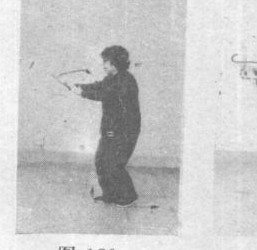
- ① Following the preceding posture, the right foot steps forward; the left foot then follows up behind the right foot, the tip of the foot touching the ground, pausing briefly and then withdrawing; at the same time the weight of the body shifts to the left leg, the tip of the right foot raised; the left hand supports the right wrist and the two push forward together (the right palm facing upward, the left palm facing downward), then wind level to the right and to the rear to the front of the right shoulder, both palms facing outward. (Figs. 120, 121, 122)
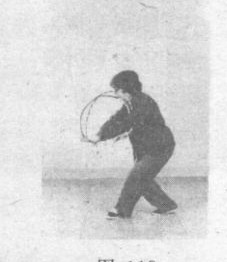
- ② The two hands push forward together; the left foot follows up to about 10 cm behind the right foot, the tip of the foot touching the ground; the eyes look at the index finger of the right hand. (Fig. 123)
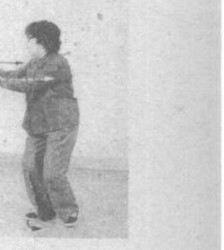
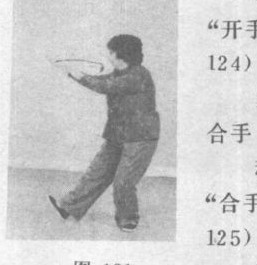
The movement is the same as that of the third posture, "opening the hands". (Fig. 124)
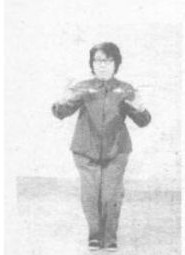
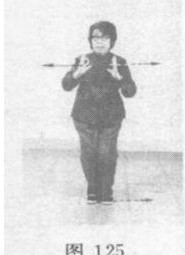
The movement is the same as that of the fourth posture, "closing the hands". (Fig. 125)
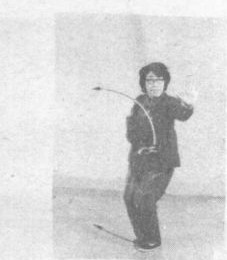
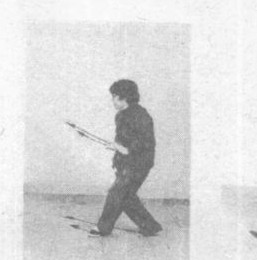
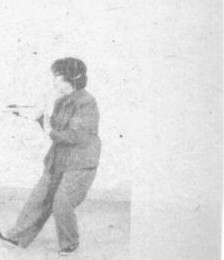
Whip The movement is the same as that of the fifth posture, "single whip". (Fig. 126)
Following the preceding posture, the left hand goes upward and to the right in an arc until the back of the hand presses against the forehead; the body turns to the right, and the raised tip of the left foot turns to the right along with it. At the same time the right foot swings outward, its tip turned slightly inward, and the right hand keeps its wrist sunk and does not move; the eyes look at the index finger of the right hand. (Fig. 127)
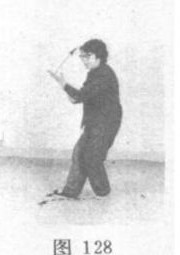
- ① Following the preceding posture, the right hand draws back, the palm sloping downward, the thumb side facing the chest; the left hand rotates outward, wraps inward and goes down to the front of the right hand, the palm facing upward; at the same time the right foot withdraws slightly and swings outward, the two legs slightly bent; the eyes look at the right hand. (Fig. 128)
- ② The left hand rotates inward
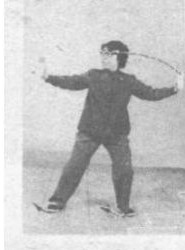
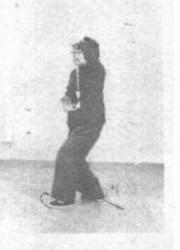
upward until the back of the hand rests against the forehead; the left foot steps out to the left front (facing southwest), and the right foot follows up to about 10 cm behind the left foot; at the same time the right hand is placed before the chest and gently pushes forward (the elbow close to the body). (Fig. 129)
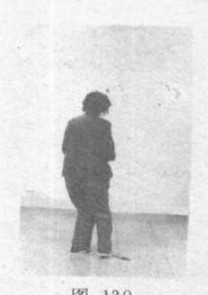
- ③ The left foot turns inward, the body turns about 180° to the right; the left hand goes down to the front of the chest, the palm facing downward; the right hand rotates inward and slightly upward, the palm facing upward (the two elbows close to the body). (Fig. 130)
- ④ The right hand rotates inward and goes upward until the back of the hand rests against the forehead; at the same time the right foot steps out to the right front (facing southeast); the left foot follows up to about 10 cm behind the right foot; the left hand gently pushes forward from the front of the chest (the two elbows still close to the body). (Fig. 131)
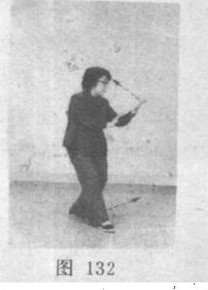
- ⑤ The right foot steps slightly forward, the tip of the foot turned slightly inward; at the same time the right hand drops to the front of the chest, the palm facing downward; the left hand rotates outward and goes upward, the palm facing upward, the two elbows close to the body, the posture the same as in ① but in the opposite direction. (Fig. 132)
- ⑥ The left foot steps out to the left front (facing northeast); the left hand rotates inward and goes down to the front of the forehead, the palm facing forward; the right foot follows up, the posture the same as in section ② but in the opposite direction. (Fig. 133)
- ⑦ The body turns to the right, the course of the hand and foot movements all the same as in section ③, but in the opposite direction. (Fig. 134)
- ⑧ The right foot withdraws a step to the right, the left foot follows up to the inner side of the right foot, the body turns 90° to the right; at the same time the left hand pushes forward
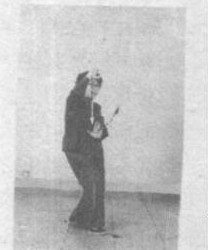
out, the arm slightly bent, the palm facing forward, the fingertips pointing upward; the right hand rotates inward and goes upward to the front of the forehead, the palm facing obliquely forward; the eyes look at the left hand. (Fig. 135)
The movement is the same as in the Eighteenth Posture, "Lazily Tucking the Robe" (懒扎衣). (Fig. 136, 137, 138, 139, 140, 141)
The movement is the same as in the Third Posture, "Opening the Hands" (开手). (Fig. 142)
The movement is the same as in the Fourth Posture, "Closing the Hands" (合手). (Fig. 143)
The movement is the same as in the Fifth Posture, "Single Whip" (单鞭). (Fig. 144)
The movement is the same as in the Thirty-Sixth Posture, "Cloud Hands" (云手). (Fig. 145, 146)
Continuing from the previous posture, when the two hands have moved to the right side, the right palm turns over to face upward and pushes forward level, the wrist sinking; the left hand still moves upward in an arc to the front of the left hip; at the same time the right foot follows up behind the left foot. Then the left hand pushes forward from the back of the right hand, the wrist sinking, the palm facing obliquely forward; the right hand draws back to the side of the right hip, the palm facing downward; the left foot steps forward, both legs bent; the weight of the body shifts onto the right leg; the eyes look at the left hand. (Fig. 147, 148, 149)
- ① Continuing from the previous posture, the weight of the body shifts forward; the right hand is lifted forward and upward from the side of the right hip to beside the ear, the fingertips level with the ear; the left hand moves downward in an arc to the side of the left hip, the fingertips pointing down; at the same time the right leg, close against the left leg, is lifted upward to a right angle with the body, the tip of the foot tilted up, the heel pressing down; the left leg is slightly bent, the waist sunk (塌腰, tā yāo); the eyes look forward, with a slight pause. (Fig. 150, 151)
- ② The right foot comes down forward, the leg still bent; at the same time the right hand moves downward in an arc to the side of the right hip, the fingertips pointing down; the left hand goes upward from the side of the left hip to beside the ear, the fingertips level with the ear; the left leg, close against the right leg, is lifted upward. (Fig. 152)
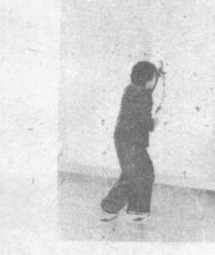
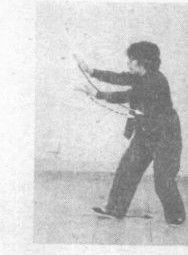
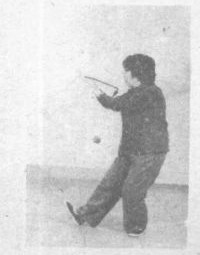
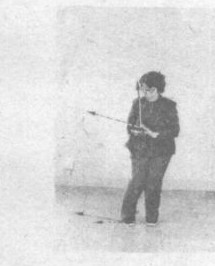
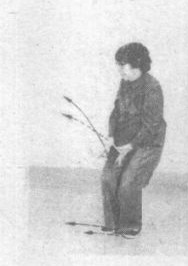
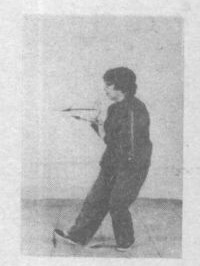
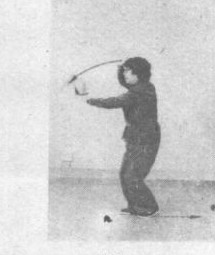
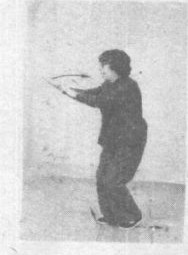
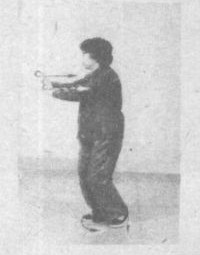
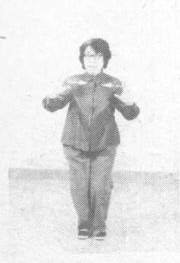
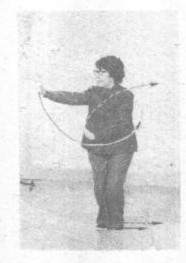
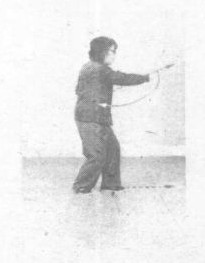
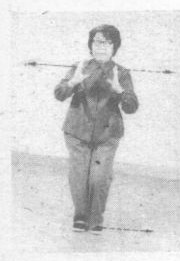
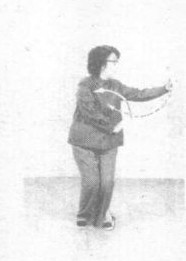
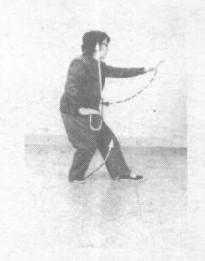
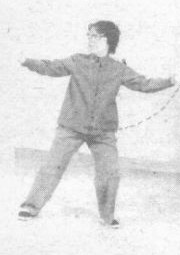
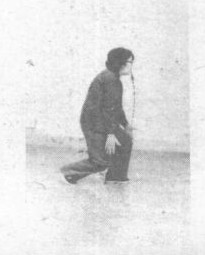
Key point (要点, yào diǎn): the body must be straight, the waist sunk (塌腰, tā yāo), and the right leg still bent.
The movement is the same as in the Twenty-Third Posture, "Step Back and Repulse the Monkey" (倒撵猴). (Fig. 153, 154, 155, 156)
The movement is the same as in the Twenty-Fifth Posture, "Hands Play the Pipa" (手挥琵琶). (Fig. 157)
The movement is the same as in the Seventh Posture, "White Crane Spreads Its Wings" (白鹤亮翅).
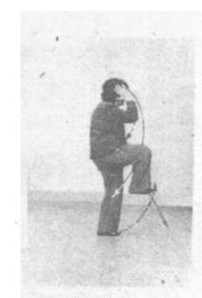
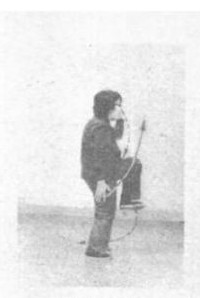
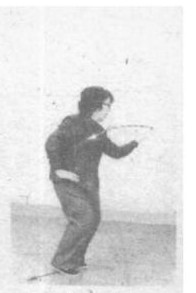
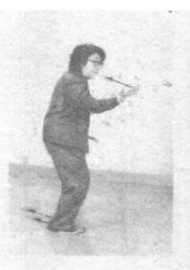
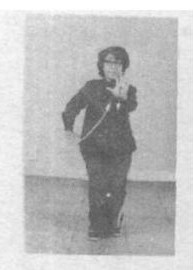
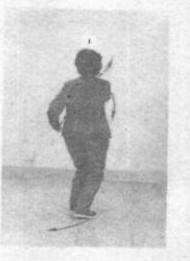
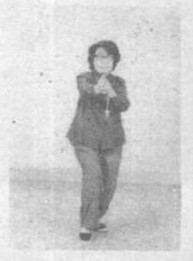
(Fig. 158, 159, 160)
The movement is the same as in the Third Posture, "Opening the Hands" (开手). (Fig. 161)
The movement is the same as in the Fourth Posture, "Closing the Hands" (合手). (Fig. 162)
The movement is the same as in the Tenth Posture, "Brush the Knee and Twist the Step" (搂膝拗步). (Fig. 163, 164)
The movement is the same as in the Eleventh Posture, "Hands Play the Pipa" (手挥琵琶). (Fig. 165)
The movement is the same as in the Thirty-First Posture, "Three Penetrations of the Back" (三通背). (Fig. 166, 167, 168, 169, 170, 171, 172, 173)
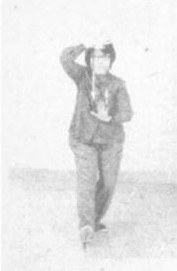
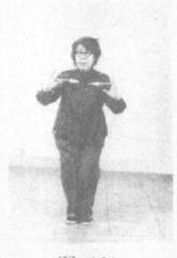
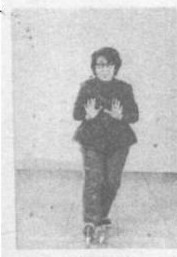
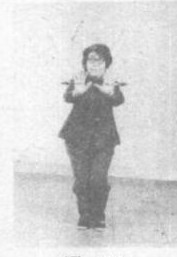
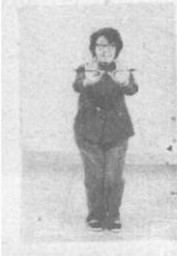
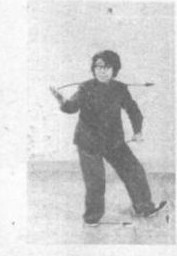
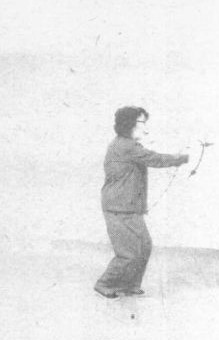
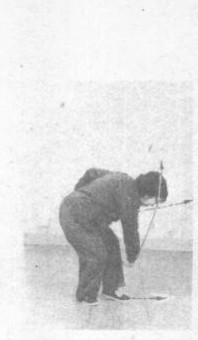
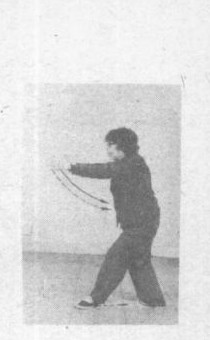
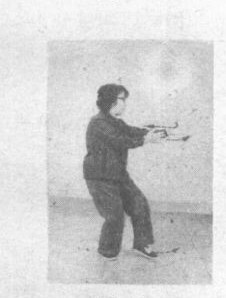
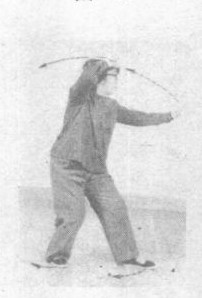
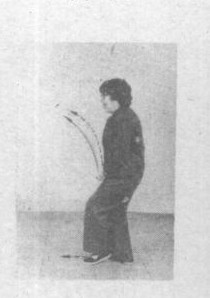
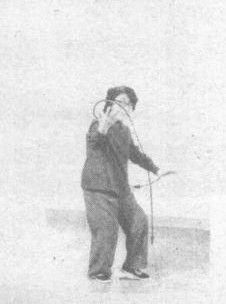
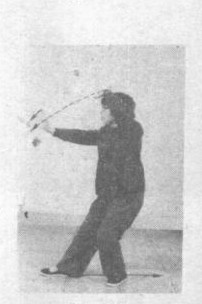
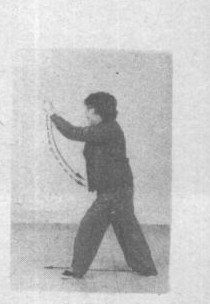
The movement is the same as in the Thirty-Second Posture, "Lazily Tucking the Robe" (懒扎衣, Lǎn Zhā Yī). (Fig. 174, 175, 176)
The movement is the same as in the Third Posture, "Opening the Hands" (开手). (Fig. 177)
The movement is the same as in the Fourth Posture, "Closing the Hands" (合手). (Fig. 178)
The movement is the same as in the Fifth Posture, "Single Whip" (单鞭). (Fig. 179)
The movement is the same as in the Thirty-Sixth Posture, "Cloud Hands" (云手). (Fig. 180, 181)
The movement is the same as in the Thirty-Seventh Posture, "High Pat on Horse" (高探马). (Fig. 182)
- ① The tip of the right foot swings outward.
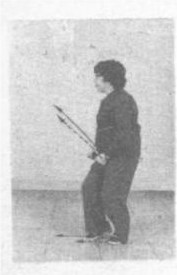
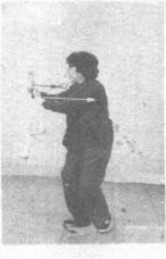
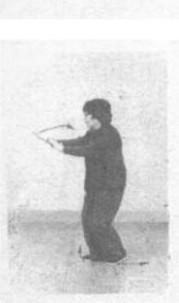
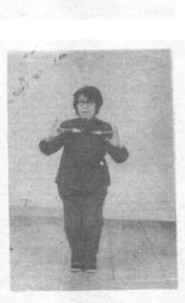
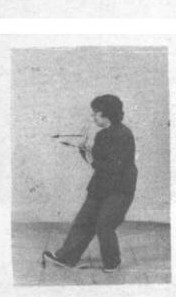
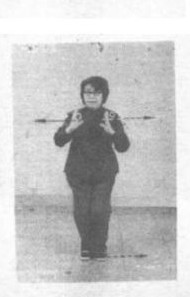
Up to the point where the heel is level with the tip of the left foot; at the same time the left hand rotates outward and inward to the front of the chest with the palm facing up; the right hand rotates inward to the front of the chest with the palm facing down, the two palms facing each other and about 10 cm apart; the eyes look at the right hand. (Fig. 183)
- ② The left foot steps forward, the toe turned inward so as to form a splayed stance (八字步, bā zì bù) with the left foot, and the body turns 90° to the left; the two hands exchange places in front of the chest, the right hand below with the palm facing up and the left hand above with the palm facing down; then the two legs bend slightly and the two hands become upright crossed palms (立掌, lì zhǎng), the right hand outside and the left hand inside, the thumbs lightly against the chest; the eyes look at the two hands. (Fig. 184, 185)
- ③ The right leg lifts at the knee, the knee swinging slightly outward; at the same time the two hands separate to left and right as in the Single Whip posture; the eyes look straight ahead. (Fig. 186)
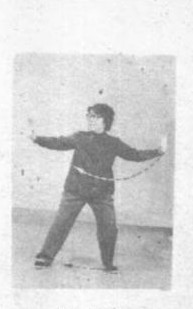
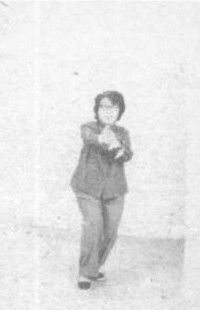
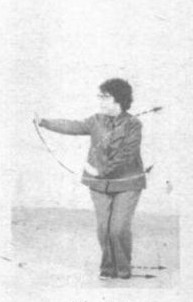
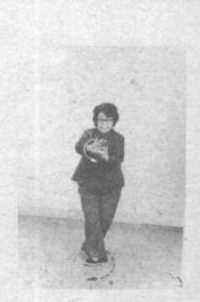
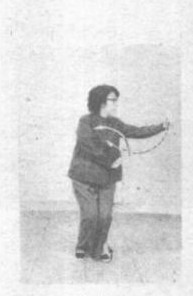
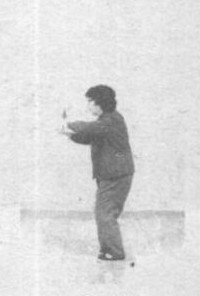
Following on from the previous posture, the right hand becomes a fist and the two hands extend forward together, the left hand supporting the right wrist, the eye of the right fist facing up; at the same time the right foot steps forward and the left foot follows; then the right foot takes another step forward and the left foot follows again up to behind the right foot with the toe touching the ground, the body forming a threefold folded shape; the eyes look at the right hand. (Fig. 187)
Key points (要点, yào diǎn): when stepping forward, the body should be like a bird folding its wings and swooping down aslant from a tree.
Following on from the previous posture, the left foot withdraws to the rear and the tip of the right foot lifts; at the same time the right hand becomes a palm, circles level upward to the right and to the rear, and then pushes forward; the left hand supports the right wrist; the eyes look at the right hand. (Fig. 188, 189, 190)
The movement is the same as in the Third Posture, "Opening the Hands" (开手). (Fig. 191)
The movement is the same as in the Fourth Posture, "Closing the Hands" (合手). (Fig. 192)
The movement is the same as in the Fifth Posture, "Single Whip" (单鞭). (Fig. 193)
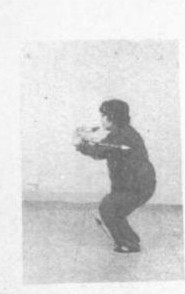
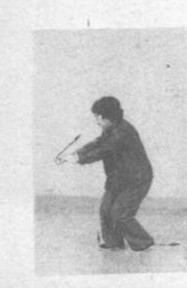
Following on from the previous posture, the right hand traces an arc downward, the arm bending until it reaches the side of the right hip with the palm facing down; at the same time the left hand drops slightly downward, the palm slanting downward; the body sits back and the weight shifts onto the right leg; the eyes look at the index finger of the left hand. (Fig. 194)
Following on from the previous posture, the right hand traces an arc forward and upward from the side of the right hip and extends out from beneath the left wrist, and the two wrists cross and are drawn in before the chest about 10 cm apart, the right hand outside, the fingertips all pointing up; as the right hand extends, the left foot shifts slightly forward and the right foot follows to behind the left foot with the toe touching the ground; the eyes look at the two hands. (Fig. 195)
Key points (要点, yào diǎn): the upper body must be straight, the waist must sink (塌腰, tā yāo), and the two legs must be bent.
Application (用法, yòng fǎ): if the opponent strikes upward at one's face from below, one props it up with both palms and, following the momentum, seizes and presses it down.
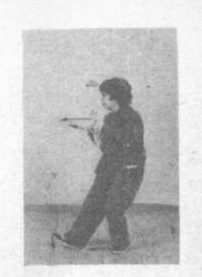
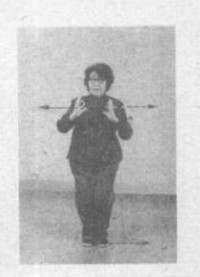
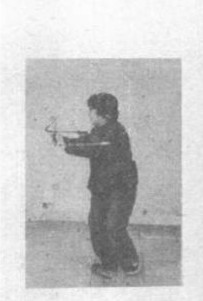
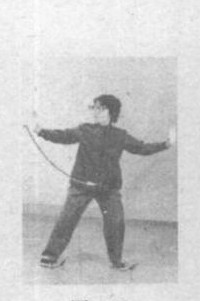
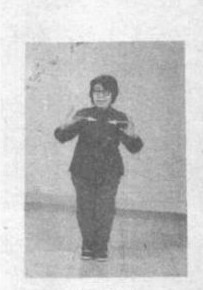
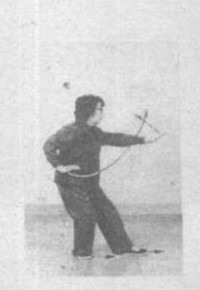
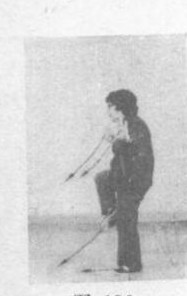
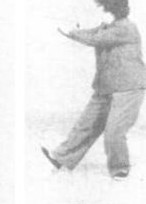
Following on from the previous posture, the two hands The hands separate; the left hand brushes downward to the side of the left hip, palm facing down; the right hand rotates outward upward, downward, then upward again and forward, and, passing in front of the forehead, rotates inward and presses down to the front of the abdomen, palm facing down; at the same time the right foot takes one step backward, the tip of the foot slanting slightly outward; the left foot withdraws to the front of the right foot with the toe touching the ground; at the same time the waist sinks (塌腰, tā yāo) and the legs bend, the right hand is raised, the left leg lifts at the knee with the toe turned up. (Fig. 196, 197)
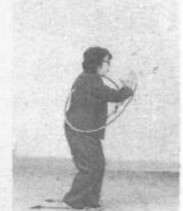
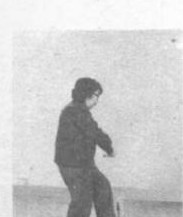
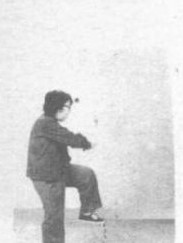
Key points (要点, yào diǎn): the movements of the body and of the hands and feet must be coordinated and as one.
Application (用法, yòng fǎ): if the opponent strikes with the hand at the middle or lower part of one's body, one steps back, covers the opponent's hand with both hands and draws it backward, so that the opponent loses balance, and at the same time raises the left foot to kick.
- ① Following on from the previous posture, the heel of the right foot lifts, the body turns 360° to the right, and when it has turned to face southwest the left foot lands, the tips of the two feet facing each other; immediately the tip of the left foot turns up and twists to the right; the right foot is lifted and swung out to the right; the two hands trace an arc upward and to the right and, when they reach the right front, strike against the right knee (the left hand strikes first, the right hand after); the eyes look at the right leg. (Fig. 198, 199)
- ② The right foot comes down slanting to the right, the two hands rotate outward and draw back to the sides of the two elbows, both palms facing up; the eyes look forward. (Fig. 200)
Application (用法): if the opponent strikes with the right fist, one leads it to the right with one's right fist and, at the moment when the left hand pushes aside, turns the body and kicks the opponent's back with the right foot.
Following on from the previous posture, the two hands extend forward at the same time; in the course of extending, the two hands rotate inward, both palms facing down, level with the shoulders, the two arms slightly bent; the weight of the body shifts forward onto the right leg along with the movement; the eyes look between the two hands. (Fig. 201)
Application (用法): if the opponent strikes with the left hand, one advances the right foot toward the opponent's left side and at the same time intercepts the incoming hand with both hands, wraps it and presses it downward to drain its force, and then strikes at the opponent's chest. The key to this posture lies in the joining of the hands and the advance of the step being as one.
Following on from the previous posture, the left foot steps up to the side of the right foot with the toe touching the ground; the two hands become fists and draw back to the front of the chest, the eye of the fist facing down; immediately the left foot steps forward (toward the northeast); the two fists thrust forward, the two arms slightly bent, the eyes of the fists facing down; the right foot follows the step, the tip of the foot slanting outward as it lands, about 10 cm from the heel of the left foot. (Fig. 202, 203)
Key points (要点): the two legs bend, the waist sinks downward (塌腰), and one pauses slightly.
Application (用法): suppose both hands press forward and the opponent presses down with both hands; one then follows the momentum and separates the hands downward, and, passing around the outside of the opponent's two arms, strikes up at the chest.
- ① Following on from the previous posture, the body turns to the right, and with the turn the two fists wrap inward, the palms facing up (the right fist at the left wrist, the two elbows close to the ribs); at the same time the left foot turns in and the right foot withdraws to the rear, the tip of the foot turning outward; the eyes look at the left fist. (Fig. 204, 205)
- ② The left fist passes under the right wrist and circles outward until it is on the outside of the right fist; the right fist rotates inward a little toward the inside, the two elbows hang down, the two fists crossing; the tip of the left foot turns up and shifts slightly forward; the weight of the body moves onto the right leg, the two legs bend, the waist must be sunk (塌腰); the eyes look between the two fists, and one pauses slightly. (Fig. 206, 207)
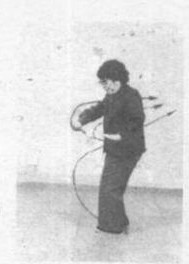
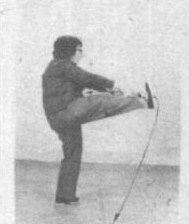
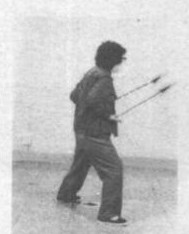
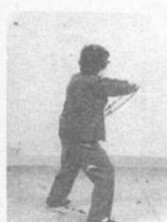
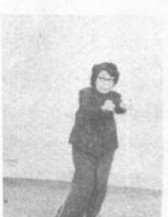
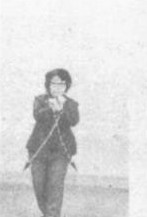
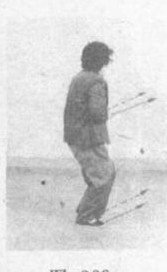
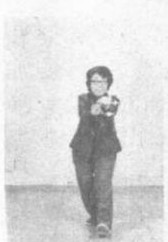
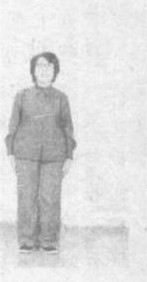
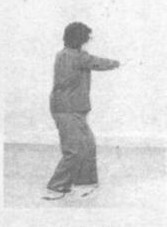
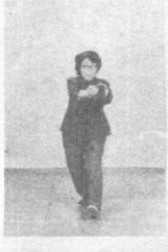
the outside, the right fist rotates inward a little toward the inside, the two elbows hang down, the two fists crossing; the tip of the left foot turns up and shifts slightly forward; the weight of the body moves onto the right leg, the two legs bend, the waist must be sunk (塌腰); the eyes look between the two fists, and one pauses slightly. (Fig. 206, 207)
Following on from the previous posture, the two hands become palms and separate to left and right as far as the sides of the hips; the left foot draws in close to the right foot, the body stands upright; the eyes look level. (Fig. 208)
(No photographic plates are printed on this page.) (This scan page is blank: no printed text, no photographic plates, and no printed page number are present on it.)
Part Two (下编, Xià Biān)
Phần 9
1. The Push-Hands Method of Taijiquan (太极拳推手法, Tàijíquán Tuīshǒu Fǎ)
Every martial art contains two parts, "substance" (体, tǐ) and "application" (用, yòng), and substance and application are mutually connected; Taijiquan is no exception. The various postures of the Taijiquan form are the substance, the art of knowing oneself (知己功, zhī jǐ gōng); although application is present within them, in solo practice it is not easy to experience the methods and the subtle excellences of application, and hence there is Taijiquan push-hands (推手, tuī shǒu) in order to put the art to use.
Taijiquan push-hands takes the practice of application as its main concern and seeks the gateway to effective use. Its methods of use comprise the eight methods (八法, bā fǎ): warding-off (掤, bīng), rolling-back (捋, lǚ), pressing (挤, jǐ), pushing (按, àn), plucking (采, cǎi), rending (挒, liè), elbowing (肘, zhǒu), and leaning (靠, kào); among the eight methods, the four hands (四手, sì shǒu) of warding-off, rolling-back, pressing and pushing are the foundation. In beginning push-hands one must first take the "four hands" as the basic method of practice, drilling them repeatedly and experiencing them with care, until one has trained to the point of adhering, joining, sticking and following (粘连黏随, zhān nián nián suí), neither losing contact nor resisting (不丢不顶, bù diū bù dǐng), with hands and feet nimble and measured, able to judge accurately the magnitude of the opponent's force (劲, jìn); only then can one attain the effects of "leading the opponent in to fall into emptiness" (引进落空, yǐn jìn luò kōng) and "moving a thousand catties with a pull of four ounces" (牵动四两拨千斤, qiān dòng sì liǎng bō qiān jīn). Plucking, rending, elbowing and leaning, and all the various hand techniques, emerge as transformations from within these. At this point one is able to make the whole body insubstantial and numinous, round and lively without obstruction, and infinitely variable — something that brush and ink cannot fully set forth.
The footwork of push-hands comprises static (fixed) step, moving (live) step, joined step, and following step, and so on. A beginner at push-hands should take the static step as the root; only after the static step is proficient does one practise the moving step. In the course of this, joined step and following step may both be used, giving four kinds: static step (joined, following) and moving step (joined, following).
1. The Static-Step Push-Hands Method (静步推手法, Jìng Bù Tuī Shǒu Fǎ)
(1)Starting Posture (起式, qǐ shì) (the woman is A, the man is B)
- ① A and B stand facing each other, about two paces apart. (Fig. 一)
- ② A and B each advance the left foot, the left hand in front with the palm facing backward, the right hand resting on the left forearm, the right wrist about 15 cm from the chest. (Fig. 二)
(2)A presses (挤, jǐ) and B rolls back (捋, lǚ)
A first presses his right hand toward B's face. B at once lightly catches A's right wrist with his right hand, while his left hand passes from beneath A's right arm up and over and lightly catches A's right elbow, and the two hands together thrust (擩, rǔ) diagonally to the right.
A then straightens the right arm and wraps the wrist inward until the palm faces inward; at the same time the left hand presses toward his own right forearm, the eyes looking at B. (Fig. 三)
(3)B rolls back and pushes (按, àn)
While A is using the press, B draws both hands back along with the body, neither losing contact nor resisting, with the tip of the front foot turned up; only after A has brought out his strength does B push.
B then pushes both hands toward A's left arm, the left hand pressing on the back of A's left hand, the right hand pressing A's left elbow. (Fig. 四, 五)
(4)A rolls back and B presses When B's two hands come pushing in, A shrinks his body backward, and at the same time his left hand lightly catches B's right wrist, while his right hand turns upward from beneath B's left arm and also lightly catches B's left elbow, and the two hands together thrust diagonally to the left.
B then straightens the left arm and wraps the wrist inward until the palm faces inward, and at the same time the right hand presses toward his own left forearm, the eyes looking into A's eyes. (Fig. 六)
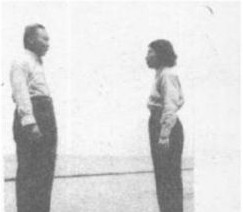
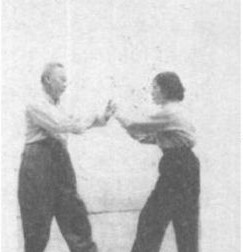
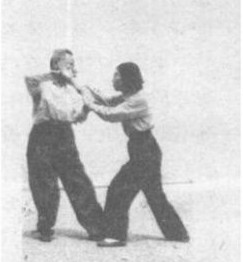
In the order given above, the pushing is carried on in a continuous cycle.
(5)The method of changing sides in push-hands To change from the left-side form to the right-side form (that is, with A and B each having the right foot in front), when B uses the thrust, A (not using the press) leads B's right hand backward with his own right hand and winds his left hand over B's right elbow, and at the same time withdraws the left foot to behind the right foot, just as in the thrust of the left-side form; B then advances the right foot and uses the press. A thrusts and pushes again, B thrusts again, and the drill is repeated in a cycle. This is the method of changing sides for a beginner at push-hands. Once it is familiar, the change may be made at will.
2. The Live-Step Push-Hands Method (活步推手法, Huó Bù Tuī Shǒu Fǎ)
The hand technique is the same as in the static step, except that in stepping forward one advances the front foot first, and in stepping backward one withdraws the back foot first. Both the advance and the retreat are of three steps. The footwork must be coordinated and as one with the hand technique; the advance is the two forms of push and press, the retreat is the two forms of thrust and thrust, drilled in a cycle. These are the forms for a beginner's entry into the art; once familiar, one can of oneself respond to the moment and adapt, and is no longer bound by fixed methods.
3. Plucking, Rending, Elbowing, Leaning (采、挒、肘、靠, Cǎi, Liè, Zhǒu, Kào)
Warding-off, rolling-back, pressing and pushing are the four cardinal directions (四正, sì zhèng). Plucking, rending, elbowing and leaning are the four corners (四隅, sì yú). The four corners are also called the great roll-back (大捋, dà lǚ).
Plucking means to pluck and hold the opponent's hand, so that it is not easy for him to change.
Rending means to rend the opponent open with the palm, so that he loses his centre of gravity and the direction of his force is changed or broken off. But one must on no account grip the opponent's arm and drag at it with dead strength, for this loses the intent and one is then controlled by the other.
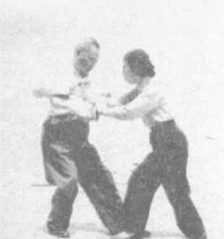
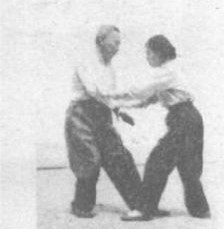
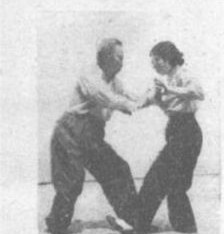
Elbowing (肘, zhǒu) means to drive the elbow against the opponent.
Leaning (靠, kào) means to press and lean against the opponent with the shoulder.
The footwork of the great roll-back is a wide and swift stride; only when the two legs have skill can one be nimble and changeable.
4. The Use of Force and the Listening to Force in Push-Hands (推手的用劲和听劲, Tuī Shǒu de Yòng Jìn hé Tīng Jìn)
In beginning push-hands one must not use clumsy strength, but must seek out the secret within the four words warding-off, rolling-back, pressing and pushing; these four words contain infinite transformations, and the student must experience them deeply.
For example: warding-off has the distinctions of straight warding-off and lateral warding-off, above and below. In rolling back one must stick to the opponent's hand, then immediately change direction and trace a circle, so that the opponent's force cannot issue forth, or if it issues forth is at once dissolved.
Warding-off is divided into upward, downward and level warding-off. In thrusting, one hand must press and hold the opponent's wrist and the other hand press the opponent's elbow, so that the opponent has no room to move and is thrust out along the line of his own force. Again, within the thrust there is also a warding-off force, which should not be used lightly.
Pressing has various methods: straight pressing, slanting pressing, and pressing with the addition of the elbow. If one presses with the arm along a curve, one can change the point of force at any moment and with any configuration, and force may be issued from any place.
Pushing includes lightness and nimbleness or heaviness and solidity, left solid and right empty or right solid and left empty, the two hands opening or closing; in sum, one must change according to the configuration.
When two people drill push-hands together, besides attending to experiencing the methods of using force, one must accomplish bending and extending in accord with the other, neither losing contact nor resisting, not using clumsy strength, calming the mind and listening to force. In time, one can lead the opponent in to fall into emptiness and move a thousand catties with a pull of four ounces.
As for "listening to force" (听劲, tīng jìn), one must on no account mistake it for two parties opposing each other with strength. One commonly sees, in push-hands, two people locking strength against each other, one asking whether the other has force yet, the other answering that he has or has not — this is a great error. "Listening to force" is to sense the magnitude and direction of the opponent's applied force and so change at once; one must on no account lock against it. In beginning practice, train the two arms first; with long practice the whole body can sense it. If one can listen to force, then when the opponent issues force one can dissolve it and make him fall into emptiness. If one cannot listen to force, one need not measure oneself against others; the student must certainly attend to this.
Phần 10
2. The Martial Application of Taijiquan (太极拳技击, Tàijíquán Jì Jī)
The martial application of Taijiquan is nothing other than the eight methods: warding-off, rolling-back, pressing, pushing, plucking, rending, elbowing and leaning. These eight methods are all contained within the Taijiquan form; push-hands is the practising of these eight methods for use. At present, whether one practises the form or practises push-hands, both are the familiarising of these eight methods, and so it is said that the eight methods are the application of Taijiquan. But to practise the form alone is to have substance without application, and its defect lies in having no change. To practise push-hands alone is to have application without substance, and its defect lies in having no root. If one practises only for the cultivation of body and mind, then practising the form is already sufficient; but if one wishes to obtain its application, one must practise both.
In terms of practising substance, Taijiquan is the art of knowing oneself (知己功夫, zhī jǐ gōng fu); only after long and thoroughly proficient practice can one make the whole body insubstantial and numinous, round and lively without obstruction, heavy and still as Mount Tai, light and nimble as a feather, with spirit (神, shén) and vital energy (气, qì) blended and fused, whereby one may of oneself dispel illness and prolong life. In terms of practising application, it is the art of knowing others (知人功夫, zhī rén gōng fu); only after long practice with pure skill can the hands and feet be nimble and alive, leading the opponent in to fall into emptiness and moving a thousand catties with a pull of four ounces. Hence only by practising both substance and application does one come to know oneself and know others; if one cannot know oneself and know others, one cannot measure oneself against others. One commonly sees those who claim to study only "martial application": using force for the sake of using force, they must apply clumsy strength, and so enter a wrong road. The student is asked to guard against this.
To become proficient in the martial application of Taijiquan, one should take the practice of the form as the main thing and seek skill from the waist and legs. For martial application first demands quick reaction; to react quickly one must have each single hand and each single posture thoroughly proficient, with waist and legs nimble and strong, before one can respond to the opponent with lightness, nimbleness, roundness and liveliness. Further, one must be able to "listen to force", for only thus can one stick to the opponent, respond to the moment and adapt, hear one and know a hundred, and change without limit.
In Part One the methods of use of some of the postures have been outlined, but the student must not memorise them by rote and rigidly. One should make the form proficient and practise push-hands diligently. In beginning the static-step push-hands, the work lies mainly in the waist; when the waist is extremely nimble, one has more than enough for dissolving the opponent's force. Once proficient, one practises the moving-step push-hands, where the work lies mainly in the legs; when the skill is pure, one advances, retreats and changes direction swiftly. Thereafter one goes through the four corners, and after that the free hand (散手, sàn shǒu). The two parties may then disregard the rules and attack and dissolve at will, each against the other.
In sum, the martial application of Taijiquan — that is, free hand — has no fixed rule or method, but changes at any time and in any configuration as the opportunity arises; this is the meaning of the saying that free hand has no fixed forms. A single posture in the art may be used in several ways, and several postures may be used as one, but one must always weigh the time and gauge the configuration before acting. Exactly as the classic says, "When the other does not move, "I do not move; if the opponent moves, I move first." This is what is meant by "the intent (意, yì) precedes the enemy." That is to say: however fierce and swift the opponent's action, one can dissolve it and turn it to one's own use. One must not wait for the opponent's technique to land upon one's own body; nor may one always use a single technique, for without change one is controlled by others. It is hoped that the student will draw inferences from one instance to three, know the applications without being bound by the applications, and diligently practise push-hands; then one may attain the mystery of Taijiquan as a fighting art. Appendix: Reference Materials I. Wang Zongyue: A Treatise on Taijiquan Taiji (太极, Tàijí) is born of Wuji (无极, Wújí); it is the mechanism of movement and stillness, the mother of yin and yang (阴阳, yīn yáng). When moved, they separate; when still, they unite. Neither excess nor deficiency — follow the bend and yield the extension. When the opponent is hard and I am soft, this is called "yielding" (走); when I am favourable and the opponent adverse, this is called "sticking" (黏). If he moves quickly, respond quickly; if he moves slowly, follow slowly. Though the transformations are countless, the principle is one throughout. From familiarity with the techniques one gradually awakens to "understanding energy" (懂劲, dǒng jìn); from understanding energy one ascends step by step to spiritual clarity (神明, shén míng). Yet without long effort one cannot suddenly penetrate it. With an insubstantial and numinous uplifting of the crown (虚灵顶劲, xū líng dǐng jìn), the qi (气) sinks to the elixir field (丹田, dāntián). Neither leaning nor inclining, now hidden, now appearing. Where the left is heavy, the left is made empty; where the right is heavy, the right is made obscure. Raise it and it becomes higher still; lower it and it becomes deeper still. Advance upon it and it grows longer; retreat from it and it grows more urgent. Not a feather may be added, not a fly may alight. Others do not know me; I alone know others. The hero who meets no match wherever he turns attains this through nothing else. There are many side doors to this art; though the postures differ, they come to no more than the strong bullying the weak and the slow yielding to the fast. Strength beating weakness, a slow hand yielding to a fast hand — all of these are inborn natural abilities, and have nothing to do with what is achieved by study. Consider the saying "four ounces deflect a thousand catties": it is plain that this is not a victory of force. Observe the form whereby the aged can hold off a crowd: what can speed do there? Stand like a balance, move like a wheel. Lean to one side and you follow; double-weight (双重, shuāng zhòng) and you stagnate. One often sees those whose pure effort of many years cannot transform — all are controlled by others and in the end cannot control others; this is simply that the fault of double-weighting has not been understood. To avoid this fault one must know yin and yang. Sticking is yielding, and yielding is sticking. Yin does not depart from yang, yang does not depart from yin; only when yin and yang aid each other is there understanding of energy. After understanding energy, the more one practises the finer one becomes; silently recognizing and pondering, one gradually arrives at "doing as the heart desires." The root is to "give up oneself and follow others" (舍己从人, shě jǐ cóng rén); most mistake it by giving up the near to seek the far. As it is said, "a hairsbreadth's difference, and the error is a thousand li" — the student must not fail to examine this with care.
Long Boxing (长拳, cháng quán) is like the great Yangtze and Yellow Rivers, flowing on without cease. The Thirteen Postures (十三势, shísān shì) are: warding-off (掤, bēng), roll-back (捋, lǚ), press (挤, jǐ), push (按, àn), pluck (采, cǎi), rend (挒, liè), elbow (肘, zhǒu), lean (靠, kào) — these are the eight trigrams; and advancing step, retreating step, leftward looking, rightward glancing and central equilibrium — these are the five phases. Taken together they make the Thirteen Postures. Warding-off, roll-back, press and push correspond to Kan, Li, Zhen and Dui — the four cardinal directions; pluck, rend, elbow and lean correspond to Qian, Gen, Xun and Kun — the four diagonal corners; advance, retreat, look, glance and settle correspond to metal, wood, water, fire and earth.
II. Wu Yuxiang: A Treatise on Taijiquan Before heaven and earth existed, within the infinite void, there was one undifferentiated qi — this is Wuji, and Wuji gives rise to Taiji. Taiji is the root of heaven and earth, the origin of all things. In Taijiquan, as soon as there is the slightest movement, the whole body must be light and nimble, and above all threaded through. The qi should be stirred and agitated; the spirit (神, shén) should be gathered inward. Let there be no place of defect, no place of bulge or hollow, no place of break or interruption. The root is in the feet, issued through the legs, commanded by the waist (腰, yāo), and expressed in the fingers. From foot to leg to waist, there must always be one complete qi. Only then, advancing and retreating, can one seize the moment and the configuration. If there is any place where one fails to seize the moment and configuration, the body becomes scattered. The fault for this must be sought in the waist and legs. This holds above and below, before and behind, left and right. All of this lies in the intent (意), not outside but within. Where there is above there is below; where there is front there is back; where there is left there is right — if the intent is to rise, then a downward intent is lodged within it. It is like lifting up an object while adding to it the intent of filing it down. Then its root is severed of itself, and one may push it and hasten it without obstruction. Empty and full (虚实, xū shí) must be clearly distinguished. Each place has its own empty and full; every place is altogether this one empty and full. The whole body is threaded joint by joint, with not the slightest hair's-breadth of interruption permitted. (Original note: these were the bequeathed teachings of the venerated Master Zhang Sanfeng of Wudang Mountain, wishing that heroes under heaven might prolong their years and increase their longevity, and not merely make of it the least of the martial arts.)
III. An Explanation of the Heart of Practice in the Thirteen Postures Use the heart to move the qi (以心行气, yǐ xīn xíng qì); one must make it sink and settle, for only then can it be gathered and drawn into the bones. Use the qi to move the body; one must make it smooth and compliant, for only then can it be convenient and follow the heart. If the spirit of vitality can be raised, there is no fear of sluggishness and heaviness — this is what is called the suspended crown (顶头悬, dǐng tóu xuán). The intent and the qi must be changed with nimbleness, for only then is there the delight of roundness and liveliness — this is what is called the transformation of empty and full. In issuing energy (发劲, fā jìn) one must sink and settle, be relaxed and still, and concentrate upon one direction. In standing the body one must be centred, upright, at ease and comfortable, supporting the eight directions; in moving the qi, be like a pearl of nine turnings, with no minute place unreached; in moving, be like steel a hundred times refined, with no hardness it cannot break. In form, like a falcon striking a rabbit; in spirit, like a cat catching a mouse. Still, like a mountain; moving, like a river. Storing energy (蓄劲, is like drawing a bow; issuing energy is like loosing an arrow. Seek the straight within the curved; store and then issue. Force issues from the spine (脊, jǐ); the step changes with the body. Gathering is issuing, and issuing is gathering; broken and then reconnected, going and returning must have folding, advancing and retreating must have conversion. Utterly soft, and thereafter utterly hard; able to breathe, and thereafter able to be nimble. The qi is nourished by straightness and so does no harm; energy is stored by curving and so has surplus. The heart is the command, the qi the banner, the waist the great standard. First seek expansion, then seek compactness, and only then does one arrive at fine closeness.
It is also said: first in the heart, afterward in the body; the belly is relaxed and clean, the qi is gathered into the marrow of the bones. The spirit at ease, the body still — this must be in the heart at every moment. Remember firmly: when one thing moves, there is nothing that does not move; when one thing is still, there is nothing that is not still. In pulling and moving to and fro, the qi clings to the back and is gathered into the spinal bones. Inwardly consolidate the spirit; outwardly show ease and rest. Step like a cat walking; move energy like drawing silk. In the whole body the intent lies in the spirit, not in the qi; to be in the qi is to stagnate. Where there is qi it drags force along; where there is no qi it is purely hard — qi is like the wheel, the waist is like the axle.
IV. Verse of the Thirteen Postures Do not lightly regard the thirteen general postures; The source of life and intent lies in the hollow of the waist. In changing and turning empty and full, take care; Let the qi pervade the body without the least stagnation. In stillness, touched, one moves, yet moving is still as before; Changing according to the opponent, one shows the marvellous. In every posture keep the heart, weigh and use intent; What is attained is won without noticing the effort spent. At every moment keep the heart upon the waist; Within the belly, relaxed and clean, the qi rises up. With the tailbone centred, the spirit runs through the crown; The whole body light and nimble, the crown suspended. Attend with care and seek it out in push-hands; Bending and extending, opening and closing, follow what is natural. To enter the gate and find the road, an oral transmission is needed; The exercise never ceases, and the method is self-cultivated. If you ask what standard governs substance and function: Intent and qi are the ruler, bone and flesh the minister. Consider what the use of intent finally comes to — Prolonging life and lengthening years, a spring that does not age. Sing it, sing it — a hundred and forty words; Every word is true and exact, the meaning leaves nothing out. If you do not seek it out in this direction, Your effort is wasted, and you will be left lamenting.
V. Verse of Push-Hands Warding-off, roll-back, press and push must be taken in earnest; Above and below following one another, the opponent finds it hard to enter. Let him come at me with giant force; A pull of four ounces deflects a thousand catties. Draw him in to fall into emptiness, and issue as he closes; Stick, connect, continue, follow — neither losing contact nor butting.
VI. Li Yiyu: The Five-Word Formula Stillness of Heart If the heart is not still, it is not single-minded: as soon as one raises a hand, front and back, left and right, there is no fixed direction at all — hence the need for stillness of heart. At first one's movements cannot be governed by oneself; one must calm the heart and experience it in the body, moving as the other moves, following the bend and yielding the extension, neither losing contact nor butting, and not shortening or lengthening of oneself. If he has force, I also have force, and my force is first; if he has no force, I also have force, and my intent is still first. One must keep watch at every moment: wherever contact is made, the heart must be applied there, and one must seek the news within "neither losing contact nor butting." Working on from this, with days and months accumulated, one can then apply it in the body; this is entirely the use of intent, not the use of strength, and in time others are controlled by me, and I am not controlled by others.
Nimbleness of Body If the body is sluggish, one cannot advance and retreat freely — hence the need for nimbleness of body. In raising a hand there must be no appearance of dullness; no sooner does his force begin to intrude upon my skin than my intent has already entered into his bones. The two hands prop each other up, one qi threaded through. When the left is heavy, the left is made empty, and the right has already gone; when the right is heavy, the right is made empty, and the left has already gone. The qi is like a wheel, and the whole body must follow along with it. Where there is any place that does not follow, the body becomes scattered and loses its power; the fault is to be sought in the waist and legs. First use the heart to command the body, following others and not oneself; afterward bring the body to follow the heart, so that although from oneself it still follows others. From oneself, one stagnates; following others, one lives. If one can follow others, the hands have measure. Measure the size of his energy, and not a fraction is mistaken; weigh the length of his coming, and not a hair's-breadth is off. Advancing and retreating, every place fits exactly. The longer the practice, the finer the skill.
Gathering of Qi If the qi's force is scattered and diffuse, there is no containment; the body is easily disordered — one must make the qi gather into the spinal bones. Breathing becomes penetrating and numinous, with no gap anywhere in the body. The in-breath is closing (合, hé) and storing (蓄, xù); the out-breath is opening (开, kāi) and issuing (发, fā). For the in-breath can naturally lift up, and can also lift a person up; the out-breath can naturally sink down, and can also send a person out. This is to move the qi by intent, not to move the qi by strength.
Whole Energy The energy of the whole body is trained into a single family. Distinguish clearly between empty and full, and the issuing of energy must have a root. Energy rises from the heels, is governed at the waist, takes form in the fingers, and issues from the spine. Further, one must raise up the whole of one's spirit: at the moment when his energy is about to come out but has not yet issued, my energy has already joined his energy, exactly neither after nor before — like skin catching fire, like a spring gushing forth. Advancing and retreating, there is not the slightest scattering or disorder. Seek the straight within the curved; store and then issue — only thus does it take effect as the hand moves. This is called borrowing force to strike the man, four ounces deflecting a thousand catties.
Gathering of Spirit When the preceding four are all complete, they return altogether to the gathering of spirit (神聚, shén jù). When the spirit is gathered, then the one qi is forged and smelted. Train the qi to return to the spirit, and the momentum of the qi shifts and manoeuvres. The spirit is poured in continuously; opening and closing have their proper order, and empty and full are clear. When the left is empty, the right is full; when the right is empty, the left is full. Empty is not being wholly without force — the momentum of the qi must be able to shift and manoeuvre. Full is not occupying everything to the death — the spirit must value continuous pouring in. The essential point lies entirely in the chest and the waist; the application is not on the outside. Force is borrowed from the other; qi issues from the spine. How can qi issue from the spine? The qi sinks downward, and from the two shoulders is gathered into the spinal bones and poured into the waist — this is the qi going from above to below, and is called closing (合, hé). From the waist it takes form in the spinal bones, spreads to the two arms, and is applied at the fingers — this is the qi going from below to above, and is called opening (开, kāi). Closing is gathering; opening is issuing. If one can understand opening and closing, one knows yin and yang. On reaching this stage, one day of practice brings one day of refinement in skill, until gradually one follows the heart's desire and nothing fails to accord with one's intent.
VII. Secret Formula of Release and Discharge The Four Words: Lifting, Drawing, Loosening, Releasing Lifting opens his energy and borrows his force — within it is the word ling (灵, numinous). Drawing him to the front of the body, his energy then begins to store — within it is the word lian (敛, gathering). Loosening my own energy, do not let it bend — within it is the word jing (静, stillness). At the release, the waist and feet must recognize the target — within it is the word zheng (整, wholeness).
VIII. Essential Words on Practising the Form and Practising the Hands The men of old said: if one can draw the other in to fall into emptiness, one can then four ounces deflect a thousand catties; if one cannot draw the other in to fall into emptiness, one cannot four ounces deflect a thousand catties. The saying is very summary; the beginner has no way to grasp it. I add several phrases to explain it, so that those who have the will for this art may have a point of entry, and so advance a little each day in achievement. If one wishes to draw [the other] in to fall into emptiness and four ounces deflect a thousand catties, one must first know oneself and know the other. If one wishes to know oneself and know the other, one must first give up oneself and follow the other. If one wishes to give up oneself and follow the other, one must first gain the opportunity and gain the position. If one wishes to gain the opportunity and gain the position, one must first make the whole body one family. If one wishes to make the whole body one family, one must first have no flaw anywhere in the whole body. If one wishes to have no flaw anywhere in the whole body, one must first have spirit and qi drumming and surging. If one wishes to have spirit and qi drumming and surging, one must first raise up the spirit. If one wishes to raise up the spirit, one must first keep the spirit from scattering outward. If one wishes to keep the spirit from scattering outward, one must first gather spirit and qi into the bones. If one wishes to gather spirit and qi into the bones, one must first have strength in the front section of the two legs. The two shoulders loosen and open, the qi sinks downward, energy rises from the heels, exchanges in the legs, is contained in the chest, moves in the two shoulders, and is governed in the waist; above it connects with the two arms, below it follows the two legs, and energy changes from within. Gathering is closing; issuing is opening. When still, all is still; stillness is closing, and within closing is lodged opening. When moving, all moves; movement is opening, and within opening is lodged closing. Touch it, and it revolves freely, with nothing that does not gain force — only then can one draw the other in to fall into emptiness and four ounces deflect a thousand catties. Practice of the form on ordinary days is the work of knowing oneself. At each movement one must first ask oneself whether the whole body accords with these several items. If it accords only slightly not, change it at once. This is why in practising the form one wants slowness, not speed. Push-hands is the work of knowing others; stillness and movement are indeed knowing others, yet it is still a question of asking oneself. If one has arranged oneself well, then when the other touches me, I do not move him the least bit, but enter along his tendency, join and fix his energy, and he falls out of himself. If one has a place where one does not gain force, that is double-weighting not yet transformed, and it must be sought in the opening and closing of yin and yang. This is what is called knowing oneself and knowing the other, and in a hundred battles a hundred victories. Cover design: Sun Jinrong, Zhou Menglin Responsible editor: Li Wenying Unified book number: 7015·2260 Price: 0.60 yuan