Wu/Hao-Style Taijiquan
Phần 1
A Short Account of Wu-Style Taijiquan
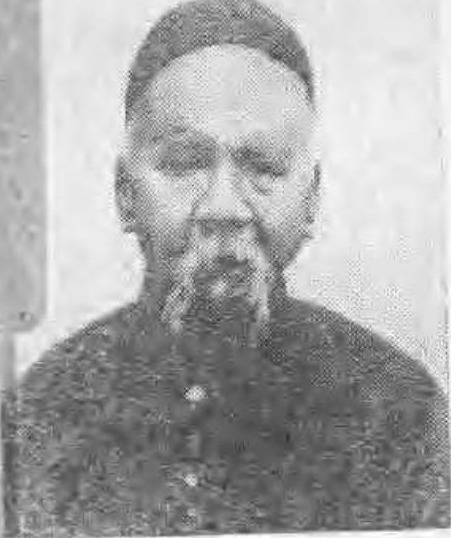
in a dark front-buttoned jacket.
Wǔ Héqīng (武河清) of Yongnian in Hebei, courtesy name Yǔxiāng (禹襄, 1812–1880), came from a minor official-landlord family, and he and his two brothers practised martial arts at home. When Yáng Lùchán (楊露禪, 1799–1872) returned to his native village from Chenjiagou, the Yǔxiāng brothers admired his art and studied the old-frame Chen family taijiquan with him, grasping its essentials. In 1852 Yǔxiāng's elder brother Chéngqīng (澄清, 1800–1884) passed the metropolitan civil-service examination and took office as magistrate of Wuyang county in Henan. Yǔxiāng travelled to his brother's post and, taking the route through Wen county, stopped at Chenjiagou intending to seek further instruction from Lùchán's teacher Chén Chángxīng (陳長興, 1771–1853). It happened that Chángxīng was already old and ill — he was then 82 and died the following year — and at the time Chén Qīngpíng (陳青萍) was teaching the new-frame Chen taijiquan at Zhaobao town; Yǔxiāng therefore studied the new frame with Qīngpíng for over a month, and came to know its theory and method thoroughly. At a salt shop in Wuyang, Chéngqīng obtained Wáng Zōngyuè's (王宗岳, a man of the Qianlong reign) Taijiquan Manual. Yǔxiāng studied the manual and gained further insight; drawing on his own experience of practising, he expounded the sense of Wang's old text, writing ten annotations to the Thirteen Postures Practice Song, under the title Essential Words on Pushing Words; he further expanded this into the Thirteen Postures Practice Heart-Explanation in four sections, and distilled the essentials of training into the Ten Requirements of Body Method. All his writings rest on his own experience, and are therefore concise and to the point, without a single ornamental phrase.
Yǔxiāng's nephew Lǐ Jīnglún (李經綸), courtesy name Yìshē (亦畬, 1832–1892), began studying with Yǔxiāng in 1853. In his own study of taijiquan Yìshē imitated Yǔxiāng's method of practical testing — summoning village braves to test his own skill — and revised his notes again and again. Yìshē's grandson Huáiyīn (槐蔭) wrote in the 1935 Li Lianrang-hall edition Preface to the Taijiquan Manual: "This manual was written by my grandfather in his later years, and was completed only after many revisions. Whenever he found a posture ingenious or a key point of a technique, he would write it on a slip of paper and paste it at his seat, testing and pondering it. After some days, if he felt something was not right and ought to be changed, he would tear it down and substitute another slip. This pasting and tearing went back and forth until it was perfect and only then stopped; in time the book was complete." Lǐ Yìshē's taijiquan essays comprise the Five-Character Formula; the Secret Formula of Release, with its four seven-character lines on bracing, drawing, reaching and releasing; and Essential Words for Practice in Walking the Frame and Pushing Hands, which sets out that walking the frame is pushing hands and pushing hands is walking the frame, and that form practice and pushing hands complete each other. In the spread of taijiquan in modern times, the greater part of the credit for ceaseless innovation in teaching materials and methods goes to three generations of the Yang family; but in the study and summation of the art's theory, the first place goes to Wu and Li. Compared with the abstract generality of Wang Zongyue's Taijiquan Treatise, theirs is far more concrete and practical — they inherit and they develop, and so were able to form a school of their own.
The Wu Yuxiang form differs both from the old and new Chen frames and from the Yang large and small frames; it studies them and transforms them, forming a school of its own. Its characteristics are: a compact posture; unhurried movement; a footwork method that strictly distinguishes substantial from insubstantial; and a chest and abdomen that, in advancing, retreating and rotating rotating, always keep upright and centred. The outer form is governed entirely by the inner conversion of substantial and insubstantial and by a "hidden turning of inner qi"; each hand governs half the body, without overstepping, and the hand does not extend past the toe. There were originally leaping movements as well, but by the fourth transmission, with Hǎo Yuèrú (郝月如, 1877–1935), these were changed to no jumping and no leaping; the double lotus-swing was likewise changed so that the foot is not slapped — reforms made to suit the needs of the old and the physically weak.
In Wu-style pushing hands the footwork is of one kind only: three and a half steps forward and three and a half steps back.
Yǔxiāng taught and read for his own pleasure, and Yìshē practised medicine for a living; both held themselves to be scholars, and accepted very few pupils in their home district. Among those Li transmitted it to, the most refined in skill was his fellow-townsman Hǎo Hé (郝和), courtesy name Wéizhēn (為真, 1849–1920). When Wu-style taijiquan first came to Beijing in the early Republic, some called it the Li frame; and when Wéizhēn's son Yuèrú and his grandson Shàorú went together to Nanjing and Shanghai in 1928 to teach, some called it the Hao frame. Yuèrú left behind several writings on taijiquan. Among the later generations of Wu and Li, few devoted themselves to taijiquan, and so Wu-style was passed on and practised by the Hao family. Shàorú had not taught for many years, until the Shanghai Municipal Gymnasium, in order to recover the tradition, opened a Wu-style taijiquan class in 1961 and invited Hǎo Shàorú to teach, so that it might be spread more widely. Wu-style taijiquan had never before appeared in illustrated form; the posture plates in this book were photographed from Hǎo Shàorú, who also wrote the movement explanations.
(Gù Liúxīn)
Phần 2
Foreword
I grew up in a family with a passion for taijiquan. Our native place is Yongnian county in Hebei. My grandfather's name was Hé, his courtesy name Wéizhēn. My father's name was Wénguì, his courtesy name Yuèrú. My grandfather learned taijiquan from our neighbour Mr Lǐ Yìshē (see note 1). Mr Li had been taught it by his maternal uncle, Mr Wǔ Yǔxiāng (see note 2). My grandfather studied with Mr Li for a long time, never interrupting for decades, right up to the time of Mr Li's death. Thus my grandfather came to possess deeply the subtleties of the Wu–Li school of taijiquan. While my grandfather was practising with Mr Li, my father was often at his side, because he was a pupil in Mr Li's traditional school. Through long observation and pondering, my father could already grasp the theory and practice of taijiquan before he came of age. From childhood I too, because of my surroundings, came early into contact with taijiquan. Afterwards, under my father's instruction, my love for it grew day by day, and by the age of fifteen I had formed the habit of practising every day.
Since Liberation, under the leadership and care of the Party, taijiquan has become a vigorous mass sport and one of the means of health care for the broad masses of the people. This has made me feel deeply that I ought to make public to the whole country the important taijiquan documents preserved in my family and the experience of three generations of my family in teaching taijiquan, and to take an active part in taijiquan research — so as to contribute my small strength to raising and developing this exceedingly precious part of our national cultural heritage. It was from this motive that I wrote this book in my spare time. In the course of writing it, Comrade Gù Liúxīn, director of the Shanghai Municipal Gymnasium, gave me powerful support: he not only read through the whole manuscript himself, but also selected a number of old martial manuals to append at the end of the book, and wrote the short account of Wu-style taijiquan. Comrade Zhōu Yuánlóng drew the diagrams on my behalf, and gave great assistance in the polishing of the text and in the arrangement. In addition, no few friends who love taijiquan took a great part in the work of compilation. Here I express my heartfelt thanks.
Because my own level is limited, shortcomings can hardly be avoided; I hope readers will not begrudge their corrections and criticism.
Hǎo Shàorú Shanghai, on the eve of National Day, 1961 (Note 1) Lǐ Jīnglún, courtesy name Yìshē, a native of Yongnian county, a Qing provincial graduate, born in the ninth month of the twelfth year of the Daoguang reign and died in the eleventh month of the eighteenth year of the Guangxu reign (1832–1892).
(Note 2) Wǔ Héqīng, courtesy name Yǔxiāng, a native of Yongnian county, a Qing county scholar, born in the second month of the seventeenth year of the Jiaqing reign and died in the eleventh month of the sixth year of the Guangxu reign (1812–1880).
Phần 3
Chapter One — The Essentials of Taijiquan
by Hǎo Yuèrú (1) The body methods of taijiquan are chiefly these thirteen: enclosing the chest, drawing up the back, wrapping the hips, guarding the ribs, lifting the crown, suspending the crotch, loosening the shoulders, sinking the elbows, soaring and shifting, flashing and battling, the tailbone held central and upright, qi sunk to the elixir field, and a clear distinction of substantial and insubstantial.
1. What is above the heart is the chest. The chest must not be puffed out; it must relax downward, with the two shoulders drawing slightly forward and together. This is called enclosing the chest (涵胸). Only when the chest can enclose can one move qi by the mind.
2. At the spine between the two shoulders there should be a sense of swelling up; the two shoulders must be lively. One must not bow the head. This is called drawing up the back (拔背).
3. The two knees exert force, with an intent of turning inward, so that the two legs are as one leg, and yet can divide substantial from insubstantial. This is called wrapping the hips (裹胯).
4. The two flanks draw in slightly, taking the posture of gathering below and closing in front, with a feeling of looseness and ease within. This is called guarding the ribs (護肫).
5. Head and neck are straight and correct, neither low nor raised; the spirit threads through to the crown, lifting up the whole body. This is called lifting the crown (提頂).
6. The two thighs exert force, the buttocks push forward, and the lower abdomen has a sense of turning upward. This is called suspending the crotch (吊襠).
7. By intent, loosen the two shoulders and let the qi sink down, adding the single word "stillness" within the intent. This is called loosening the shoulders (鬆肩).
8. Carry qi by intent so that it moves through the two elbows; the wrists must be able to stay lively, and the tips of the elbows should always have a sense of hanging downward. This is called sinking the elbows (沉肘).
9. To have the intent to move but not yet to have moved — that is, the posture of preparation to move — is called soaring and shifting (騰挪).
10. Body, hands, waist and legs follow one another in accord, completing in a single breath and issuing outward, the jin like a loosed arrow, swift as thunder, invincible wherever it goes. This is called flashing and battling (閃戰).
11. The two thighs are powerful, the buttocks draw forward, and the root of the spine lifts the elixir field (the lower abdomen) forward. This is called the tailbone held central and upright (尾閭正中).
12. If one can achieve the tailbone held central and upright, enclosing the chest, guarding the ribs, loosening the shoulders and suspending the crotch, then one can send qi by intent to reach the abdomen without letting it float upward. This is called qi sunk to the elixir field (氣沉丹田).
13. The substantial and insubstantial of the two legs must be clearly distinguished. The insubstantial is not entirely without force: the point where the foot is placed and made substantial must have the posture of soaring and shifting. Soaring and shifting means that foot and chest have the sense of drawing and binding to each other; otherwise one becomes sunk to one side. The substantial is not entirely dead-weighted: the spirit threads through the substantial thigh, which props up the whole body, and there must be a sense of lifting upward. If substantial and insubstantial are not distinguished, one falls into double weighting (雙重).
(2) Hand, eye, body, step, essence, qi, spirit The method of the hand requires that the momentum of the posture soar and shift, that there be a posture of preparation to move, and no sense of looseness or sprawl. The two shoulders must also be loosened, without the least force in them. Hand positions are in themselves not fixed: whether raised or lowered, extended or bent back, there must always be a corresponding intent — when the intent moves, the hand arrives. This is what is meant by "the hand responds as the mind directs". The posture of soaring and shifting is precisely "having intent", "carrying qi", and "concentrating the spirit". Carry qi by intent: in time one becomes refined; refined and more refined, one becomes spiritual; spiritual and more spiritual, one becomes numinous. Whoever grasps this principle will possess the wonder of spiritual clarity. The spirit gathers in the eyes; the eye is the sprout of the heart-mind. Intent is born in the heart: wherever my intent wishes to go, there the gaze shoots straight, and the whole body also faces straight there. When the eye turns, the whole body turns. Regard stillness as movement and movement as stillness — always it must come from the gathering of the spirit.
In the body method, first seek "the tailbone held central and upright". Central and upright means "the root of the spine pointing forward". One must also guard the ribs: if the ribs are not guarded, the tail cannot stand firm, and the whole body has no governing principle. Wherever my intent wishes to go, there the "root of the spine" faces straight. The turning takes place in the two eye-of-the-waist points: turning left, the left waist-eye draws slightly upward and the right waist-eye lifts up the left; turning right, the right waist-eye draws slightly upward and the left waist-eye lifts up the right — and then the tailbone is naturally central and upright. In sum, each item of the body method must be matched one by one; joined together they are a single body method. If one place does not accord, the whole body goes awry — and so the body method may never be wrong. Though there be a thousand changes and ten thousand transformations, one can never step outside this body method.
As for the footwork distinction of substantial and insubstantial: the insubstantial is not entirely without force — within it there must be soaring and shifting; the substantial is not entirely dead-weighted — the spirit must be concentrated through it. Soaring and shifting is called the insubstantial, and within the insubstantial there is the substantial; the spirit is called the substantial, and within the substantial there is the insubstantial. Insubstantial within substantial and substantial within insubstantial, substantial within insubstantial and insubstantial within substantial — this is the meaning.
(3) Rise, carry, open, close In walking the taijiquan frame, each posture is divided into four movements. The first movement is rise (起) — as in the first movement of "left lazy tucking the robe". The second is carry (承) — as in the second movement of that posture. The third is open (開), which is also issuing — as in the third movement. The fourth is close (合), which is also gathering; gathering means storing — as in the fourth movement. But it is not rigid: there is opening within closing and closing upon closing. This is what is meant by neither losing nor resisting, every point exactly matching.
(4) Folding and conversion Taijiquan has the art of folding and the method of conversion. Folding is mutual correspondence: where there is up there is down; where there is forward there is back; where there is left there is right. If the intent is to go up, then lodge a downward intent within it; if the intent is to go down, then lodge an upward intent within it. Forward and back, left and right, are all like this. This is what is called folding. Conversion means the step changes with the body; the source of the commanding intent lies between the waist-eyes. Converting to the left, the left waist-eye draws slightly upward and the right waist-eye lifts up the left; converting to the right, the right waist-eye draws slightly upward and the left waist-eye lifts up the right. This is what is meant by "the source of the commanding intent lies in the waist crevice".
(5) Yielding self to follow others Taijiquan has the art of yielding self to follow others: wherever one is touched, there one is lively. If touched at the hand, the wrist is lively; if touched at the elbow, the elbow can be lively; if touched at the chest, the chest can be lively — and everywhere on the body likewise. Again, touched at the hand, the intent is at the elbow; touched at the elbow, the intent is at the shoulder; touched at the shoulder, the intent is at the chest; touched at the chest, the intent is at the waist; touched at the waist, the intent is at the thigh. Extend this: adhere, connect, stick and follow; neither lose nor resist; draw in and make empty; borrow force to send the other out — all are this same meaning.
Phần 4
Walking the Frame and Pushing Hands in Taijiquan
by Hǎo Yuèrú Taijiquan lies not in the form but in the momentum; not in the outer but in the inner. In daily practice of walking the frame, one must study and ponder the way of emptiness, looseness, roundness and liveliness; the spirit and qi must drum and surge; the whole body is like a balloon; the momentum values soaring and shifting; the body is as if suspended in the air. The two hands, whether high or low, bent or extended, one forward one back, one left one right, can all be lively and free. The two legs, whether advancing or retreating, turning left or right, changing substantial and insubstantial, all follow the wish of the intent. With time and deep practice, one reaches the state of not knowing that the hands dance and the feet stamp. When one understands the principle, practises the body method until familiar, is good at using intent and skilful at carrying qi, then at this stage every single movement accords with measure — there is no such thing as wrong.
The student of taijiquan must first seek the tailbone held central and upright. Central and upright means the root of the spine facing between the eyes. Stepping to the left, the left hip draws slightly upward to the left and the right hip lifts up the left; stepping to the right, the right hip draws slightly upward to the right and the left hip lifts up the right — and then the tailbone is naturally central and upright. Being central and upright, one can prop up in all eight directions; propping up in all eight directions, one can rotate freely, and there is nothing to be gained. Next, the footwork's substantial and insubstantial must be clearly distinguished. The insubstantial is not entirely without force — within it there must be soaring and shifting, that is, the posture of preparation to move. The substantial is not entirely dead-weighted — within it the spirit must be concentrated through, that is, the sense of lifting upward. Bear firmly in mind that when the two feet are in front-bow and rear-press, they must not be entirely dead-weighted: one must be insubstantial and one substantial, otherwise one falls into the fault of double weighting. The two shoulders must be loosened, without the least force: with force one cannot yield self to follow others and draw in to make empty. Sinking the elbows means the tips of the elbows always have a downward-sinking intent. The forearms and the two thighs must have within them the posture of soaring and shifting; without soaring and shifting they are not lively, and without liveliness there is no delight of roundness and life. One must also guard the ribs: if the ribs are not guarded, the tail cannot stand firm, and the whole body has no governing principle. One must also nourish qi: qi is nourished straight and without harm — that is, sinking into the elixir field and cultivating it without injury. One must also store jin: jin is stored by bending, with surplus, and must be gathered and concealed within the spine. Inhaling is closing and storing; exhaling is opening and issuing. For in inhaling one can naturally lift up — and can lift another up too; in exhaling one can naturally sink down — and can send another out. This is carrying qi by intent, not compelling qi by force, and it is the way of breathing in taijiquan. (The "breathing" spoken of here refers specifically to the taijiquan "open, close, store, issue" and differs from our ordinary breathing; readers should not mistake it.)
The art of taijiquan is exceedingly subtle and ingenious; it does not rely on great strength or quick hands. Great strength and quick hands are bestowed by nature at birth — what need is there to learn them? Therefore one who wishes to learn this art should first seek it through enclosing the chest, drawing up the back, wrapping the hips, guarding the ribs, lifting the crown, suspending the crotch, loosening the shoulders, sinking the elbows and clearly distinguishing substantial and insubstantial. When these are right, then seek to gather qi: qi is gathered in the spine and pours into the waist. Then seek soaring and shifting. Soaring and shifting is essence, qi and spirit. Essence, qi and spirit are concentrated through the two feet, the two legs, the two hands and the front sections of the two forearms. Wherever the other touches me, there I direct my attention; on the whole body there is not one inch without essence, qi and spirit, not one inch that is not taiji. Only then seek the method of advancing, retreating and rotating. The pivot of rotation lies in the waist crevice. When one can rotate freely without the least disorder, then seek the art of movement and stillness: stillness is nothingness, and from nothingness is born being — that is, intent. Intent has no fixed direction; it must prop up in all eight directions. In solo practice, each posture divides into four words — rise, carry, open, close. After each word, ask: can I prop up in all eight directions? If I cannot prop up in all eight directions, then ponder it at once. If two people In pushing hands my intent must come first. Though the other's hand be quick, it is no match for my intent coming first; though the other's strength be great, it is no match for my qi gathered in. If he strikes with immense force, I meet it with intent, touching only the skin or hair without letting it land, borrowing his force and taking advantage of his momentum — whichever of the eight directions is favourable, there I strike. Bear firmly in mind: do not use force, do not prize breath-force, do not resist, do not lose. One must follow the other and yet still be led by oneself; only having gained the moment and the momentum can one act effectively at will. Movement likewise is intent: the step moves but the body method is not disordered; the hand moves but the momentum is not scattered. In solo practice, at every movement ask: can I convert in all eight directions out of the movement? If I cannot convert in all eight directions, then ponder it at once. In two-person pushing hands, if I wish to go to him, first arrange the whole body well, keep the intent still ahead, fix upon his key point, and go straight at it. The moment my intent touches his skin or hair, if it can respond, one exhale and out he goes. If his force comes resisting and I do not let his force be issued, my intent still borrows his force — neither losing nor resisting — and strikes along his force. This is the marvel of borrowing force to strike, of four ounces deflecting a thousand catties. All of this is carrying qi by intent, not compelling qi by force. When one can strike by intent, in time even intent is not used, and the body method has nothing that does not accord. At this stage one has reached the realm of round harmony and subtle excellence. Say it is, and it is; say it is not, and it is not — every single movement follows the heart's desire. Truly one no longer knows that the hands dance and the feet stamp.
The student of taijiquan must comprehend the principle of taiji. To know the principle of taiji, one must first raise the whole spirit in practice, outwardly showing ease and composure, inwardly consolidating the spirit, with the momentum soaring and shifting and the abdomen drumming and surging. Taiji is the whole body, and the whole body is taiji. Like a balloon: advancing it does not bulge, retreating it does not cave, turning left it is not deficient, turning right it does not collapse — myriad changes, with no interruption whatsoever, completed in a single breath, without outer or inner, form and spirit both forgotten. Only then can one advance into the subtle and refined.
In pushing hands, my intent must be first. Wherever his force touches me, there my intent is employed. The moment his force touches my skin or hair, my intent has already entered his bones. I meet his force with my intent, not with my force colliding against his; exactly neither after nor before, my intent joins with his force. If the left is heavy, then the left is made empty; if the right is heavy, then the right is made void. Raise it and it grows higher; lower it and it grows deeper; advance it and it grows longer; retreat and it grows more pressing. Not a feather can be added, not a fly or insect can alight. Others do not know me, I alone know others. This is what is meant by adhering, connecting, sticking and following; neither losing nor resisting. The student of taijiquan must comprehend the meaning of yin and yang completing each other. In movement they divide; in stillness they join. Dividing is opening wide; joining is contracting small — and in both, the two qi of yin and yang open and close, convert, and answer each other, never parting from start to finish. Opening is largeness, not colliding; contracting is smallness, not dodging. In one movement there is no part that does not move; in one stillness there is no part that is not still. Movement is the turning of qi; stillness is the posture of preparation to move — this is what is meant by regarding stillness as movement and movement as stillness. Qi is like a cartwheel, the waist like the axle. It is not a matter of the two hands flailing and the body shifting about at random. The crux lies entirely in storing jin: storing jin is like drawing a bow, issuing jin like loosing an arrow. Without storing jin there is no force to loose the arrow. In issuing jin, upper and lower must follow one another; jin rises from the heel of the foot, pours into the waist, and takes form at the fingers. From foot to leg to waist, it must always be one whole qi. The waist is like the grip of the bow, the feet and hands like its tips; within there must be elasticity, and only then is there force to loose the arrow. Arrange oneself well: the moment he touches my skin or hair, my intent fixes upon his jin. To touch skin or hair is neither to lose nor to resist; to meet it with intent is the posture of following along. Being able to follow along, one can borrow force; being able to borrow force, one can strike — this is what is meant by borrowing force to strike, four ounces deflecting a thousand catties. At this stage the hand has measure: it can weigh the size of his jin, can gauge the length of his advance, without the least error. Advancing and retreating, looking left and right, everywhere exactly matching — this is what is meant by "know yourself and know the other, and in a hundred battles you will win a hundred". In daily walking of the frame and pushing hands, one must proceed from this: walking the frame is pushing hands, and pushing hands is walking the frame — the same principle throughout. In walking the frame, each posture must divide into four words: rise, carry, open, close. After each word ask: is it right? If slightly not right, change it at once. A hair's difference loses a thousand li. One who can grasp this meaning will find that walking, standing, sitting and lying are all taiji; the student must not fail to examine this minutely.
In daily practice of walking the frame, one must by intent sink the qi down and deliver it to the elixir field (by intent, not by force; not by straining qi, not by using breath), keeping and nourishing it, not letting it float up, with the abdomen loose and still and the momentum soaring. Practising according to the method, in time one can naturally gather qi into the bone (the spine). Then, by intent, turn the qi of the spine upward from the tailbone through the elixir field. Reaching this stage, one can carry qi by intent throughout the whole body. Wherever he touches me, there my intent arrives, and the qi likewise comes out after it, as echo answers sound, swift as lightning. There is no place on the whole body where it is not so. This is what is meant by "carrying qi as through nine winding pearls, reaching the smallest place; issuing jin like steel refined a hundred times, nothing so hard it cannot break" — and likewise "where intent arrives, qi arrives". Moreover the qi of the elixir field must be nourished straight and without harm, and only then can it be like the water of the long river and the great sea, inexhaustible in use, unfailing in supply. When the practice is mature and one has refined the whole body into a single family, just like a balloon — left heavy then left empty, right heavy then right void — things come and one responds, and nothing fails to match. All of this is "carrying qi by intent", not "compelling qi by force", "within and not without" — that is, "he who prizes breath-force has no force; he who nourishes qi is purely firm".
Note: "Pushing hands" in this text means taijiquan pushing hands. The text was slightly abridged and revised when published here.
Phần 5
Some Reflections on Teaching and Practice
Hǎo Shàorú Drawing on more than thirty years of practising and teaching, I hold that whether teaching or practising, one must first of all fix one's eyes on the body method — the eight body methods of Wǔ Yǔxiāng — and must proceed from the inner outward.
The body method is one of the principal contents of taijiquan theory. In both teaching and practice, the body method is at once the most basic and, from first to last, the most important. Therefore the body method must be required strictly.
In practising taijiquan, to say nothing of reaching refined skill, even basic skill cannot be attained in a single step. Therefore in teaching or practising, one must broadly divide the work into two stages.
The first stage is the practice of the outer form: that is, learning the frame, with attention to the body method. But the eight body methods cannot all be grasped at once. One must first choose one or two as the emphasis emphasis, and after these are mastered, gradually add more. The coordination of the upper and lower limbs with the body method is also extremely important, because poor coordination will directly affect the body method. Coordination of the upper limbs is comparatively easy to master; but the lower limbs, since they must both support the body's stability and attend to distinguishing substantial from insubstantial, are more difficult for beginners. Only when these eight body methods are mastered can the muscles and bones of the whole body be lively and harmonious, with movements unified, and only then can one reach the stage of following the heart's desire.
The second stage is the practice of the inner form, also called inner jin. One must first take the practice of intent as one's guide, and gradually refine intent, qi and frame into one. From outer form to inner form, from coarse qi to refined qi. Then there is no outer and no inner, no coarse and no refined, all in a great oblivion. Only when practice reaches this stage can one climb the high peak of taijiquan art along a road of ceaseless advance. As for those who taste but briefly and stop, or who set up novelties out of thin air, they are not worth taking as models.
Phần 6
Explanation of the Sequence Diagrams
All the movements of Wu-style taijiquan are arranged according to the sequence of rise, carry, open, close. Four movements make up one sequence of rise, carry, open, close. For example, the four movements of the second posture, "left lazy tucking the robe", are the four diagrams in the sequence diagrams: Figure 1 is "rise", Figure 2 is "carry", Figure 3 is "open", Figure 4 is "close" — joined into one sequence. The entire set is arranged as sequences joined one to the next. Between one sequence and the next, though there appears to be a pause, one must keep the jin broken but the intent unbroken, and internally the sequences must still join in an unbroken thread — and so in practice one must not break off because of the sequence divisions.
A sequence is mostly formed from a single posture, as with the "left lazy tucking the robe" cited above, which has four movements and makes one sequence. But there are also cases where two, or even four or five postures combine into one sequence — for example the fourth posture, "single whip", and the fifth, "raise the hand", whose two postures are joined together as four movements into one sequence.
Phần 7
Examples of the Sequence Diagrams
Second posture — Left Lazy Tucking the Robe Figure: rise (图 起)
(Labels in the diagram, from the head downward:)
- 虛領 — empty the collar
- (吸) 拔 — (inhaling) draw up
- 鬆 — loose
- 沉直 — sinking and straight
- 騰挪 — soaring and shifting
- 曲 — bent
- 精神貫注 — spirit concentrated
- 實 — substantial
(On the right, top to bottom): 鬆 loose · 斂氣 gather qi · 沉 sink · 騰挪 soaring and shifting · 沉 sink · 吊襠 suspend the crotch · 曲 bent · 騰挪 soaring and shifting · 虛 insubstantial (Below the figure): facing due south (Bottom right): compass diagram — north (top), south (bottom), east (right), west (left)
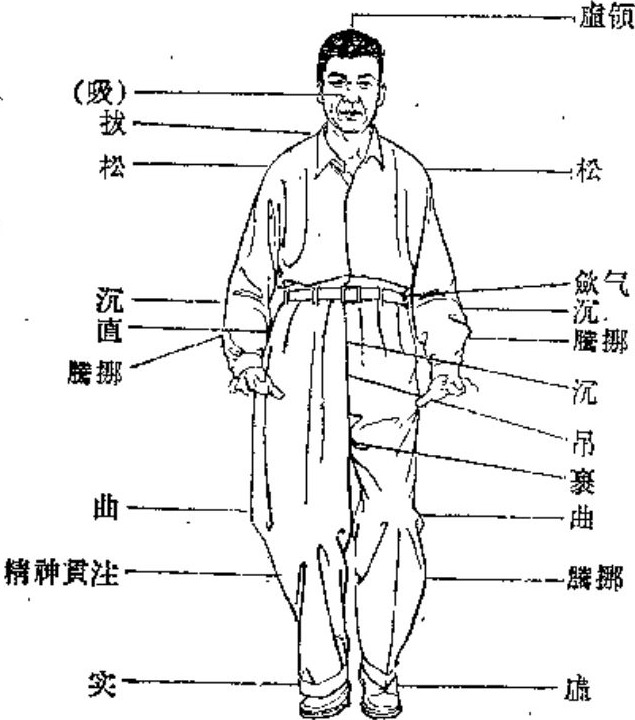
both arms hanging naturally at the sides, the feet parallel and apart at shoulder width.
Leader lines mark the requirements at each part of the body: at the head "emptying the
collar"; at the shoulders "loose"; at the chest "enclosing the chest and drawing up the
back"; at the waist "sinking and straight"; at the hips "soaring and shifting"; at the knees
"bent"; at the feet "substantial"; with "spirit concentrated" also noted. A second group of
leader lines on the right labels "loose", "gather qi", "sink", "soaring and shifting",
"sink", "suspend the crotch", "bent", "soaring and shifting" and "insubstantial". Below the
figure it is noted "facing due south"; at the lower right is a compass diagram — north at
the top, south at the bottom, east at the right, west at the left.
Figure 2 — carry (图 2 承)
(Labels on the left, top to bottom): 虛領 empty the collar · (吸) 拔 (inhaling) draw up · 鬆 loose · 騰挪 soaring and shifting · 沉 sink · 直 straight · 曲 bent · 精神貫注 spirit concentrated · 實 substantial (Labels on the right, top to bottom): 鬆 loose · 意向上開 intent opening upward · 騰挪 soaring and shifting · 沉 sink · 意向上開 intent opening upward · 斂氣 gather qi · 沉 sink · 吊 suspend · 裹 wrap · 曲 bent · 騰挪 soaring and shifting · 虛 insubstantial (Below the figure): facing south-east; the left foot set out toward the south-east; the left hip drawn back; the tailbone must be central and upright.
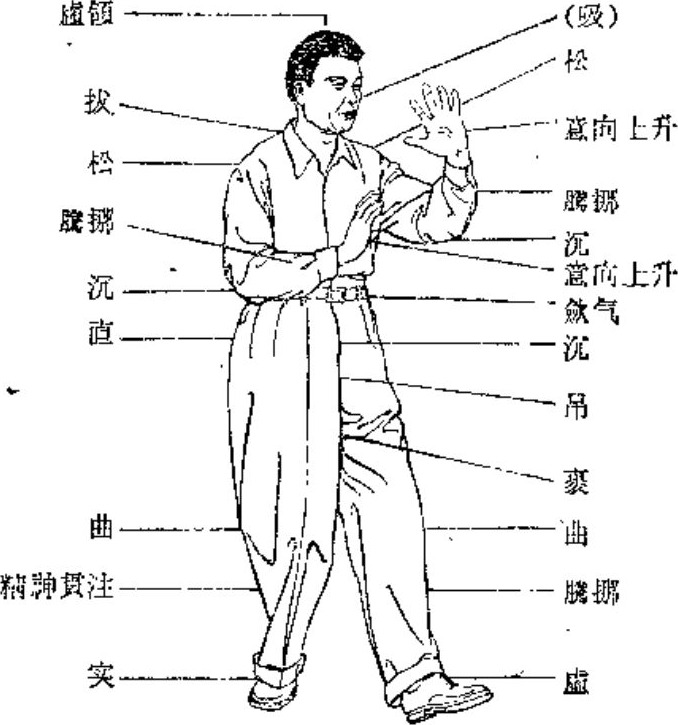
figure stands facing south-east, the right hand raised before the face with the palm turned
to the left, the left hand pressing at the front of the abdomen, the two legs set one before
the other. Leader lines mark the requirements at each part: on the left, top to bottom,
"empty the collar", "(inhaling) draw up", "loose", "soaring and shifting", "sink", "straight",
"bent", "spirit concentrated" and "substantial"; on the right, top to bottom, "loose", "intent
opening upward", "soaring and shifting", "sink", "intent opening upward", "gather qi", "sink",
"suspend", "wrap", "bent", "soaring and shifting" and "insubstantial". Below the figure are
noted "facing south-east", "the left foot set out toward the south-east", "the left hip drawn
back" and "the tailbone must be central and upright".
Figure 3 — open (图 3 開)
(Labels on the left, top to bottom): 虛領 empty the collar · (呼) 拔 (exhaling) draw up · 鬆 loose · 騰挪 soaring and shifting · 沉 sink · 直 straight · 曲 bent · 騰挪 soaring and shifting · 虛 insubstantial (Labels on the right, top to bottom): 鬆 loose · 意向上開 intent opening upward · 騰挪 soaring and shifting · 沉 sink · 意向上開 intent opening upward · 斂氣 gather qi · 沉 sink · 裹 wrap · 曲 bent · 精神貫注 spirit concentrated · 實 substantial (Below the figure): facing south-east; the left leg bows; the right leg presses.
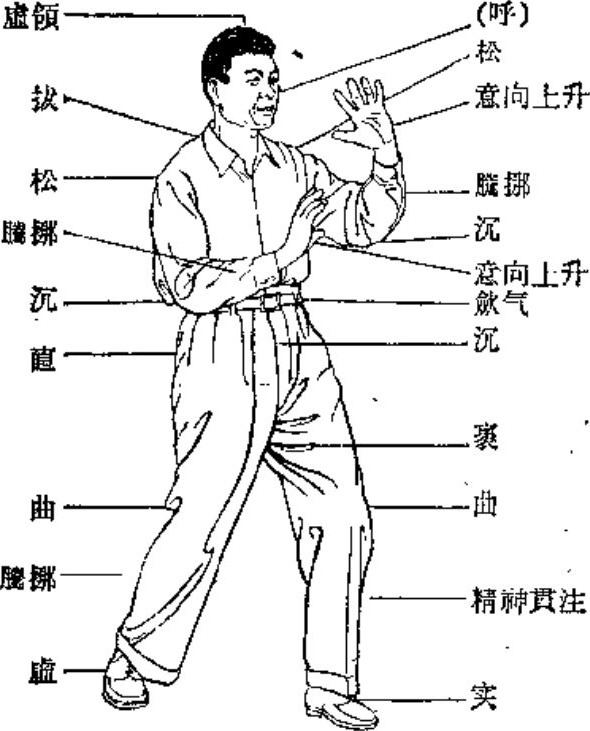
figure stands facing south-east, the right hand raised before the face with the palm turned
to the left and the fingers spread, the left hand pressing at the front of the abdomen; the
left leg bows in front and the right leg presses behind. Leader lines mark the requirements
at each part: on the left, top to bottom, "empty the collar", "(exhaling) draw up", "loose",
"soaring and shifting", "sink", "straight", "bent", "soaring and shifting" and
"insubstantial"; on the right, top to bottom, "loose", "intent opening upward", "soaring and
shifting", "sink", "intent opening upward", "gather qi", "sink", "wrap", "bent", "spirit
concentrated" and "substantial". Below the figure are noted "facing south-east", "the left
leg bows" and "the right leg presses".
Figure 4 — close (图 4 合)
(Labels on the left, top to bottom): 虛領 empty the collar · (吸) 拔 (inhaling) draw up · 鬆 loose · 騰挪 soaring and shifting · 沉 sink · 直 straight · 曲 bent · 騰挪 soaring and shifting · 虛 insubstantial (Labels on the right, top to bottom): 鬆 loose · 意向上開 intent opening upward · 騰挪 soaring and shifting · 沉 sink · 斂氣 gather qi · 沉 sink · 吊 suspend · 裹 wrap · 曲 bent · 精神貫注 spirit concentrated · 實 substantial (Below the figure): facing south-east; the right foot lifted and set forward half a step; the two hands closing level with the mouth.
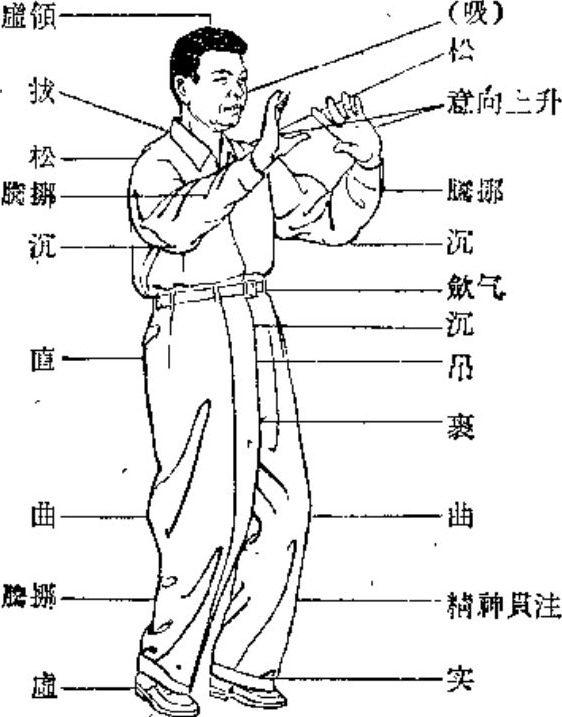
figure stands facing south-east, the two hands closed together before the chest at the height
of the mouth, palms facing each other; the right foot is lifted and set forward half a step.
Leader lines mark the requirements at each part: on the left, top to bottom, "empty the
collar", "(inhaling) draw up", "loose", "soaring and shifting", "sink", "straight", "bent",
"soaring and shifting" and "insubstantial"; on the right, top to bottom, "loose", "intent
opening upward", "soaring and shifting", "sink", "gather qi", "sink", "suspend", "wrap",
"bent", "spirit concentrated" and "substantial". Below the figure are noted "facing
south-east", "the right foot lifted and set forward half a step" and "the two hands closing
level with the mouth".
Phần 8
Chapter Two — Illustrated Explanation of Wu-Style Taijiquan
| Posture | Posture | ||
|---|---|---|---|
| 1 | Preparatory posture | 14 | Hand strums the lute |
| 2 | Left lazy tucking the robe | 15 | Right lazy tucking the robe |
| 3 | Right lazy tucking the robe | 16 | Single whip |
| 4 | Single whip | 17 | Raise the hand |
| 5 | Raise the hand | 18 | Look at the fist beneath the elbow |
| 6 | White goose spreads its wings | 19 | Left repulse the monkey |
| 7 | Brush the knee and twist the step | 20 | Right repulse the monkey |
| 8 | Hand strums the lute | 21 | Left repulse the monkey |
| 9 | Brush the knee and twist the step | 22 | Right repulse the monkey |
| 10 | Hand strums the lute | 23 | Hand strums the lute |
| 11 | Step up, deflect, seize and punch | 24 | White goose spreads its wings |
| 12 | As if sealing, as if closing | 25 | Brush the knee and twist the step |
| 13 | Embrace the tiger and push the mountain | 26 | Hand strums the lute |
| Posture | Posture | ||
|---|---|---|---|
| 27 | Press | 51 | Hand strums the lute |
| 28 | Blue dragon issues from the water | 52 | Right lazy tucking the robe |
| 29 | Turn the body | 53 | Diagonal single whip |
| 30 | Three-closing-the-back | 54 | Lower the posture |
| 31 | Single whip | 55 | Part the wild horse's mane |
| 32 | Lower the posture | 56 | Single whip |
| 33 | Waving hands | 57 | The jade maiden works the shuttle |
| 34 | Single whip | 58 | Hand strums the lute |
| 35 | Raise the hand | 59 | Right lazy tucking the robe |
| 36 | High pat on horse | 60 | Single whip |
| 37 | Left sharp-tiger posture | 61 | Lower the posture |
| 38 | Right raise the foot | 62 | Waving hands |
| 39 | Right hidden-tiger posture | 63 | Single whip |
| 40 | Left raise the foot | 64 | Lower the posture |
| 41 | Turn the body and kick | 65 | Golden rooster stands on one leg |
| 42 | Single whip | 66 | Left repulse the monkey |
| 43 | Treading step and strike | 67 | Right repulse the monkey |
| 44 | Turn the body, double kick | 68 | Left repulse the monkey |
| 45 | Drape the body | 69 | Right repulse the monkey |
| 46 | Retreat the step and kick | 70 | Hand strums the lute |
| 47 | Turn the body and kick | 71 | White goose spreads its wings |
| 48 | Step up, deflect, seize and punch | 72 | Brush the knee and twist the step |
| 49 | As if sealing, as if closing | 73 | Hand strums the lute |
| 50 | Embrace the tiger and push the mountain | 74 | Press |
Seventy-fifth posture — Blue dragon issues from the water Eighty-sixth posture — Step forward, ward-off, intercept, punch Seventy-sixth posture — Turn the body over Eighty-seventh posture — Right deflect, parry, punch Seventy-seventh posture — Three Yong-shan peaks Eighty-eighth posture — Single whip Seventy-eighth posture — Single interception Eighty-ninth posture — Lower the posture Seventy-ninth posture — Lower the posture Ninetieth posture — Step up to seven stars Eightieth posture — Cupping hand Ninety-first posture — Step back and bestride the tiger Eighty-first posture — Single whip Ninety-second posture — Turn the foot and swing the lotus Eighty-second posture — Raise the hand, lift the posture Ninety-third posture — Bend the bow and shoot the tiger Eighty-third posture — High pat the horse Ninety-fourth posture — Double embracing punch Eighty-fourth posture — Punch to the heart Ninety-fifth posture — Hand plays the lute Eighty-fifth posture — Turn the body, cross-swing the lotus Nineth-sixth posture — Closing posture
Phần 9
Some notes on the illustrations
1. The photographs in these illustrations are traced from the author's own posture photographs.
2. So that the reader can check the direction of a posture against the pictures, the direction of the preparatory posture (Figure 1) is assumed as follows: facing the reader equals south, the back equals north, the reader's right-hand side equals east, the reader's left-hand side equals west. Once the reader becomes skilled in practice, any direction may be chosen according to the shape of the ground, and the preparatory posture need not always begin facing south.
3. Every solid or broken line in the pictures indicates the direction of travel of a hand or a foot. Every arrow in the pictures indicates the direction in which the movement passes from that picture into the next. Where a movement is simple enough to be made clear in words, its direction of travel is not shown in the picture; refer to the text and to the following picture.
4. An arrow drawn with a solid line indicates the direction of travel of the right hand or the right foot; one drawn with An arrow drawn with a broken line indicates the direction of travel of the left hand or the left foot.
5. Because the movement of the feet in taijiquan is very fine, shading is drawn beside the foot in order to indicate the angle of the foot to the ground, so that they may be told apart:
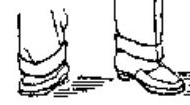
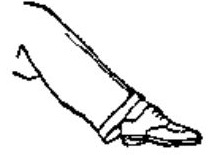
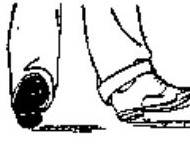
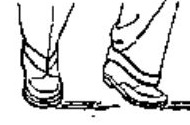
Means the whole foot is on the ground With no shading beside the foot: the whole foot is off the ground Means the heel is on the ground Means the toe is on the ground
Phần 10
Illustrated explanation of the Wu-style taijiquan form
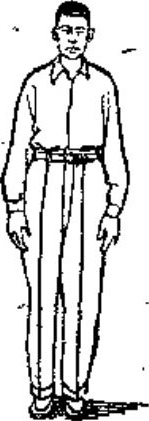
The two feet stand together (about one fist apart), the two knees slightly bent, not stiff; the two arms hang naturally; the eyes look straight ahead. (Figure 1)
The requirement, when the two feet stand together and one has taken up the stance, is that the body be natural and calm; that the whole spirit be raised and distracting thoughts excluded; that the intent contain a lifting energy (ding jin), so that the head is upright and straight, the chin slightly drawn in; that the two shoulders be relaxed; that the abdomen be loosened, with the breath sunk to the dantian; that the chest be contained, the back pulled up, the crotch wrapped, and the ribs protected.
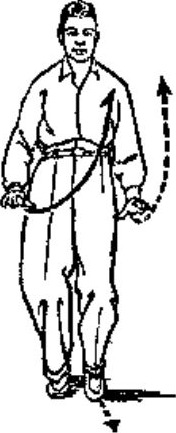
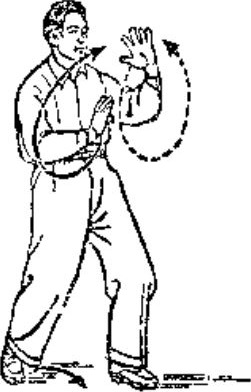
Movement one: the two legs bend at the knees and sink slightly; the body weight gradually moves onto the right leg, and the right leg becomes full (solid); the left heel lifts, the toe touches the ground, and the left leg becomes empty. At the same time the two arms bend slightly and the two hands move forward, resting at the sides of the hips, the backs of the hands upward, the fingers pointing forward, slightly flexed and separated. (Figure 2)
Throughout the form of Wu-style taijiquan, the two arms and two legs of every movement and posture may never be straightened, but must keep a certain bend; and when the body turns, the heel of the full leg must serve as the axis. Moreover, in every movement the head, trunk, chest, back and the other parts must accord with the requirements of the preparatory posture; this will not be repeated below.
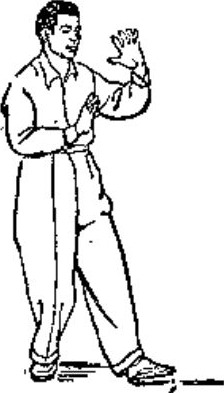
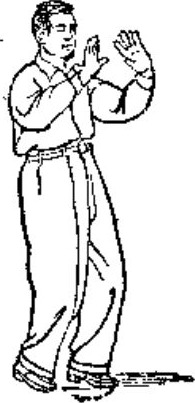
Movement two: the body turns slightly to the left, and the left foot accordingly lifts and steps out toward the left diagonal (a 45-degree diagonal; the diagonals referred to from here on are all 45 degrees), the toe tilted up and the heel touching the ground, the left leg slightly bent (the two legs are still empty-left and full-right). At the same time the two hands lift toward the chest, the fingers pointing up to form upright palms, the left hand outside, level with the mouth; the right hand inside, level with the heart, both palms turned slightly forward (the two elbows must sink); facing the southeast diagonal. (Figure 3)
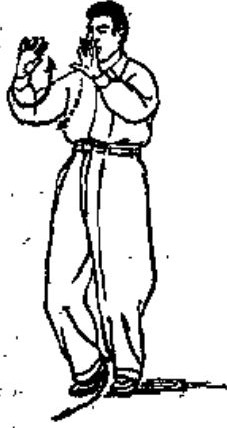
Movement three: the right heel presses, the left leg bows forward, the left sole settles flat, the body weight moves onto the left leg, the right leg bends slightly, and the two legs become full-left and empty-right. At the same time the two hands push slowly forward (the upper body may not lean forward or backward; the shoulders must be relaxed and the elbows sunk), the palms still turned slightly forward, the left hand level with the eyes, the right hand level with the chest. (Figure 4)
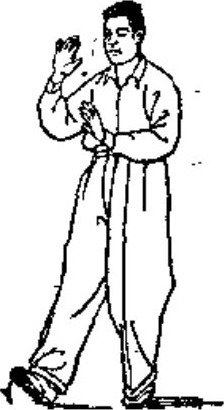
Movement four: the two hands fall at the same time; when the two hands come level with the hips (with the two hands down they may not let the elbows stand out behind the back) they part to left and right, arc upward, and the upright palms come together before the chest with the intent of holding a ball, the two hands level with the mouth, the palms turned slightly forward. At the same time as the two hands part left and right, the right foot follows forward to beside the left heel, touching the ground with the toe. (Figure 5)
The requirement is to relax the shoulders and sink the elbows; there should be a lively roundness between the hands and the chest. The two legs are still full-left and empty-right.
Movement one: with the left heel as the axis (the right toe still touching the ground), the body turns slightly to the right, facing due south, the two legs still full-left and empty-right. (Figure 6)
Movement two: the waist revolves slightly to the right, and the right foot accordingly steps out toward the right diagonal, the toe tilted up and the heel touching the ground, the right leg slightly bent (the two legs still full-left and empty-right). At the same time the left hand moves from above downward and the right hand from below upward, drawing a small circle, still as upright palms (fingers pointing up): the right hand outside, level with the mouth; the left hand inside, level with the heart; both palms turned slightly forward (the two elbows must sink); facing the southwest diagonal. (Figure 7)
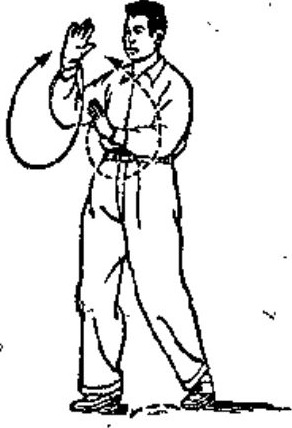
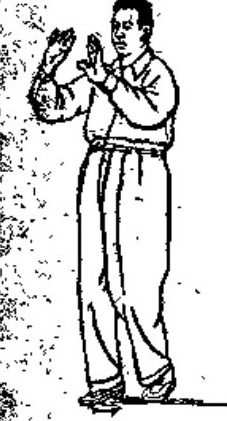
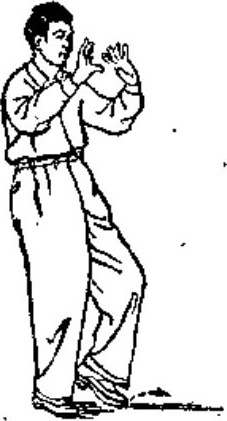
Movements three and four are the same as movements three and four of the second posture, "Left grasp and tie the garment", only that left and right are reversed and the direction is different. The direction of this posture is toward the southwest diagonal. (Figures 8– 9)
The two postures are joined into one section-sequence (as to what a section-sequence is, see the explanation of the section-sequence diagrams). Movements one, two and three are "Single whip"; movement four is "Raise the hand and lift the posture".
Movement one: with the right heel as the axis (the left toe still touching the ground), the body turns 90 degrees to the left, facing the southeast diagonal, still with the right leg full and the left leg empty. (Figure 10) Movement two: the left foot steps out, the toe tilted up and the heel touching the ground, the two legs still empty-left and full-right. (Figure 11)
Movement three: the right heel presses, the left leg bows forward, the left sole settles flat, the right leg bends slightly, and the two legs become full-left and empty-right. At the same time the two hands part to left and right, the fingers pointing up, the palms turned outward, still as upright palms: the left hand level with the eyes, the right hand level with the mouth (the two elbows must sink); facing the diagonal east, slightly toward south. (Figure 12)
Movement four: the right leg draws in toward the left, with the right toe touching beside the left foot (the two legs still full-left and empty-right). At the same time the body turns slightly to the right, facing due south. The two hands follow the movement: the right hand arcs downward and to the left, scooping up from below and coming to rest before the abdomen, the fingers pointing forward; the left hand rises, the palm turned up, with the intent of lifting upward, level with the eyebrows (the shoulders must relax and the elbows sink). (Figure 13)
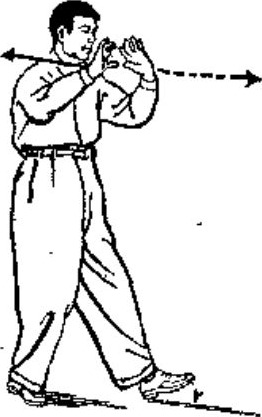
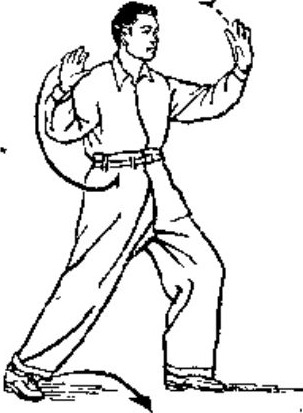
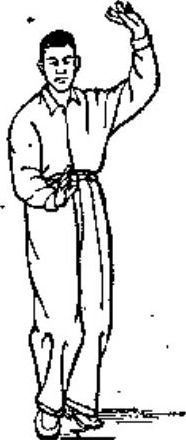
Movement one: the right toe still touching the ground, with the left heel as the axis, the body turns slightly to the right, facing the southwest diagonal, the two legs still full-left and empty-right. (Figure 14)
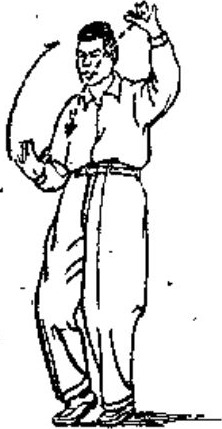
Movement two: the right foot steps forward, the toe tilted up and the heel touching the ground, the right leg slightly bent (the two legs still full-left and empty-right). At the same time the right hand lifts from the outside, the palm held crosswise and raised to above the forehead, the palm turned forward; the left hand comes down from the inside, passing before the face as an upright palm, and comes level with the heart (the shoulders must relax and the elbows sink). (Figure 15)
Movement three: the left heel presses, the right leg bows forward, the right sole settles flat, and the two legs become full-right and empty-left. At the same time the left hand pushes slowly forward (the upper body may not lean forward or backward), the left hand level with the chest and the palm turned slightly forward (the right hand must have the intent of turning upward; the shoulders must relax and the elbows sink). (Figure 16)
Movement four: the right hand extends slightly forward and the elbow hangs down; the two hands fall at the same time; when the two hands come level with the hips (as the two hands fall, the elbows may not stand out behind the back) they part to left and right, arc upward, and the upright palms come together before the chest with the intent of holding a ball, the two hands level with the mouth and the palms turned slightly forward. At the same time as the two hands part left and right, the left foot follows forward to beside the right heel, touching the ground with the toe; facing the right-front diagonal. (Figure 17)
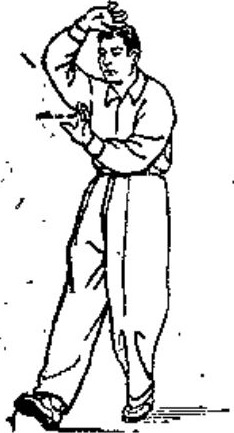
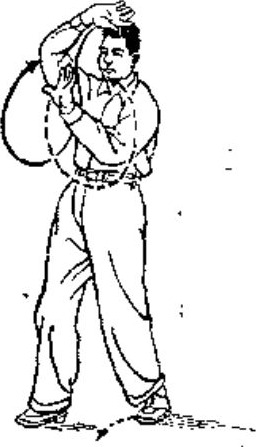
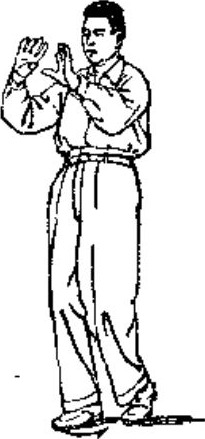
The requirement is that there be a lively roundness between the hands and the chest; the two legs are still full-right and empty-left.
In practising taijiquan, every movement requires relaxed shoulders and sunk elbows throughout; the reader is asked to bear this firmly in mind, and it will not be repeated below.
Movement one: the left toe shifts slightly and touches the ground behind to the left; with the right heel as the axis, the body turns 135 degrees to the left, facing due east, the two legs still full-right and empty-left. (Figure 18)
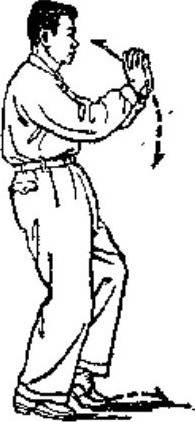
Movement two: the body turns slightly to the left, facing the northeast diagonal. The hands and feet follow the movement: the left foot steps out toward the left diagonal, the toe tilted up and the heel touching the ground, the left leg slightly bent, the two legs still full-right and empty-left; the left hand falls to before the abdomen; the right hand rises beside the right cheek, level with the ear, the fingers pointing up and the palm turned forward; facing the northeast diagonal. (Figure 19)
Movement three: the right heel presses, the left leg bows forward, the left sole settles flat, the right leg bends slightly, and the two legs become full-left and empty-right. At the same time the left hand brushes downward past the left knee and comes to rest beside the left leg, the fingers pointing forward; the right hand pushes slowly forward (the upper body may not lean forward or backward), the fingers still pointing up, level with the eyes; the face still toward the northeast diagonal. (Figure 20)
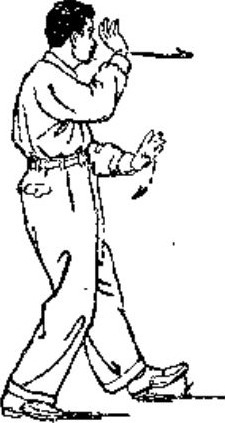
Movement four: the right hand falls past the side of the left leg (fingers pointing forward); when it comes level with the left hand, the two hands part to left and right and arc upward, and the upright palms come together before the chest with the intent of holding a ball, the two hands level with the mouth, the palms turned slightly forward; at the same as the two hands part left and right, the right foot in front follows to beside the left heel, touching the ground with the toe, and the two legs are still full-left and empty-right. (Figure 21)
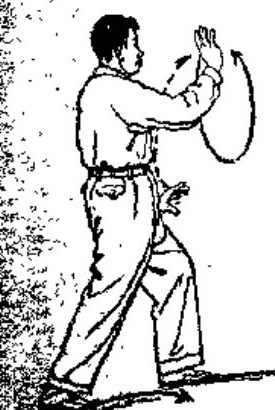
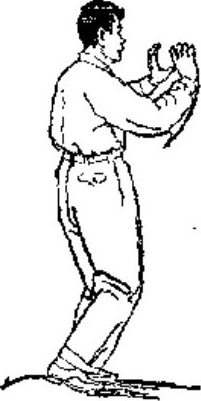
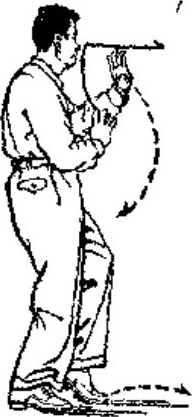
The two postures are joined into one section-sequence: movement one is "The hand plays the lute"; movements two, three and four are "Brush the knee and twist the step".
Movement one: the right foot steps back and settles, the toe pointed due east; the left foot draws in before the right and touches the ground with the toe, and the legs become full-right and empty-left. At the same time the two hands draw in and close with the body, still as upright palms: the left hand still level with the mouth, the right hand fallen to before the abdomen, both palms turned slightly forward; facing the northeast diagonal. (Figure 22)
The requirement is that there be a lively roundness between the hands and the chest.
Movement two: the left foot steps forward, the toe tilted up and the heel touching the ground. The two hands follow the movement: the left hand falls to before the abdomen, and the right hand rises beside the right cheek (as in the posture of Figure 19). Then the right heel presses, the right leg bends slightly, and the left sole settles flat accordingly, so that the left leg in front becomes the full left leg and the right leg becomes empty. At the same time the left hand brushes downward past the left knee and is set beside the left leg, the fingers pointing forward; the right hand pushes slowly forward (the upper body may not lean forward or backward), the fingers still pointing up, level with the eyes; facing the northeast diagonal. (Figure 23) (with the twisted step)
Then the right foot strides past the left and settles flat and firm outside the left foot, and the two legs become full-right and empty-left. At the same time the left hand rises level with the mouth and the right hand falls to rest before the chest, the fingers of both hands pointing up and the palms turned slightly forward; the face still toward the northeast diagonal. (Figure 24)
Movement three is the same as the explanation of Figure 23 within movement two of this posture, up to "with the twisted step". (Figure 25)
Movement four is the same as the explanation of movement four, Figure 21, of the seventh posture, "Brush the knee and twist the step". (Figure 26)
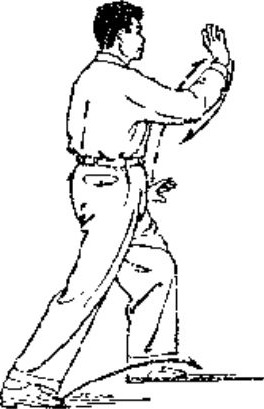
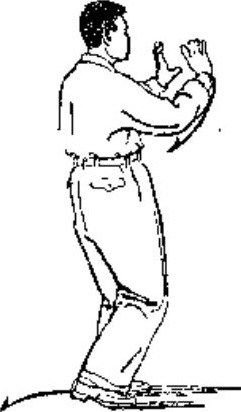
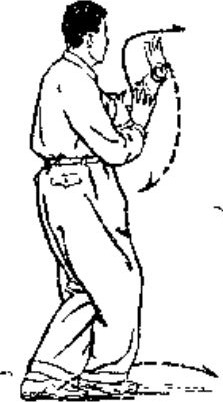
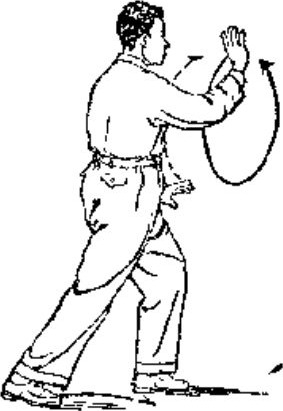
The two postures are joined into one section-sequence: movement one is "The hand plays the lute"; movements two, three and four are "Step up, deflect and intercept, punch". Movement one is the same as the explanation of movement one of the eighth posture, "The hand plays the lute". (Figure 27)
Movement two: (step up to the left) the left foot still steps out toward the left-front diagonal, the toe tilted up and the heel touching the ground. The two hands follow the movement: the right hand is raised high above the head to the upper right, the palm turned left, the fingers slightly spread and pointing forward; the left hand falls to before the abdomen, the fingers pointing up and the palm turned right. Immediately the right heel presses, the left leg bows forward, the left sole settles flat, and the right leg bends slightly, so that the left leg becomes full and the right leg empty. At the same time the two hands extend forward (the upper body may not lean forward or backward); the face still toward the northeast diagonal. (Figure 28)
Movement three: (step up to the right) with the left heel as the axis, the body turns right; the right foot accordingly lifts, passes beside the left foot, and steps out toward the right-front diagonal, the toe tilted up and the heel touching the ground. At the same time the two hands follow the movement: the left hand is raised high above the head to the upper left, the palm turned right, the fingers slightly spread and pointing up; the right hand comes down past the face and falls straight to before the abdomen, the fingers pointing up and the palm turned left. Immediately the left heel presses, the right leg bows forward, the right sole settles flat, and the left leg bends slightly, so that the two legs become empty-left and full-right. At the same time the two hands extend forward (the upper body may not lean forward or backward); facing the southeast diagonal. (Figure 29)
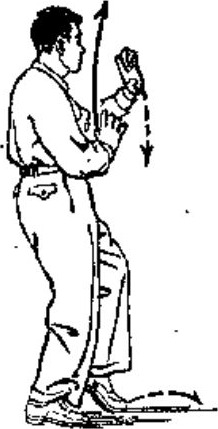
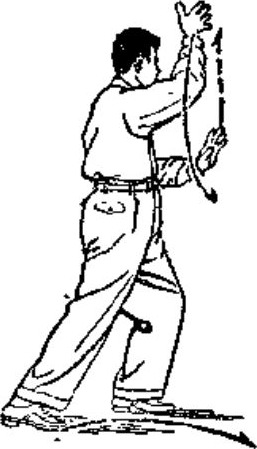
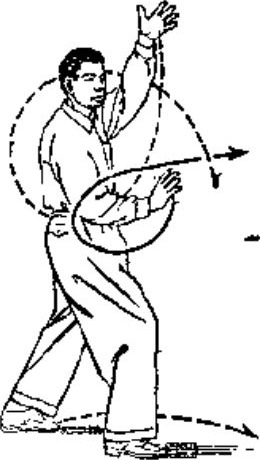
Movement four: (deflect, intercept, punch) the left hand comes down past the face, arcs to the left, scoops up from below, and again rises and falls forward to before the abdomen, the fingers pointing up. The left foot accordingly lifts, passes beside the right foot, and steps out due east, touching the ground first with the heel; the right hand falls to beside the right hip and closes into a fist. Immediately the left sole settles flat, the left leg bows forward, the right foot follows forward and touches with the toe beside the left heel, so that the left leg becomes full and the right leg empty. At the same time the right fist drives slowly forward along the back of the left hand (the upper body may not lean forward or backward), the eye of the fist turned up, level with the heart; facing due east. (Figure 30)
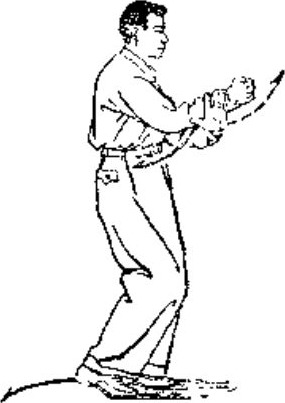
Movement one: the left leg does not move; the right foot and right fist shift back at the same time; the right foot withdraws behind the left, the toe pointed toward the right-front diagonal, the right leg slightly bent, the two legs still full-left and empty-right; the right fist is set beside the right hip, the eye of the fist still turned up. At the same time the left hand rises as an upright palm to before the chest, the palm turned right; facing due east. (Figure 31)
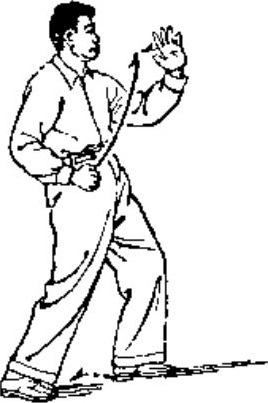
Movement two: the body shifts back, the right leg becomes full, and the left leg draws back with the toe touching before the right foot, so that the left leg becomes empty. At the same time the right fist opens into a palm, rises and joins the left hand, and the two become upright palms drawn in before the chest, both palms turned forward. (Figure 32)
Movement three: the left leg steps forward, the toe tilted up and the heel touching the ground, the left leg slightly bent; the legs are still full-right and empty-left. (Figure 33)
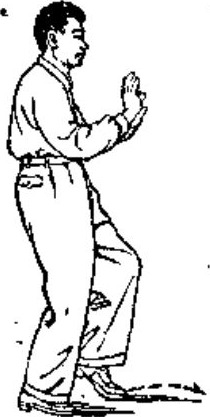
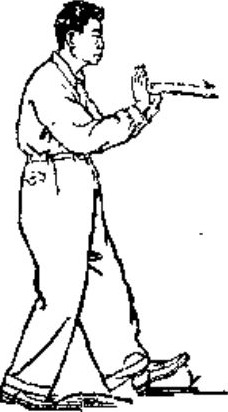
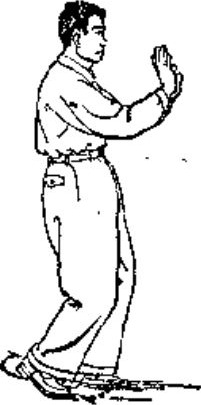
Movement four: the two hands push slowly forward in parallel, level with the chest (the upper body may not lean forward or backward). At the same time the left leg bows forward and the left sole settles flat, so that the left leg becomes full; the right foot follows forward and touches with the toe beside the left foot, so that the right leg becomes empty (the left heel should have the intent of pressing out); facing due east. (Figure 34)
Movement one: the right foot moves behind and past the left heel to touch the ground on the left side behind the left foot; with the left heel as the axis, the body turns 180 degrees to the right-rear, facing due west, the two legs still full-left and empty-right. (Figure 35)
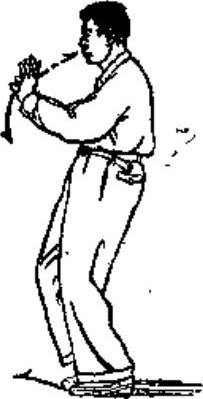
Movement two: the body turns slightly to the right; the hands and feet follow the movement; the right foot steps out toward the right-front diagonal, the toe tilted up and the heel touching the ground, the right leg slightly bent, the two legs still full-left and empty-right; the right hand falls to before the abdomen; the left hand rises beside the left cheek, level with the ear, the fingers pointing up and the palm turned forward; facing the northwest diagonal. (Figure 36)
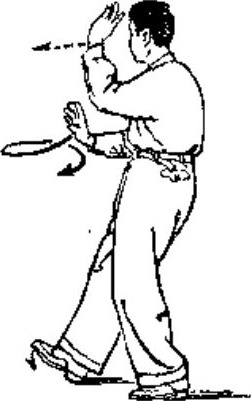
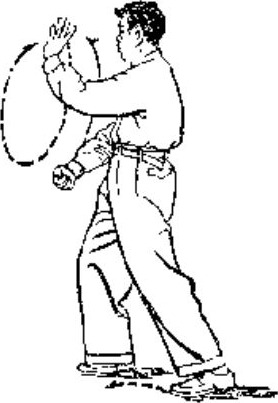
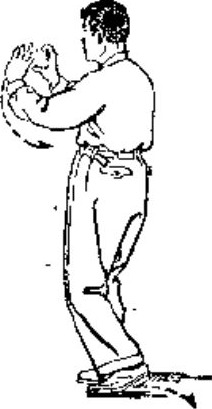
Movement three: the left heel presses, the right leg bows forward, the right sole settles flat, and the legs become full-right and empty-left. At the same time the right hand circles downward and outward to the left before the abdomen and closes into a fist at the right of the abdomen, the palm toward the chest, the right arm in the manner of embracing a tiger; the left hand pushes slowly forward as an upright palm (the upper body may not lean forward or backward), the left hand level with the eyes; facing the northwest diagonal. (Figure 37)
Movement four: the right fist, its centre turned down, moves downward and opens into a palm past the side of the right leg; the left hand accordingly falls with its palm turned down; when the two hands have descended to the same level, the two hands part to left and right at the same time and arc upward, and the upright palms come together before the chest with the intent of holding a ball, the two hands level with the mouth, the two palms turned slightly forward. At the same time as the two hands part left and right, the left foot follows forward to beside the right heel, touching the ground with the toe, and the two legs are still full-right and empty-left. (Figure 38)
The requirement is that there be a lively roundness between the hands and the chest and arms.
The two postures are joined into one section-sequence: movements one and two are "The hand plays the lute"; movements three and four are "Right lazy tie the garment". Movement one: the left foot steps back and settles, the toe pointed toward the southwest diagonal; the right foot draws in before the left and touches the ground with the toe, and the two legs become full-left and empty-right. The two hands turn left with the body, and the upright palms are drawn in before the chest: the right hand still level with the mouth, the left hand fallen to before the abdomen, both palms turned slightly forward; facing due west. (Figure 39)
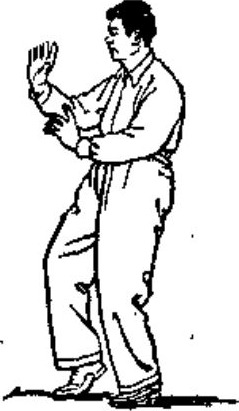
The requirement is that there be a lively roundness between the hands and the chest and arms.
Movement two: the right foot steps forward, the toe tilted up and the heel touching the ground, the right leg slightly bent, the two legs still full-left and empty-right. (Figure 40)
Movements three and four are the same as movements three and four of the third posture, "Right grasp and tie the garment", except that the direction differs slightly: this posture faces due west. (Figures 41–42)
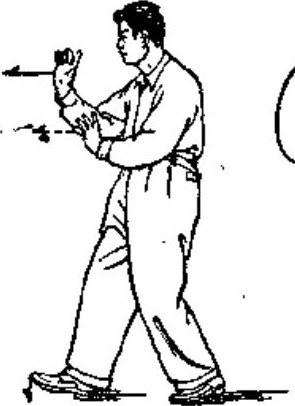
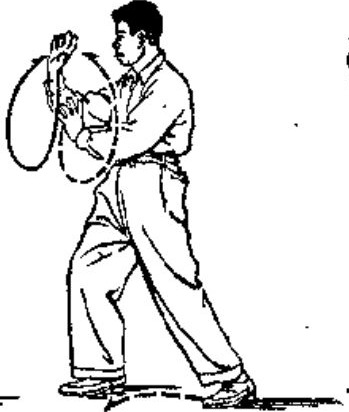
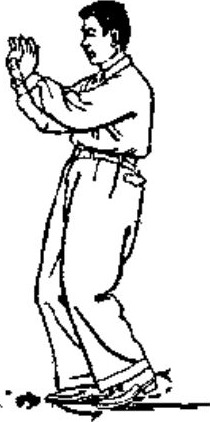
The two postures are joined into one section-sequence: movements one, two and three are "Single whip"; movement four is "Raise the hand and lift the posture".
Movement one: the left foot lifts and moves to touch the ground on the left side behind the right foot; with the right heel as the axis, the body turns 135 degrees to the left-rear, facing a diagonal slightly east of south, the two legs still full-right and empty-left. (Figure 43)
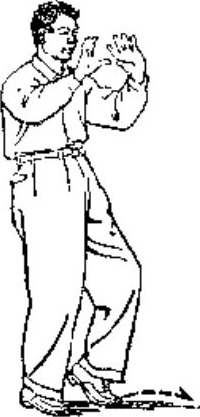
Movements two and three are the same as movements two and three of the fourth posture, "Single whip". (Figures 44–45)
Movement four is the same as the movement of the fifth posture, "Raise the hand and lift the posture" — that is, the same as movement four of the joined fourth and fifth postures. (Figure 45)
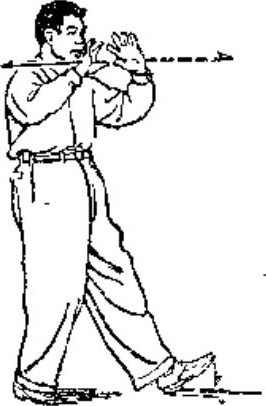
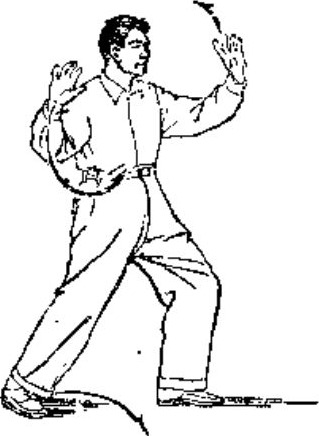
Movement one: the right foot steps forward, the toe tilted up and the heel touching the ground; the left leg is still full and the right leg empty. At the same time the right hand rises to before the chest, the fingers pointing up and the palm turned slightly forward. (Figure 47)
Movement two: the left heel presses, the right leg bows forward, the right sole settles flat, and the left leg bends slightly, so that the right leg becomes full and the left leg empty. At the same time the right hand pushes slowly out from before the chest (the upper body may not lean forward or backward); facing due south. (Figure 48)
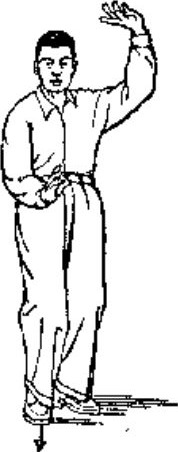
Movement three: the left leg does not move; the right toe turns 90 degrees to the left and the waist revolves slightly to the left, toward due east, the two legs still full-right and empty-left. (Figure 49)
Movement four: the two hands close into fists and the body turns left toward due east. At the same time the right fist circles beneath the left elbow with the eye of the fist turned inward; the left forearm straightens upright accordingly, the fist level with the crown of the head and the eye of the fist turned left (the two arms forming a right angle). At the same time as the body turns left, the left foot draws close beside the right heel, the heel lifted and the toe touching the ground, the two legs still full-right and empty-left. (Figure 50)
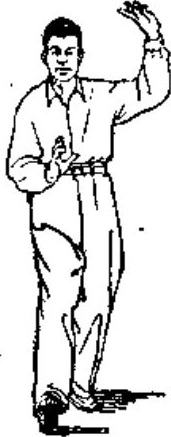
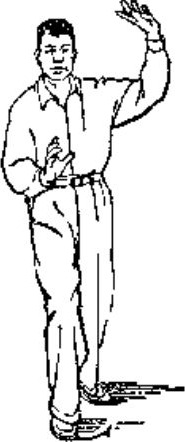
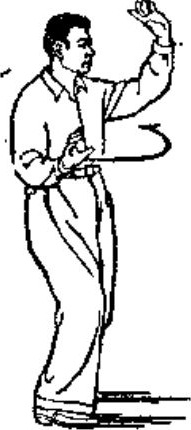
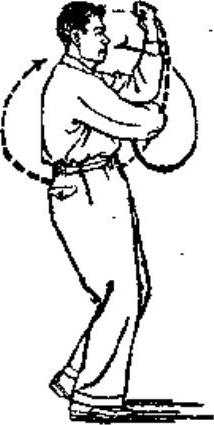
Movement one: the two fists open into upright palms, the fingers pointing up and the palms turned outward, parted left and right, level with the shoulders. The left foot shifts slightly back and touches the ground; with the right heel as the axis, the body turns 90 degrees to the left and the right leg sits full, the two legs still full-right and empty-left; facing due north. At the same time the two hands come together facing each other before the chest with the intent of holding a ball, level with the mouth. (Figure 51)
The requirement is that there be a lively roundness between the hands and the chest and arms. Movements two, three and four are the same as movements two, three and four of the seventh posture, "Brush the knee and twist the step", except that the direction and angle differ: this posture is toward due west. (Figures 52–54)
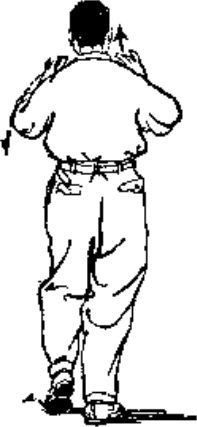
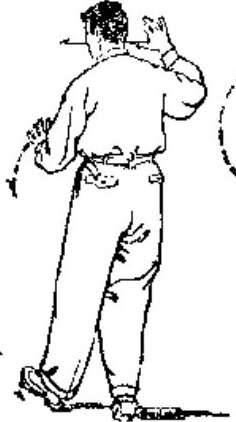
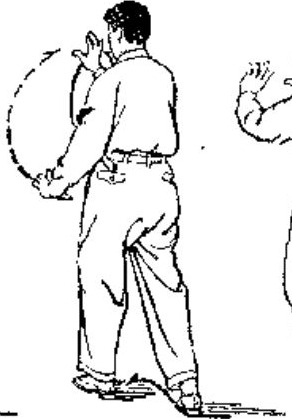
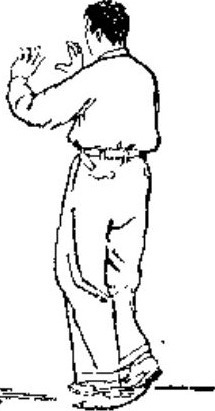
Movement one: the right foot lifts and moves behind the left foot to touch the ground with the toe on the left side of the left heel; with the left heel as the axis, the body turns 225 degrees to the right-rear, facing due south, the two legs still full-left and empty-right. (Figure 55)
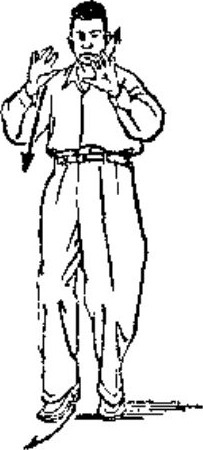
Movement two: the body turns slightly to the right; the hands and feet follow the movement; the right foot steps out toward the right-front diagonal, the toe tilted up and the heel touching the ground, the right leg slightly bent, the two legs still full-left and empty-right; the right hand falls to before the abdomen; the left hand rises beside the left cheek, level with the ear, the fingers pointing up and the palm turned outward; facing the southwest diagonal. (Figure 56)
Movement three: the left heel presses, the right leg bows forward, the right sole settles flat, the left leg bends slightly, and the legs become full-right and empty-left. At the same time the right hand brushes downward past the right knee and is set beside the right leg, the fingers pointing forward; the left hand pushes slowly forward (the upper body may not lean forward or backward), the fingers still pointing up, level with the eyes. (Figure 57)
Movement four: the left hand falls past the side of the right leg (the fingers pointing forward); when it comes level with the right hand, the two hands part left and right and arc upward, and the upright palms come together before the chest with the intent of holding a ball, the two hands level with the mouth, the palms turned slightly forward. At the same time as the two hands part left and right, the left foot follows forward to beside the right heel, touching the ground with the toe, and the two legs are still full-right and empty-left. (Figure 58)
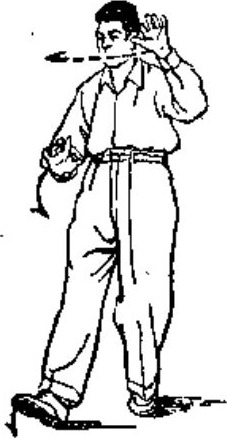
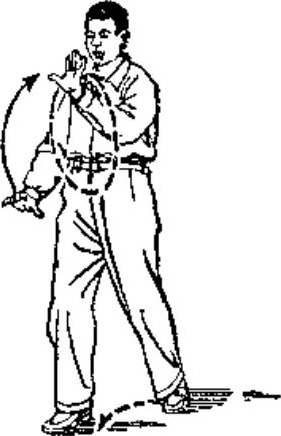
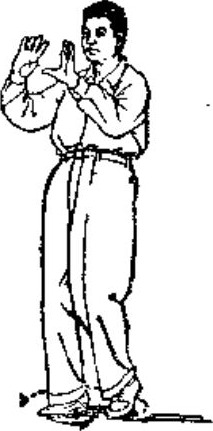
Movement one: the left foot lifts and moves behind the right foot to the right side of the right heel, touching the ground with the toe; with the right heel as the axis, the body turns 225 degrees to the left-rear, facing due north, the two legs still full-right and empty-left. (Figure 59)
Movements two, three and four are the same as movements two, three and four of the seventh posture, "Brush the knee and twist the step", except that the direction and angle differ: this posture is toward the northwest. (Figures 60–62)
Movements one, two, three and four are the same as the four movements of the twentieth posture, "Right push back the monkey". are the same. (Figures 63–66)
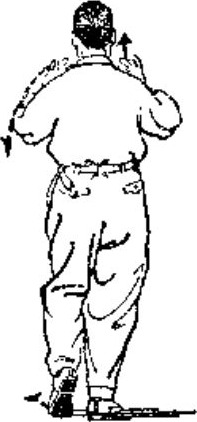
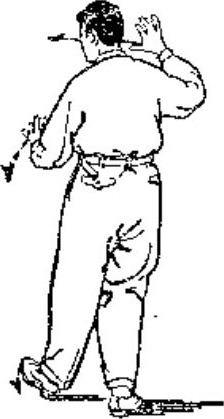
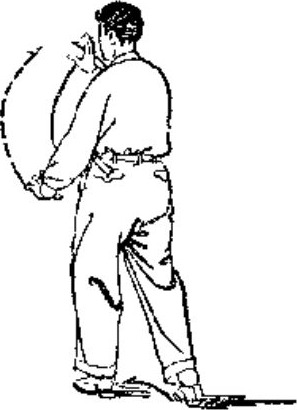
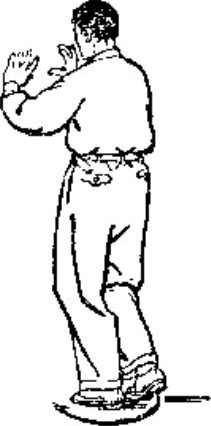
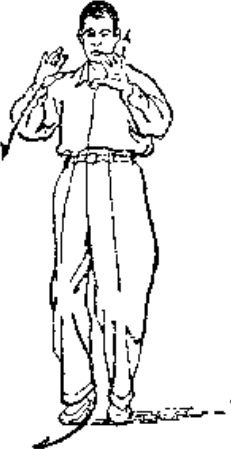
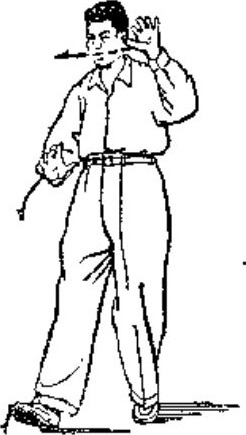
The two postures are joined into one section-sequence: movement one is "The hand plays the lute"; movements two, three and four are "The white goose spreads its wings".
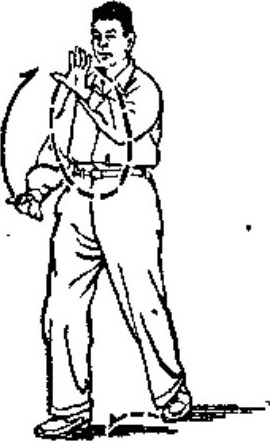
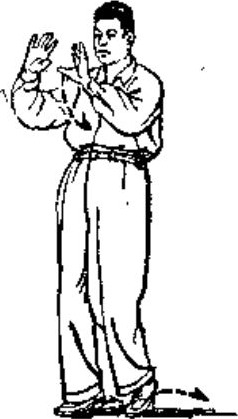
Movement one: the left foot steps back and settles, the toe pointed due south; the right foot draws in before the left and touches the ground with the toe, so that the left leg becomes full and the right leg empty. At the same time the two hands draw back with the body as upright palms: the right hand is drawn in before the chest, level with the mouth, and the left hand falls to before the abdomen, both palms turned slightly forward; facing the southwest diagonal. (Figure 67)
The requirement is that there be a lively roundness between the hands and the chest and arms.
Movement two: the right foot steps forward, the toe tilted up and the heel touching the ground, the right leg slightly bent, the two legs still full-left and empty-right. At the same time the right hand is raised above the forehead, the palm held crosswise and turned forward; the left hand moves to before the heart, the fingers pointing up. (Figure 68)
Movements three and four are the same as movements three and four of the sixth posture, "The white goose spreads its wings". (Figures 69–70)
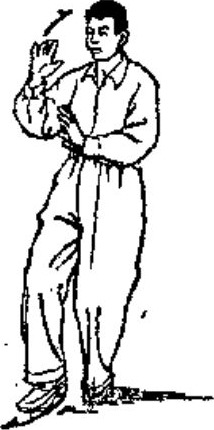
Movements one, two, three and four are the same as the four movements of the seventh posture, "Brush the knee and twist the step". (Figures 71–74)
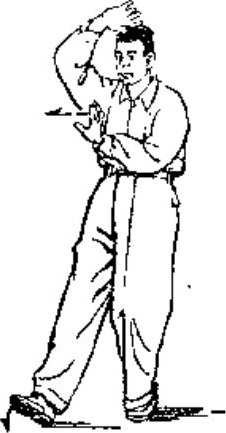
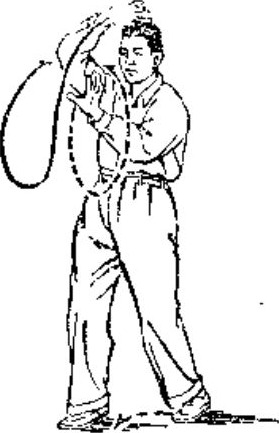
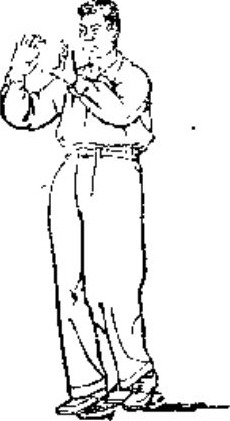
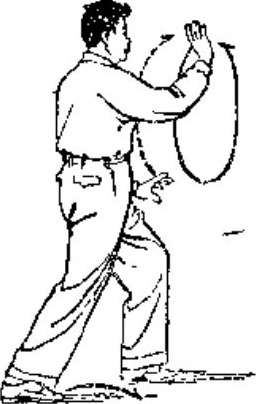
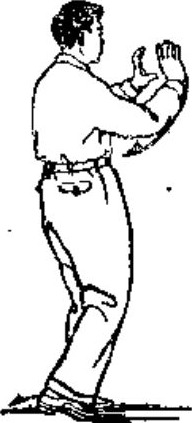
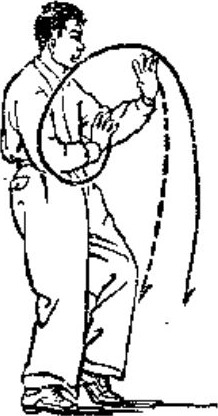
Four postures are joined into one section-sequence: movement one is "The hand plays the lute"; movement two is "Drape the posture"; movement three is "Blue dragon issues from the water"; movement four is "Turn the body over".
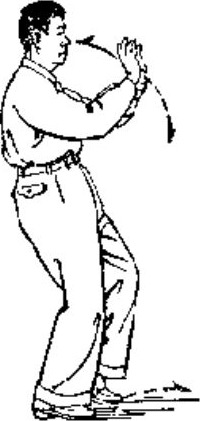
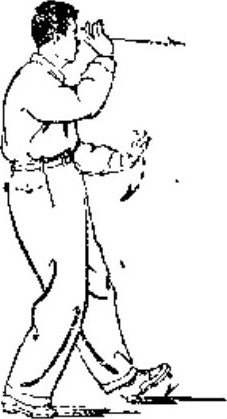
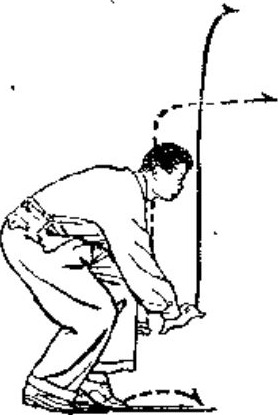
Movement one: the right foot steps back and settles, the toe pointed toward the southeast diagonal; the left foot draws in before the right and touches the ground with the toe, and the two legs become full-right and empty-left. At the same time the two hands turn right with the body and draw in before the chest as upright palms: the left hand still level with the mouth, the right hand fallen to before the abdomen, both palms turned slightly forward; facing due east. (Figure 75)
The requirement is that there be a lively roundness between the hands and the chest and arms.
Movement two: the right hand turns upward and circles up to the right; when it reaches before the face the palm is turned down; at the same time the left hand (its palm turned down) arcs from before the chest down and to the left to beside the left leg; then the two hands press straight down. The upper body bends forward and, following the momentum, sinks slightly. The fingers of the left hand point forward and are set to the left of the left shin; the fingers of the right hand point left and are set before the two legs. (Figure 76)
The requirement is that when the body bends forward the head still be upright and pointed forward, the two arms slightly bent, and the two legs still full-right and empty-left.
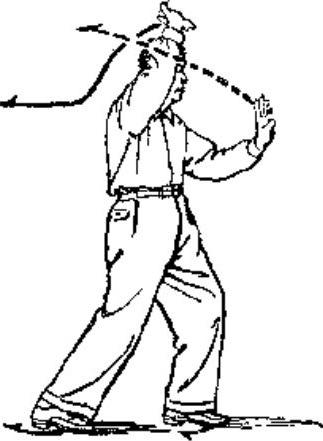
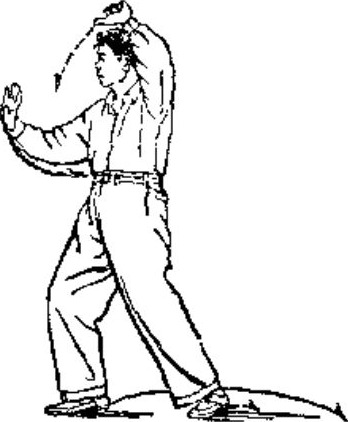
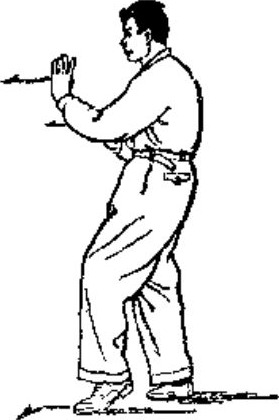
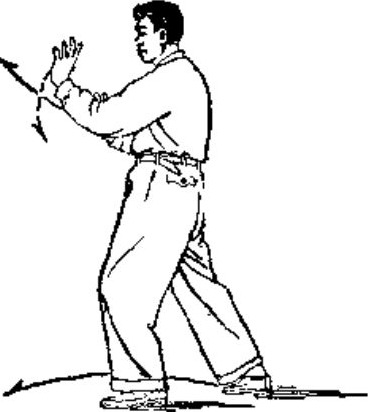
Movement three: the upper body straightens up; the two arms rise accordingly. The right hand is above the crown of the head, the palm turned slightly forward, the fingers pointing left; the left hand is held as an upright palm before the chest, the fingers pointing up, the palm turned slightly forward. At the same time the left foot steps forward, the right heel presses, the left leg bows forward, the left sole settles flat, the left toe points due east, the right leg bends slightly, and the two legs become full-left and empty-right; the left hand pushes slowly forward accordingly (the upper body may not lean forward or backward), the hand level with the chest. (Figure 77)
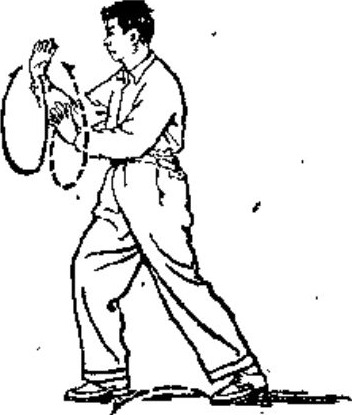
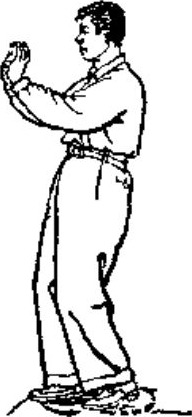
Movement four: with the left heel as the axis, the left toe turns 135 degrees to the right and settles, the body bows to the right-rear, and the right toe tilts up accordingly. At the same time the left hand rises above the crown of the head, the heart turned slightly forward and the fingers pointing right; the right hand falls accordingly and becomes an upright palm set before the chest, the fingers pointing up and the palm turned slightly forward; the left heel presses, the right leg bows forward, the right sole settles flat, the left leg bends slightly, and the two legs become full-right and empty-left. The right hand then pushes slowly forward (the upper body may not lean forward or backward), level with the chest; facing due west. (Figure 78)
Movement one: the right foot steps back one long pace and settles, the toe pointed toward the right-front diagonal; the left leg draws back, touching with the toe before the right foot, and the two legs still become full-right and empty-left. At the same time the two hands are drawn in before the chest as upright palms, the left high and the right low, the left hand level with the mouth, both palms turned slightly forward; facing due west. (Figure 79)
Movement two: the left foot steps forward, touching first with the heel; then the right heel presses, the left leg bows forward, the left sole settles flat, the right leg bends slightly, so that the left leg becomes full and the right leg empty. At the same time the two hands push slowly forward (the upper body may not lean forward or backward), both palms still turned slightly forward, the left hand level with the eyes and the right hand level with the chest. (Figure 80)
Movement three: the left toe turns slightly outward, and the left leg sits full; the right foot steps forward one long pace, touching first with the heel; then the left heel presses, the right leg bows forward, and the right sole settles flat, the right toe pointing straight ahead, the right leg bends slightly, and the legs become full-right and empty-left. At the same time the right hand arcs upward, level with the eyebrows; the left hand arcs downward, level with the heart; and as the right leg bows forward the two hands push slowly forward (the upper body may not lean forward or backward), both palms still turned slightly forward, the right hand level with the eyes and the left hand level with the chest. (Figure 81)
Movement four is the same as movement four of the third posture, "Right grasp and tie the garment", except that the direction and angle differ: this posture faces due west. (Figure 82)
The two postures are joined into one section-sequence: movements one, two and three are "Single whip"; movement four is "Lower the posture".
Movement one is the same as movement one of the sixteenth posture, "Single whip". (Figure 83)
Movements two and three are the same as movements two and three of the fourth posture, "Single whip". (Figures 84–85)
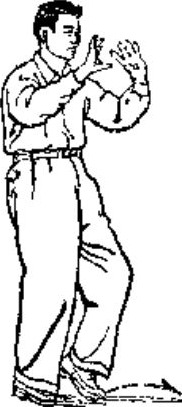
Movement four: the body turns slightly to the left and the left foot accordingly draws in beside the right, touching the ground with the toe, so that the right leg becomes full and the left leg empty. At the same time the left hand falls to before the abdomen, the left arm slightly bent, the fingers pointing forward; the right hand rises level with the crown of the head, the palm turned up; facing due east, with the upper body leaning slightly toward south. (Figure 86)
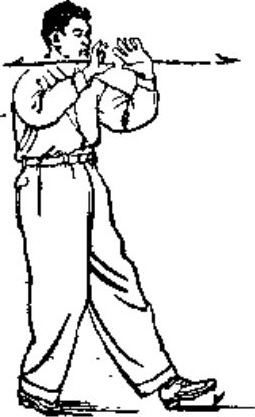
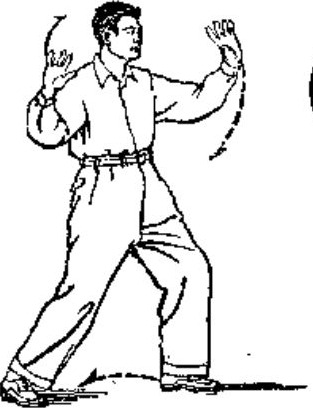
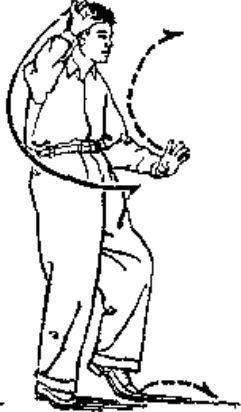
Movement one: the left foot steps forward, the toe pointing toward the left corner, touching the ground with the heel; the right heel presses, the left leg bows forward, the left sole settles flat, and the two legs become full-left and empty-right. At the same time the left hand moves upward past the abdomen and the right hand arcs from the right downward; the left hand is raised to before the forehead, level with the head, the palm turned slightly forward; the right hand falls and scoops up to the left to before the abdomen, the palm turned slightly down, the two hands facing each other above and below; facing the southeast diagonal. (Figure 87)
Movement two: with the left heel as the axis, the body turns right and the left toe accordingly turns inward 90 degrees, sitting the left leg full. The right foot lifts and rests before the left heel, touching the ground with the heel, the toe tilted up, the two legs still full-left and empty-right. At the same time the left hand moves from the left downward and the right hand arcs upward from before the abdomen; the right hand is raised to before the forehead, level with the head, the palm turned outward; the left hand falls and scoops up to the right to before the abdomen, the palm turned slightly down, the two hands facing each other above and below; facing the southwest diagonal. (Figure 88)
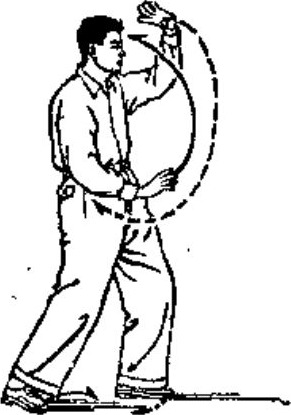
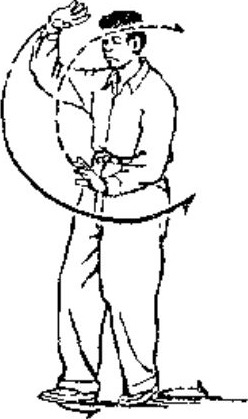
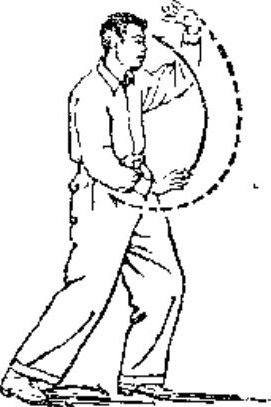
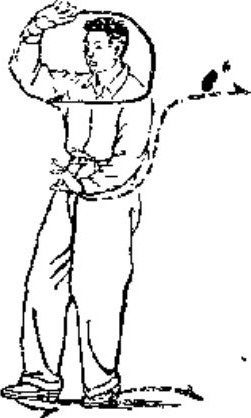
Movement three: the right toe turns inward about 90 degrees and settles, sitting the right leg full, and at the same time the body turns left; the left foot steps out to the left, touching first with the heel; then the right heel presses, the left leg bows forward, the left sole settles flat with the toe pointing toward the left corner, and the two legs still become full-left and empty-right. At the same time the left hand moves upward past the abdomen and the right hand arcs from the right downward; the left hand is raised to before the forehead, level with the head, the palm turned slightly forward, and the right hand falls and scoops up to the left to before the abdomen, the palm turned slightly down, the two hands facing each other above and below; facing the southeast diagonal. (Figure 89)
Movement four is the same as movement two of this posture. (Figure 90)
Three postures are joined into one section-sequence: movement one is "Single whip"; movements two and three are "Raise the hand and lift the posture"; movement four is "High pat the horse".
Movement one: the right toe turns inward about 90 degrees and settles; the right leg sits full, and at the same time the body turns left; the left foot steps out to the left, touching first with the heel; then the right heel presses, the left leg bows forward, the left sole settles flat with the toe pointing toward the left corner, and the two legs still become full-left and empty-right. At the same time the left hand rises and the right hand falls, both becoming upright palms; when the two hands come level with the mouth they part to left and right, the left hand level with the eyes and the right hand level with the mouth; facing a diagonal slightly east of south. (Figure 91)
Movement two: the right foot lifts, passes along the inner side of the left foot, and steps forward, touching first with the heel; then the left heel presses, the right leg bows forward, the right sole settles flat with the toe pointing ahead, the left leg bends slightly, and the legs become full-right and empty-left. At the same time the body turns slightly right. The two hands follow the movement: the right hand moves from the right downward and scoops to the left to before the abdomen, the fingers pointing forward; the left hand rises, the palm turned up, with the intent of lifting upward, level with the crown. As the right leg bows forward, the right hand pushes slowly forward (the upper body may not lean forward or backward), the right hand level with the chest; facing due south. (Figure 92)
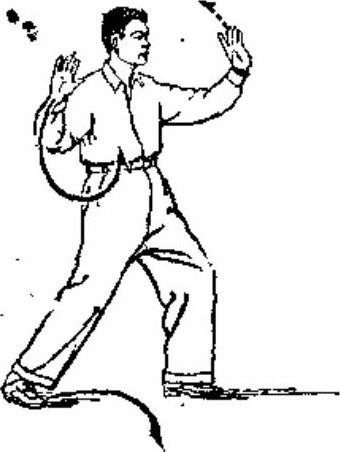
Movement three: the right toe turns inward about 45 degrees, pointing toward the southeast diagonal, and at the same time the waist revolves slightly left, sitting the right leg full; the two legs are still full-right and empty-left. (Figure 93)
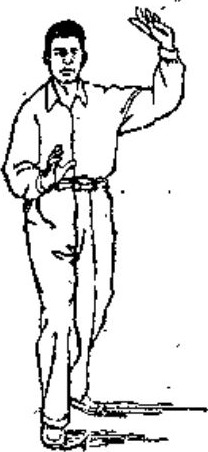
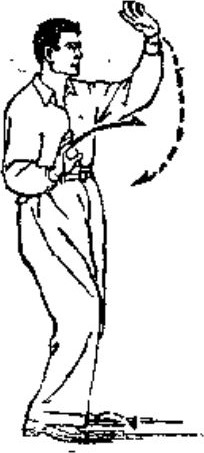
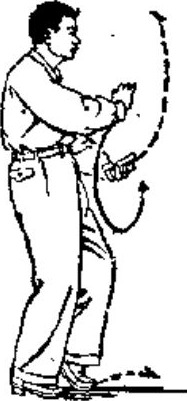
Movement four: the left hand arcs from the front downward and inward to before the abdomen, the palm turned up and the fingers pointing right; the right hand accordingly draws in near the right hip, then rubs and presses toward the chest, the palm turned down, level with the chest, facing the left hand above and below (both arms forming a half-circle). At the same time the body continues to turn left, facing due east. At the same time the left foot shifts close beside the right, touching the ground with the toe, and the two legs are still full-right and empty-left. (Figure 94)
The two postures are joined into one section-sequence: movements one and two are "Left subdue the tiger"; movements three and four are "Right kick".
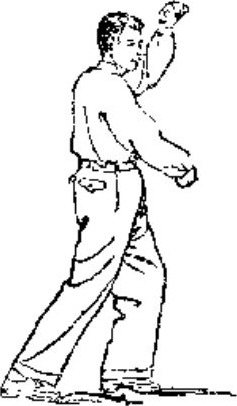
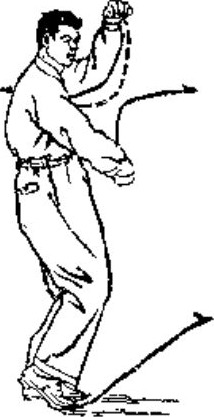
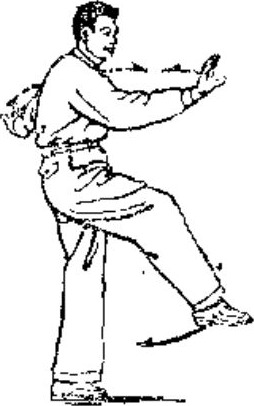
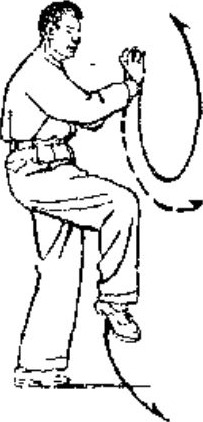
Movement one: the body turns slightly to the left; the left foot steps out toward the left-front diagonal, touching first with the heel; the right heel presses, the left leg bows forward, the left sole settles flat, so that the left leg becomes full and the right leg empty. As the left leg bows forward the two hands follow the movement: the left hand rises along the left leg and forward and up past the face, above the crown of the head; the right hand drops from before the chest outward and downward and the forearm rotates outward, coming to rest before the abdomen; the two hands close into fists at the same time, the eyes of the fists facing each other above and below, and as the fists close the body turns to the right. (Figure 95) Movement two: the whole weight shifts onto the left leg; the right foot lifts and touches forward with the toe beside the left foot. (Figure 96)
Movement three: the right leg lifts and the right toe kicks out to the right, level with the knee. At the same time the right fist rises and the left fist falls; when the two fists come level with the eyebrows both become upright palms and part to left and right, the right high and the left slightly lower, the right hand level with the eyebrows, the right arm in line with the right leg; the left leg bends slightly. (Figure 97)
Movement four: the left and right hands come together before the chest. At the same time the right leg does not move; the right shin hangs down, the toe pointing down, the heel near the left knee; facing the right-front diagonal. (Figure 98)
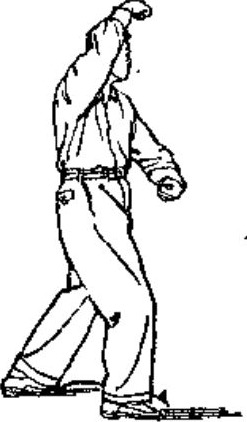
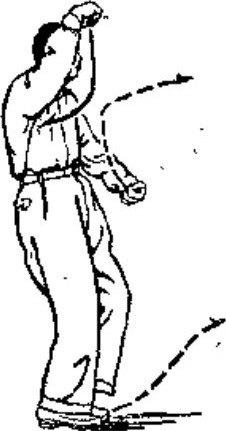
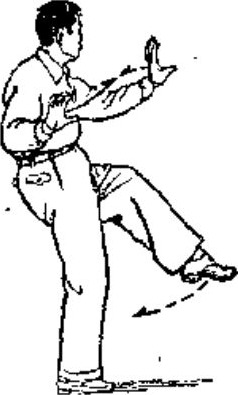
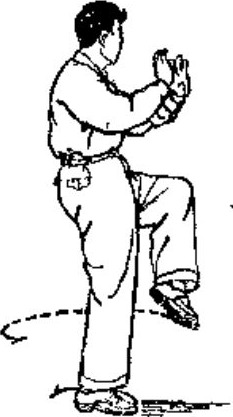
The two postures are joined into one section-sequence: movement one, movement two is "Right subdue the tiger"; movements three and four are "Left kick".
Movements one, two, three and four are the same as the explanation of the four movements of the thirty-seventh posture, "Left subdue the tiger", joined with the thirty-eighth posture, "Right kick", except that left and right are reversed and the direction differs slightly: this posture's heel-push is toward the northeast diagonal. (Figures 99–102)
Three postures are joined into one section-sequence: movements one and two are "Turn the body and push with the heel"; movement three is "Single whip"; movement four is "Tread the step and strike a blow".
Movement one: with the right heel as the axis, the body turns 180 degrees to the left-rear; facing due west. (Figure 103)
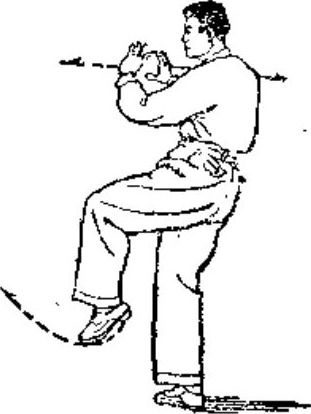
Movement two: the left toe tilts up and pushes forward with the heel, level with the knee, the right leg slightly bent. At the same time the two hands part left and right as upright palms, the left high and the right slightly lower, the left hand level with the shoulder, the left arm in line with the left leg; facing due west; the weight is still on the right leg, which bends slightly. (Figure 104)
Movement three: the left leg falls straight down, touching first with the heel, and at the same time the two hands come together before the chest. Then the right heel presses, the left leg bows forward, and the left sole settles flat and becomes full; as the left leg bows forward, the two hands part to left and right following the leg, forming the single-whip posture. (Figure 105)
Movement four: the left hand falls past the left hip, arcs up to the left and forward and down, and is still drawn back to beside the hip (without pausing), the palm turned down. At the same time the right hand rises past the right ear, arcs forward and down and back, and is still drawn back beside the right ear (without pausing) and closes into a fist, the eye of the fist turned left. As the two hands circle, the right foot steps up, the sole settling flat beside the left foot; then the left foot steps forward and settles, the toe pointing west; the right foot follows forward and touches with the toe behind the left foot, so that the left leg becomes full and the right leg empty; the upper body bends forward and, following the momentum, sinks slightly. At the same time as the body bends forward and sinks, the right fist drives down and forward past the chest from beside the ear, the centre of the fist turned inward, set before the two legs; at the same time the left palm presses down from beside the hip, the fingers pointing forward, set to the left of the shin. (Figure 106)
The requirement: when the body bends forward and sinks, the head must still be upright and the eyes look forward. The two arms must be slightly bent.
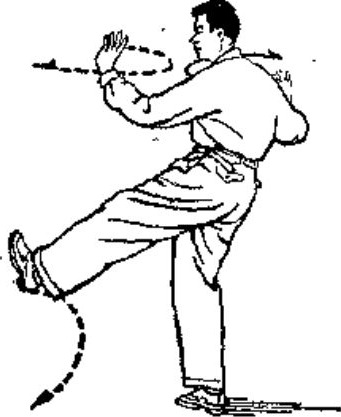
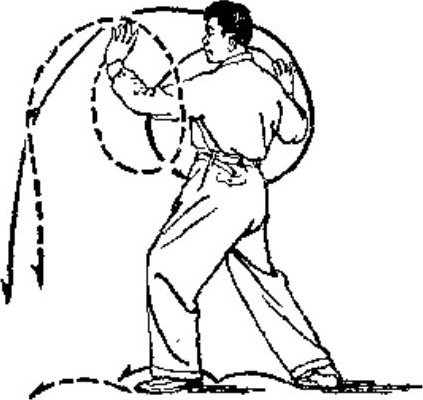
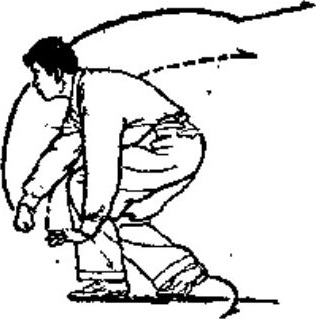
The two postures are joined into one section-sequence: movements one and two are "Turn the body over, second rise"; movements three and four are "Drape the body".
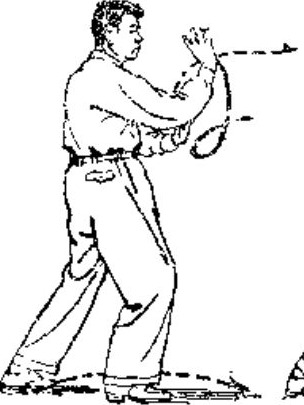
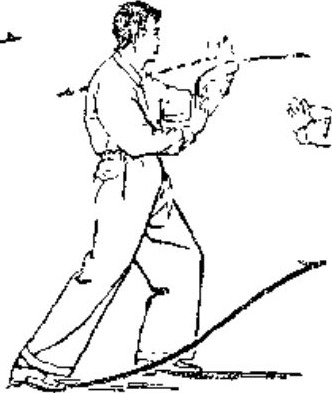
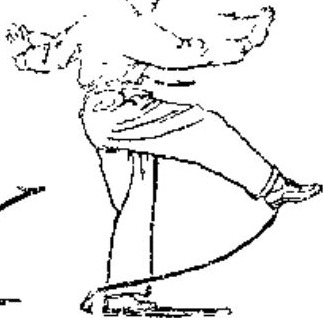
Movement one: with the left heel as the axis, the body flips over to the right-rear, and the left toe accordingly turns 135 degrees to the right, sitting the left leg full. At the same time the right fist rises with the turn of the body, passes before the face, and falls to the right-rear, becoming an upright palm before the chest; the left hand likewise rises as an upright palm to before the chest, the two hands right high and left low. The right leg turns with the body toward due east, and the right foot steps forward, touching first with the heel (as in the right lazy-tie-the-garment posture). The left heel presses, the right leg bows forward, the right sole settles flat, the left leg bends slightly, and the legs become full-right and empty-left; the two hands push slowly forward (the upper body may not lean forward or backward); facing due east. (Figure 107)
Movement two: the right toe turns slightly outward and settles; the left foot steps forward one long pace, touching first with the heel; then the right heel presses, the left leg bows forward, and the left sole settles flat and becomes full. At the same time the two hands, before the chest, circle with the left hand moving up and the right hand moving down; when the left hand comes level with the mouth and the right hand level with the chest, they push slowly forward as the left leg bows forward (the upper body may not lean forward or backward). (Figure 108 甲) Then the left toe turns slightly outward and settles, the whole weight shifts onto the left leg, the right leg lifts and the right toe kicks forward, level with the knee, the left leg bending slightly; at the same time the two hands part left and right, the right high and the left slightly lower, the right hand level with the shoulder, the right arm in line with the right leg, and the right hand having the intent of slapping the top of the right foot; facing due east. (Figure 108 乙) Movement three: the right leg falls; the right foot passes behind the left heel and settles flat on the left side behind the left heel, the two legs full-right and empty-left. At the same time the two hands draw in before the chest, the right hand level with the mouth and the left hand level with the chest. (Figure 109 甲) Then the left foot steps back one pace, the toe pointing toward the left-front diagonal, the left leg slightly bent, still empty-left and full-right; at the same time the two hands shift back with the retreating step. The weight shifts back, sitting the left leg full, and the right toe tilts up, so that the legs become full-left and empty-right; at the same time the two hands move from the front downward, drawing back in an arc before the chest. Then the left heel presses, the right leg bows forward, the right sole settles flat, and the legs still become full-right and empty-left; at the same time the two hands push slowly forward (the upper body may not lean forward or backward), the right hand level with the eyes and the left hand level with the chest; facing due east. (Figure 109 乙)
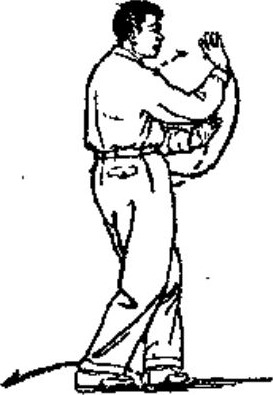
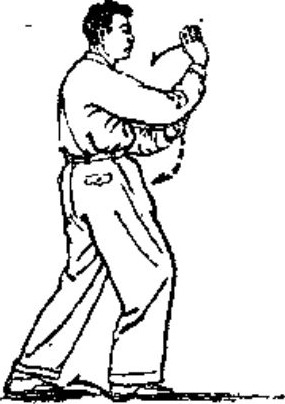
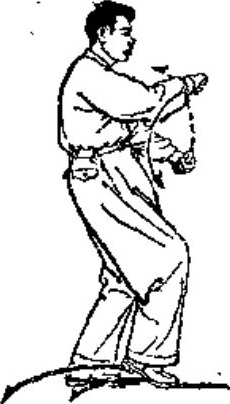
Movement four: the right leg draws back and touches with the toe before the left foot, and the body shifts back, so that the left leg becomes full and the right leg empty; the two hands shift back with the body and close into fists, the left fist set before the abdomen and the right fist level with the chest, the centres of the fists facing each other above and below and both arms forming a half-circle; facing due east. (Figure 110)
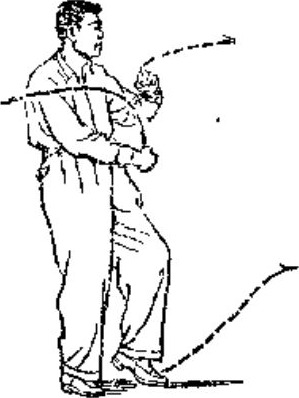
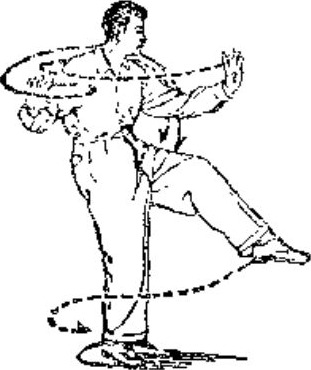
Three postures are joined into one section-sequence: movements one and two are "Step back and kick"; movement three is "Turn the body and push with the heel"; movement four is "Step up, deflect and intercept, punch".
Movement one: the right foot withdraws behind the left and settles, the toe pointed toward the right-front diagonal; the weight shifts back, the left leg draws in with the toe touching before the right foot, so that the right leg becomes full and the left leg empty. At the same time the two fists shift back with the body: the left circles up and the right circles down, the left fist level with the chest and the right fist set before the abdomen, the centres of the fists facing each other above and below and both arms forming a half-circle; facing due east. (Figure 111)
Movement two: the whole weight shifts onto the right leg, which bends slightly; the left leg lifts and the left toe kicks forward, level with the knee. At the same time the two fists open into upright palms parted left and right, the left high and the right slightly lower, the left hand level with the shoulder, the left arm in line with the left leg; facing due east. (Figure 112)
Movement three: the left leg does not move; the shin hangs down, the toe pointing down; with the right heel as the axis, the body and the right toe turn about 270 degrees to the right-rear, and then the left foot settles flat to the north (slightly toward east), the right leg bending slightly and becoming empty. Before the turn, the two hands draw in as upright palms to before the chest above the left leg as the body revolves; when the left foot lands, the left and right palms turn down, the two hands with the intent of pressing down, the fingers pointing forward, the two arms slightly bent; facing the northeast diagonal. (Figure 113) Then the whole weight shifts onto the left leg, and the two hands and the right leg lift together; the right toe tilts up and pushes forward with the heel, level with the knee, the two legs bending slightly. At the same time the two hands part left and right as upright palms, the right high and the left slightly lower, the right hand level with the shoulder, the right arm in line with the right leg; facing due east. (Figure 114)
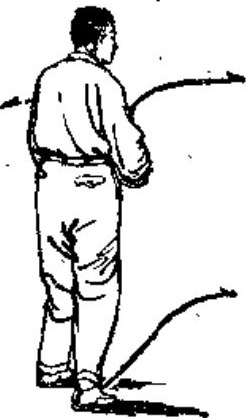
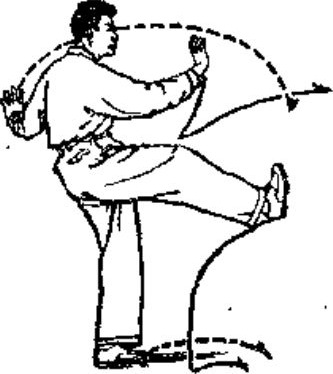
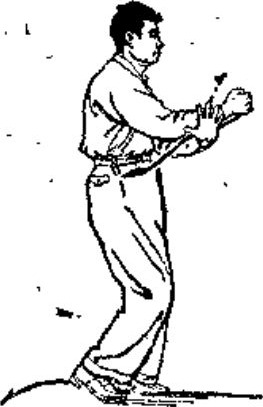
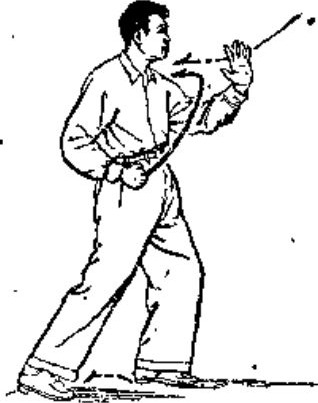
Movement four: the right leg falls forward and the right foot settles beside the left heel; the left foot steps forward and up, and the left leg then bows forward and becomes full; the right foot follows forward, touching with the toe beside the left heel, and the legs still become full-left and empty-right. As the right foot steps up, the left hand arcs up and forward and falls to before the chest, and the right hand falls beside the right hip and closes into a fist. As the right foot follows, the right fist drives slowly forward along the back of the left hand (the upper body may not lean forward or backward), the eye of the fist turned up, level with the heart; facing due east. (Figure 115)
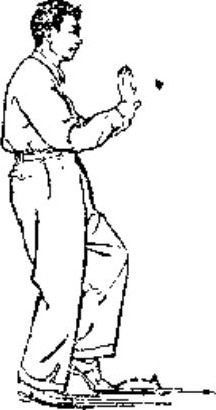
Movements one, two, three and four are the same as the four movements of the twelfth posture, "As if sealing, as if closing". (Figures 116–119)
Movements one, two, three and four are the same as the four movements of the thirteenth posture, "Embrace the tiger and push the mountain". (Figures 120–123)
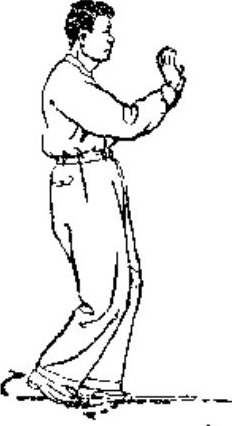
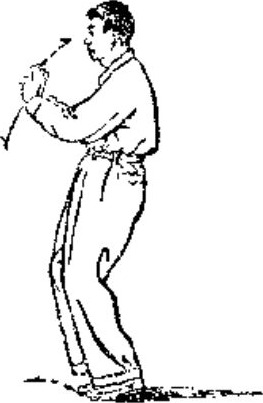
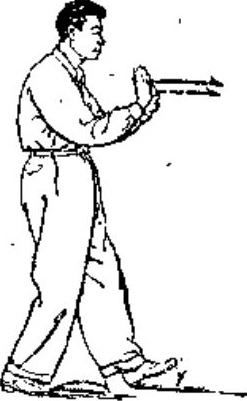
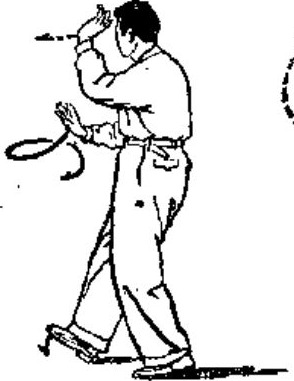
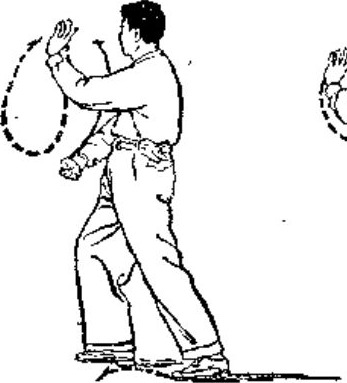
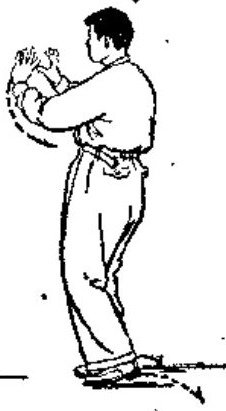
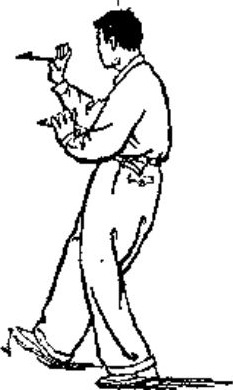
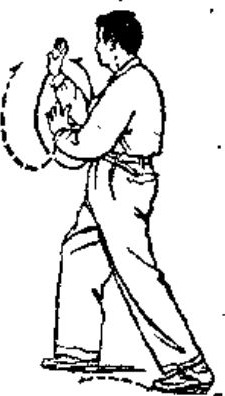
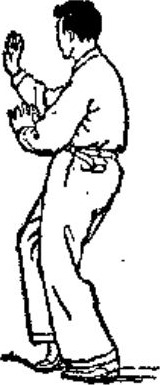
The two postures are joined into one section-sequence: movements one and two are "The hand plays the lute"; movements three and four are "Right lazy tie the garment".
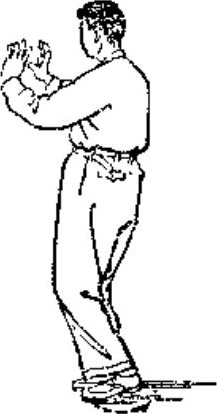
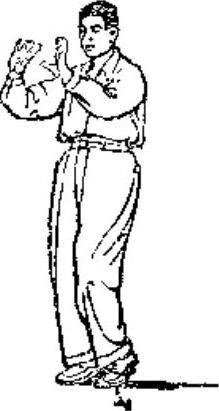
Movements one and two are the same as movements one and two of the fourteenth posture, "The hand plays the lute", are the same, except that the direction differs: this posture faces the northwest diagonal. (Figures 124–125)
Movements three and four are the same as movements three and four of the third posture, "Right lazy tie the garment", except that the direction differs: this posture faces the northwest diagonal. (Figures 126–127)
The two postures are joined into one section-sequence: movements one, two and three are "Diagonal single whip"; movement four is "Lower the posture".
Movements one, two and three are the same as movements one, two and three of the fourth posture, "Single whip", except that the direction and angle differ: this posture faces due south, with the chest toward south slightly toward the west. (Figures 128–130)
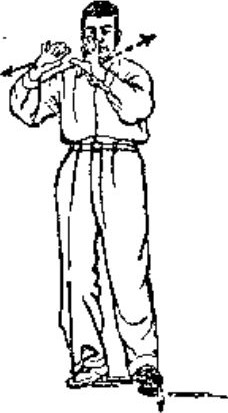
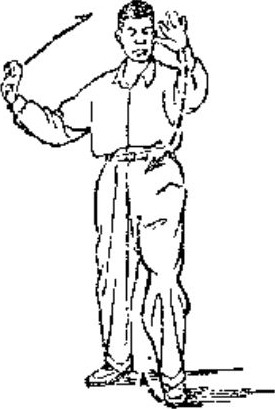
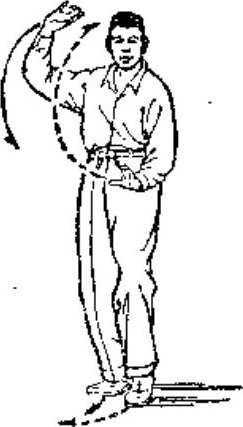
Movement four is the same as movement four of the thirty-second posture, "Lower the posture", except that the direction and angle differ. (Figure 131)
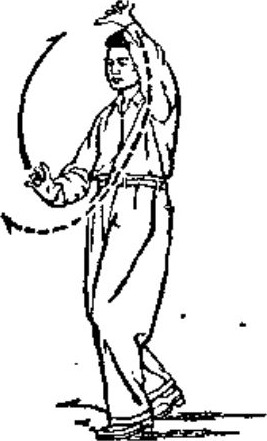
Movement one: the left foot steps up toward the southwest diagonal. At the same time the left hand arcs from before the abdomen up and to the right, rising to before the forehead level with the crown, the palm turned outward; the right hand arcs down and scoops up to the left to before the abdomen, the fingers pointing up. As the two hands arc, the right foot follows forward and touches with the toe beside the left heel, so that the legs become full-left and empty-right; facing the southwest diagonal. (Figure 132)
Movement two: the right foot steps up toward the northwest diagonal and the body turns right. At the same time the right hand arcs from before the abdomen up and to the left, rising to before the forehead level with the crown, the palm turned outward; the left hand arcs down and scoops up to the right to before the abdomen, the fingers pointing up. As the two hands arc, the left foot follows forward and touches with the toe beside the right heel, so that the legs become full-right and empty-left; facing the northwest diagonal. (Figure 133)
Movement three: the same as the explanation of movement one of this posture, except that after the left foot steps up the body turns slightly to the left. (Figure 134)
Movement four: the right foot steps up toward due west. At the same time the left hand arcs downward and the right hand rises from before the abdomen, the two hands becoming upright palms as in the right lazy-tie-the-garment posture. Then the two hands push slowly forward, the left hand inside and level with the chest, the right hand outside and level with the eyes; the left foot accordingly follows forward and touches with the toe behind the right heel, so that the legs become full-right and empty-left; facing due west. (Figure 135)
Movement one: the left toe shifts back to the left and touches the ground; with the right heel as the axis, the body and the right toe turn 135 degrees to the left, facing the southeast diagonal, still with the right leg full and the left leg empty. At the same time the left hand circles down, to the left and up, and joins the right hand before the chest, the two hands still as upright palms, level with the mouth. (Figure 136)
Movements two and three are the same as movements two and three of the fourth posture, "Single whip". (Figures 137–138)
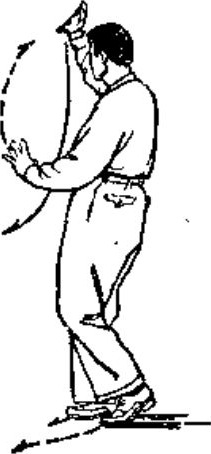
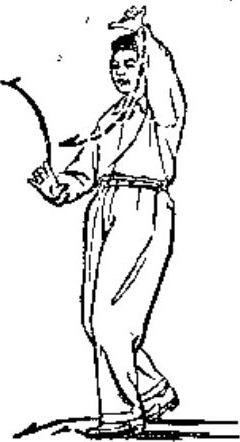
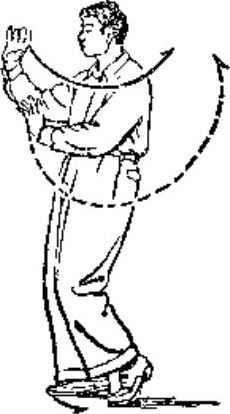
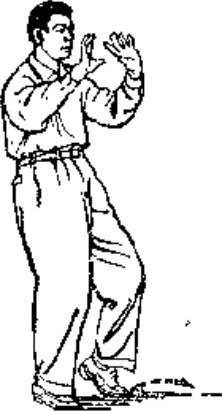
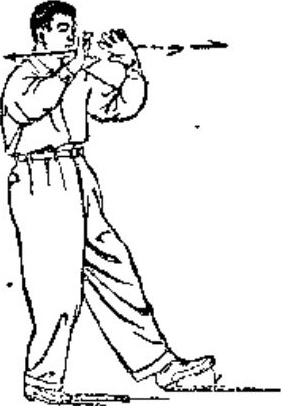
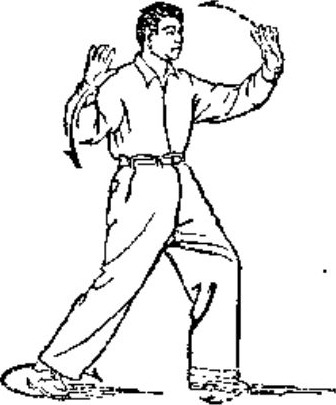
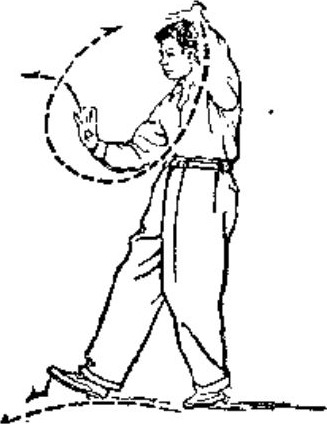
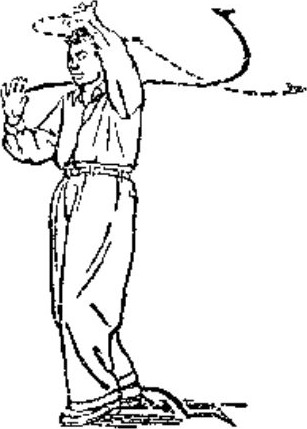
Movement four: the left toe turns inward about 90 degrees and the left leg sits full, the body turning right accordingly; the right heel touches the ground and the toe tilts up, turning with the body, the right leg bending slightly, the legs still full-left and empty-right. At the same time the left hand rises, level with the head, the palm turned up; the right hand falls as an upright palm before the chest; facing due west. (Figure 139)
Movement one: the right leg bows forward and the weight shifts onto the right leg; the left foot then steps up toward the southwest diagonal and the right foot immediately follows forward, touching with the toe beside the left heel, so that the left leg becomes full and the right leg empty. At the same time the left hand falls, circles forward and up, and is lifted past the face to above the forehead, the fingers pointing right; the right hand rises slightly and, as the body shifts forward and the right foot follows, pushes slowly forward (the upper body may not lean forward or backward); facing the southwest diagonal. (Figure 140)
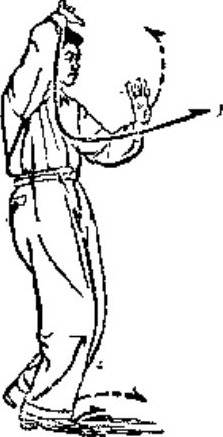
Movement two: the right foot lifts, passes behind the left foot to the left side of the left heel, and touches the ground with the toe; with the left heel as the axis, the body and the left toe bend back to the right at the same time; then the right foot steps up and settles toward the southeast diagonal, the left foot follows forward and touches with the toe beside the right heel, so that the right leg becomes full and the left leg empty. At the same time as the body turns and the foot steps up, the left hand arcs down and the right hand arcs up; the right hand is lifted past the face and set above the forehead, the fingers pointing left; the left hand falls to before the chest. As the body shifts forward and the left foot follows, the two hands push the mountain forward slowly (the upper body may not lean forward or backward); facing the southeast diagonal. (Figure 141)
Movement three: the left foot steps up and settles toward the northeast diagonal, the right foot follows forward and touches with the toe beside the left heel, so that the legs become full-left and empty-right. At the same time the left hand arcs up, is lifted past the face, and is set above the forehead with the fingers pointing right; the right hand falls to before the chest. As the body shifts forward and the right foot follows, the two hands push slowly forward (the upper body may not lean forward or backward); facing the northeast diagonal. (Figure 142)
Movement four is the same as movement two of this posture, except that the direction and angle differ: in this posture the right foot steps up toward the northwest diagonal. (Figure 143)
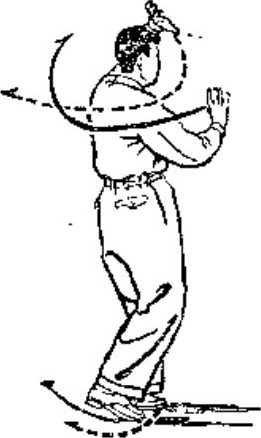
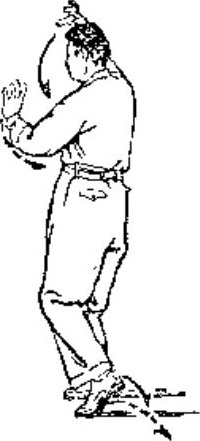
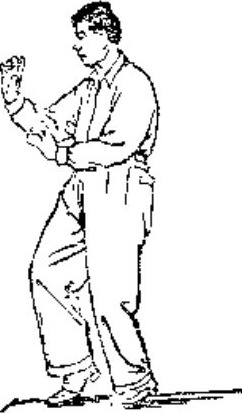
The two postures are joined into one section-sequence: movements one and two are "The hand plays the lute"; movements three and four are "Right lazy tie the garment".
Movements one and two are the same as movements one and two of the fourteenth posture, "The hand plays the lute". (Figures 144–145)
Movements three and four are the same as movements three and four of the fifteenth posture, "Right lazy tie the garment". (Figures 146–147)
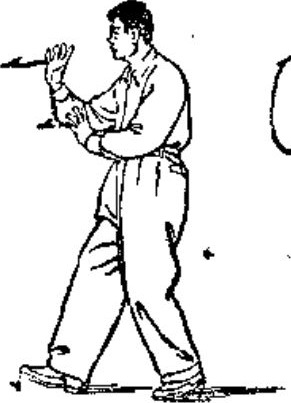
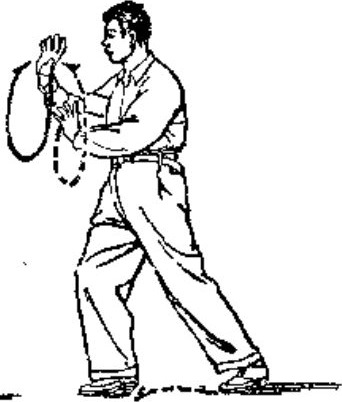
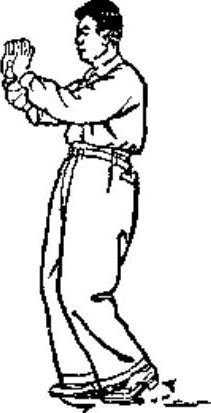
The two postures are joined into one section-sequence: movements one, two and three are "Single whip"; movement four is "Lower the posture".
Movement one is the same as movement one of the sixteenth posture, "Single whip". (Figure 148)
Movements two and three are the same as movements two and three of the fourth posture, "Single whip". (Figures 149–150)
Movement four is the same as movement four of the section-sequence joining the thirty-first posture, "Single whip", and the thirty-second posture, "Lower the posture". (Figure 151)
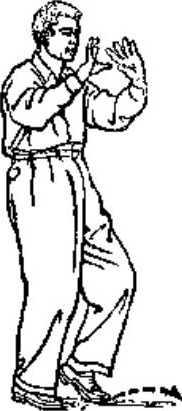
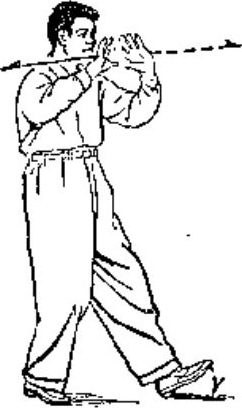
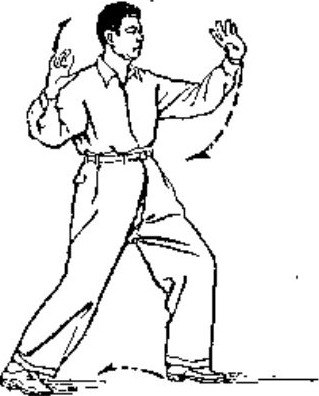
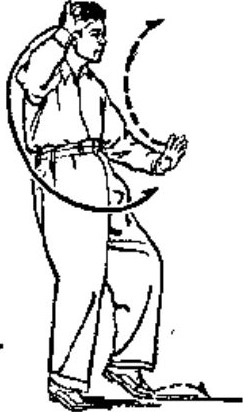
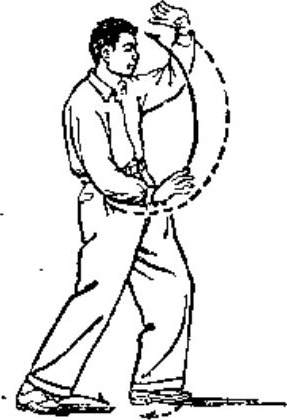
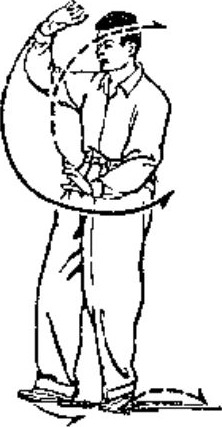
Movements one, two, three and four are the same as the four movements of the thirty-third posture, "Thread the hands". (Figures 152–155)
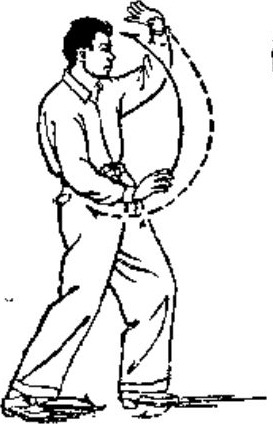
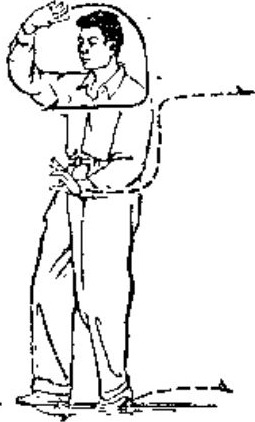
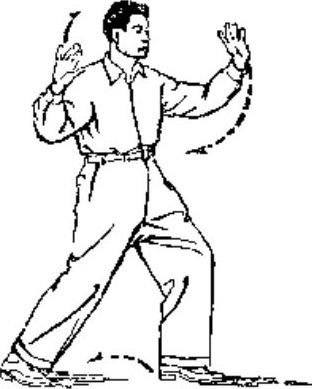
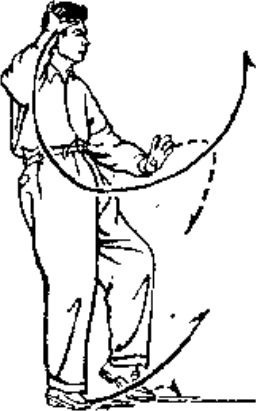
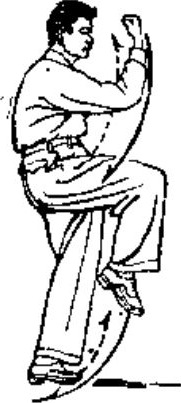
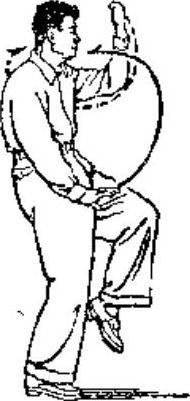
Three postures are joined into one section-sequence: movement one is "Single whip"; movement two is "Lower the posture"; movements three and four are "The golden rooster stands on one leg".
Movement one is the same as movement one of the thirty-fourth posture, "Single whip". (Figure 156)
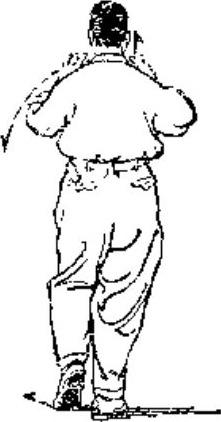
Movement two is the same as the section-sequence joining the thirty-first posture, "Single whip", and the thirty-second posture, "Lower the posture", Movement two is the same as movement four of the section-sequence joining the thirty-first posture, "Single whip", and the thirty-second posture, "Lower the posture". (Figure 157)
Movement three: the left foot steps forward and settles with the toe pointing due east; the weight gradually shifts wholly onto the left leg and the body turns slightly left accordingly; the right leg accordingly lifts forward, the knee bent and the thigh level, the shin hanging down with the toe pointing down, so that the left leg becomes the standing leg; as the leg lifts, the right hand drops to the right past the right hip, closes into a fist and rises level with the crown, the centre of the fist turned inward and the forearm upright, above the right thigh; the left hand rises slightly at the same time, then presses down beside the left hip level with the right thigh, the fingers pointing forward, the left arm slightly bent; facing due east. (Figure 158)
Movement four: the right sole falls beside the left foot and settles; the left leg then lifts, the knee bent and the thigh level, the shin hanging down with the toe pointing down, so that the right leg becomes the standing leg. At the same time the right fist opens into a palm and presses down beside the right hip level with the left thigh, the fingers pointing forward, the right arm slightly bent; the left hand at the same time closes into a fist beside the left hip and rises level with the crown, the centre of the fist turned inward and the forearm upright, above the left thigh. (Figure 159)
Movement one: the left foot falls and touches with the toe behind the right heel; the two hands become upright palms parted left and right, level with the shoulders; with the right heel as the axis, the body and the right toe turn 90 degrees to the left, sitting the right leg full; as the body turns the two hands come to face each other and join before the chest with the intent of holding a ball, level with the mouth. (Figure 160)
The requirement is relaxed shoulders and sunk elbows, with a lively roundness between the hands and the chest and arms, and the two legs must be empty-left and full-right.
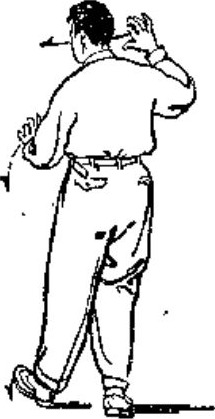
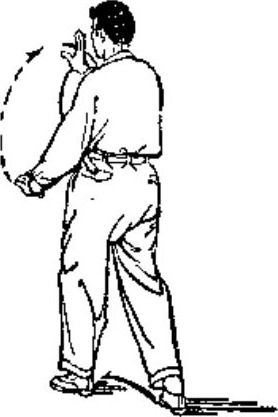
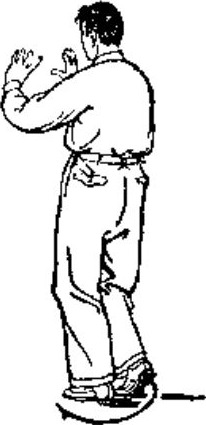
Movements two, three and four are the same as movements two, three and and four are the same. (Figures 161–163)
Movements one, two, three and four are the same as the four movements of the twentieth posture, "Right push back the monkey". (Figures 164–167)
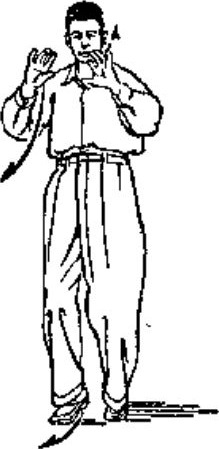
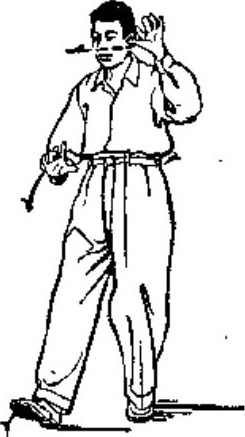
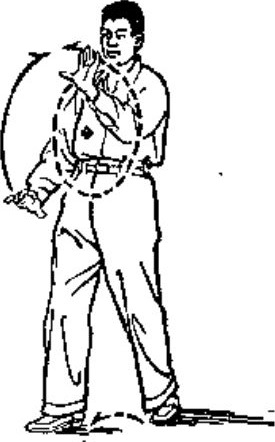
Movements one, two, three and four are the same as the four movements of the twenty-first posture, "Left push back the monkey". (Figures 168–171)
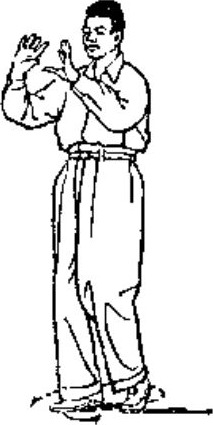
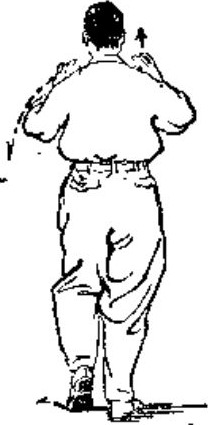
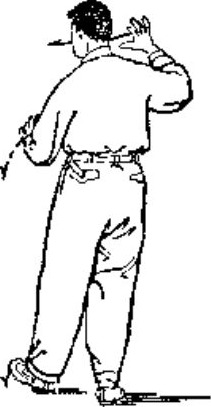
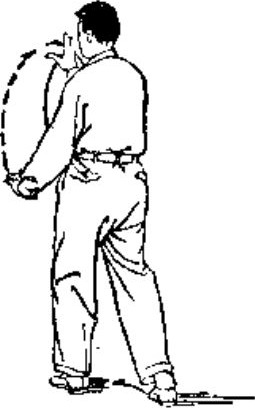
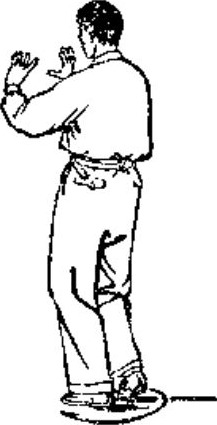
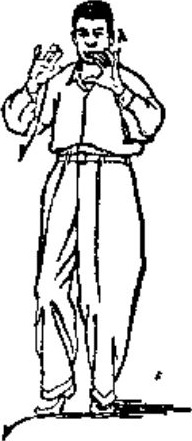
Movements one, two, three and four are the same as the four movements of the twentieth posture, "Right push back the monkey". (Figures 172–175)
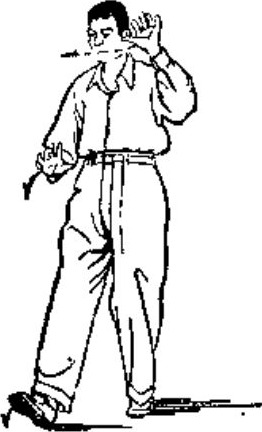
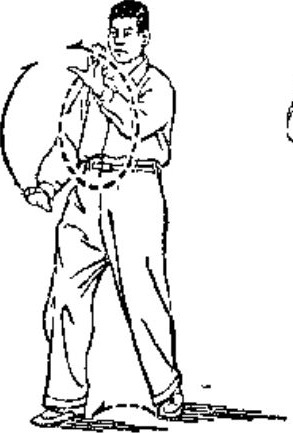
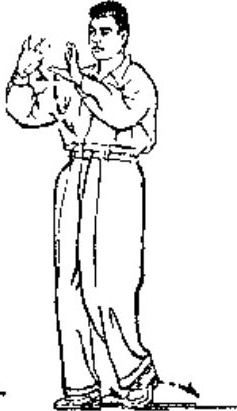
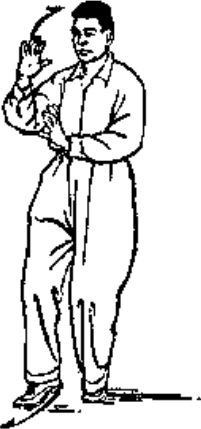
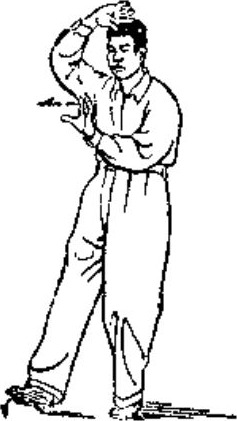
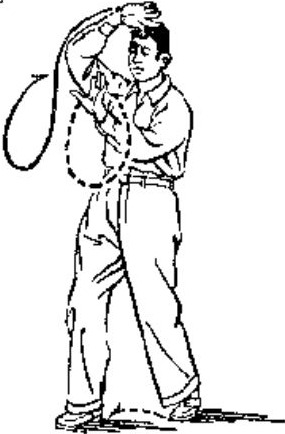
The two postures are joined into one section-sequence, and the explanation of its four movements is the same as that of the section-sequence joining the twenty-third posture, "The hand plays the lute", and the twenty-fourth posture, "The white goose spreads its wings". (Figures 176–179)
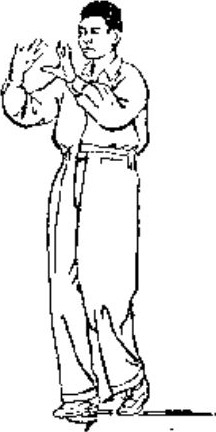
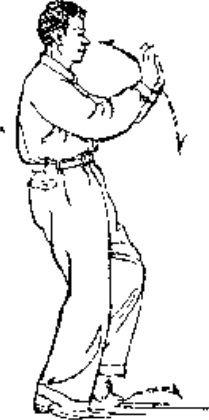
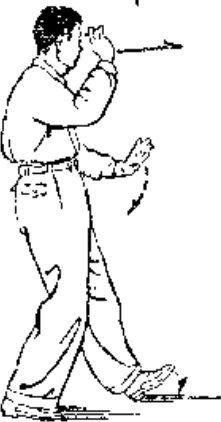
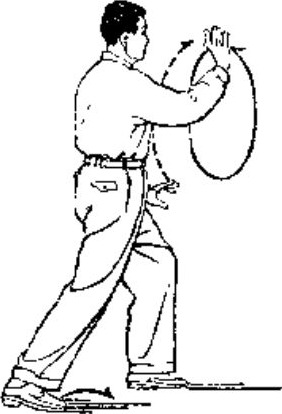
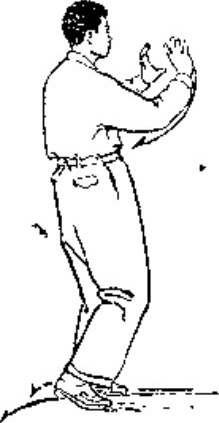
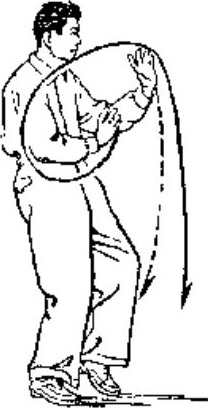
Movements one, two, three and four are the same as the four movements of the seventh posture, "Brush the knee and twist the step". (Figures 180–183)
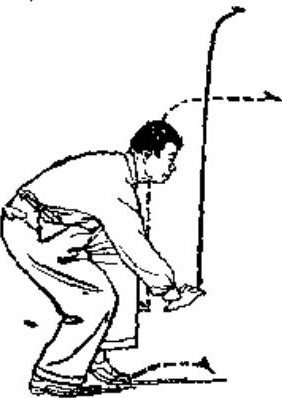
Four postures are joined into one section-sequence, and the explanation of its movements is the same as that of the section-sequence joining the twenty-sixth posture, "The hand plays the lute", the twenty-seventh posture, "Drape the posture", the twenty-eighth posture, "Blue dragon issues from the water", and the twenty-ninth posture, "Turn the body over". (Figures 184–187)
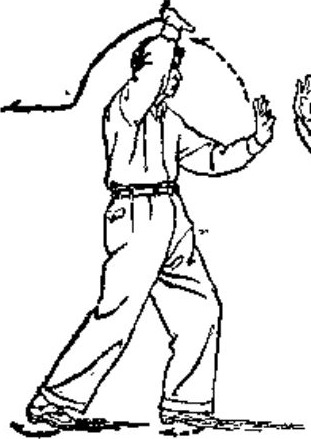
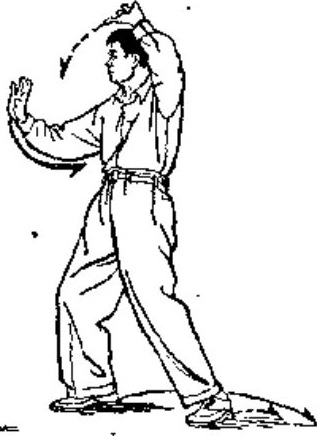
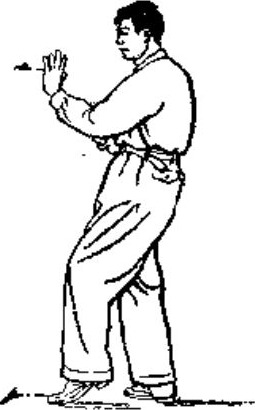
Movements one, two, three and four are the same as the four movements of the thirtieth posture, "Three Yong-shan peaks". (Figures 188–191)
The two postures are joined into one section-sequence, and the explanation of its movements is the same as that of the section-sequence joining the thirty-first posture, "Single whip", and the thirty-second posture, "Lower the posture". (Figures 192– 195)
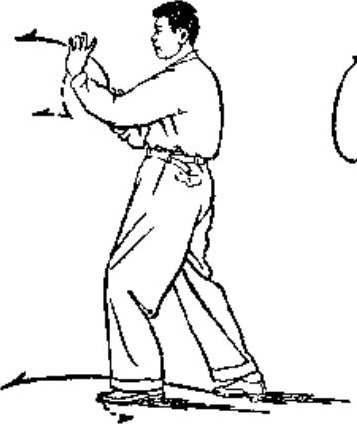
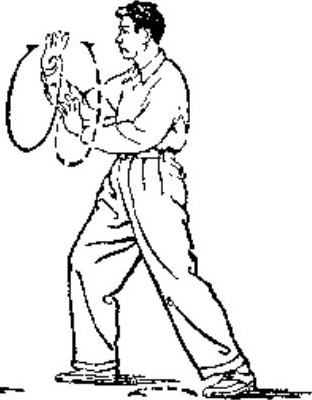
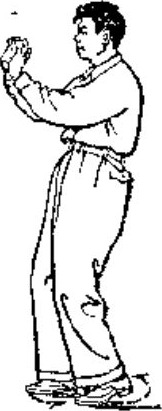
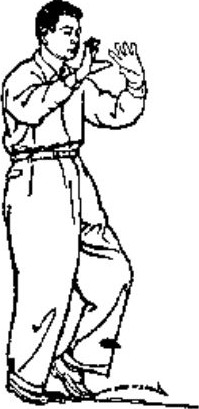
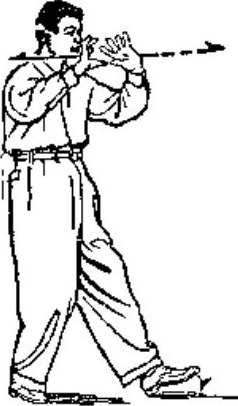
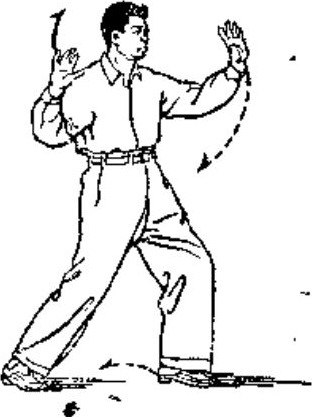
Movements one, two, three and four are the same as the four movements of the thirty-third posture, "Thread the hands". (Figures 196–199)
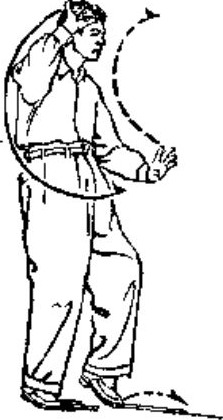
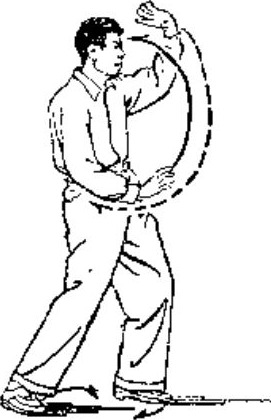
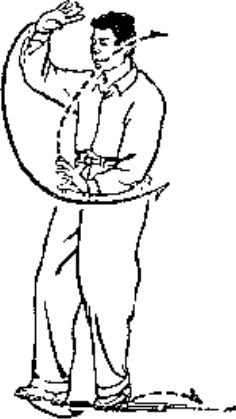
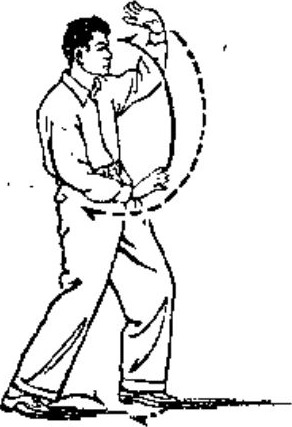
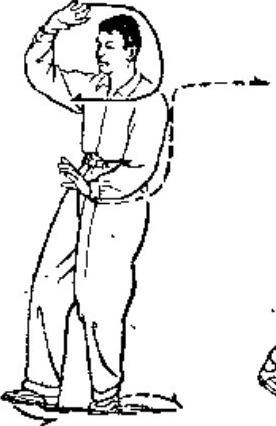
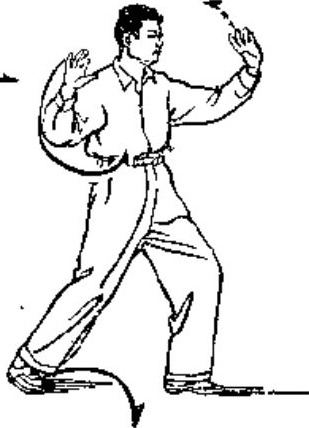
Three postures are joined into one section-sequence, and the explanation is the same as that of the section-sequence joining the thirty-fourth posture, "Single whip", the thirty-fifth posture, "Raise the hand and lift the posture", and the thirty-sixth posture, "High pat the horse", the explanation of whose movements is the same. (Figures 200–203)
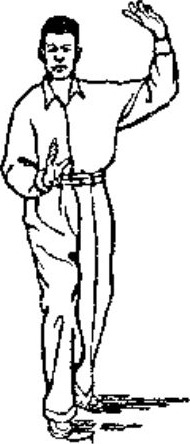
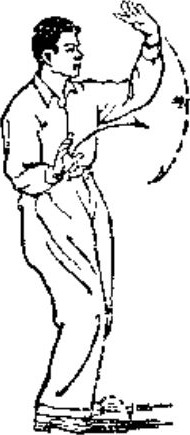
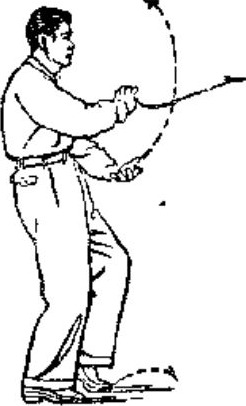
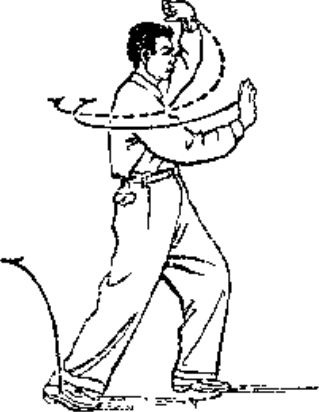
Four postures are joined into one section-sequence: movement one is "Palm to the heart"; movement two is "Turn the body, cross-swing the lotus"; movement three is "Step up, punch to the crotch"; movement four is "Right lazy tie the garment".
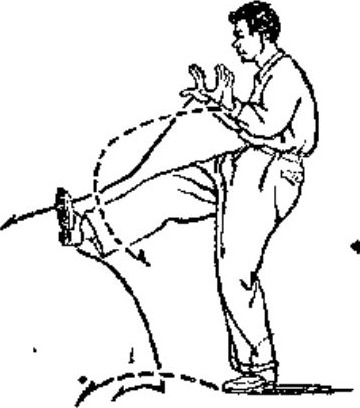
Movement one: the left foot steps out due east, touching first with the heel; the right heel presses, the left leg bows forward, the left sole settles flat, the right leg bends slightly, and the two legs become full-left and empty-right. The left hand passes in front of the right hand (its palm turning down), rises and is lifted past the face (the palm turning up as it lifts), and is set above the forehead, the fingers pointing right; the right elbow hangs down, and the right hand becomes an upright palm and pushes slowly forward as the left leg bows forward (the upper body may not lean forward or backward), the right hand level with the chest; facing due east. (Figure 204)
Movement two: with the left heel as the axis, the body turns to the right-rear and the left toe turns 135 degrees to the right and settles, the whole weight shifting onto the left leg; the right toe tilts up and the right leg lifts, arcing forward from the left as the body turns, the sole facing forward and level with the knee, the two legs bending slightly. At the same time as the turn, the left hand drops from the front to the outside of the right hand and crosses it before the chest, forming the shape of a cross. As the right leg lifts and arcs, the two hands part left and right as upright palms with the fingers pointing up, level with the shoulders; facing due west. (Figure 205)
Movement three: the right sole settles flat beside the left foot; the left foot steps forward and up, the toe pointing toward the left-front diagonal, the left leg bows forward, and the right foot then follows forward, touching with the toe beside the left foot, the two legs still becoming full-left and empty-right. As the left foot steps up, the left hand brushes down past the chest and the left knee and is set beside the left leg with the fingers pointing forward; the right hand at the same time falls beside the right hip and closes into a fist, the centre of the fist turned down, and as the right foot follows it drives slowly forward and down, the right fist level with the chest and the two arms slightly bent; the body at the same time leans slightly forward; facing due west. (Figure 206)
Movement four: the right foot steps forward and up. At the same time the right fist opens; the two hands straighten with the upper body into upright palms and rise to before the chest, the right hand high and the left low, and push slowly forward (the upper body may not lean forward or backward), the palms turned slightly forward, the right hand level with the eyes and the left hand level with the chest. As the two hands push forward the left foot follows forward, touching with the toe behind the right heel, and the two legs become full-right and empty-left; the face still toward due west. (Figure 207)
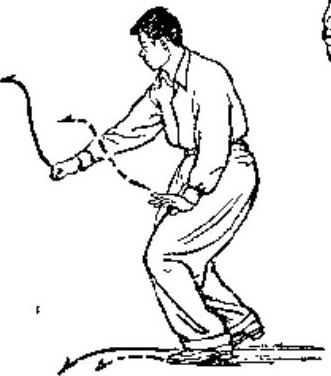
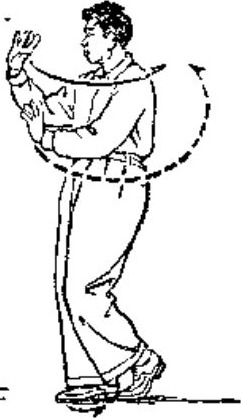
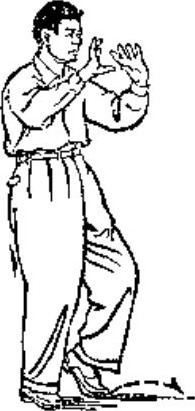
The two postures are joined into one section-sequence: movements one, two and three are "Single whip"; movement four is "Lower the posture".
Movement one is the same as movement one of the fifty-sixth posture, "Single whip". (Figure 208)
Movements two, three and four are the same as movements two, three and four of the section-sequence joining the thirty-first posture, "Single whip", and the thirty-second posture, "Lower the posture". (Figures 209–211)
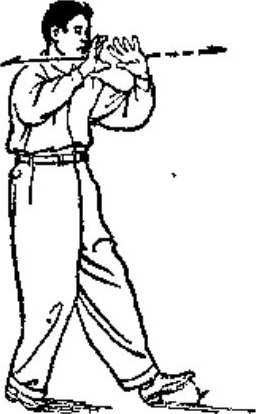
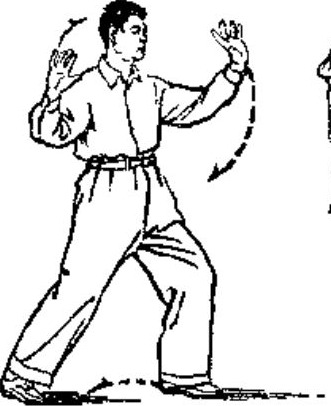
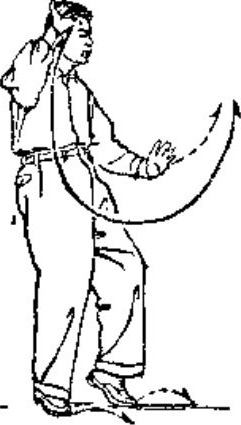
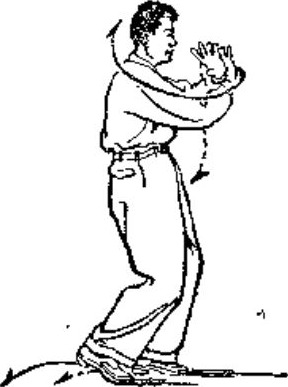
Five postures are joined into one section-sequence: movement one is "Step up to seven stars"; movement two is "Step back and bestride the tiger"; movement three is "Turn the foot and swing the lotus" and "Bend the bow and shoot the tiger"; movement four is "Double embracing punch".
Movement one: the left foot steps forward, the toe pointing straight ahead, sitting the left leg full; the body turns slightly right; the right foot follows forward and touches with the toe beside the left heel, so that the two legs become full-left and empty-right. At the same time the right hand moves down to the right past the hip and scoops forward, and together with the left hand rises to before the chest; the two hands cross, level with the mouth, the fingers pointing up, the right hand outside, the backs of the hands facing each other; the face toward due east. (Figure 212)
Movement two: the right foot steps back and settles, the toe pointed toward the right-front diagonal; the left foot draws back and touches with the toe before the right foot, so that the two legs become full-right and empty-left. At the same time the two hands follow the movement: the right hand parts to the upper right and the left hand to the lower left; the right hand is held as an upright palm circling before the right of the head, level with the crown, and the left hand, its palm turned down and the fingers pointing forward, is set before the left hip, the two arms bent; facing due east. (Figure 213)
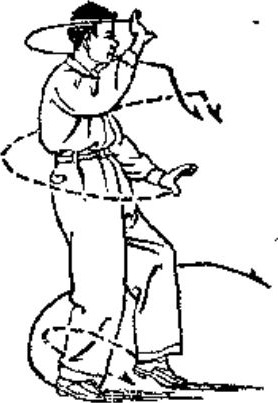
Movement three: (turn the foot and swing the lotus) the left foot lifts (level with the knee, the toe pointing down) and swings out to the right; following the momentum, with the right sole as the axis, the body turns to the right-rear, and the left foot falls at the northeast diagonal and settles; the right foot then lifts, passes before the left leg, rises and swings crosswise to the right. The two hands remain as they were during the turn; when the right foot swings up, the left hand rises to the upper right corner level with the right hand, and then the two hands (left first, then right) come down from above to meet and slap the top of the right foot as it swings out (Figure 214 shows the posture of turning the foot and swinging the lotus just before the foot is slapped). (Bend the bow and shoot the tiger) Then the right foot falls toward the southeast diagonal, touching first with the heel; then the left heel presses, the right leg bows forward, the right foot settles flat, and the two legs become full-right and empty-left. At the same time the two hands arc upward, forward and down, draw back past the right knee, and rise past the lower abdomen to before the chest, closing into fists; the weight shifts back, and as the right leg bows forward again the left fist parts to the upper-left diagonal and the right fist to the lower-right diagonal, forming the shape of drawing a bow, the left fist with its centre turned forward and level with the mouth, the right fist with its centre turned down and set before the right hip; facing the northeast diagonal. (Figure 215)
Movement four: the left leg lifts and steps forward one long pace, touching first with the heel; then the right leg becomes full and the right foot follows forward, touching with the toe behind the left heel, so that the two legs become empty-right and full-left. As the left foot steps up the two fists fall respectively beside the left and right hips; as the right foot follows, the two fists lift slightly and then drive slowly forward and down, the eyes of the fists facing each other, level with the abdomen, the two arms slightly bent; facing due east. (Figure 216)
Movement: the right foot lifts and moves behind the left foot, settling with the toe pointing due south; the left foot draws back and touches with the left toe before the right foot, so that the two legs become full-right and empty-left. At the same time the body turns right, and the two fists lift and become upright palms, each circling once before the chest, forming the hand-plays-the-lute posture, the left hand level with the mouth and the right hand fallen to before the abdomen; facing a diagonal south of east. (Figure 217)
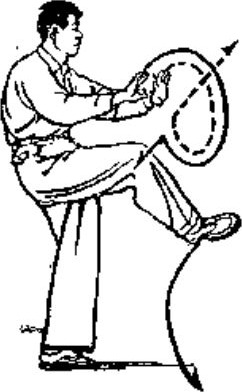
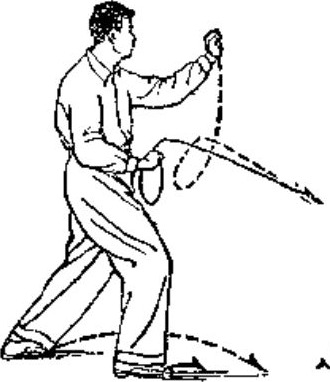
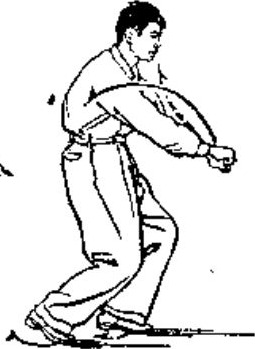
Movement: the left foot steps in beside the right, the body turns square, and the two hands press down to left and right and are set beside the hips (Figure 218). Then the two hands hang naturally, the body stands upright, and the preparatory posture is resumed. (Figure 219)
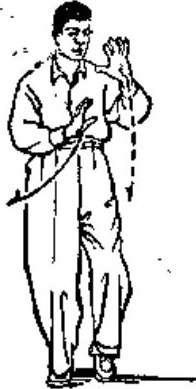
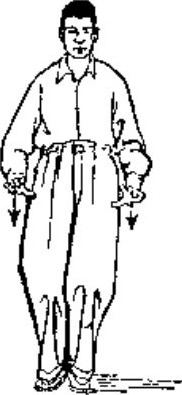
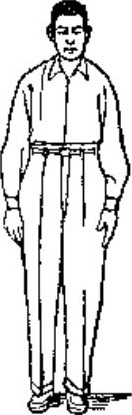
Illustrated explanation of Wu-style taijiquan push-hands Taijiquan push-hands was originally called "hitting hands". Of what Wu Yuxiang and Li Yishe handed down, there is only the one kind — moving-step push-hands. Why adopt only moving-step push-hands and not fixed-step? The reason is that moving-step push-hands can be applied with agility and has no defect of stiffness; it trains both the stepping method and the body method, and at the same time allows practice of "stick, connect, adhere, follow". Moreover, in the course of the movement one is constantly able to keep a centred and stable posture, and can still issue energy while in motion. Once practised to familiarity, one can reach what the ancients called "walking, stopping, sitting, lying" — all of them states of practising the form.
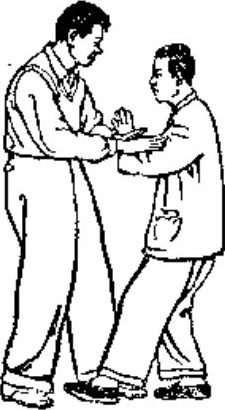
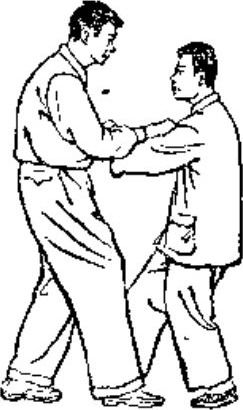
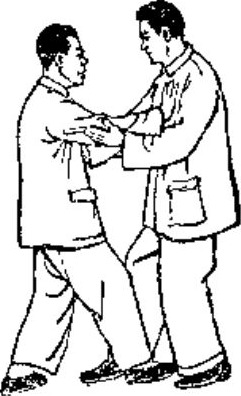
The stepping method of Wu-style push-hands is three and a half steps forward, three and a half steps back. On the first and second steps forward, the advancing foot is placed on the outside of the opponent's front foot; on the third step forward, one foot is placed between the opponent's steps; on the fourth step the rear foot moves up beside the front foot with the toe touching the ground lightly, which is called a half-step. Whether placed on the outside of the opponent or between his steps, one should keep slightly close to the opponent's front foot. On one straight line I advance and he retreats, and he advances and I retreat. Above, the four hands of "ward-off, roll-back, press, push" are applied, the same as in the other kinds of push-hands, so they will not be drawn and explained again; only a few of the postures in which energy is issued are set out below for reference. (Figures 220–225)
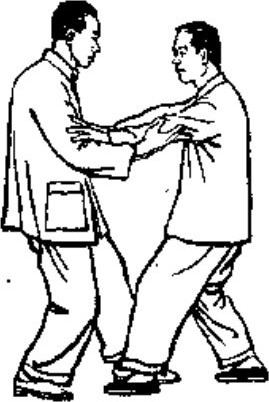
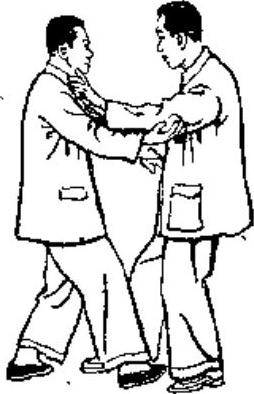
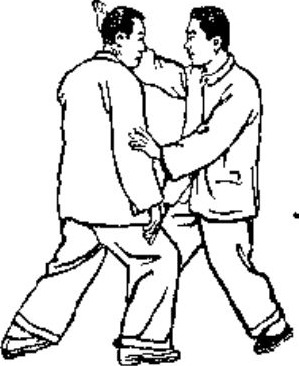
Appendix — Classical treatises on the art
Phần 11
Treatise on taijiquan
Wang Zongyue of Shanyou Taiji is born of wuji and is the mother of yin and yang. In movement it divides; in stillness it joins. Neither excess nor deficiency: follow the bend and yield to the extension. When the other is hard and I am soft, this is called "walking away"; when I am yielding and the other is against his own advantage, this is called "sticking". If the movement is urgent, respond urgently; if the movement is slow, follow slowly. Though the transformations are myriad, the principle is one throughout. From familiarity with the postures one gradually awakens to understanding energy (dong jin); from understanding energy one ascends step by step to the divine illumination. Yet without long application one cannot break through to sudden comprehension. Empty the collar and lift the crown of the head; sink the breath to the dantian. Neither lean nor incline; now hidden, now revealed. If the left is heavy, the left becomes empty; if the right is heavy, the right vanishes. Look up and it grows higher; look down and it grows deeper. Advance and it grows longer; retreat and it grows more pressing. Not even a feather can be added, nor an insect alight. The other does not know me; I alone know the other. That the hero meets no enemy wherever he turns comes about from this alone. There are very many side doors to this art; though the postures differ, they amount to no more than the strong cheating the weak and the slow giving way to the quick. Strength beating weakness and a slow hand yielding to a quick hand are all natural endowments of the inborn body, not something that comes from learning. Consider the saying "four ounces deflect a thousand catties" — plainly it is not victory by strength. Observe the form of the aged defeating a crowd — of what use is speed? Stand like a balance beam; move like a wheel. Lean to one side and you follow; be double-weighted and you stagnate. One constantly sees men of several years' pure practice unable to transform, and it is invariably because they let themselves be controlled by the other — they have not awakened to the fault of double-weighting. To avoid this fault one must know yin and yang. Sticking is walking away, and walking away is sticking; yin does not leave yang, nor yang leave yin. Only when yin and yang aid each other is there understanding of energy. After understanding energy, the more one practises the finer it becomes; silently recognizing and pondering, one gradually arrives at doing as the heart desires. The root of it is to give up the self and follow the other; many mistake this and give up the near to seek the far.
As the saying goes, "a difference of a hair's breadth is an error of a thousand li" — the student cannot but examine this carefully. This is the treatise.
Phần 12
The thirteen postures (also called the long form, also called the thirteen postures)
Wang Zongyue of Shanyou The long form: it is like the great Yangtze and the great sea, rolling on without cease.
The thirteen postures: ward-off, roll-back, press, push, pluck, split, elbow, shoulder, advance, retreat, look left, gaze right, and central equilibrium. Ward-off, roll-back, press and push are the four cardinal directions, kan, li, zhen and dui. Pluck, split, elbow and shoulder are the four diagonal corners, qian, kun, gen and xun. These are the eight trigrams. Advancing, retreating, looking left, gazing right and central equilibrium are metal, wood, water, fire and earth. These are the five elements. Taken together, they are called the thirteen postures.
Do not slight the thirteen postures in all; Their life and intent have their source in the waist's gap. In changing fullness and emptiness, take care; Let breath go through the body, not dulled in the least. Touched in stillness, moving yet still as before; To change with the enemy is the wonder. In every posture keep the mind weighing intent; What is gained comes without felt expenditure of effort. Moment by moment keep the mind at the waist; Within the belly, loose and still, the breath rises. The tailbone centred, spirit threading the crown; The whole body light and nimble, each part suspended. Attend closely and seek it out in yourself; Bend and extend, open and close, follow what is free. Crossing the threshold needs guiding by word of mouth; Ceaseless application, and the method settles of itself. If you ask what the standard of body and use is: Intent and breath are the lord, bone and flesh the minister. Push the question of intent to its end — where does it lie? Long life, lengthened years, an unwithering spring. Sing, O sing — a hundred and forty lines; Every word is true, its meaning beyond doubt.
If one does not seek it out along this path, one wastes one's labour and will only lament too late!
Phần 13
Song of pushing hands Revised by Wang Zongyue
Ward-off, roll-back, press and push — take them seriously; When upper and lower follow one another, the opponent finds no way in. Let him come at me with all his giant strength — A pull of four ounces deflects a thousand catties. Draw him in, let him fall into emptiness, issue as he closes; Stick, connect, adhere, follow — never lose the crown of the head.
Sink the chest, raise the back, wrap the crotch, protect the ribs, lift the crown, suspend the crotch, soar and shift, flash and battle.
Explanation: Use the mind to move the breath; one must be sunk and steady, and only then can it gather and enter the bones — this is what is meant by "the source of the command of intent lies in the gap of the waist." The intent and breath must be exchanged with agility, and only then is there the delight of roundness and liveliness — this is what is meant by "in changing and turning, fullness and emptiness must be heeded." Stand with the body centred and upright, at ease and comfortable, bracing in all eight directions; move the breath like a nine-bend pearl, so that no subtlety is unreached — this is what is meant by "the breath goes through the whole body without the least dullness."
In issuing power one must be sunk, steady, loose and still, concentrating on a single direction — this is what is meant by "touched in stillness, moving yet still as before." In going and returning there must be folding; in advancing and retreating there must be turning — this is what is meant by "to change with the enemy is the wonder." Seek the straight within the curved, store and then issue — this is what is meant by "in every posture keep the mind weighing intent; moment by moment keep the mind at the waist." If the spirit can be raised, then there is no fear of slowness and heaviness — this is what is meant by "within the belly, loose and still, the breath rises." With an insubstantial crown lifting the power, the breath sunk to the elixir field, neither leaning nor inclining — this is what is meant by "the tailbone centred, spirit threading the crown; the whole body light and nimble, the crown suspended." Move the body with the breath, and one must be smooth and compliant, and only then can one be agile and follow the mind — this is what is meant by "bend and extend, open and close, follow what is free." The mind is the command, the breath the banner, the spirit the commander-in-chief, the body the servant — this is what is meant by "intent and breath are the lord, bone and flesh the minister." Explanation: Though the body moves, the mind values stillness; the breath must gather, the spirit should be at ease. The mind is the command, the breath the banner, the spirit the commander-in-chief, the body the servant; moment by moment keep the mind on it, and only then is anything attained. First in the mind, afterwards in the body. When it is in the body, one no longer knows that the hands dance and the feet stamp. This is what is meant by "completing it in one breath," "giving up the self and following others," "drawing him in to fall into emptiness," "four ounces deflecting a thousand catties." Know that when one thing moves, nothing is unmoved; when one thing is still, nothing is unstilled. Regard movement as stillness, regard stillness as movement; inwardly solidify the spirit, outwardly show ease and comfort. One must follow others, not proceed from oneself; following others one lives, proceeding from oneself one stagnates. He who prizes breath has no power; he who nourishes breath is purely firm. When the other does not move, I do not move; when the other moves slightly, I move first. Leaning on others with oneself, one must know oneself, and only then can one turn and follow and follow and meet; sticking to others with oneself, one must know others, and only then can one be neither behind nor before. If the spirit can be raised, there is no fear of slowness and heaviness; if sticking and leaning can follow with agility, only then is the wonder of falling into emptiness seen. In going and returning, yin and yang must be distinguished; in advancing and retreating, there must be turning and closing. The opportunity is issued from oneself; the force is borrowed from others. In issuing power, upper and lower must follow one another, and then one goes forward invincible; in standing, the body must be centred and upright, not inclining, and then it can brace in all eight directions. Still as a mountain, moving as a river. Step as if on the brink of an abyss, move power as if drawing silk, store power as if drawing a bow, issue power as if loosing an arrow. Move the breath like a nine-bend pearl, so that no subtlety is unreached; move power like steel tempered a hundred times, and what hardness will it not shatter. In form like a falcon seizing a hare, in spirit like a cat catching a mouse. Seek the straight within the curved, store and then issue. Gathering is issuing, continuous without break. Utterly soft, and only then can one be utterly firm; able to stick and lean, and only then can one be agile. Nourish the breath by what is straight and it does no harm; store the power by what is curved and it has surplus. Gradually one comes to respond to things as they come — this too is "knowing to stop, and so attaining."
Again it is said:
First in the mind, afterwards in the body; belly loose, breath gathered into the bones, spirit at ease, body still, moment by moment keeping the mind. Remember always: when one thing moves, nothing is unmoved; when one thing is still, nothing is unstilled. Regard stillness as movement, regard movement as stillness. In moving, pulling to and fro, the breath clings to the back, gathered into the spine — be still. Inwardly solidify the spirit, outwardly show ease and comfort. Step as a cat walks, move power as if drawing silk. The whole body's intent lies in storing spirit, not in breath; if in breath, then it stagnates. He who has breath has no power; he who has no breath is purely firm. The breath is like a cartwheel, the waist like the axle.
Again it is said:
When the other does not move, I do not move; when the other moves slightly, I move first. As if loose yet not loose, about to unfold yet not — unfold. The power breaks but the intent does not break.
Again it is said:
In every movement, the hand alone first applies force, and then immediately loosens. One must still thread it through, and this is nothing other than beginning, sustaining, turning and closing. First the intent moves, then the power moves; the transition must be strung on a single thread. The breath should be stirred and agitated, the spirit should be gathered inward. Do not allow any place of defect, do not allow any place of concavity or convexity, do not allow any place of break or interruption. Its root is in the feet, it issues from the legs, it is governed by the waist, it takes form in the fingers. From feet to legs to waist, it must always be one complete breath. Advancing and retreating, only then does one gain the opportunity and the position; where one does not gain opportunity and position, the body becomes scattered, and one must come to lean and tilt — the fault must be sought in the waist and legs, and it is so above and below, before and behind, left and right. All of this is intent, not outward form: where there is above there is below, where there is front there is back, where there is left there is right. If the intent wishes to go up, then lodge the intent below; if a thing is about to be lifted, and you add a breaking force to it, then its root breaks of itself, and it is destroyed swiftly, beyond doubt. Fullness and emptiness should be clearly distinguished: each place has its own fullness and emptiness, and every place is always this one fullness and emptiness; the whole body is threaded joint by joint — do not let there be the least interruption.
Phần 14
Releasing in pushing hands
Ward-off péng (upper level tone) · yè (entering tone) · yī (rising tone) · ké (entering tone) · hū (rising tone) · kēng · hē · hā.
If the mind is not still, then it is not focused; as soon as one raises a hand, front, back, left and right have no fixed direction at all — hence the mind must be still. At first the movements cannot come from oneself; one must calm the mind and personally recognise it, following what the other does, yielding and extending with him, neither losing nor resisting, not extending and contracting on one's own. If he has force, I too have force, and my force is first; if he has no force, I — also have no force, and my intent is still first. One must keep the mind on it moment by moment: wherever one is touched, the mind must be applied there; one must seek the news within "neither losing nor resisting." Working on in this way, in a year or half a year one can apply it in the body. This is entirely intent, not the use of force; in time, others are controlled by me, and I am not controlled by others.
If the body is stagnant, then one cannot advance and retreat freely; hence the body must be agile. In raising a hand one must not have a stupid look. When the other's force has just touched my skin and hair, my intent has already entered his bones; both hands brace, and one breath runs through. When the left is heavy, the left empties and the right has already gone; when the right is heavy, the right empties and the left has already gone. The breath is like a cartwheel: the whole body must follow along. Where it does not follow, the body becomes scattered and cannot get force — the fault must be sought in the waist and legs. First use the mind to command the body, following others and not oneself. Afterwards the body can follow the mind, and even proceeding from oneself is still following others. Proceeding from oneself one stagnates; following others one lives. If one can follow others, then in the hands there is measure. Weigh the size of his force, and there is no error of a fraction; gauge the length of his advance, and there is no difference of a hair. Advancing and retreating, everywhere exactly fitting — the longer the work, the finer the skill.
If the breath's momentum is scattered and loose, then there is no containment, and the body easily scatters; one must cause the breath to gather into the spine. The breathing is numinous and unobstructed, and the whole body has no gap. Inhaling is closing and storing; exhaling is opening and issuing. For inhaling naturally lifts one up, and can also lift the other up; exhaling naturally sinks one down, and can also send the other out. This is moving the breath by intent, not driving the breath by force.
The power of the whole body is trained into one family, distinguishing clearly fullness and emptiness. In issuing power there must be a root: the power rises from the heel, is governed at the waist, takes form in the fingers, and issues from the spine and back. One must also raise up the whole of one's spirit: at the moment when the other's power is about to issue but has not yet issued, my power has already joined his power — exactly neither behind nor before, like skin catching fire, like a spring gushing out. Advancing and retreating, there is not the least scattering; seek the straight within the curved, store and then issue, and only then can one succeed at once with the hand. This is what is meant by "borrowing force to strike the man, four ounces deflecting a thousand catties."
When the above four are all present, they all return to the gathering of the spirit. When the spirit gathers, then one breath forges and casts, refining the breath and returning it to the spirit, and the breath's momentum soars and shifts. The spirit is poured in; opening and closing have order; fullness and emptiness are clear. When the left is empty, the right is full; when the right is empty, the left is full. Emptiness is not being utterly without force — the breath's momentum must have soaring and shifting; fullness is not being utterly locked up — the spirit must be valued and poured in. The crux lies entirely in the transforming within the chest and waist, not outside. Force is borrowed from others; breath issues from the spine. How can breath issue from the spine? The breath sinks downward, gathering from both shoulders into the spine and pouring into the waist — this is the breath going from above to below, and it is called closing. From the waist it takes form in the spine, spreads to both arms, and is applied in the fingers — this is the breath going from below to above, and it is called opening. Closing is gathering; opening is issuing. If one can understand opening and closing, then one knows yin and yang. Arriving at this stage, one day's work is one day's refinement of skill, until gradually one follows what the mind desires, and nothing fails to accord with one's intent.
Phần 15
Secret formula for releasing Li Yiyu
Lift, draw, loosen, release Lift up his body, borrowing his force. Within it is the word "numinous." Draw him to the front of the body, and the power only then stores. Within it is the word "gather." Loosen my power and do not let it bend. Within it is the word "still." In releasing, the waist and feet must recognise the exact point. Within it is the word "whole."
The men of old said: "One can draw in and let fall into emptiness, and can deflect a thousand catties with four ounces; one cannot draw in and let fall into emptiness, and cannot deflect a thousand catties with four ounces." The words are very comprehensive, and the beginner has no way to grasp them. I add a few phrases to explain them, so that those who have the will in this art may find the way in, and so advance daily with achievement. If one wishes to draw in and let fall into emptiness, and to deflect a thousand catties with four ounces, one must first know oneself and know others. If one wishes to know oneself and know others, one must first give up up the self and follow others. If one wishes to give up the self and follow others, one must first gain the opportunity and the position. If one wishes to gain opportunity and position, one must first make the whole body one family. If one wishes to make the whole body one family, one must first have no defect in the whole body. If one wishes to have no defect in the whole body, one must first have the spirit and breath stirred and agitated. If one wishes the spirit and breath stirred and agitated, one must first raise up the spirit, so that the spirit cannot scatter outward. If one wishes the spirit not to scatter outward, one must first have the spirit and breath gather and enter the bones. If one wishes the spirit and breath to gather and enter the bones, one must first have strength in the front section of both thighs. Both shoulders loosen, the breath sinks downward, the power rises from the heel, changes in the legs, is contained in the chest, moves in both shoulders, and is governed in the waist. Above, the two arms are linked; below, the two legs follow. The power is exchanged from within: gathering is closing, releasing is opening. When still, all is still; stillness is closing, and within closing is lodged opening. When moving, all moves; movement is opening, and within opening is lodged closing. Touched, one then turns and revolves freely, and nowhere fails to get force. Only then can one draw in and let fall into emptiness, and deflect a thousand catties with four ounces. In ordinary practice of the form, this is the work of knowing oneself: at each movement, first ask whether one's whole body accords with these several items; if it accords but slightly not, then change at once — hence in practising the form one should be slow and not fast. Pushing hands is the work of knowing others; movement and stillness are indeed knowing others, but it is still asking oneself. If one has arranged oneself well, then when another touches me, I do not move him a hair's breadth, but take advantage of his momentum to enter, join and fix his power, and he falls out of himself. If one has a place where one cannot get force, then it is double-weighting not yet transformed, and one must seek it in the opening and closing of yin and yang. This is what is meant by "know yourself and know others, and in a hundred battles you will win a hundred victories."
Note: The above classical treatises on boxing are selected and transcribed from the definitive edition of the Taijiquan Manual that Li Yiyu copied out and presented to Hao Weizhen in 1881; the text has not been altered by later hands.
Phần 16
Four-word secret formula (author to be verified)
Fu (spread): Fu means moving the breath in one's own body and spreading it over the other's power, so that he cannot move.
Gai (cover): Gai means using the breath to cover the place from which the other comes.
Dui (match): Dui means using the breath to match the place from which the other comes, fixing the aim and then going out.
Tun (swallow): Tun means using the breath to swallow him wholly and enter into transformation.
These four words are without form and without sound; only after understanding power, when one has refined to the most exquisite stage, can one know them — completely it is spoken of in terms of breath. If one can nourish one's breath by what is straight and without harm, only then can one apply it to the four limbs, and the four limbs will speak without words.
Textual note: Li Fuyin, grandson of Li Yiyu, compiled the Lianrang Hall edition of the Taijiquan Manual in 1935 and took the "Four-word secret formula" to be a work of Wu Yuxiang, basing this on the Brief Account of My Late Grandfather, the Honourable Lianquan, written by Wu Laixu, grandson of Wu Yuxiang. Laixu said of his grandfather that "receiving the art, his insights came entirely from the four-word formula," and so Fuyin took the "Four-word secret formula" to be Wu Yuxiang's work. Considering that this formula's boxing theory is lofty and subtle, with a level above Li Yiyu's "Secret formula for releasing"; that Li Yiyu's Taijiquan Manual, written out for Hao He in 1881, fully records Wu Yuxiang's boxing treatises; that Wu Yuxiang died in 1880; and that Wu and Li stood as teacher and student and lived in the same village — if this formula were Wu Yuxiang's work, there is no way it would not have been included. Hence this formula is probably not Wu Yuxiang's work, and may have been composed by a disciple of Wu or of Li. Li Yiyu died in 1892, so it is also possible that he wrote this formula. It is singled out here for further examination.
(Appendix note by Gu Liuxin)