wu_style_taijiquan_xu_zhiyi_en_full
Phần 1
Trang 封面
Compiled by Xu Zhiyi (徐致一, Xú Zhìyī)
People's Sports Publishing House (人民體育出版社)
Compiled by Xu Zhiyi (徐致一, Xú Zhìyī)
Published by People's Sports Publishing House (人民體育出版社)
Printed by Beijing Printing Factory No. 1 Distributed by the Xinhua Bookstore Beijing Distribution Office 787 × 1092 mm, 32mo format 75,000 characters 4 16/32 printed sheets First edition July 1958 7th printing May 1982 Impression: 182,001–272,000 copies Responsible editors: Yan Hai, Wang Jie Cover design: Zhou Menglin, Sun Quanrong Unified book number: 7 Price: 2 041 7723 8
- Chapter 1 The Advantages of Taijiquan3
- Chapter 2 The Psychological Effects of Taijiquan in Movement10
- Chapter 3 The Physiological Effects of Taijiquan's Movement Characteristics15
- Chapter 4 The Mechanical Basis of Taijiquan in Combat23
- Chapter 5 Rules to Observe When Practising the Form33
- Chapter 6 Illustrated Explanation of Wu-style Taijiquan47
- Sequence of Wu-style Taijiquan Posture Names (with notes)47
- Basic Movements53
- Illustrated Explanation of the Wu-style Taijiquan Postures64
- Chapter 7 Rules to Observe When Practising Pushing Hands122
- Chapter 8 Illustrated Explanation of Wu-style Taijiquan Pushing Hands129
- Appendix Wang Zongyue's Treatise on Taijiquan140
- Wu Yuxiang's Treatise on Taijiquan141
- Verses on the Thirteen Postures141
- Mental Explanation of Practising the Thirteen Postures142
- Song of Striking Hands143
This book was compiled by the late author Xu Zhiyi (徐致一, Xú Zhìyī). After its publication in 1958 it went through five printings up to 1964. After 1964 it was neither reprinted nor reissued.
The book presents the postures of the famous martial arts teacher Wu Jianquan (吳鑑泉, Wú Jiànquán, 1870–1942). Of the illustrations of the postures, more than sixty were drawn from surviving photographs of Wu Jianquan in these postures; the other fifty were drawn from supplementary photographs by Mr. Wu's disciple Zhao Shoucun (趙壽村, Zhào Shòucūn). Some of the supplementary photographs show transitional movements within a posture rather than a settled final position, and may therefore not correspond exactly to the final form; this point should be made clear.
The theoretical portions concerning the art were set out by the author on the basis of Mr. Wu Jianquan's instruction. The parts dealing with the natural sciences are the author's own reflections and experience.
Wu-style Taijiquan takes softness and neutralisation as its principal approach. The author discusses the theory and method of Taijiquan only from the aspect of softness and neutralisation, but does not deny the related theories of Taijiquan in other respects.
During the writing of the original book the author received help from Zhao Shoucun, Wu Yaozong, Chen Zhenmin, Zhang Daquan, Guo Qitong, Sun Runzhi, Yang Bingcheng, Yang Xiaowen, Ding Jinshan, Ding Deshan, Cheng Xifu, Chen Juewu, Zhu Lianxiang, Zhou Yuanlong and others.
In this reprint only the "Brief Introduction to Wu-style Taijiquan" has been rewritten; the content of the original edition has not been altered. Readers are asked to offer comments on any unsuitable points in the book, so that it may be continually improved and enriched.
Editorial Department, People's Sports Publishing House (人民體育出版社)
April 1980
Wu-style Taijiquan (吳式太極拳, Wú shì Tàijí quán) developed out of, and innovated upon, the postures transmitted within Yang-style Taijiquan (楊式太極拳, Yáng shì Tàijí quán). Yang-style Taijiquan originally had a division between the large frame and the small frame; Wu-style Taijiquan was gradually revised on the basis of the Yang-style small-frame postures. Wu-style Taijiquan began with the Manchu Quan You (全佑, Quán Yòu, 1834–1902) and was later improved and refined by his son Wu Jianquan (吳鑑泉, Wú Jiànquán, who took the Han surname Wu, 1870–1942) into a distinct school.
Wu-style Taijiquan is known for softness and neutralisation; its movements are relaxed and natural, continuous and unbroken, and its postures are small, compact and nimble. The frame passes from expansive to compact, and even when compact it does not appear constrained. In pushing hands (推手, tuī shǒu) the movements are precise and fine, keeping stillness and not moving rashly, and here too it excels at softness and neutralisation.
What the book presents are the postures transmitted by Wu Jianquan in his later years.
Every kind of martial arts routine makes particular demands in its training. Because its training requirements are confined to certain aspects, it inevitably cannot attend to other aspects as well; hence any martial art has its advantages and also its disadvantages. Taijiquan (太極拳, Tàijí quán) is a soft style of martial art; when one trains according to its method, it naturally has its own characteristics in therapeutic effect and in the skill of softness and neutralisation; but in enlarging the muscles and developing externally robust skill it naturally cannot be mentioned in the same breath as hard styles. Therefore, to say that Taijiquan has advantages does not amount to saying that Taijiquan has no disadvantages, nor does it amount to saying that these advantages belong to Taijiquan alone. In short, it is an undeniable fact that Taijiquan has its own characteristics. The following sets out its advantages on the basis of those characteristics:
(1) All-round training: The movements of Taijiquan have several extremely important characteristics — softness, slowness, continuity, movement along curved lines (that is, circular movements), and "when one part moves, no part is still" (a phrase found in the "Mental Explanation of Practising the Thirteen Postures") — and all of these are principles that absolutely must not be neglected in training. They will be discussed separately in detail later. Here the characteristic "when one part moves, no part is still" is used merely to demonstrate its all-round training effect. Everyone knows that swimming is an exercise requiring the arms, legs and body to move together, and it has already been generally recognised as one of the sports with an all-round training effect. When Taijiquan is performed, every part of the body that can move must take part in the action, and that is why it is called "when one part moves, no part is still". Although its amount of exercise is smaller than that of swimming, in the harmony and refinement of the whole-body movement it more than matches it. It can therefore be seen that Taijiquan has the advantage of all-round training.
(2) Attending to both inner and outer: In training Taijiquan, not only do the muscles perform a great variety of soft movements, but at the same time one must also do breathing exercise and diaphragm movement well, in order to promote the functional activity of the internal organs — heart, lungs, intestines, stomach and so on. In addition, because every movement is guided by intention (意, yì), the practitioner's spirit is concentrated and no distracting thoughts arise, so that the more he practises the purer and quieter he becomes (that is, the mind becomes extraordinarily calm), and this too enables the central nervous system to carry out its regulating function better. This method of training has on the one hand the benefit of general sports in exercising the muscles, and on the other hand it absorbs the benefit of quiet sitting (靜坐, jìng zuò) in regulating the breath and nourishing the spirit; hence it has the advantage of attending to both inner and outer.
(3) Rich in interest: The movements of Taijiquan all travel along circular or arcing paths. When one first practises the form it is not easy to perform the circular movements well, and of course there is comparatively little interest. But as one practises on, the more one practises the more familiar it becomes, and as the degree of roundness and ease steadily increases, a keen interest develops. In the end, if one can apply the transformations of substantial and insubstantial (虛實, xū shí) within the circular movements, together with the skill of regulating the breath through movement, the interest becomes inexhaustible (and this interest applies no less to pushing hands). Keen interest raises one's enthusiasm for training and is very beneficial for promoting health; this too is one of the advantages that Taijiquan possesses.
(4) Cultivating the temperament: The movements of Taijiquan require softness and lightness threaded through, and they also require that the movements contain the mental function of "stillness within movement and movement within stillness"; this enables practitioners of an impatient or a sluggish disposition to be influenced imperceptibly and to correct their original habits. For Taijiquan on the one hand values sensitivity, which can make a person more responsive, and on the other hand values quiet calm, which can make a person restrain impetuousness. Moreover, in pushing hands, even when two people are equal in skill, the one who is fond of bravery and fighting tends to receive more or heavier blows, and this too can bring about an imperceptible transforming effect on a rough person. From this it can be seen that Taijiquan has the advantage of cultivating the temperament, and that this has a certain basis both in theory and in fact.
(5) Anyone can practise it: The movements of Taijiquan are soft and relatively slow, and the postures are not hard to learn; moreover, whether the postures are high or low and whether the force used is more or less can all vary according to each person's constitution. Because its amount of exercise can be large or small, not only do the elderly and the physically weak avoid harmful effects from regular practice; it is also extremely suitable even for people who are strong or who engage in strenuous sports. Although pushing hands is a method of two-person combat practice, since Taijiquan takes sensitivity and softness and neutralisation as its principal approach, so long as neither side uses stiff force or brute strength, no injurious accident will occur. These are the superior conditions that make Taijiquan suitable for anyone to practise.
(6) Therapeutic effect: Physical exercise with a comparatively large amount of exertion consumes too much strength; the weak cannot sustain it, and after illness it is even less suitable. Taijiquan has its various characteristics that allow it to accommodate the differing requirements of patients (except those currently coughing up blood or bleeding), and so it can help patients obtain marked results in recovery and in improving functional activity. Long ago we already had the saying that illness arises from "disharmony of qi and blood". This phrase was once regarded as unintelligible; in fact it is an old form of wording — it uses the heart for the brain and qi for nerve fibres — and so it is hard to reconcile with modern theory. According to the author's own understanding, this phrase originally contains the meaning that the nervous system's regulation and control of the heart and blood-vessel system cannot be unified; and so when internal-medicine practitioners of Chinese medicine prescribe, they all seek to promote the patient's own vital capacity to treat his illness, while acupuncturists and massage practitioners likewise use methods of stimulating or pressing the relevant nerves to achieve a therapeutic effect. Taijiquan on the one hand uses effective movements to exercise the whole body's muscles (which of course includes the activity of the nerve fibres); on the other hand it uses deep and long breathing to regulate the functional activity of the heart and the circulation of the blood; and at the same time it uses intention to guide the movements, so that the practitioner rids himself of distracting thoughts and concentrates single-mindedly, proceeding in an extremely calm mood of training; all of this works to make the nerve centre exert a favourable influence on the whole nervous system, so that one treats illness or improves health by means of one's own vital capacity.
(1) Using softness to assist hardness: The reason Taijiquan values softness and makes little of hardness is not merely the principle that softness can overcome hardness; it is chiefly to prevent a person from falling into the fault of "double weighting" (雙重, shuāng chóng) in combat. Some people hold that "both legs exerting force simultaneously to support the body" is "double weighting", to the point of removing the horse-riding stance (騎馬式, qí mǎ shì) from the routines; this is wrong, and indeed does people no small harm. Whether or not the horse-riding stance is used in the routines may of course be decided by each person's requirements. But to explain the horse-riding stance as double weighting is bound to mislead people badly. What is called double weighting means that when crossing hands with another person, one is neither willing to use the yielding movement of "he is hard, I am soft" to lead the opponent into emptiness, nor able to seize the opportunity to use "sticking force" (粘勁, zhān jìn) to gain the advantage of "I am smooth, the other is awkward"; one only knows that if the other presses with force, I too press with force, and that if the other seizes the initiative, I too seize the initiative — with the result that the weaker in force loses to the stronger, and the slower hand loses to the faster. This is not because the opponent's martial skill is high, but because one has asked for trouble. Wang Zongyue's Treatise on Taijiquan speaks very clearly on this point, and students could originally come to understand it themselves; but fearing that the misinterpretation of double weighting will go ever deeper, this opportunity is taken to explain it briefly. The fault of double weighting, put simply, is the fault of knowing only how to use hardness and not how to use softness. One must realise that if both people in an encounter use hard force, the one with less force is bound to be controlled by the one with more, or else both suffer injury. Taijiquan speaks of softness and neutralisation everywhere, chiefly in order to avoid this kind of unnecessary conflict, or conflict unfavourable to oneself. But in an encounter, if one knows only how to retreat and evade and cannot attack, then this does not accord with the principle of hardness and softness assisting each other and softness overcoming hardness. The reason Taijiquan is called Taiji is chiefly to explain that its use of force is hardness within softness and softness within hardness, corresponding to the Taiji meaning that yin does not depart from yang and yang does not depart from yin. One sometimes hears it said that a person who practises only softness and neutralisation cannot issue a person (that is, has no "issuing" [發, fā]); this is to mistake "softness" for "issuing" as two separate things, and to have failed to understand the principle that within softness there is hardness and within hardness there is softness.
The movements of Taijiquan must follow curved lines; this is laid down in order to make it easier, within the movements, to turn from softness to hardness and from hardness to softness. In application, hardness and softness cycle round with no findable beginning, and this is utterly different from the clear-cut coming and going of ordinary straight-line striking methods. Someone may ask: is not a fast hand beating a slow hand, and great force beating small force, more straightforward — why must one take the roundabout, slower curve? One should know that a person who trusts only in his own fast hands and great strength, and never reckons that another may be faster and stronger, and so strikes lightly, is plainly acting from a subjective standpoint and taking a risk. He may win by luck, and he may also be utterly defeated; in terms of safety there is no guarantee at all. Taijiquan uses soft force everywhere, first of all to avoid pointless sacrifice in a conflict, so as not to meet with the danger of failure the moment one strikes; at the same time, through softness and neutralisation one can learn the opponent's substantial and insubstantial, strong and weak points, and then, on the basis of the advantage already gained, strike back at once. And even if one does not strike back at the right moment, one will not lose control and injure the opponent by mistake. As for following curved lines: at a rough glance this seems slower than going in a straight line, but a curved movement can turn and change anywhere, and sometimes it is even faster than a straight line; the saying "issued later, arrives first" (後發先至, hòu fā xiān zhì) is obtained from precisely this. This combat method of "hardness and softness assisting each other, equally suited to attack and defence" is where Taijiquan's basic advantage lies, and learners should pay particular attention to it.
(2) Using stillness to await movement: Although Taijiquan's method of softness and neutralisation has the advantages of being equally suited to attack and defence and of guaranteeing safety, if it is used at the wrong time or at the wrong point, and one fails to grasp the opponent's direction of movement, it is still difficult to obtain a full result. Therefore in application one must also rely on the cultivation of "using stillness to await movement". From what has been said above one can see that in striking a person Taijiquan does not advocate the subjective method of "striking first is strongest"; rather, after hearing (this is the sensation in an encounter, called in technical terms "listening to force" [聽勁, tīng jìn], and it means using the sensation in the body and hands to listen to the opponent's line of force) the opponent's true direction of movement, one uses the counter-striking method of "issued later, arrives first". This kind of striking first requires that one be oneself extremely calm; one lets the opponent contend to strike and issue force first, and must not panic; one must wait until he issues his force, and then he may still strike back. If the incoming force is rather fierce, one may use neutralising force (化勁, huà jìn) to lead it into emptiness, and then choose either of the two forces, warding-off (掤勁, péng jìn) or roll-back (捋勁, lǚ jìn). If one does not want him to come close, one may also intercept him with warding-off force before he arrives, or attack with a burst of force in the gap after his first force has passed and his second force has not yet been issued. In short, one must deliver a rapid strike at the moment when the opponent cannot change in time or has fallen into a disadvantageous position. As the "Song of Striking Hands" (打手歌, dǎ shǒu gē) says: "When he does not move, I do not move; when he moves slightly, I move first." This refers precisely to "using stillness to await movement" and "striking later but arriving first." The value of this advantage shows itself mainly in two ways: first, one waits for the opportunity before moving, and so easily strikes the opponent; second, should a strike fail, the opponent is already in a passive position and cannot strike back.
(三)Defeating the large with the small: This is Tai Chi Chuan's application of mechanical principles: by means of a certain kind of action (called a "technique" (着, zhāo) in combat), one adds one's own force to the opponent's movement or subtracts one's force (going suddenly from having force to having none, a term called "empty force" (空勁, kōng jìn); the purpose is to make the opponent meet emptiness — the "striking a man with empty force" spoken of outside is not a force that exists in Tai Chi Chuan), so that the opponent's centre of gravity is disturbed, or one first "neutralises" (化, huà) and then "sticks" (粘, zhān) to force the opponent into an unfavourable position, and then takes advantage of the situation to strike, never using the method of hard striking and hard advancing. The saying in the boxing treatise "four ounces deflect a thousand catties" is no exaggeration, because when the opponent's centre of gravity is extremely unstable, a light deflection will topple him, and there is no need to use much strength. Sometimes a single loud shout will make the opponent topple with the momentum out of fright. For the human body is also a physical object, and cannot escape the influence of its centre of gravity; but a person can move of himself, and if one strikes him as he moves of himself, he loses his balance more easily than an immovable object. All of this has a basis in mechanics, and proves the possibility of the small force controlling the great; it is by no means that this art of boxing has some other mysterious effect. A person of weak constitution and little strength who wishes to understand something of the principles of combat will find the study of Tai Chi Chuan especially suitable.
(四)Advancing by retreating: Although the use of force in Tai Chi Chuan is endlessly varied, in general it comes down to two characters: one is "walk" (走, zǒu), the other is "stick" (粘, zhān) (see the "Treatise on Tai Chi Chuan" (太極拳論, tài jí quán lùn) in the appendix). Walking is the method of neutralising the opponent softly in order to secure one's own safe method; sticking is the method of, after neutralising softly, seizing the moment to press in close in order to control the opponent's changes. These two methods, in application, are really two sides of one method, and the student must understand the principle that "walking is sticking, and sticking is walking" (a phrase found in the "Treatise on Tai Chi Chuan") before he can exhaust their subtle use. At the same time, in performing the movements one must cultivate the habit of following curved lines; one should know that "the transition from walking to sticking and from sticking to walking" is based on circular movement, and that the deeper one's skill, the shorter the curve walked in application becomes, until at last there is only the suggestion of a curve and the curved movement is very hard to see. This method of "seeking the straight within the curved" (曲中求直, qū zhōng qiú zhí) (a phrase found in the "Mental Elucidation of the Thirteen Postures" (十三勢行功心解, shí sān shì xíng gōng xīn jiě)) appears at first sight slow and roundabout, but in fact it is the chief key to "striking later but arriving first." As for why walking and sticking must be used in alternation, put simply, it is only to teach a person that in crossing hands he must first follow the direction of the incoming force and use the "walking" method to lead it into emptiness, so as to avoid conflict (that is, to avoid injury); then, following the remaining momentum after the neutralising walk, he immediately uses the sticking method to press and check the opponent's changes, so as to create the advantage of "I am smooth, the other is awkward." At this point, if the opponent still tries to struggle stubbornly, one may stick more and more tightly, making his body lose its balance; and if one then issues force with the momentum, the opponent, in a position of disadvantage, cannot strike back and can hardly escape the blow. If my sticking cannot check the opponent, then I must not rashly issue force, but should let him change and continue to use walking and sticking to create an advantage before issuing a strike. Of course, a combat expert of higher skill can strike the opponent with a single use of walking and sticking. But in practice one should strive for proficiency in using them in alternation, so as to cultivate the habit of "advancing by retreating," and only then can one obtain, in application, the guarantee of winning without defeat and, even in defeat, of not being injured. Compared with the method of hard striking and hard advancing, which lacks any guarantee of safety, it is not hard to see that the method of advancing by retreating is indeed an enormous advantage in combat.
This chapter is chiefly meant to explain wherein lies the nature and the interest of Tai Chi Chuan; it does not intend to exaggerate it into an all-powerful martial art, for a soft martial art inclines towards the function of cultivation, and in developing muscle and training outward strength it cannot be compared with a hard martial art.
In any sport, every movement requires the use of force, and is subject to definite requirements. If no one's consciousness exercised control through the central nervous system, it would be absolutely impossible for any movement to occur at all. Each martial art, though it chiefly imitates combat movements, differs in its requirements by such characteristics as hardness, softness, speed and slowness; hence in practice one must also, according to each person's different requirements, use consciousness to imagine the combat function of each movement. It can be seen that practice in every martial art requires "using intention" (用意, yòng yì), and it is not only Tai Chi Chuan that values this rule. Why, then, does Tai Chi Chuan especially emphasise the one characteristic of "using intention and not using force" (用意不用力, yòng yì bù yòng lì)? It is because the use of force in Tai Chi Chuan differs from the use of force in other martial arts, and so in "using intention" it is also especially important. Let us now speak first of the union of movement and consciousness. The movements of Tai Chi Chuan are a kind of soft, relaxed, slow movement, altogether different from hard, powerful, fast movement. Since these two kinds of movement differ so greatly in their requirements, one being hard and one soft, one fast and one slow, then in practice, although the same combat movements serve as the object, the imagination brought to bear cannot adopt the same content if it is to match the requirements of the movement: since the one takes hard, fast movement as its main feature, it should naturally imagine its combat function in terms of "attacking first"; since the other takes soft, slow movement as its main feature, it should naturally imagine its combat function in terms of "neutralising first and striking after"; each has its own causality and cannot be changed at will. At the same time, for accepting the control of consciousness, the slow movement of Tai Chi Chuan has an even more important function: a hard, powerful, fast movement, because of its high speed, can only operate at the two points, or even at only one of them, be under the control of consciousness (once issuing, it must issue fully; once withdrawing, it must withdraw fully; there is no room for turning about in between); whereas Tai Chi Chuan, because its movements are soft and slow, is under the control of consciousness not only at the two points of movement and stillness, the beginning and the end, but also receives the guidance of consciousness throughout every process of going from movement to stillness and from stillness to movement, so that one may stop wherever one wishes and advance wherever one wishes. In combat this method of practice has chiefly two functions: first, it teaches a person to imagine without interruption while in movement, raising combat skill to the stage of "spiritual illumination" (神明, shén míng) — in other words, it uses spiritual power (that is, mental function) to influence the various trainings of the body; second, it lies in cultivating the habit of not moving rashly, so that in crossing hands a person does not unconsciously make useless movements. The above has chiefly explained the difference between the two kinds of combat movement; below, the principle by which the spirit influences the body will be briefly introduced for the reference of beginners.
Examples of the spirit's power to control the body are too numerous to list. The commonest is that a person of strong will is often afraid of no hardship in his work or his undertakings, and does not yield to a hundred setbacks. More striking still, men of revolutionary purpose possessed of a strong will can, in any circumstances, endure any suffering in life or in body and never submit; all of this proves the great power of spiritual strength. To take a small matter: when a person is unusually happy, he often finds everything before his eyes lovely, and his appetite is better than usual; if he meets with something sorrowful, the opposite phenomenon occurs. This too proves that physiological function is influenced by mental function. This is because the human nervous system, from the centre to the extremities, is a single whole. When the body comes into contact with an external object or receives a stimulus, the sensation of the nerve endings is first aroused; sensation has no power to cognise the thing contacted, and after sensation the impulse of the nerve endings is at once transmitted through the nerve fibres to the nerve centre, and only then can imagination occur and cognition take place — this is called perception. Perception is the place of origin of people's various ideas (觀念). The relation of ideas to the motor centre is extremely close, that sometimes, when we have just thought of taking hold of something in our minds, before we have thought of the object, the hand is already raised; or when we see a plum, though we have not tasted its sourness, the mouth fills with saliva — these are all reflex phenomena caused by ideas acting upon the motor centre. The so-called "practice makes perfect" in movement is in fact the reflex action spoken of above. Furthermore, those who study psychotherapy are able to use hypnosis to treat illness or correct habits, and this too makes use of the person's own mental function to achieve a medical effect. Sometimes we need not even use hypnosis; encouragement in words alone can be effective. For example, in a translation recently seen (published in the Shanghai Xinmin Bao, a partial translation by Ai Li from the Soviet magazine Neva) it is said: there was a girl of twelve who, after a severe illness, could not walk for a long time; the main thing that prevented her from walking independently was that she did not believe she could ever stand up and walk again; later, under everyone's persuasion and encouragement, she finally tried to practise walking, and in the end could walk. The doctor, without surgery but with psychotherapy, was cultivating her confidence in recovering the ability to walk (such is the general sense, not the whole of the original text) — a very forceful proof. Recently in sports reference materials one also sees a piece of news: "Soviet experts are studying the possibility of applying hypnosis to sport; ski-jump athletes have already used hypnosis in practice." This still further proves the close relation between mental function and sport. A beginner in Tai Chi Chuan must understand the principles stated above before he can deeply comprehend the function of "using intention and not using force."
In the "Mental Elucidation of the Thirteen Postures," Tai Chi Chuan opens at once with such phrases as "use the mind to move the qi" (以心行氣, yǐ xīn xíng qì) and "use the qi to move the body" (以氣運身, yǐ qì yùn shēn). Though this is a very important rule in practice, beginners often find it hard to grasp. In fact, the two characters "use the mind" in the first phrase should be interpreted as "use intention" — this is what everyone can think of; and in the "Treatise on Tai Chi Chuan" and the "Thirteen Postures Song" the character "intention" (意, yì) is repeatedly mentioned. What is hard to understand is only the question of "moving the qi" and "using the qi." What on earth is this "qi" (氣)? This is because our predecessors, regarding the existence within the body of the spiritual centre, nerve fibres and nerve endings, and of their physiological function, had no clear understanding. They always supposed that a person's movement was a kind of "qi" or a kind of "spirit" (神, shén) acting within, and the term "inwardly train essence, qi and spirit" (内練精氣神, nèi liàn jīng qì shén) used in the terminology comes from this understanding. To speak in terms of the physiological knowledge we now possess, the "qi" referred to here is by no means the qi connected with breathing, and should be explained as the nerve fibres and nerve endings distributed throughout the whole body. For the movements of the human body and the activities of the internal organs are all effects produced by these things after receiving the commands of the nerve centre. It can be seen that "use the mind to move the qi" is no more than the sense of applying consciousness, and when combined with the phrase "use the qi to move the body," it can explain the relation of principal and subordinate between consciousness and movement. Our predecessors regarded "qi" as a kind of thing outside the nervous system, and so divided it into two phrases to explain the method of practice; this is the first thing that should be clearly seen.
The preceding passage was chiefly to affirm the mental function of Tai Chi Chuan in practice. As to how Tai Chi Chuan combines mental function with movement, this must be explained in some detail. In the first chapter we already know that the movements of Tai Chi Chuan have a good many characteristics; training according to these characteristics will of course also yield very good results in health and in combat. But the creators of Tai Chi Chuan regarded spiritual training and muscular training as equally important, and even regarded the former as more important still. At the same time, because our predecessors firmly believed in the principle that the spirit can control the body, they also put forward, in the method of training, the highest rule of "using intention and not using force," so that all movements, under the constant influence of consciousness, may generate spiritual power and thereby raise the exercise effect of Tai Chi Chuan.
In the "Mental Elucidation of the Thirteen Postures," immediately after the phrases "use the mind to move the qi" and "use the qi to move the body," there follow such phrases as "if the spirit can be raised, there is no fear of slowness and heaviness…; the intention and qi must be exchanged with agility, and only then is there the delight of roundness and liveliness," and these too are statements of using the spirit to influence movement. Therefore, when we practise Tai Chi Chuan, we do not merely satisfy the visible requirements in posture and movement; we must at the same time, in movement and in posture, add a definite imagination, and must be convinced that each imagination will certainly produce the expected effect in movement. This method the author once gave a name to thirty years ago: "taking it as so" (想當然, xiǎng dāng rán) — he made use only of the surface of the words, not their original sense, and the author explains it as "every imagination has its natural effect." For example, the two elusive movements "use the mind to move the qi" and "use the qi to move the body" cannot be performed at all; we can only follow the instructions of the boxing treatise and use our own imagination to affirm their function and effect. Again, after the phrase "use the mind to move the qi" there is also the phrase "be sure to make it sunk and steady"; since Tai Chi Chuan does not permit the use of force, then we can only produce the imagination of being sunk and steady in the movement, so as to conform to the requirement of the boxing treatise. There are also such requirements as "sink the qi into the cinnabar field (丹田, dān tián)" and "the qi should be stirred and roused"; though these can obtain a certain help from the movement, in practice one still does not use force to drum up the qi or use force to sink the qi, but merely produces the proper imagination in consciousness. The imagination spoken of above, though simple to describe, does not yield its effect all at once; one must, in ceaseless training and ceaseless imagination, first subject one's own spirit to a kind of hypnotic action before a definite physiological influence can occur. The phrases in the "Thirteen Postures Song" — "in every posture keep the mind measuring intention, and what is gained is won without awareness of effort" and "when kung fu is unceasing, the method cultivates itself" — all suffice to prove the principle that this method naturally shows its effect with long practice. In combat, Tai Chi Chuan relies on this method of training to cultivate reflex action in the central nervous system, so that in crossing hands a person, merely by virtue of sensation or of imagination, and without the analysing function of perception, can issue the appropriate movement and gain victory. The same principle explains why, in our manual operations, some people are able to develop astonishing skill.
Because "using intention and not using force" is the single most important rule in Tai Chi Chuan, rather more explanation has been given it. But to explain this rule thoroughly is in truth not easy, and the author, limited by his level, can say no more than this.
The mental function spoken of in the previous chapter is in reality physiological function as well, and could originally have been included within the scope of this chapter and explained together with it; but in view of the fact that this one characteristic — "using intention and not using force" — is the most prominent of all the characteristics of Tai Chi Chuan and requires rather more explanation, a separate chapter has been made for it; it is not being set apart from the other characteristics. The various characteristics of Tai Chi Chuan — some showing in movement, some showing in posture — are all important standards in training, and their content will of course be explained separately in the practice methods that follow. To avoid repetition, this chapter merely introduces their physiological function briefly, for the reference of students.
(1)Softness (柔, róu): Among the martial arts there are those that train exclusively in hard force, and those that first train hard force and afterwards train soft force (as Xingyi Chuan (形意拳, xíng yì quán) has the stages of bright force (明勁, míng jìn), hidden force (暗勁, àn jìn) and neutralising force (化勁, huà jìn)); Tai Chi Chuan, on the other hand, always takes the training of soft force as its main task, and is therefore a soft martial art. The advantage of softness is that it uses less force and does not overtax the muscles; looked at from the point of view of enlarging the muscles and strengthening the physique, its effect is admittedly smaller, but in exercise it does not cause the breathing to become too hurried, nor does it consume too much physical strength; for a person of rather weak body, or one newly recovered from illness, it is a kind of health-preserving movement that suits physiological requirements and does not give rise to harmful effects.
(2)Slowness (緩, huǎn): Training hard force or training bright force requires fast and powerful movement. Training soft force also has its use of fast movement, but Tai Chi Chuan takes slow movement as its main feature, and so "slowness" is also a characteristic of Tai Chi Chuan's movement. Slowness and softness are closely combined in movement. Slowness has a more active controlling function in regulating the breath, and is at the same time an effective method of restraining the expenditure of physical strength. Furthermore, for the exercise method of "using consciousness to guide movement" it plays an extremely important step-by-step role, and this is the chief reason why Tai Chi Chuan must use slow movement.
(3)Relaxation (鬆, sōng): From the point of view of health preservation, Tai Chi Chuan is a training method of "cultivating the quiet-sitting exercise while in movement," called in the terminology "seeking stillness within movement" (動中求靜, dòng zhōng qiú jìng). Therefore, in practising the form, one absolutely must not have the slightest tense posture such as stiffening the neck, glaring, arching the chest, or pulling up the waist. Not only must the wrist, arm and shoulder, which are most involved in movement, be relaxed first; even in the chest, abdomen, waist and back one must achieve relaxation everywhere before it counts as correct (the lower limbs must bear the weight of the body, so although relaxation cannot be sought there, one must still strive for naturalness). Doing this first avoids tension in the emotions, and second keeps abdominal breathing and diaphragm movement from being hampered, so that they may play a greater part. Combined with the two movements of softness and slowness spoken of above, it forms a trinity; it is the fundamental movement of all Tai Chi Chuan movements, and it is precisely the key to why a practitioner of Tai Chi Chuan can obtain health benefits from postures that seem plain and unremarkable.
(4)Harmony (和諧, hé xié): The great majority of martial arts, in their movements, pay attention to harmony, called in the terminology generally the "inner three unions" and the "outer three unions," collectively the "six unions" (六合, liù hé), and Tai Chi Chuan is of course no exception. But the harmony required by Tai Chi Chuan must be this: all parts of the body, from head to foot, must closely cooperate with the movement indicated by the hand, achieving "when one part moves, no part is unmoved," and becoming a complete single whole. Not only in movement — advancing and retreating, rising and falling, above and below, left and right — must every place respond to every other place, in full harmony; but also in breath and in consciousness, it must as far as possible be combined with the empty and full, the moving and still, of each posture. Its function lies first in enabling all parts of the body, in every movement, to have the opportunity of moving at the same time; second, in using the completeness of the movement to promote the stirring action of abdominal breathing (that is, what the boxing treatise calls "the qi should be stirred and roused"); at the same time, in its proper combination with the three fundamental movements spoken of above, it can also play an extremely natural regulating role. Because the harmony required by Tai Chi Chuan differs from ordinary harmony, it too has become an important characteristic of movement.
(5)Continuity (連貫, lián guàn): This means that in the whole set of Tai Chi Chuan, between the various postures, or between the various movements, there must be connection from front to back, with no noticeable pause at the point of connection and no trace of interruption appearing (where in the formless one uses consciousness to express empty and full, light and heavy, this does not apply); the whole movement must be strung together joint by joint, unbroken and unceasing, as if completed in one breath. Gymnastics, for example, or simple martial arts movements, all complete one form before doing the next, and the forms are not connected with one another — the exact opposite of this. This characteristic lies chiefly in joining the harmonious movements of the various forms together to form a natural rhythm, thereby raising the effect of the movement. The saying in the boxing treatise "like the long Yangtze and the great sea, rolling on without cease" refers precisely to this phenomenon. Furthermore, this rhythmical continuous movement, because the movements are unusually fine and detailed, also has the strong interest of leading one on step by step into the fascination of it, and can raise the spirits of the practitioner, and will of course also have a good physiological effect.
(6)Circular movement (圓形動作, yuán xíng dòng zuò): The great majority of movements for training the body follow straight lines, whereas in Tai Chi Chuan every single movement follows a curve; because the movements are connected front to back, the curves often join one another, and so naturally become circular movement. The advantage of circular movement lies not only in its positive role in fulfilling the requirements of the above-mentioned characteristics (without following curves it is impossible to achieve the harmony and continuity required by Tai Chi Chuan); at the same time, because of the circular turning and bending of the movement, and because throughout the whole body there are circular movements large and small, obvious and hidden, proceeding in harmony, the muscles, bones and ligaments are all enabled at once to receive appropriate and Thus, in terms of training effect, it cannot be mentioned in the same breath as any straight-line movement. Of course, this characteristic still has to be combined with the other characteristics described above before it can bring out the exercise effect of taijiquan; otherwise it is nothing more than a general circular movement.
(7) Use intention, not force. This means that when practising the form one should influence the movement with intention, and should not rely on using a great deal of strength to obtain results. (Using no strength at all is impossible; using little strength is possible.) The physiological effects of this characteristic and its importance have already been explained in detail in the previous chapter, so they will not be repeated here.
(1) Suspending the crown and relaxing the nape (懸頂弛項, xuán dǐng chí xiàng). Suspending the crown is called "the crown suspended" (頂頭懸, dǐng tóu xuán) in technical language, and is also called "emptily leading the crown energy" (虛領頂勁, xū lǐng dǐng jìn). It means that the crown of the head should maintain a posture perpendicular to the horizontal, as though a rope were hanging the top of the head from above. In this way the head can be naturally vertical, and at the same time it will not tip forward or backward, nor slant left or right. Suspending the crown differs from pulling up the crown, which is why the boxing treatises also give the instruction "emptily lead the crown energy", teaching people not to pull the crown up deliberately. Relaxing the nape is exactly the opposite of stiffening the nape: it teaches people not to use strength in the neck but to let it relax naturally, so as to match the suspended crown. Taijiquan requires the whole body to be able to relax; the head is where the nerve centre is located, so it is all the more important that there be not the slightest tension there. According to the theory of the Soviet physiologist Pavlov, we should believe that whatever method causes the nerve centre to receive good influences (the nerve centre requires calm, not tension) is also an effective method for making the central nervous system play a good role in the functional activity of every system and organ of the body. Therefore, as regards the head posture in taijiquan, we should not merely keep it vertical — what matters especially is attending to its relaxation and naturalness. At the same time we should also remember that whether the head posture is correct or not has a great influence on the whole body's posture as well. As for the facial expression, this too should of course be left natural. First, one should not glare (staring without glaring should also be avoided); otherwise it conflicts with the saying in the boxing treatises, "the spirit should be gathered inward" (神宜內斂, shén yí nèi liǎn), and at the same time it makes the muscles of the eyeballs insufficiently nimble. Second, one should not use strength to close the mouth, and even more should one avoid clenching the teeth with force. Breathing through the nasal cavity is a good, hygienic habit; therefore closing the mouth is necessary, but the force used on the mouth should not be too great, for that will produce the fault of holding the breath without releasing it (if the breathing becomes too tense during practice, one should open the mouth and slowly breathe out). Third, the tongue should touch the upper palate, so that the salivary glands secrete more fluid. This not only meets the need to moisten the throat during practice, so that the breathing is not affected by a dry throat, but also, with more fluid swallowed into the stomach, is of some help to digestion.
(2) Hollowing the chest and raising the back (含胸拔背, hán xiōng bá bèi). Physiologically, the strength or weakness of the body is closely related to the strength or weakness of muscular motive power. But muscles are divided into voluntary and involuntary: the former are connected with the bones and joints of every part of the body and, under the suggestion of consciousness, can contract and extend at will; the latter surround the walls of the internal organs and are not subject to the suggestion of consciousness, moving instead by the contractile force of the body itself. From this one can see that if involuntary muscle activity depended solely on movement of the limbs, it could obviously obtain only indirect or comparatively small effects; if larger direct effects are to be obtained, appropriate movement of the trunk is indispensable. The hollowing of the chest and raising of the back in taijiquan is one of the main postures for achieving this effect. Hollowing the chest is exactly the opposite of throwing out the chest: throwing out the chest makes the chest protrude, hollowing the chest makes the chest draw in — the difference in their action is easy to see. Taijiquan takes the practice of deep breathing (what the technical language calls "sinking the qi to the cinnabar field" (氣沉丹田, qì chén dāntián)) as one of its principal exercises; therefore the hollow-chest posture allows the diaphragm within to have the opportunity to stretch downward (hollowing the chest varies with the movement and is not a fixed posture), and a diaphragmatic-style deep breathing can form very naturally (on inhaling the abdomen can contract naturally, on exhaling the abdomen can relax naturally, the same as the reverse breathing of qigong therapy). At the same time, by the contraction and expansion of the diaphragm, the abdominal cavity and liver are subjected to an abdominal-pressure movement of alternating tension and relaxation, which of course also has good physiological effects on the transport of blood and on promoting the functional activity of the liver. As for raising the back, it is originally a posture in which, accompanying the hollowing of the chest, the back naturally arches out; if one can hollow the chest one can naturally also raise the back. Its main function is to allow the spinal vertebrae (also called the thoracic vertebrae) to obtain the regulating movement of turning from the forward-bowed form 〔)〕 to the backward-bowed form 〔(〕; secondly, it allows the muscles of the shoulder and back region to obtain more stretching movement during exercise. The saying in fighting technique that "force issues from the spine" is formed from the habit acquired here. Diaphragmatic breathing movement certainly also has a definite physiological influence on the function of other internal organs, but this book does not undertake a specialized study of it and therefore passes over it.
(3) Turning the wrist and rotating the upper arm (轉腕旋膊, zhuǎn wàn xuán bó). Earlier on, the author also regarded "sinking the shoulder and dropping the elbow" (沉肩墜肘, chén jiān zhuì zhǒu) as one of the characteristics of taijiquan. In fact, "the shoulders must not be cold" (that is, the two shoulders raised up as if one were afraid of the cold, exactly the opposite of sinking the shoulder) and "dropping the elbow to protect the ribs" are originally rules common to martial arts in general and can only be called essential points, not characteristics. Of course, the sinking of the shoulder and dropping of the elbow in taijiquan has its own special function in fighting technique, but this too is merely a difference in application and cannot be discussed as a characteristic of posture, so it is not included in this text. The term "turning the wrist and rotating the upper arm" (the upper arm meaning the forearm) is the author's own coinage and is not found in the classics; but since the movements of taijiquan follow arcs, in the overwhelming majority of upper-limb movements we can see the fine movements of "the wrist turning with the palm" and "the upper arm turning with the wrist", matching the circular movements, and this is plainly different from the upper-limb movement of rigid martial arts in general (where the wrist must be fixed and strong and the forearm seldom rotates as it bends and extends). Therefore we have reason to treat it as a characteristic of posture. In fighting technique it is a method of raising the effect of softening, and at the same time it increases the muscular activity of the wrist, elbow, arm and shoulder in their joint movement — a movement effect that no straight-line movement can obtain.
(4) Extending the fingers and hollowing the palm (展指凸掌, zhǎn zhǐ tū zhǎng). Although taijiquan is called a boxing art, in fact it grips the fist very seldom and uses the palm far more often. In the methods of training the palm, the general emphasis is on the fingers using strength and being held close together; taijiquan is just the opposite, requiring that they extend naturally, neither permitting them to be pressed together with force nor deliberately spread apart. However, at the moment when the arm extends and the palm reaches its end point, and especially in the movement of standing the palm to push forward, the centre of the palm should be made to bulge very slightly with force (if no hidden energy (暗勁, àn jìn) is used, the intention must at least be silently expressed at the same time), so that the fingertips have a certain sensation, as if qi were being poured into them, and the muscles of the forearm also feel slightly tense. Although these two postures are both very small characteristics, extending the fingers plays a main role in relaxing the shoulders and arms, while hollowing the palm is closely related to abdominal breathing (it echoes the sinking of qi). Some people who practise the form attend only to extending the fingers and do not value hollowing the palm; in the author's view this is not strict enough.
(5) Bowing the waist and tucking the buttocks (弓腰收臀, gōng yāo shōu tún). In the boxing treatises there is the phrase "the master is in the waist" (主宰于腰, zhǔ zǎi yú yāo), and in the "Song of the Thirteen Postures" there are also such phrases as "the source of life and intention is in the waist crevice" (命意源头在腰隙, mìng yì yuán tóu zài yāo xì) and "moment by moment keep the mind on the waist" (刻刻留心在腰間, kè kè liú xīn zài yāo jiān), from which it can be seen that taijiquan attaches great importance to the movement of the waist. We said earlier that taijiquan is a movement that goes in circles, but this circular movement is not simply a matter of drawing a few circles with the hands; the waist, too, must have a rotating movement to adapt to, or to lead, the movements of the other parts of the body, and only then does it conform to the rule. Once one understands the principle that the movement of the waist should be closely bound up with every movement, these few lines of the boxing classics are not hard to understand. Bowing the waist is the same as sitting the waist, and is also called sinking the waist (塌腰, tā yāo); it is a posture in which, when sitting the body down, one relaxes the waist downward so that the waist bows outward. It is the exact opposite of the general posture of pulling the waist upward so that the waist caves inward. Combined with hollowing the chest, this posture is the sitting posture of the method of quiet sitting. Tucking the buttocks is the posture in which, after bowing the waist, the buttocks are naturally drawn in; it is the exact opposite of the general posture of sinking the waist and protruding the buttocks. The function of bowing the waist and tucking the buttocks is mainly related to sinking the qi, that is, to strengthening the diaphragmatic breathing movement; secondly, it preserves the natural central uprightness of the tailbone (尾閭, wěi lǘ, that is, the coccyx, at the lower end of the spinal column) (when the buttocks protrude it is easy to twist them, which often affects the central uprightness of the tailbone); in addition, because the body's centre of gravity can be lowered somewhat, it is also of great help in performing balance movements well. (6) Bending the knee and sitting the leg (屈膝坐腿, qū xī zuò tuǐ). In the martial arts in general, whenever a posture has one leg extended backward, the requirement is that the knee and leg be straightened with force and not permitted to bend; taijiquan on the other hand chiefly straightens them naturally, and at the same time it alone has many postures of bending the knee and sitting the leg, which are rarely seen in the martial arts generally. Its function is still mainly related to sinking the qi. Because this posture is adopted in the movements, the muscles and ligaments of the knee and hip joints obtain more stretching activity, which also has a very marked training effect (the proof is that when one first practises taijiquan, one's legs ache even though one has not consciously used strength). In addition, because of this posture the two legs are one empty and one full, constantly exchanging during the movement, which also avoids the shortcoming that using both legs with force at the same time easily produces fatigue. In the past this posture was not treated as a characteristic; in fact, closely combined with hollowing the chest and bowing the waist, it is an extremely important posture, and it is also indispensable to taijiquan, so the author has made a point of listing it for the reference of beginners.
The main purpose of this chapter has been to give a brief introduction to the principles relating the movement characteristics of taijiquan to physical fitness, for readers to study. As for the other basic movements, these of course also have the effect of strengthening the constitution, but because they are all movements common to the martial arts, no explanation is given.
Striking a person with the fist or pushing him with the palm can make his body receive the action of a force and move from its original position; sometimes, however, one may fail to obtain the expected result because the force is applied improperly or because the opponent is already prepared. From the standpoint of mechanics, regardless of what effect they produce, such results are the inevitable phenomena of conformity with the laws of motion. Therefore, any martial art, whether rigid or soft, so long as the force used to strike is truly a physical force and acts and reacts between two people, is likewise governed by the laws of motion. At the same time it can be seen that these laws of motion are neither the exclusive property of taijiquan, nor does taijiquan possess some miraculous power by which it can create or violate the laws of motion; it is merely that after long practice of taijiquan one has achieved a certain level, and is able, in application, to grasp the laws of motion to a greater or lesser degree, so that the action of the force conforms to one's own requirements. Because recently there are still unavoidably some people who hold a mystical view of the fighting technique of taijiquan, the author first gives a brief introduction to the shallow principles set out above, in the hope that all lovers of taijiquan may have a correct understanding. Secondly, the fighting techniques of taijiquan are endlessly varied, and the author cannot introduce their mechanical basis hand by hand either; therefore in this chapter he takes only a few of the more basic essential points and, on the basis of personal experience, gives some statements of principle. (1) Conformity with the law governing the duration and speed of the action of force. A practitioner of external-style boxing strikes with a clenched fist: the hand comes out fast and the force is great, but its effect is only to make the part struck hurt or be injured; unless an exceptionally powerful force is used, it is very hard to knock the opponent's body away or knock him down. This is mainly because the aim of the punch is largely to hurt or injure the opponent, so one seeks only to hit on a single stroke and has fundamentally no intention of making the "force" continue forward after the hit. At the same time, because one fears that the extended hand will be injured by the opponent, one usually withdraws it very quickly, so that the force acting on the opponent's body, at the same time as it meets the opponent's reaction force, immediately disappears. Such a way of striking can only hurt the opponent and cannot move him from his position — this is the natural result. In the striking method of taijiquan, although the speed of the hand and the amount of force used must also vary according to objective circumstances, once the extended hand has come into contact with the opponent's body it is not immediately withdrawn; instead, force is consciously and continuously added to his body so as to prolong the duration of the force's action, causing his body to undergo accelerated motion. His body will then naturally change its original position in the direction of the force. This accords with Newton's second law: "Motion changes along a straight line in the same direction as the external force" and "the change of momentum is equal to the product of force and time". In taijiquan the hand always begins to extend the arm and issue energy (發勁, fā jìn) only after contact has been made with the opponent's body — precisely for this reason. In order to make clearer to the reader the influence of the duration of the force's action on changes in the speed of an object, two more examples are given below for reference. ① Place objects of considerable weight on the two pans of a balance and bring it into equilibrium. If one then strikes the weight rapidly with a small glass tube (striking a person and withdrawing on the instant is this kind of striking method), the balance will not be affected in any way; but if this small glass tube is placed onto the weight, that pan immediately drops and the equilibrium of the balance is destroyed. ② When we strike a large stone several feet square with a heavy iron hammer, if we raise the heavy hammer with a hard handle in both hands and strike the stone with force, then because we fear the webbing between our thumbs and forefingers will be painfully jarred, we usually let the force relax the instant the hammer reaches the stone surface. Because the duration of the force's action is very short, the result can only shatter the surface of the stone and cannot split it open. If instead one uses a heavy iron hammer with a flexible handle (a flexible handle of rattan or bamboo prevents the webbing of the hand from being jarred painfully), and uses the same amount of force, or less, with both hands to strike the stone, one need only let the heavy hammer fall heavily, so that the stone receives the shock (that is, one lengthens the duration of the force's action), and the stone will split in two. What taijiquan calls "internal energy" (內勁, nèi jìn) is a striking method similar to this; in reality it is not a question of the nature of the force but a question of the duration of the force's action.
(2) Conformity with the law of inertia of bodies. From Newton's first law of motion — "a body not acted on by an external force does not change its original state" — we know that bodies have the property of preserving their own state of rest or motion, and this property is called inertia in mechanics. Newton's third law of motion also tells us: "Every action always has a reaction equal in magnitude and opposite in direction; or, the mutual action of two bodies is always equal in magnitude and opposite in direction." For example, when a bullet leaves the barrel of a gun, the gun must recoil backward — this is caused by the reaction force. As for examples of the inertia of bodies: if a person stands in a tram and the tram suddenly stops, he will continue to sway forward and may even fall over — this is one manifestation of the inertia of bodies. In taijiquan, when the hand comes out, the less force is used the better; one is unwilling to use great force immediately to strike the opponent. In this way, first, no excessively great reaction force is set up acting on oneself. Secondly, when force is added to the opponent's body after contact has been made with it, if he resists with great force, one can very naturally release the hand immediately, reducing or withdrawing the force, so that his body, governed by the law of inertia, continues forward involuntarily and loses balance. At this moment one can seize the opportunity, while his centre of gravity is unsteady, to issue energy at once and strike him. If his body leans forward but not very violently and he is struggling with force, one may still add force to his body in the original direction; if the tendency to lean forward is very violent, one should add force to the left and right or in the opposite direction — in either case the opponent is very easily struck out or knocked down. If the opponent does not understand taijiquan, he is often unwilling to move his feet with the momentum, and under the action of inertia the upper body alone tips forward instead of the whole body moving forward together, so that his own centre of gravity is affected. A practitioner of taijiquan in this situation must necessarily step along with it in order to preserve his own balance. As in the example given above of riding on a tram, when we meet with a sudden stop we should take advantage of the momentum and step forward to avoid falling over — this is exactly the same principle.
(3) Conformity with the principle of the resultant of forces. In the striking methods of taijiquan, whenever an opponent strikes at me first, one should never use force to resist from the opposite direction; one should always, to a greater or lesser degree, follow the direction of the opponent's attack and add force to his force, so as to produce a larger resultant force, causing his body to lose balance and fall into a disadvantageous position. This striking method is mainly based on "softness" (柔, róu) and "following" (順, shùn) and is completely different from the method of hard striking and hard advancing, so there is also a great difference in the result. When two people cross hands, if both use the method of hard striking and hard advancing, the result, though it may be that the quick hand beats the slow hand and the strong beats the weak, is that even the strong and quick hand cannot entirely avoid injury. Therefore a practitioner of taijiquan is in the habit of always waiting in stillness for movement and does not snatch the initiative in striking; even if he strikes first, it is only to draw the opponent out, so that in contact he may rely on feeling to discover the opponent's empty and full (虛實, xū shí), and then act as opportunity offers. If there is no opportunity to seize, he immediately changes his technique, preferring to change again and again and only neutralize without striking, and never rashly attacking in the hope of one quick success. Of course, one whose skill is comparatively deep can also hit the opponent's weak point on first contact and make him fall away, but in principle one always stops at using the resultant force to pull the opponent's centre of gravity into motion. The "adding force to the opponent's force" spoken of above is sometimes neutralizing energy (化勁, huà jìn), whose purpose is to set the opponent's centre of gravity in motion, and sometimes issuing energy (發勁, fā jìn), which must be used when the opponent's centre of gravity is unsteady. In short, none of it is separable from adding force in good time along the direction of the incoming force, raising the effect of the strike by means of the resultant force. This is the method of borrowing another's force for one's own use, and it is precisely the key to taijiquan's ability to defeat great force with small force. In order to give practitioners of the form a fuller understanding of the principle of the resultant force, below some diagrams of the composition of forces are given for reference.
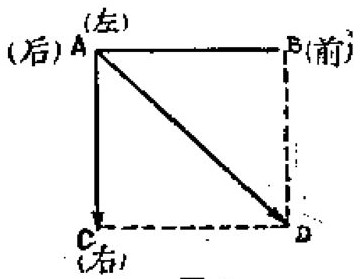
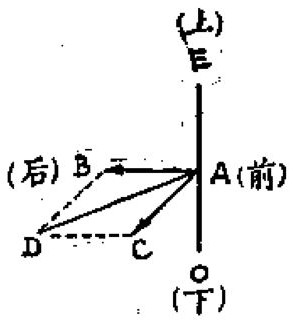
As in Figure 1: take the line AB as the force sent forward by the opponent's arm and its direction, and take the line AC as the force and direction of a horizontal strike made with force in an ordinary striking method. Then the sum of the horizontal force AC and the straight force AB is the resultant force received by the opponent, as represented by the oblique line AD in the diagram, both in magnitude and direction.
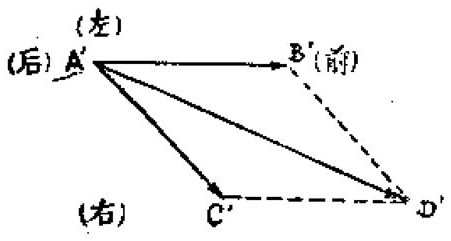
As in Figure 2: the line A′B′ still serves as the opponent's straight force (the same in magnitude and direction as the line AB in Figure 1), and the line A′C′ serves as the oblique force with which taijiquan acts on the opponent along his direction (the same in magnitude as the line AC in Figure 1, but not the same in direction). Then the resultant force received by the opponent should be the magnitude and direction represented by the line A′D′.
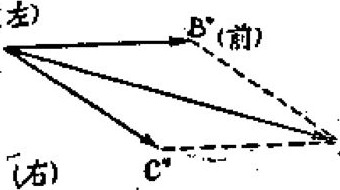
As in Figure 3: the direction of the oblique force A′′C′′ is more oblique than that of the oblique force A′C′ in Figure 2. Then the resultant force received by the opponent should be the magnitude and direction represented by the line A′′D′′.
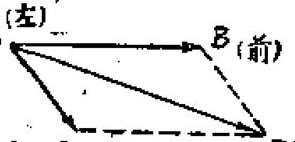
Judging from the situations shown in the three diagrams: the resultant AD in Figure 1 is smaller than the resultant A′D′ in Figure 2, and the resultant A′D′ in Figure 2 is in turn smaller than the resultant A′′D′′ in Figure 3. This accords with what is proved by the principle of the composition of forces in mechanics: "when the magnitudes of two component forces are unchanged, the smaller the angle between them, the larger their resultant; the larger the angle, the smaller the resultant." It can be seen that the striking methods of taijiquan described above also accord with the principle of the resultant force. Sometimes in striking we do not need too large a resultant force; in that case we can reduce the component force AC, as in Figure 4, where the line AB is unchanged and the line AC is shorter, yet the resultant AD obtained is still equal to the AD of Figure 1. This too can prove the mechanical basis for taijiquan using comparatively little force while achieving a comparatively large effect.
What has been said above is the example of the opponent striking out at me. If it is I who strike out and add force to the opponent's body, we can study the striking method of taijiquan from the three diagrams below.
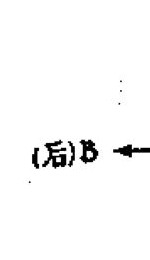
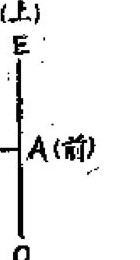
As in Figure 5: the line EO serves as the opponent's chest, and the line AB as the force with which I push straight forward with the palm against his chest. When force is applied in this straight push, first, his chest exerts an equal reaction force on my body; second, if I push forward with effort, he can also resist with effort, and when neither yields the situation often becomes a deadlock. If his force is greater, he will instead push me back. According to the principles of taijiquan, if I do not intend to withdraw my palm, I must use the method indicated in Figure 6 or Figure 7 to deal with him. As in Figure 6: the line AB still serves as the force and direction of the straight push, while the line AD serves as the movement in which my palm, while pushing straight, further uses the palm and fingers to add force upward by means of friction (that is, the lifting movement referred to in the boxing treatises as "as if lifting an object upward …"). At this moment the two forces, forward and upward, combine into the resultant AD, causing the opponent to receive a still greater push, and, seen from the direction of the resultant, it also acts at the same time to lift the opponent's toes off the ground and to tilt his body backward, both of which are disadvantageous to him. Sometimes, when the opponent sinks his body downward and my upward addition of force cannot lift him, I should, while pushing forward, take the opportunity to change the direction of the fingers and add force downward (rubbing downward with the fingers likewise makes use of friction). If his right leg is supporting behind him, the force should be added toward his lower left; if his left leg is behind, it should be added toward his lower right.
As in Figure 7: AD is the resultant of AB (a straight forward force) combined with AC (an oblique downward force), and its direction is along the same line as the direction in which the opponent is sinking his body, so that his body is easily pushed into motion. Suppose that after using the method of Figure 7 the opponent still stubbornly resists and is not moved; then I should consciously add a little more force in the direction of AC, in order to force him to use strength to resist upward, and immediately turn to adding force upward (as shown in Figure 6); or I should immediately withdraw the force in my palm (this is related to making use of the inertia of bodies), so that his force comes to nothing. If the opponent does not understand the method of moving his feet to adapt, or suddenly has no time to step and save himself, his body will tip forward and he will stand unsteadily, and if I then add force to his body I shall obtain the expected result.
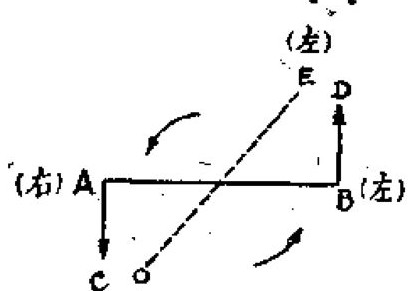
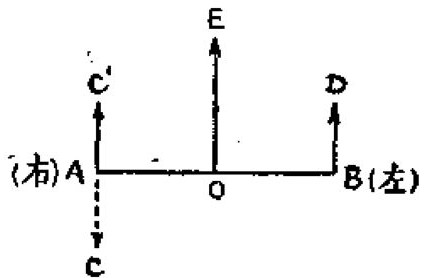
(4) Conformity with the principle of the couple. Any two parallel forces equal in magnitude and opposite in direction are called, in mechanics, a couple. A couple cannot produce a resultant force, but it can make a body rotate. In the striking methods of taijiquan, if the opponent strikes my left shoulder with his right hand (or strikes my right shoulder with his left hand, and so on by analogy), my left shoulder should avoid it by turning the body along the direction of the incoming hand, so that his force continues forward without meeting the resistance of my body; at the same time I immediately strike his left shoulder with my right hand, and without needing to use great force I can make the opponent's body to rotate. As in Figure 8: AC is the force acting on his right shoulder when the opponent reaches out and strikes my left shoulder. When the opponent strikes me, I turn my body to evade (rotating only the waist, without moving my feet), so that this single acting force continues forward and thereby draws his body into motion; I then immediately strike his left shoulder in the direction BD. At this moment both of the opponent's shoulders are acted on by the two parallel forces AC and BD, which point in opposite directions, so that his body is made to rotate (as shown by the dashed line OE) and he becomes unstable. If the opponent feels unstable and immediately withdraws his right hand, then the force AC vanishes of itself, and another force AC′ is produced acting on the opponent's right shoulder (as in Figure 9); at this moment the force BD still exists, and the opponent instead receives both BD and AC′, which are parallel forces in the same direction, and their resultant is OE. The opponent is then acted on by a greater force and must step backward (that is, in the direction OE) or be thrown off his feet. This is one phenomenon of a couple turning into a resultant. For convenience of explanation, only the two shoulders have been used above for comparison. For example, the lie (挒, liè) energy of taijiquan (see the illustrated explanations of pushing hands) is based on the principle of the couple: on the opponent's two arms one "neutralises" and "strikes" at the same time, so as to make his body lean over, and then one takes the opportunity to add force to his body.
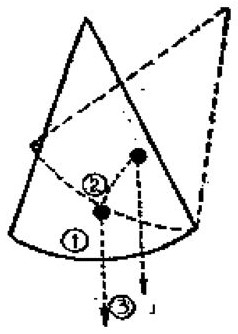
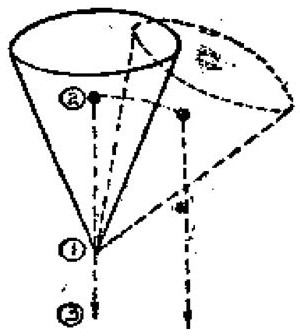
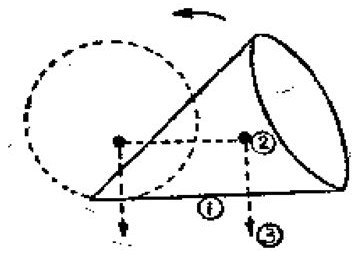
(5) Conformity with the principle of equilibrium of bodies. A body has three states of equilibrium, namely stable equilibrium, unstable equilibrium and neutral equilibrium. As in Figure 10: a cone is in a state of stable equilibrium; when it is not tilted too far, then although its centre of gravity rises, the vertical line through the centre of gravity does not easily pass outside the base area, and it quickly returns to its original position. As in Figure 11: a cone is in a state of unstable equilibrium; a very slight tilt is enough for its centre-of-gravity line passes outside the base area at once, and although the centre of gravity is lowered it still cannot escape toppling. As in Figure 12: a cone is in a state of neutral equilibrium; however it is pushed, its centre of gravity neither rises
- ① base area; ② centre of gravity; ③ line of the centre of gravity
Figure 10 Figure 11 Figure 12 nor falls, and the line of the centre of gravity always remains inside the base area; hence it is called neutral equilibrium. From this it can be seen that if a body is to have great stability, it is indispensable to lower the centre of gravity and enlarge the base area. When the human body stands upright its centre of gravity lies in the region of the hip, and without the help of an external object or force it is impossible to increase its stability very much. For example, a tightrope walker must hold a long pole with heavy objects tied to its two ends, so that the two ends of the pole are lower than his two feet and the centre of gravity is lowered to the utmost, and only thus can he walk freely on the rope. Most martial artists practise the standing-post exercise (that is, frequently taking the riding-horse posture), and some also practise the sinking-of-breath exercise, so that in application they can, of course, steady the body's centre of gravity or lower it. But the base area occupied by a person's two feet, if it is broad in one direction, will be narrow in the other. When the two feet are set one in front of the other, the stance is broad front-to-back and narrow left-to-right; when the two feet are set left and right of each other, it is broad left-to-right and narrow front-to-back, and if one strikes toward the narrow part, the line of the body's centre of gravity still passes very easily outside the base area. It can be seen that the martial artist who relies only on lowering his centre of gravity and does not know how to make good the deficiency in his base area will still find it very hard to keep his body stable. Taijiquan takes throwing the opponent's body off balance as its principal method of striking, and so at the moment of issuing force one must first of all unsettle the opponent's centre of gravity, causing the line of his centre of gravity to pass outside his base area so that he loses stable equilibrium. One must at all times likewise give first place to maintaining the stable equilibrium of one's own body, but as regards method one does not rely solely on squatting the legs and sinking the breath in order to support one's body. It should be understood that taijiquan already takes placing the whole weight of the body on one foot as one of its basic postures, and the base area of one foot is narrower than that of two; when one is struck, the line of the centre of gravity passes outside the base area all the more easily. These are very obvious facts, but why is it that the balance of the body can nevertheless be maintained all the better? The one method is to rely entirely on the two feet changing from empty to full (虛實, xū shí) according to circumstance, so as to meet the needs of the body's stability. The so-called changing of empty and full between the two feet means this: when one foot becomes unsteady, the whole weight of the body is at once shifted onto the other foot, so that the body returns from disequilibrium to equilibrium; that is, the base area shifts at every moment along with the changes of the centre of gravity. In this way the line of the centre of gravity can naturally, at the very instant when it is about to pass outside one base area, be brought within another base area. In form this differs from a body in neutral equilibrium, but in effect it is the same; when practising the exercise there is what is called "seeking stillness within movement," and in the striking art this meaning is likewise included. Again, take the example of tightrope walking mentioned above: a person with skill, when walking a fairly short rope, can do without the help of a long pole, relying only on his two feet being good at shifting; otherwise he would contravene the principles of mechanics and fall down.
The main purpose of this chapter has been to prove that the methods of using energy in taijiquan tally with the laws of mechanics, so that beginners may not be misled by mystifying statements. It is a matter for regret that the author's scholarship is insufficient and that he cannot expound the theory more fully and more deeply.
The complete set of postures of taijiquan is customarily called the "frame" (架子, jià zi). To practise the frame (盤架子, pán jià zi) means to practise the boxing. Since taijiquan is a martial art that "values intention and does not value outward form," not only have several different sets of postures been handed down, but even within one and the same set, taught by one and the same teacher, once a fairly deep level of attainment is reached no two individuals will be entirely alike either in the "spiritual likeness" or in the "outward likeness" of the postures. This is just like learning calligraphy: at the beginning one always strives for outward likeness in any style of character, and later, once one has a foundation of outward likeness, one seeks development specifically in spiritual likeness according to one's own insights and preferences; in the course of time the style will naturally change. The practice of the frame is the same. Secondly, the frame of taijiquan may also vary according to the strength of the practitioner's own body or the level of his requirements. Therefore any one frame can be divided into three kinds of posture, large, medium and small, for practice: a large frame can be practised on a smaller scale, or the frame can be practised still larger; a small frame can be practised on a larger scale, or the frame can be practised still smaller. In short, one should first practise on a large scale and afterwards practise on a small scale. The "Heart Explanation of the Practice of the Thirteen Postures" (十三勢行功心解) says: "First seek extension, afterwards seek compactness." The practice of the frame is no exception. But the size of the frame is related to the amount of exercise: a larger frame means a larger amount of exercise, a smaller frame a smaller amount. Hence the "first seek extension, afterwards seek compactness" spoken of above is not suitable for practitioners whose bodies are relatively weak; in the early stage of learning one must by all means act according to one's strength and must not force oneself.
The practice of the frame is in itself also a means of practising the striking art, and so in some books the applications of the postures are mentioned; but this chapter is chiefly concerned with explaining the methods of movement of taijiquan, and so the principles set out below are written only in accordance with the requirements of exercise for health. In fact, the striking skill and the health-giving effect of taijiquan are originally two products of one and the same method. If in one's intention one regards every movement as a striking method, one can of course improve one's striking skill, but at the same time one will not thereby lessen its health-giving effect. If the working of the intention is concentrated on the side of health, one can naturally obtain a more marked or a more complete health-giving effect; but imperceptibly this also serves to cultivate a foundation for the striking art, though before one has studied the striking methods not everyone is able to make use of this foundation.
The above are the two points which the beginner in taijiquan should first of all understand clearly. Below, according to the author's views, the principles of practising the frame are explained in three stages:
For the beginner in taijiquan, whatever other martial art he may have practised before, in the earliest stage it is best not to absorb all the various principles of taijiquan at once into every posture or into the whole set of the frame, lest in attending to one thing he loses another and reaps little by way of result. The author therefore puts forward only the four following points as the principles of the early period of practising the frame:
(1) Lightness (輕, qīng). What the boxing treatise says — "when one movement is made, the whole body must be light and nimble" — is the standard for one who has already become practised in taijiquan; the beginner should start from the word "light" and need not be in a hurry to seek "nimbleness." Experience shows that those who have practised other martial arts, although their bodies and hands are relatively nimble, mostly have an excess of nimbleness and a deficiency of lightness, because they have long been accustomed to using great force in their movements. As for those who have never taken part in athletic activities, most of them likewise find nimbleness easy and lightness comparatively hard to learn. When the author first studied taijiquan he had in mind the idea that "practising boxing must require the use of force," and so he always attended to nimbleness and not to lightness. Later he understood the special characteristics of taijiquan, and only then did he reverse this idea. It should be understood that the method of practising taijiquan consists chiefly in cultivating from the mental side a sensitive feeling, and not in seeking nimbleness of body and hand from the side of movement alone. The former uses little force, the latter much. Using too much force has a certain effect on sensitivity (for example, when two arms strike each other and the fist is clenched hard, the sense of pain can be reduced). Therefore in the early stage of learning one should put a great deal of effort into the word "light," in which the less force the better, and may let nimbleness of movement take second place; when the word "light" has a foundation, one may then go on to practise the word "nimble," and this will never be too late. The high degree of sensitivity described in the boxing treatise as "not even a feather may be added, not even a fly may alight" is not wholly obtained from the word "light," but the word "light" is the step by which one enters and learns this sensitive skill. At the same time one should also know that practising light movement well merely lays a foundation for later practice (one must not take the foundation for the goal): first, in the matter of lightness and heaviness of movement, one can reduce one's attention and let things be natural; secondly, when one also practises the skill of composure, one will not rashly stir up clumsy energy and go astray.
(2) Slowness (慢, màn). Everyone knows that the movements of taijiquan should be slow, but is it true that the slower the better? This is a question very much worth studying. In the boxing treatise it is said both that "when one movement is made, the whole body must be light and nimble" and that "if the opponent moves urgently, respond urgently; if he moves slowly, follow slowly." It can be seen that taijiquan is not simply to be slow and not fast. In the "Heart Explanation of the Practice of the Thirteen Postures" it is further said that "if the spirit can be raised, there is no fear of sluggishness and heaviness… the intent and the energy must be changed nimbly, and then there is the delight of roundness and liveliness," which also proves that taijiquan requires nimbleness and is opposed to sluggishness and heaviness. Although in the latter part of the Heart Explanation there is another phrase, "movement like drawing silk," which can serve as a ground for saying that the movements should be slow, its original meaning is to teach one that in using energy one should be as continuous as silk being drawn and must not use a sharp, quick, new energy; if it is explained as meaning that the slower the better, then it can in no way be reconciled with the several sentences quoted above. According to the author's own experience: the movements of taijiquan should be slower than those of martial arts in general, that is beyond doubt, and especially in the early stage of learning one must deliberately seek slowness, and it may be said that the slower the better. Practising in this way, first, is more suitable for those whose bodies are weak; secondly, it can avoid hasty and slipshod movement affecting the correctness of the posture; thirdly, in the early stage of practice one first forms the habit of slow movement, and later, however nimble one becomes, one can still maintain a certain slowness in movement and will not practise faster and faster in violation of principle. It can be seen that slowness, like lightness, is a basic skill; just what one should build upon the foundation is of course another matter. As for one whose attainment is relatively deep and who practises specifically the skill of seeking stillness within movement, his movements should indeed pass from nimbleness to plainness, but as regards speed he may still follow his own habit and need not deliberately seek slowness, because at this time his intention is only to seek stillness and not to seek slowness, which is different from the slowness pursued for its own sake in early practice.
(3) Roundness (圓, yuán). In taijiquan, every movement must follow a curved line and is not permitted to go in a straight line; even when one has reached great depth of skill, one still cannot but follow curved lines. However, in early practice one seeks extension of posture and at the same time must deliberately seek slowness in movement, and so it is necessary to make the curve larger and rounder, so as to accord with the requirements of the posture and the movement. Later, when one's skill is deeper and the postures gradually become more compact, the curve correspondingly shortens, and of course one need no longer make the circle too large. But in the path of movement, even a very small movement should still keep its original curve and must not be altered. At present some teachers, for the convenience of beginners, break each posture down into a larger number of small movements, so that no curve can be seen in the movement as a whole. It must be understood that this is only a teaching method, and not that the movements of taijiquan may dispense with curves. Therefore, having learned the set under this method of teaching, one must still join the broken-down movements together again and change them into curved movements for practice, so as to wipe out the traces of joining between the various movements (that is, what the boxing treatise calls "do not let there be any place of interruption"); only then may one consider one's study at an end as far as that stage is concerned. Although round movements are not difficult to perform, to perform them very naturally and very appropriately is not a simple matter either, because they are closely related to the movements of the whole body, and it is impossible to reach such a level very quickly. Hence the beginner is asked only to form the habit of following curves in the movements of the hand first; later, when the movements of the whole body co-operate with one another, he will naturally be able to make the round move- ment be performed more perfectly. Taijiquan lays stress on "stillness within movement, movement within stillness"; the transformation and mutual circulation of movement and stillness take round movement as their stepping-stone, and it can be seen that the function of roundness is very important. It is to be hoped that beginners in taijiquan will from the very beginning apply themselves seriously to the word "round" and understand its function, and not simply imitate the outward form as one draws a gourd from a pattern and consider the matter finished.
(4) Evenness (勻, yún). Of the points given above, the first — lightness — is a question of the strength of movement; the second — slowness — is a question of the speed of movement; the third — roundness — is a question of the path of movement; and now in the fourth point a question of the evenness of movement must further be raised. By evenness of movement is meant this: the movement of the hand, whether its speed be relatively fast or relatively slow, should complete its course of movement by means of a corresponding "uniform motion." For example, when we ordinarily put out a hand, it very quickly extends from the starting point to the end point, and since the course of the movement takes an extremely short time, it is impossible and also unnecessary for us to control its "uniform motion." But taijiquan moves slowly, and in the early stage of learning, even if one is very careful, it is still very easy in the course of a movement to fall into the fault of uneven speed, either so that within each posture the movement is fast in some places and slow in others, or so that throughout the whole frame the speed before and after is uneven. As has been said above, in practising taijiquan one should use the intention to govern movement, but this rule is, generally speaking, rather hard to grasp. Hence it is necessary for us first to apply our intention to the evenness of movement, so as to lay a favourable foundation for grasping this rule more fully in the future. The method of practising evenness, simply put, is that every time the hand goes out one should regard the course of the movement as made up of a succession of "points" joined together (that is, like a dashed line ……), and not regard it as a single solid line with only a beginning and an end; in this way one can give one's movement an imperceptible sense of proceeding by "points," and after long practice, once the habit is formed, the movement of the hand will naturally be able to avoid losing its due evenness at any speed. Of course, when one's skill is deeper, one's movements must further take account of the changes of empty and full, though it does not require strict uniformity in the speed of movement; but in putting out the hand, whatever the speed of the movement, one should still maintain a suitable uniform motion (that is, proceeding by "points"), otherwise one violates the requirement of "movement like drawing silk" and will also fall into the fault of superficiality and slipperiness in movement.
The four points above are all related to the foundations of taijiquan, and so the author has listed them all as the principles of practice for the first stage. But circumstances differ from person to person, and each may still judge for himself and proceed point by point; it is not necessary to carry out all four at once. However, before a foundation has been laid, it is best not to begin the methods of practice of the second stage, for practice that advances step by step achieves greater results.
In the preceding stage it was said that in practice every movement should attend to the four points of lightness, slowness, roundness and evenness, chiefly in order to lay a good foundation; for the practice of the frame this can still only be reckoned as preparatory work. Experience shows that the better this preparatory work is done, the more the movements will often appear exceptionally constrained — this is an unavoidable stage, and we must not dislike it as stiff and regard it as a fault. At the same time, precisely because of this, it is necessary in the second stage to put forward several other points as the further aims of practice. Suppose we say that in the first stage the requirement for the movements is to achieve "uprightness," then in the second stage one should practise so as to achieve "fluency." It should be understood that if fluency is added on the foundation of upright movement, no movement will lose its propriety; but if one first practises fluency and afterwards uprightness, one will inevitably get half the result with twice the effort. The four points of this stage are as follows:
(1) Nimbleness (灵活, líng huó). Taijiquan takes slow movement as its foundation, and the nimbleness it requires is not only limited in degree as regards movement, but must also be attended to on the mental side with re- servedness, and one must not expose it to the full so as to display an excessive nimbleness. Secondly, although taijiquan sets great store by sensitivity, in this stage one should still first seek nimbleness in the outward appearance of the movements; if nimbleness and sensitivity are lumped together, the beginner will on the contrary be at a loss what to follow. The author therefore asks the beginner here to attend only to the following three points: ① if the original frame has already been practised with sufficient extension, then it should be reduced somewhat, so as to accord with the requirement of compactness; ② as regards speed, one should no longer deliberately seek slowness, but should let the movement of the hand be relatively freer or slightly faster; ③ in moving, one should not move only the four limbs and not the waist, but should give the waist the governing place (that is, what the boxing treatise calls "the master is in the waist"). In other words, one should use the movement of the waist to lead the movements of the hands and feet; this is the most important point and calls for special attention. If the beginner practises according to the three points above, and, without coming into conflict with his former constraint, arrives at a very natural harmony, then he can accord with the nimbleness that taijiquan requires.
(2) Relaxation and purity (松淨, sōng jìng). This point, put simply, means that every part of the whole body is relaxed and free from the least entanglement. It is of course closely related to the lightness and nimbleness spoken of above. Some beginners set to work on the word "relaxation" from the very outset; although this is not contradictory, to seek relaxation-and-purity first merely in order to gain lightness and nimbleness is, perhaps, to underrate the function of relaxation-and-purity; moreover, in the early stage of learning, if one first practises "relaxation," and if the function of relaxation is over-emphasised, then because the movements are too relaxed the slow speed of the movements will be affected, and one may even lapse into superficiality and slipperiness. Hence the beginner had better proceed step by step. In the early stage of learning taijiquan this phenomenon often occurs: the more one does not want to use force, the more stiff one's hands and feet become; but if one simply lets them alone, they are on the contrary much more natural. This is a question of whether the emotions are tense or not; so long as the emotions are not tense, the muscles can naturally be relaxed. The phrases "the spirit comfortable," "the body still," in the "Heart Explanation of the Practice of the Thirteen Postures," point precisely to the causal relationship here. As for the method of practising relaxation-and-purity: first, in the emotions one should achieve freedom and naturalness; secondly, in the body one should not only relax the neck and relax the waist, but every part of the whole body should be relaxed, so that they co-operate with one another free from entanglement; only thus can one accord with the requirement of relaxation-and-purity and give play to its function. It should be understood that the movements of taijiquan do not stop at the two words "light and nimble," but must go a step further into the stage of composure; only thus, in unceasing application, can one raise the principal skill of sinking the breath to the cinnabar field (氣沉丹田, qì chén dān tián). Composure does not mean simply adding a little more force to the movements; it consists chiefly in attaining through relaxation-and-purity of the whole body a natural heaviness in movement. From the reasoning above it can be seen that the function of relaxation-and-purity lies chiefly in attaining composure and not in attaining lightness and nimbleness, and so the author has placed it after lightness and nimbleness in his discussion. On the point that the whole body should be relaxed and pure, there have also been people who said that the abdomen may as well be tense; judged by "sinking the breath to the cinnabar field" this is correct, but the boxing treatise also has the phrase "the breath should be made to drum," and it can be seen that during movement the abdomen should be sometimes tense and sometimes relaxed, and not tense all the time. Lest beginners should misunderstand, a few further words are added here.
(3) Completeness (完整, wán zhěng). When the preceding Chapter Three dealt with the characteristic of "harmony," the author already explained the high degree of completeness in movement, and it will not be repeated here. The two words "completeness" now put forward are only a general requirement, and it is merely hoped that in the outward appearance of the movements one may achieve completeness as a single whole; as for the inner co-ordination of respiration and of intention, this may be left to the next stage for practice. In the early stage of learning we mostly set great store by slow movement, but under the bias of deliberately seeking slowness one often cannot attend at the same time to the completeness of the movement. Even among those who have practised boxing for many years, there are some who, in practising the frame, still cannot avoid places where hand and foot are not of one speed. The most conspicuous example is when the foot has already completed its step while the hand is still moving slowly along; looked at, this is always an excess of slowness and a deficiency of completeness. This is at variance with the requirement of the boxing treatise that "from the foot to the leg, to the waist, there must always be completeness as one breath" (the several phrases above, including "manifested in the fingers," should be taken together to be understood), and with the requirement in the "Heart Explanation of the Practice of the Thirteen Postures" that "when one part moves, no part does not move; when one part is still, no part is not still." In addition, the "Heart Explanation of the Practice" says that "stepping is like a cat walking, movement is like drawing silk," which likewise hints that the movements of hand and foot should match each other in speed. Therefore in this stage, as far as the outward appearance goes, one must as much as possible make the hand and the foot start together and stop together, so as to accord with the requirement of completeness as one breath (the co-operation of the movements of the waist has been spoken of under the first point, and here the emphasis is only on the hands and feet).
(4) Continuity (連貫, lián guàn). This point has already been explained in Chapter Three of the preceding part and will not be interpreted again here. But one thing must be attended to, namely that in the early stage of learning one must not, in pursuit of continuity, change the speed of the movements faster at will. It should be understood that speed has most to do with round movement: if speed is not kept under control, the fault of excessive roundness and liveliness can hardly fail to arise, and this will on the contrary affect the proper completion and the expected result of the other points (including the points of the third stage); the learner must not fail to know this.
The preceding stage required above all that a complete and firm foundation be laid on the side of movement; following the order indicated by the boxing treatise, it is the stage of "from familiarity with the postures gradually awakening to the understanding of energy" (由着熟而漸悟懂勁). The present stage is the last stage, and the several points put forward below are all necessary rules of "from understanding energy advancing to spiritual illumination." Although what the boxing treatise says is chiefly concerned with the striking art, the method of practising taijiquan values intention and not force, and Mr. Wu also once said that "advancing to spiritual illumination after understanding energy does not depend entirely on pushing hands, but must be continuously cultivated through the high-level skill of practising the frame." It can be seen that the last stage of taijiquan is a stage in which health and the striking art can be separated and yet cannot be separated; all principles relating to the striking art are also principles relating to health, and the learner should take this view when he consults the boxing treatise.
(1) Distinguishing empty and full (分虛实, fēn xū shí). In the two preceding stages our movements are constrained by slowness and evenness, and at the same time must attend to the other points; although in the second stage one may practise somewhat more briskly, still, in order to lay a good foundation, there is always more constraint than free- ...is comparatively small. Now that the foundation has been laid, we ought to take up practice by another method, the aim being to dispense with complicated attention and replace it with simple attention. The requirement of distinguishing substantial and insubstantial (分虛實, fēn xūshí) in the movements is a rule put forward to reach this end. In practice, therefore, one may set aside entirely the various points that required attention at the earlier stage (set them aside only as objects of attention, not as changes to the movements) and concentrate attention on the substantial and insubstantial in the movement.
In distinguishing substantial and insubstantial, one must first attend to the substantial and insubstantial of the hand. When the hand extends, the whole course from starting point to end point should be regarded as "from insubstantial to substantial" (由虛而實, yóu xū ér shí). At this time the palm must pass from a reserved state to a gradual opening out, and at the end point the palm should bulge very slightly, to express the extreme point of "substantial" (the technical term is 陽極, yángjí, "the utmost of yang"). When it withdraws, the course should be regarded as from substantial to insubstantial (the technical term is 陽極而陰生, yángjí ér yīn shēng, "at the utmost of yang, yin is born"). At this time the palm must pass from open to a gradual return to reserve. In the movement of closing the fist, likewise, the fist gradually goes from relaxed to tight as it is thrust out, and from tight to relaxed as it is drawn back; it is not that the fist stays relaxed and never tightens (this does not apply to those who train only the art of emptiness and stillness), nor that it stays tight and never relaxes.
Next, the body, waist and legs must likewise accord with the substantial and insubstantial of the hand. For example: the hollowing of the chest always widens gradually as the hand withdraws; the bow stance and the settling of the waist and legs must also be suited to the speed of the hand. Again, when the foot comes down, the heel should touch the ground first, and then, as the hand nears its end point, the whole foot should gradually press down firmly; when the foot withdraws, it should borrow the residual force of the pressing foot and draw back slowly with that momentum, so as to answer the substantial and insubstantial of the hand. This point has the closest bearing on what is discussed below as "regulating the breath"; its importance will be seen from the next point, and it is not dwelt on further here.
(二)調呼吸 Regulating the breath: In martial application, taijiquan speaks only of yielding transformation (柔化, róuhuà) and does not overcome others by strength. In cultivation, therefore, it takes the nourishing of qi (養氣, yǎngqì) as its sole aim. What is called "qi sinking to the dantian" (氣沉丹田, qì chén dāntián) is likewise formed naturally through the lightness, relaxation and stillness of the movements, and never by forced methods. In the two preceding stages we did not discuss the breathing method of taijiquan, yet because the movements of taijiquan must be slow and even, it has already, imperceptibly, the effect of preventing shallow, short and hurried breathing ...and it is not difficult, in the natural course of things, to develop gradually the habit of even, fine, deep and long breathing. When the breath is even and fine, it not only bears on regulating the breath and nourishing the qi, but is also an aid to "calming and unifying the mind" (寧靜一志, níngjìng yīzhì). When the breath is deep and long, it not only raises the effect of "expelling the old and taking in the new" (吐故納新, tǔ gù nà xīn), but can also exert a good propelling effect on the blood circulation and other functions of the internal organs. Anyone learning taijiquan should therefore regard the breath as a still more important kind of movement, so as to obtain more benefit from the exercise.
The "regulating the breath" now put forward is the breathing exercise of one whose attainment is comparatively deep, for the even, fine, deep and long breathing described above is, within taijiquan, only a standard for natural breathing and not yet a breathing exercise. At the proper time, therefore, one must use the movements to influence the breath, so that the breath also becomes an exercise, and only then can one obtain a higher health benefit from a complete exercise. In practising the form, the movements are sometimes large and sometimes small, whereas the breath must be even and long. As some people say, it would be impossible and also unnecessary for every movement to be brought into accord with every breath. Hence we ask only that within each posture one should, as far as possible, use the transitions from insubstantial to substantial in the movement to accord with the natural cycle of the breath. That is to say, within each posture one should seek out every opportunity to perform the following breathing exercise well: when the hand's movement goes from insubstantial to substantial, the exhalation must likewise match it with the same intention and the same speed, so that the breath is exactly fully exhaled at the moment the hand reaches its end point and the palm bulges slightly; at the same time the abdomen below the kua (胯, kuà) tenses very slightly. Conversely, when the hand's movement goes from substantial to insubstantial, the inhalation must likewise match it with the same intention and the same speed, so that the breath is exactly fully inhaled when the movement comes to rest; at the same time the abdomen above the kua contracts very slightly. The alternate stretching and contracting of the abdomen described above is taijiquan's "abdominal breathing exercise combined with the movements"; in the boxing treatises it is called "the qi should be stirred" (氣宜鼓盪, qì yí gǔdàng). One need only practise accordingly, without deliberately exerting force, and in time one will naturally attain the skill of qi sinking to the dantian (the dantian lies below the kua). Such regulation of the breath is of course comparatively difficult to perform, so in the early stages of learning, when we run through a whole set, ...only a very few postures can be done comparatively naturally. After a somewhat longer time, or after first trying it out in single-form practice for a period, one will naturally progress by degrees. Provided that in each run through the set one third or one quarter of the postures can be done quite correctly, a very good exercise effect can be obtained. There is no need to set too high a demand, insisting that every single posture in every run through the set be capable of regulating the breath. If one cannot learn it well for the time being, one should not force it, lest natural breathing be affected.
(三)用意識 Using the intention: When learning the postures, we do of course use intention to complete the movements, but the intention then used can only attend to whether the movement is correct or not; it cannot have attention to spare for applying the movement. The "using the intention" now put forward is therefore of course more demanding. It consists chiefly in applying our faculty of imagination to the movements, in accordance with taijiquan's rule of "use intention, not force" (用意不用力, yòng yì bù yòng lì); and secondly, it adds much interest to our practice of otherwise plain and unremarkable boxing movements. Its requirements are set out below under two points.
- ① In movement, the more intention is used the less force should be used, so that the movement's significance becomes richer — for instance, when the movement is required to be light and nimble (輕靈, qīnglíng). Every raising of our hand or setting down of our foot should treat the whole course of the movement as countless separate raisings or settings down, with intention closely guiding at every point, and even so slight a movement as a single motion or rest is no exception. Using the imagination continuously in this way, so that the movements become finer and finer with practice, will naturally raise one's skill in nimbleness. If one wishes to train the skill of steadiness (沉着, chénzhuó), one should likewise, in the movement, form the imagination of "exerting with steadiness", rather than using more strength to increase the power of the arm. Other movements may be treated by analogy.
- ② For each movement's alternation of insubstantial and substantial, or of stretching and relaxing, one must use intention to imagine its martial-application effect or its health-giving effect, and may even magnify it in the imagination. Since our muscular activity is constantly under the influence of this kind of psychological action, and on the theory that psychological action can govern physiological action, our exercise effect can naturally be raised imperceptibly as well.
(四)求虛靜 Seeking emptiness and stillness: This is the training method of seeking the insubstantial within the substantial and stillness within movement; hence it is called "seeking emptiness and stillness" (求虛靜, qiú xūjìng), and it is one of the more difficult skills to train in taijiquan. Under the preceding rule, although our movement takes the use of intention as its principal matter, the imagination we form lies wholly in bringing out the movement's function; in its essential nature the movement is still chiefly one of being able to move, not one of being able to be still. In terms of martial skill, one is still seeking victory in movement, not victory in stillness. This still leaves a certain distance from taijiquan's highest stage of "using stillness to govern movement" (以靜御動, yǐ jìng yù dòng) and "though moving, yet still" (雖動猶靜, suī dòng yóu jìng); hence in both martial application and cultivation, "seeking emptiness and stillness" is taken as the final rule.
Although seeking emptiness and stillness also requires the use of intention, its requirement being different, it first reduces the various imaginations to a single imagination — that is, it regards movements of every kind, whatever their outward form and content, as no more than the phenomenon of a single movement and a single stillness — and then, on the basis of this phenomenon, single-mindedly forms the imagination of passing from movement to stillness or from substantial to insubstantial (movement being substantial, stillness being insubstantial), so that our will is concentrated on the one point of seeking stillness, and thereby influences the movement being performed. We are then able, in our movements, to become purer and stiller the more we practise (this being the state in which the intention is present and the outward form is not), and at the same time our spirit can naturally, in such exercise, obtain a more serene rest and nourishment. This method of training is most suitable for treating neurasthenia and high blood pressure; but in practising it, besides clearing away distracting thoughts, one had best choose a quiet environment and work alone, so as to avoid disturbance. Further, the distinguishing of substantial and insubstantial, the regulating of the breath and the other imaginations described above should all be set aside and disregarded when practising the rule of seeking emptiness and stillness; one should no longer attend to them, lest the attention be divided.
The various training methods listed above are only a brief account based on the author's personal study and experience. It is quite possible that in many places they do not entirely agree with the paths taken by others, and it is equally possible that in many places they are not yet clearly stated. For example: in training nimbleness, it is impossible to form at the same time, within the same movement, the imagination of steadiness. One may train nimbleness alone, or steadiness alone, through one run of the set; it is best to attend [to nimbleness] in the movements that pass from substantial to insubstantial, ...intention on nimbleness, and in the movements that pass from insubstantial to substantial to attend to steadiness; this point was not mentioned above. Again, as to the point that the fist should tighten and relax with the substantial and insubstantial of the movement, the example given was only that of the extended fist; no incidental explanation was given of the example of 撇身捶 (Pīshēnchuí, "deflecting the body and striking with the fist"), in which the fist is slightly tightened as the arm bends (for 撇身捶 uses the bow stance). Matters of this kind are all places where the account is not sufficiently detailed; yet on careful study by the reader they are not hard to extend by analogy.
吳式太極拳拳式名稱順序(附釋)Order of the Posture Names of Wu-style Taijiquan (with Explanatory Notes)
The posture names of taijiquan differ not only from school to school; even within Wu-style taijiquan alone, although no one disputes the content and order of the movements, the names are not necessarily consistent between different teachers, because transmission came earlier or later and records were more or less detailed. The points most liable to raise doubt are, for instance, exactly which movements make up certain postures, and where the divisions between sections fall — on which different people also disagree. So that the illustrated explanations in the following chapter may have something to rest on, the author cannot but first put the names in order and explain where they agree and differ, for the reference of beginners.
1. 預备式 Yùbèishì (Preparatory Posture): In earlier times this posture had no name at all, and the author's earlier work Taijiquan Qianshuo ("A Shallow Account of Taijiquan"; hereafter abbreviated as 致本, Zhiben) did not include it. Wu Tunan's Taijiquan (hereafter abbreviated as 图本, Tubent) calls this posture 太極勢 (Tàijíshì), "the posture of taiji", which carries the meaning of being still but not yet moving, and may serve as a fitting name for it. Chen Zhenmin and Ma Yueliang, in their joint compilation Wu Jianquan-shi de Taijiquan ("The Taijiquan of Wu Jianquan"; hereafter abbreviated as 振本, Zhenben), call it 太極起式 (Tàijíqǐshì, "taiji rising posture"), having transferred to it the name of the next posture and renamed that next posture 太極出手 (Tàijíchūshǒu, "taiji issuing the hand"). The present book, for the sake of being readily understood, calls this first posture — which has no movement (meaning no movement of hands or legs) — the preparatory posture. 2. 太極起式 Tàijíqǐshì (Taiji rising posture): This is the original name and Zhiben did not change it. Tubent omits it, but merges the movement that belonged to it into the first movement of the next posture, 攬雀尾 (Lǎnquèwěi, "grasping the bird's tail"). Zhenben calls it 太極出手 (Tàijíchūshǒu, "taiji issuing the hand"), which differs little from 太極起式. The present book does not advocate changing it, and therefore still uses the original name.
3. 攬雀尾 Lǎnquèwěi (Grasping the Bird's Tail), 4. 單鞭 Dānbiān (Single Whip), 5. 提手上勢 Tíshǒu Shàngshì (Raising the Hand Upward): These three names are the same in all editions, except that Tubent's "grasping the bird's tail" contains the movement of the "taiji rising posture", a slight difference.
6. 白鶴亮翅 Báihè Liàngchì (White Crane Spreads Its Wings): This is the original name and is the same in all editions, except that Zhenben replaces the character 亮 (liàng, "bright") with 晾 (liàng, "to air"), a slight difference. 亮翅 and 晾翅 both denote the movement of spreading the wings, and either may be used.
7. 摟膝拗步 Lōuxī Àobù (Brush the Knee and Twist Step), 8. 手揮琵琶 Shǒu Huī Pípá (Hand Strums the Lute): These two names are the same in all editions; only in Tubent does "hand strums the lute" have one more character, 式 (shì, "posture").
9. 上步搬拦捶 Shàngbù Bānlánchuí (Step Up, Deflect, Parry and Punch): All editions originally wrote 进步搬拦捶 (jìnbù bānlánchuí) here; because this posture advances only one step, 进步 (jìnbù, "advancing step") is changed to 上步 (shàngbù, "stepping up"). In this book the two characters 进步 are used only for postures that advance two steps or more, so as to mark the distinction.
10. 如封似閉 Rú Fēng Sì Bì (As If Sealing, As If Closing): The name is the same in all editions, but as regards the movements, the photographs in Tubent lack a small movement at the beginning; Zhenben moves the third movement to become the first movement of the next posture, 豹虎推山 (Bàohǔ Tuīshān, "Leopard and Tiger Push the Mountain"); the present book does not use the name 豹虎推山 for the next posture, nor the original name 抱虎归山 (Bàohǔ Guīshān, "Embrace the Tiger and Return to the Mountain"), and this posture still comprises three movements, so as to accord with the form of one sealing and one closing.
11. 十字手 Shízìshǒu (Cross Hands): After the preceding posture, "as if sealing, as if closing", the name 抱虎归山 was used in earlier times, Zhiben and Tubent agreeing; Zhenben changed 抱虎归山 to 豹虎推山. The present book considers that this posture has only two movements, and that, judged by its outward form, calling it 十字手 is also more appropriate than calling it either 抱虎归山 or 豹虎推山. It therefore adopts the order listed in the posthumous work of Mr. Xu Yusheng, renaming these two movements 十字手 and renaming the following posture 抱 ...虎归山".
12. 抱虎归山 Bàohǔ Guīshān (Embrace the Tiger and Return to the Mountain): After "cross hands", Zhiben originally abbreviated this as 摟膝拗步 (lōuxī àobù); Tubent merges "cross hands" into "brush the knee and twist step" and calls the whole 抱虎归山; Zhenben names the two movements, forward and reverse, 斜摟膝拗步 (xié lōuxī àobù, "diagonal brush the knee and twist step") and 翻身斜摟膝拗步 (fānshēn xié lōuxī àobù, "turn the body, diagonal brush the knee and twist step"). The present book considers that in this posture the forward and reverse brush-the-knee movements follow one another continuously, and that in outward appearance this is closer to the form of "embrace the tiger and return to the mountain" than the movement of "cross hands" is. Following the illustrations and explanations in Mr. Xu's work and in Tubent, it therefore renames it 抱虎归山, but does not merge "cross hands" into it — this being where it differs from Tubent.
- 攬雀尾 Lǎnquèwěi,
- 斜單鞭 Xié Dānbiān (Diagonal Single Whip),
- 肘底看捶 Zhǒudǐ Kànchuí (Fist Under the Elbow),
- 倒撵猴 Dǎo Niǎn Hóu (Step Back and Drive the Monkey Away),
- 斜飞勢 Xiéfēishì (Diagonal Flying Posture),
- 提手上勢 Tíshǒu Shàngshì,
- 白鶴亮翅 Báihè Liàngchì,
- 摟膝拗步 Lōuxī Àobù,
- 海底針 Hǎidǐ Zhēn (Needle at the Bottom of the Sea),
- 扇通背 Shàn Tōngbèi (Fan Penetrates the Back): These ten names are the same in all editions; only Zhiben and Zhenben mistakenly write 輦 (niǎn) for 撵 (niǎn), and Tubent uses 山 (shān) for 扇 (shàn) and 珍 (zhēn) for 針 (zhēn). The wording differs a little, but the movements are the same.
23. 撇身捶 Pīshēnchuí (Deflect the Body and Punch): This movement involves only a ninety-degree turn of the body, for which 撇身 is already sufficient. Zhiben and Zhenben both call it 翻身撇身捶 (fānshēn pīshēnchuí), in which the two characters 翻身 are superfluous; it is therefore corrected as above, following Tubent.
24. 卸步搬拦捶 Xièbù Bānlánchuí (Withdrawing Step, Deflect, Parry and Punch): This is the original name, and Zhiben and Zhenben agree on it. Tubent calls 卸步 (xièbù) 退步 (tuìbù, "retreating step"), which is more colloquial; but this step retreats backwards from the forward bow stance, and in fact covers the distance of two steps. Moreover, in the movement one first leans the body forward, and then takes advantage of the momentum to retreat the step, which differs from an ordinary retreating step. The present book therefore still uses the two characters 卸步.
25. 上步攬雀尾 Shàngbù Lǎnquèwěi, 26. 單鞭 Dānbiān, 27. 云手 Yúnshǒu (Cloud Hands), 28. 單鞭 Dānbiān: These four names are the same in all editions; only Tubent writes 上勢 (shàngshì) for 上步, a slight difference in wording.
29. 高探馬 Gāo Tànmǎ (High Pat on Horse), 30. 左右分脚 Zuǒyòu Fēnjiǎo (Part the Feet Left and Right): Both of these are original names, unchanged in Tubent. Zhiben altered them to 左高探馬 (zuǒ gāo tànmǎ), 右分脚 (yòu fēnjiǎo) and 右高探 ...馬" and "左分脚". Zhenben altered them into six names — 左高探馬 (zuǒ gāo tànmǎ), 左披身 (zuǒ pīshēn), 踢右脚 (tī yòujiǎo, "kick the right foot"), 右高探馬 (yòu gāo tànmǎ), 右披身 (yòu pīshēn) and 踢左脚 (tī zuǒjiǎo, "kick the left foot") — all of which split the movement into several names. This does not agree with the principle of naming by posture; moreover, once the practice is familiar, the single "high pat on horse" between the left and right part-the-feet can also be reduced to a small movement that takes the place of the "high pat on horse" form. The present book therefore still uses the original name, without further splitting.
31. 轉身蹬脚 Zhuǎnshēn Dēngjiǎo (Turn the Body and Heel Kick): The same in all editions.
32. 进步栽捶 Jìnbù Zāichuí (Advance and Plant the Fist): This is the original name, the same in Tubent. Zhiben prefixes the two characters 摟膝 (lōuxī); Zhenben prefixes the name 摟膝拗步. But in this posture, when advancing continuously, one may proceed continuously in the manner of "brush the knee and twist step", or one may simplify the movement of both hands, brushing and advancing together, with the emphasis placed on the planting punch, so that only the two movements of advancing and planting the fist appear in complete form. The present book therefore still uses the original name.
33. 翻身撇身捶 Fānshēn Pīshēnchuí (Turn the Body, Deflect and Punch): The same in all editions.
34. 上步高探馬 Shàngbù Gāo Tànmǎ (Step Up and Pat the Horse on High): Originally there were no two characters 上步, and Tubent agrees; Zhiben adds 上步; Zhenben calls it 进步左高探馬 (jìnbù zuǒ gāo tànmǎ). In this posture the left foot steps up while the right foot remains where it is, which differs from an advancing step; hence the addition of the two characters 上步.
35. 披身踢脚 Pīshēn Tījiǎo (Drape the Body and Kick): For this posture a leaping movement was used in earlier times, called 二起脚 (èrqǐjiǎo, "double rising kick"); Tubent calls it 翻身二起脚 (fānshēn èrqǐjiǎo); Zhiben changed it to 右分脚; Zhenben changed it to the two names 左披身 and 踢右脚. Now that the leaping movement has been abolished, leaving only the posture of draping the body and kicking, without the appearance of consecutive kicks, the original name 二起脚 is not used.
36. 退步打虎 Tuìbù Dǎhǔ (Retreat and Beat the Tiger): Zhiben has one character more, 式 (shì); Tubent merges the retreating movement into "turn the body, double rising kick" and hence abbreviates it as 打虎勢 (dǎhǔshì, "the posture of beating the tiger"). The present book follows Zhenben and makes no change.
37. 二起脚 Èrqǐjiǎo (Double Rising Kick): Formerly, Zhiben called this 披身踢脚 and Zhenben called it 右分脚; the "posture of beating the tiger" in Tubent occurs once on each side, so this kick was omitted there. The present book ...considers that this kick answers distantly to posture 35, "drape the body and kick", and therefore adopts the original name 二起脚.
38. 双峰貫耳 Shuāngfēng Guàn'ěr (Twin Peaks Pierce the Ears): The same in all editions.
39. 翻身二起脚 Fānshēn Èrqǐjiǎo (Turn the Body, Double Rising Kick): Zhiben originally divided this into the two names 左分脚 (zuǒ fēnjiǎo) and 轉身蹬脚 (zhuǎnshēn dēngjiǎo); Tubent calls them 披身踢脚 (pīshēn tījiǎo) and 轉身蹬脚. The present book, following Zhenben, keeps the above name, because this posture includes both turning the body and kicking up with the left and right feet in succession, so that the name matches the reality.
40. 撇身捶 Pīshēnchuí: Zhiben agrees; Tubent omits it; Zhenben substitutes a high-pat-on-horse form and calls it 右高探馬 (yòu gāo tànmǎ). The present book considers that this posture, followed below by "deflect, parry and punch", is comparatively powerful, and therefore keeps the original name and the original movement.
- 上步搬拦捶,
- 如封似閉,
- 十字手,
- 抱虎归山,
- 攬雀尾,
- 斜單鞭: All six of these are repeated postures; where the editions differ has been explained above.
47. 野馬分鬃 Yěmǎ Fēnzōng (Wild Horse Parts Its Mane): The same in all editions.
48. 玉女穿梭 Yùnǚ Chuānsuō (The Jade Maiden Works the Shuttle): This is the original name, and Zhiben and Tubent agree on it. Zhenben adds the words 轉身 (zhuǎnshēn, "turning the body") to two of the four forms, and also includes in the names the hand-changing movement of the "wild horse parts its mane" form that comes between them. The content of the movements is the same in all editions, and the present book still uses the original name.
49. 攬雀尾 Lǎnquèwěi: This is a repeated posture, the same in Zhiben and Zhenben; Tubent has the two characters 上勢, but the form in this book does not step up, so it is left unchanged.
- 單鞭 Dānbiān,
- 云手 Yúnshǒu,
- 單鞭 Dānbiān,
- 下勢 Xiàshì (Lower the Posture),
- 金鸡独立 Jīnjī Dúlì (Golden Rooster Stands on One Leg),
- 倒撵猴 Dǎo Niǎn Hóu,
- 斜飞勢 Xiéfēishì,
- 提手上勢 Tíshǒu Shàngshì,
- 白鶴亮翅 Báihè Liàngchì,
- 摟膝拗步 Lōuxī Àobù,
- 海底針 Hǎidǐ Zhēn,
- 扇通背 Shàn Tōngbèi,
- 撇身捶 Pīshēnchuí,
- 上步搬拦捶 Shàngbù Bānlánchuí,
- 上步攬雀尾 Shàngbù Lǎnquèwěi,
- 單鞭 Dānbiān,
- 云手 Yúnshǒu,
- 單鞭 Dānbiān: Of these eighteen forms, apart from the two, "lower the posture" and "golden rooster stands on one leg", the rest are all repeated postures, broadly the same in all editions; where they differ ...(apart from the fact that Zhiben omits the name of posture 52, "single whip", and that both Tubent and Zhenben add the two characters 翻身 to posture 62, "deflect the body and punch"), the rest has already been explained above. The two names "lower the posture" and "golden rooster stands on one leg" are exactly the same in all editions; "deflect the body and punch" involves only a ninety-degree turn of the body, for which the name 撇身 is already sufficient, so the two characters 翻身 are not added.
68. 迎面掌 Yíngmiànzhǎng (Palm Facing the Face): Tubent omits this, but retains the "high pat on horse" posture before it. Zhiben calls it 扑面掌 (pūmiànzhǎng), and also calls the preceding posture "high pat on horse"; Zhenben calls it 披面掌 (pīmiànzhǎng) and calls the preceding posture 左高探馬 (zuǒ gāo tànmǎ). The present book considers that the two characters 迎面 (yíngmiàn) carry the sense of waiting, which accords better with taijiquan's method of striking; it therefore adopts the name listed above (the name 迎面掌 was also in common use in earlier times). As for the movement of the high pat on horse, in earlier times it was mixed together with palm facing the face and had no separate name, so the present book likewise no longer retains the name of high pat on horse.
69. 轉身十字摆蓮 Zhuǎnshēn Shízì Bǎilián (Turn the Body, Cross-Shaped Swing the Lotus): The original name of this posture is 十字摆蓮 (shízì bǎilián); Tubent agrees; Zhiben has one extra character, 蹬 (dēng); Zhenben adds the two characters 轉身, and one more, 脚 (jiǎo). The present book considers that this posture involves a comparatively large turn of the body (a turn of 180 degrees) and therefore adopts the two characters 轉身 added by Zhenben, so as to avoid going in the wrong direction.
- 摟膝指裆捶 Lōuxī Zhǐdāngchuí (Brush the Knee and Strike the Crotch),
- 上步攬雀尾 Shàngbù Lǎnquèwěi,
- 單鞭 Dānbiān,
- 下勢 Xiàshì,
- 上步七星 Shàngbù Qīxīng (Step Up to the Seven Stars),
- 退步跨虎 Tuìbù Kuàhǔ (Retreat and Ride the Tiger): Of the six forms above, forms 70, 74 and 75 are the same in all editions; the other three are repeated postures.
76. 轉身迎面掌 Zhuǎnshēn Yíngmiànzhǎng (Turn the Body, Palm Facing the Face): Tubent omits this; Zhiben calls it 扑面掌; Zhenben calls it 披面掌, as with posture 68. This posture likewise involves a large turn of the body of 180 degrees, hence the addition of the two characters 轉身.
77. 轉身双摆蓮 Zhuǎnshēn Shuāng Bǎilián (Turn the Body, Double Swing the Lotus): Zhiben and Zhenben both call it 轉身摆蓮脚. This posture uses both hands to slap the foot, whereas "cross-shaped swing the lotus" slaps the foot with one hand only; the present book therefore adopts Tubent's name, adding the character 双 (shuāng, "double"), to mark the distinction.
- 弯弓射虎 Wāngōng Shèhǔ (Bend the Bow and Shoot the Tiger): The same in all editions.
- 上步迎面掌 Shàngbù Yíngmiànzhǎng,
- 翻身撇身捶 Fānshēn Pīshēnchuí,
- 上步高探馬 Shàngbù Gāo Tànmǎ,
- 上步攬雀尾 Shàngbù Lǎnquèwěi,
- 單鞭 Dānbiān: All five of the above are repeated postures, and are omitted entirely in Tubent. In Zhenben and Zhiben there is a "step up and pat the horse on high" before "palm facing the face". The name "high pat on horse" is now omitted (see the note on posture 68, "palm facing the face"), and the two characters 上步 are added to "palm facing the face", so that the movement of stepping up is not lost.
84. 合太極 Hétàijí (Closing Taiji): The same in all editions.
The arrangement made above neither reduces the number of movements in the postures nor alters their original order. In names there have indeed been some changes, but names used in earlier times are still adopted, and nothing is newly invented. This work can therefore solve only the following two points: (1) each posture is given one name only, and movements are no longer split off into several names under certain postures; (2) for the few postures whose name does not entirely match the reality, the necessary corrections have been made in the name and in the division of the movements. The author very much hopes that comrades who have practised Wu-style taijiquan will put forward better opinions, so that the arrangement may be revised again in future.
Although taijiquan has the saying "value the intention, not the form" (重意不重形, zhòng yì bù zhòng xíng), beginners should nevertheless value form first and intention afterwards. One must strive for correct postures and lay a firm foundation in the basic movements, and on no account begin practising the skill of "spiritual likeness" (神似, shénsì) before one has done enough work on the skill of "formal likeness" (形似, xíngsì). Some of the basic movements listed in this chapter are very important rules; others are no more than patterns of movement. To avoid confusion, they are dealt with in two parts, each explained briefly in turn. The first part covers the methods of movement of the head, body and hands; the second part covers the move[ments] Formal postures. Most of the rules making up Part One have already been explained in Chapter 3 of the first part; to avoid repetition, only necessary additions are made here, and wherever something can be omitted it is no longer discussed in detail.
1. Suspended crown (懸頂, xuán dǐng): In this posture, the beginner need only remember the following points: (1) the top of the head points upward, and this should be left entirely to nature — do not strain and stretch the neck in order to conform to the suspended crown; (2) apart from a few forms in which the body is slanted or in which a slight bend at the waist is required, one should keep as far as possible a straight line from the crown to the buttocks, or a vertical line from the crown to the ground; (3) do not tilt the head when slanting the body, and do not lower the head when bending the waist; (4) the requirement of "emptily leading the crown and energising the crown (虛領頂勁, xū lǐng dǐng jìn)" may be set aside for the time being. At the beginning stage one should first prevent the faults of lowering the head and tilting the face upward, and of leaning to left or right; as for "emptily leading the crown and energising the crown", one may use intention to imagine it later when one's skill is deeper — there is no need to hurry. For the rest, refer to the relevant explanations in Chapter 3 of the first part.
2. Correct countenance (正容, zhèng róng): At the beginning stage the main point is to keep the face normal and let the facial muscles relax naturally; do not deliberately brace up the spirits, for if the spirit is not comfortable the body cannot be calm either (the phrase "spirit comfortable, body calm" appears in the "Thirteen Postures Practice Formula Explained" 十三势行功心解). In addition, the following must be noted: (1) the eyes should look level; do not glare. When moving, the eyes should turn with the movement of the hands and must not stare blankly; (2) the mouth should be lightly closed — never clench the teeth — with the tongue touching the upper palate; in this way the mouth secretes more saliva and the throat can be moistened at any time; (3) breathe through the nose, evenly, finely and deeply. If exhalation feels blocked, one may open the mouth and let the breath out slowly (closing it again as soon as the breath is out), but one must not hold the breath in.
3. Slackened neck (弛項, chí xiàng): In movement the neck must turn left and right with the posture. If one uses force and makes a stiff-necked posture, this affects the turning to a certain degree and at the same time obstructs the naturalness of the two postures of suspended crown and correct countenance. A slackened neck is very easy to achieve: one need only not use force and not be tense. People who want to use force the moment they move their hands are the most liable to the fault of a stiff neck; this rule is therefore addressed chiefly to them.
• 54 • 4. Containing the chest (含胸, hán xiōng): Containing the chest plays an important part in fitness, and is at the same time an important movement in the martial art: no technique that employs neutralising energy, that is, yielding energy (化勁・走勁, huà jìn / zǒu jìn), can do without the help of a contained chest. It is the opposite of throwing the chest out. Beginners are mostly quite unaccustomed to it, and to do it with too much containment all at once is also unsuitable for people in poor health. So at the beginning one should not set too high a demand: at first one need only completely dismiss the thought of throwing the chest out, and then gradually, in movements that sit the body down, contain the chest slightly so as to meet the needs of the movement; in time it will naturally come to be contained more and more fully. Further, one should note that containing the chest is only one component of movements that sit the body down — not every movement requires a contained chest. To contain the chest everywhere is not only unnecessary but physiologically reduces its effect. For "containing" and "not containing" should be used alternately, and once one has learned to contain the chest, in certain postures one may also slightly throw the chest out to assist the tendency to contain. In sum, containing the chest is not a fixed and unchanging posture, and the student must not misunderstand it.
5. Raising the back (拔背, bá bèi): Since the back cannot but arch out when the chest is contained, the two have long been spoken of together as "containing the chest and raising the back". In fact this movement has most to do with the muscular activity of the shoulder-and-back region. But at the beginning one does not yet know how to sink the shoulders, and it is very hard to make the back muscles stretch, so it may be practised slackly for the time being. If one forces it, it will only affect other aspects of the movement. It is better to wait until one is good at sinking the shoulders and then practise raising the back — it will certainly be far easier. Some people cannot manage it while practising the form (盤架子, pán jiàzi) but, when they reach push-hands (推手, tuī shǒu), come to understand the use of energy in the shoulder and back and only then can apply it in the form. This shows that the movement is comparatively hard to master, and it is better to put it off.
6. Arching the waist (弓腰, gōng yāo): In training external-strength arts one throws the chest out rather than containing it, and if the chest is thrown out the waist cannot but be pulled back; so the chest and the waist are fairly consistent in movement. Taijiquan requires a contained chest, and therefore when the chest is contained the waist must be arched. Arching the waist means requiring the waist to relax and to arch backward, so that the whole back becomes a shallow arc. This posture is not • 55 • hard to do. One need only be able to relax the waist while containing the chest, and the waist will naturally arch backward. At the beginning, when one cannot yet contain the chest, there is no need to force the waist into an arch; one may first attend to relaxing the waist, so as to avoid bringing on the fault of pulling the waist back.
7. Collecting the buttocks (收臀, shōu tún): Those accustomed to pulling the waist back tend to protrude the buttocks, making the belly thrust forward and the buttocks stick out behind. When one has reached the point in Taijiquan of being able to arch the waist, the buttocks will absolutely not protrude; this movement is therefore chiefly a contrary requirement set for those who have trained the habit of protruding the buttocks. Collecting the buttocks is also called drawing in the buttocks (斂臀, liǎn tún); the original intention was to require the practitioner, when doing the horseman posture or the sitting-body empty-step posture, to draw the buttocks in as far as possible. The author holds that the chief key to this posture lies in arching the waist: without arching the waist one cannot collect the buttocks, while with the waist arched the buttocks will naturally hang vertically instead of protruding. The author therefore earlier renamed it "hanging the buttocks" (垂臀, chuí tún), asking the student only to see that after the waist is arched the buttocks hang naturally vertical, and not to draw them in deliberately, lest this give rise to a feeling of constraint. That meaning is retained here for the reference of beginners.
8. The coccyx centred and upright (尾閭中正, wěi lǘ zhōng zhèng): This is a posture to be attended to, not a movement. Earlier teachers, fearing deeply that a student might twist the buttocks about at random in movement, or that the buttocks being off-centre might adversely affect the whole body, set forth the requirement that the coccyx be centred and upright. One must also bear in mind that the coccyx and the top of the head answer each other from afar: in movement, if one both does well the "suspended crown" (頂头悬, dǐng tóu xuán) and can attend to the coccyx being centred and upright, the whole body will naturally be able to keep a certain steadiness.
9. Sinking the shoulders (沉肩, chén jiān): Sinking the shoulders is a movement that stretches the muscles and ligaments of the shoulder region. In any movement that extends the arm one may use a lively energy, very slightly, to lengthen the shoulder muscles so as to draw on the muscles of both sides of the back. But when the arm is bent, relaxing the shoulders (鬆肩, sōng jiān) should be the main thing; if one is to sink the shoulders, one should use intention more and force less. For when one has bent the arm and dropped the elbow (墜肘, zhuì zhǒu) and then extends the arm forward again, the shoulder, in the course of going down and back and then up and forward, contains a natural circular sinking movement of the shoulder; there is therefore no need to sink the shoulder specially. As for push-hands, • 56 • one often has to sink the shoulders when using the elbow to draw the opponent's arm — that is a method of using energy. In practising the form it is still best to sink naturally and loosely, without using excessive force.
10. Dropping the elbow (墜肘, zhuì zhǒu): When the arm is bent in front of the chest, unless the movement places the elbow level with or above the shoulder, the tip of the elbow should in general be turned downward and must not be lifted to left or right. This posture has a very important function both in practising the form and in push-hands. Lifting both elbows upward not only obstructs the sinking of the shoulders but also affects the sinking of the breath (沉氣, chén qì); moreover the two flanks are too much exposed, and the elbows are easily propped up by an opponent — all the more undesirable in the martial art. The beginner should therefore form the habit of dropping the elbow from the start. Sinking the shoulders paired with dropping the elbow is an elbow method constantly needed in push-hands; formerly, when the martial application was stressed, sinking the shoulders and dropping the elbow were always joined together, precisely because in use the two are inseparable.
11. Turning the wrist and rotating the upper arm (轉腕旋膀, zhuǎn wàn xuán bǎng): This requires that in both extending and bending the arm one must not move straight out and straight in; one should bring out as far as possible the rotational movement of the wrist and forearm. For example, in extending the palm forward, at the outset one always begins with a "side palm" (側掌, cè zhǎng) whose centre faces the cheek, and in the course of extending forward one turns it slowly, so that only at the end point does it become an "upright palm" (立掌, lì zhǎng) with the centre facing forward. It can be seen that its advance carries a rotational form. Some teachers nowadays, to accommodate beginners, start by teaching straight-out straight-in movement. Its advantage is that it is easy to learn, but after learning it one should still correct it, in order to improve the effect of the arm movement.
12. Spreading the fingers and doming the palm (展指凸掌, zhǎn zhǐ tū zhǎng): In Taijiquan one mostly begins to attend to the substantial and insubstantial (虛實, xū shí) of a movement only when one's skill is deeper; in fact it is also improper for a beginner to understand nothing at all of substantial and insubstantial. Since Taijiquan movements use the palm a great deal, only one requirement is set out here, that of "spreading the fingers and doming the palm", in the hope that the beginner will apply it conscientiously in the "substantial palm" (實掌, shí zhǎng) movements when extending the arm, so as to raise the quality of the movement. Further, once this movement has been practised to familiarity, it will be all the easier in future to distinguish, in other fist and palm movements, the change from insubstantial to substantial and from substantial to insubstantial. The way this movement is done is explained separately, in the same item in the chapter on physiological effects and in "Distinguishing substantial and insubstantial" (分虛實) in Chapter 2 of this part. Here it is not • 57 • repeated again.
1. Methods of the fist (拳法, quán fǎ): The Taijiquan fist grip does not differ in form from that of ordinary martial arts. At the beginning one should hold a substantial fist (實拳, shí quán), but not grip too tightly; when one's skill is deeper, and movements must be divided into substantial and insubstantial, the fist too can be divided into substantial and insubstantial, the insubstantial fist (虛拳, xū quán) being held more loosely than the substantial. In changing from palm to fist, or from a substantial fist loosened into an insubstantial one, one must move slowly; do not grip too quickly and do not loosen too quickly — only so can one match the slowness of the whole movement. Some people, in practising the form, constantly hold an insubstantial fist rather than a substantial one, and some grip so loosely that the shape of the fist is lost. This is a method of practice that uses intention and not force, and cannot be done without real skill; at the beginning it is better to hold the substantial fist more often. Again, in Taijiquan there are only five movements that strike with the fist; in earlier days these were called the Five Taiji Hammers (太极五捶, Tàijí wǔ chuí). The fist forms listed below are a reduction to a few names of all the fist-gripping movements, according to direction or shape; they are not limited to the five hammers, nor are they traditional names. The explanations given are meant only to distinguish the different directions of each fist, for reference.
(1) Upright fist (正拳, zhèng quán): A fist extended forward or drawn back inward whose tiger's mouth (虎口, hǔ kǒu) faces upward is an upright fist. In using the fist one seldom uses the movement of turning the wrist and rotating the upper arm; the upright fist is the only fist form without a rotational movement.
(2) Reversed fist (反拳, fǎn quán): This is a form in which the tiger's mouth faces downward, limited to those held high in front of the head.
(3) Standing fist (立拳, lì quán): Any fist whose top points upward or obliquely upward with the tiger's mouth facing front, back, left or right is a standing fist.
(4) Planting fist (栽拳, zāi quán): Any fist whose tiger's mouth faces forward and whose top is inclined downward is a planting fist. Its direction is the opposite of the standing fist; it may also be called the inverted fist (倒拳, dào quán), and is used only when striking forward and downward.
(5) Upward-facing fist (仰拳, yǎng quán): Any fist whose centre faces upward with the back of the fist downward is an upward-facing fist.
• 58 • (6) Downward-facing fist (俯拳, fǔ quán): Opposite in direction to the upward-facing fist; any fist whose centre faces downward with the back of the fist upward is a downward-facing fist.
(7) Grasping fist (抓拳, zhuā quán): This differs from the ordinary fist grip: it is a form in which the five fingers are gathered together with the fingers pointing downward. It was formerly called the "grasper" (抓子, zhuā zi), and also the "hook" (鉤子, gōu zi) or "hook hand" (鉤手, gōu shǒu). Because it is a fist method of striking an opponent with the back of the hand (near the wrist) after the palm has landed (the palm being an upright palm), it is included among the fist methods.
2. Methods of the palm (掌法, zhǎng fǎ): At the beginning, both the issuing and the withdrawing of the palm are chiefly a matter of natural extension: the fingers should not be pressed tightly together with force nor spread with force, and the centre of the palm should not be made into a hollow shape. When one's skill is deeper and one already understands the substantial and insubstantial of movement, this too should be expressed in the palm. For example, in extending the hand forward: before it extends, the palm carries a slight hollow shape, storing and not spreading — this is the insubstantial palm (虛掌, xū zhǎng); in the course of extending forward it gradually opens out, that is, the hollow shape gradually decreases — this is called "from insubstantial to substantial". At the end point the hollow shape disappears entirely and one slightly spreads the fingers and domes the palm to assist the forward-extending tendency — this is the substantial palm. When the palm is withdrawn, it gradually returns from extended to reserved, again forming a slight hollow — this is called "from substantial to insubstantial". The movement of the palm is part of the movement of the whole, so the substantial and insubstantial of the palm should accord with the substantial and insubstantial of the whole movement. If one does not intend to distinguish substantial and insubstantial in the movement as a whole, then in the palm one need only use the natural palm, and need not make a hollow palm or a domed palm in the movement. The saying in the boxing treatise, "Its root is in the feet, it issues from the legs, it is governed by the waist, and it takes form in the fingers", contains the meaning that the expression of the hand should accord with the complete movement of waist, legs and feet. The various palm methods, classified by the direction and shape of the palm, are listed as follows:
(1) Straight palm (正掌, zhèng zhǎng): Fingertips upward, palm centre facing forward, the wrist forming a right angle of about ninety degrees — this is a straight palm.
(2) Standing palm (立掌, lì zhǎng): Fingertips upward or inclined upward, with the palm centre not facing forward but turned in some other direction — this is a standing palm.
(3) Hanging palm (垂掌, chuí zhǎng): Fingertips pointing downward or inclined downward, regardless of the direction • 59 • the palm centre faces, is a hanging palm.
(4) Upward-facing palm (仰掌, yǎng zhǎng): One whose palm centre faces upward or inclined upward, no matter which way the fingertips point, is an upward-facing palm.
(5) Side palm (側掌, cè zhǎng): One in which the thumb points upward and the hand stands on its side, no matter which way the palm centre faces, is a side palm.
(6) Downward-facing palm (俯掌, fǔ zhǎng): One whose palm centre faces downward or inclined downward, no matter which way the fingertips point, is a downward-facing palm.
(7) Reversed palm (反掌, fǎn zhǎng): One in which the hand stands on its side with the thumb below is a reversed palm.
3. Methods of the leg (腿法, tuǐ fǎ): In the Taijiquan standing posture, apart from the horseman posture in which both legs bear the body weight, the body weight is chiefly placed on one leg. In movement, the leg muscles are not trained by the supporting power of the two legs but by the movement of bending the leg under load. If one squats lower and bends the knee more, the amount of leg movement increases and one feels the strain. Beginners, therefore, and those of weaker physique, should stand rather high and not too low, so that the legs are not overtaxed. Each of the leg methods below has its own standard and cannot be learned well in a short time; at the beginning one may also lower the demands according to one's own strength, without forcing it.
(1) Lifting the leg (提腿, tí tuǐ): The leg that stands (bearing the body weight) should bend slightly at the knee and not be held straight; the leg that is lifted should have the knee higher than the hip, with the lower leg extended slightly forward and the toes tilted upward. In addition, the whole body must be relaxed and must not use excessive force. This point must be attended to in every leg method.
(2) Kicking the leg (踢腿, tī tuǐ): This is the movement of kicking the lower leg forward (to the right or to the left) after lifting the leg. In kicking, the whole leg must be straightened, with the height level with the hip. Kicking forward with the toes is called a kick (踢腿, tī tuǐ), also called a toe kick (踢脚, tī jiǎo); thrusting forward with the heel is called a heel thrust (蹬腿, dēng tuǐ), also called a heel push (蹬脚, dēng jiǎo). The foot, when it lands, should land to the left front or the right front.
(3) Swing-lotus leg (摆蓮腿, bǎi lián tuǐ): This leg uses only the right leg, never the left. When starting the kick there is no need • 60 • to lift the leg first: it may be raised directly on the spot, toes upward, and kicked out along an arc with the outer side of the foot toward the right front, at a height level with the hip; on landing it comes down to the right front.
(4) Bowing leg (弓腿, gōng tuǐ): This is the leg method of the substantial step. For the leg that bows out, the slant of the thigh may be greater or smaller according to each person's strength; there is no need to bring the thigh entirely flat, but the knee should be level with the toes. The rear leg should be naturally straight, without using much force, and the heel should not leave the ground. The whole body weight should press down on the bowing leg; the straightened leg should not be used to support with force.
(5) Sitting leg (坐腿, zuò tuǐ): This is the leg method of the insubstantial step. When the bowed-out leg is drawn back half a step and changes into an insubstantial step, the whole body weight shifts onto the other leg and one should take the opportunity to bend the knee and sit down — hence "sitting leg". The slant of the sitting leg may also be decided by the individual; at the beginning it is better to make the slant steeper and not to bend the knee too much, for this is a comparatively taxing movement.
(6) Squatting leg (蹲腿, dūn tuǐ): There are two forms of squatting leg. The first is the "horseman posture" (騎馬势, qí mǎ shì) — the two feet are separated in an inverted figure-of-eight with the toes turned outward and the knees in the same direction as the toes; do not turn the toes in. The distance between the feet is at least two chi and at most two and a half chi; do not stand too wide. The height of the legs is similar to that of the bowing leg, and it is best if one can at the same time contain the chest and arch the waist. The second is the "lowering posture" (下势, xià shì) — the two legs are spread wider than in the horseman posture, with the toes of both feet pointing the same way as the body; one squats down to the very bottom, the left leg straightened, the right leg bent so that thigh and lower leg come into contact, the body held vertical, and the whole body weight pressed onto the right leg. The lowering posture squats too low, and those suffering from high blood pressure should not practise it; they may do it more freely and not squat down.
4. Methods of the foot (脚法, jiǎo fǎ): The movement of the foot is part of the movement of the leg, and could have been explained incidentally under the leg methods; for ease of reference it is listed separately here.
(1) Toe kick (踢脚, tī jiǎo): First lift the leg and stand steady, then kick out slowly with the toes, keeping the instep level. As to direction, the right foot always kicks toward the right front and the left foot toward the left front.
(2) Heel push (蹬脚, dēng jiǎo): First lift the leg and stand steady, then thrust slowly forward with the heel, • 61 • with the toes tilted upward and hooked inward, so that energy is easily issued from the heel.
(3) Separating foot (分脚, fēn jiǎo): Separating foot is the posture of the toe kick. In the form "left and right separating feet", if one lays stress on the posture of separating the feet in succession, the kicking movement may be done more freely.
(4) Turning the foot (轉脚, zhuǎn jiǎo): To turn the body one must first turn the foot. In turning the left foot one mostly uses the heel, and the rest of the foot may be slightly off the ground; in turning the right foot one mostly uses the toes, and the rest of the foot may be slightly off the ground. If both feet turn at once, one of them should be on a substantial step; the two feet must not both be on insubstantial steps.
(5) Setting the foot down (落脚, luò jiǎo): In setting the foot down forward, the heel should touch the ground first; in setting it down backward, the toes should touch first, and then one gradually presses the foot down firmly. Among the insubstantial steps there are also a few forms in which the toes of the front foot touch the ground; this is because the advancing tendency or the retreating tendency differs in the movement.
(6) Changing the foot (換脚, huàn jiǎo): In changing feet one should first settle the body steadily on the leg that is not stepping, bending that leg at the same time, and then lift the other foot and slowly step and set it down forward, backward or in some other direction. Do not seek convenience and step directly.
5. Methods of the step (步法, bù fǎ): Taijiquan has several frames (架子, jiàzi), and the forms within them differ in size, so the step methods cannot be uniform either. The explanations given below are all based on Mr. Wu's boxing forms; for other frames they will inevitably not all apply.
(1) Substantial step (實步, shí bù): The front leg is bent, the rear leg is straight, and both feet are set down firmly. This is the substantial step; because one leg is bowed out (see the explanation of the bowing leg) it is also called the bow step (弓步, gōng bù). The front-to-back distance between the two feet may be enlarged or reduced according to each person's build and strength; generally a straight measurement of about one chi from the front heel to the rear toes, or an oblique measurement of about one and a half chi, is appropriate. The lateral distance between the two feet should not exceed one and a half chi, and the toes of both feet should point forward as far as possible. In movement, when a substantial step is met with one must • 62 • strictly keep a suitable distance between the two feet, front to back and left to right, standing as if on the two ends of the character 川; as shown by the two feet in diagram 甲 above. The term "character-川 step" refers to this.
(2) Insubstantial step (虛步, xū bù): The insubstantial step is mostly formed by drawing half a step back from the substantial step. The front leg, having for the most part been in the shape of a bent leg bowed forward, changes to the shape of a straight leg extended forward, with the heel on the ground and the toes tilted upward; the rear leg should bend slightly and carry the whole body weight (see the explanation of the sitting leg), and the body should contain the chest and stand upright, not leaning forward. The front-to-back and lateral distances between the two feet are half those of the substantial step, as with the two feet in diagram 乙 at the right. There is also another kind of insubstantial step in which the toes touch the ground; the rear leg may then stand rather straighter, the two feet are very close, with front-to-back and left-to-right distances of no more than one or two cun or so. The foot, whether the heel or the toes are touching, must be set down emptily, not stamped on the ground with force, so as to meet the requirement of the insubstantial step. Again, the toes of both feet should as far as possible point forward, and must not differ so greatly that one is straight and the other crooked.
(3) Parallel step (平行步, píng xíng bù): The two feet stand side by side with the toes both forward, the distance between them being of the order of five or six cun; they may be brought closer still, but one should not stand too wide. This step method is not important; it is enough to remember this much.
(4) Horseman-posture step (騎馬式步, qí mǎ shì bù): Abbreviated as horse step (馬步, mǎ bù), also called post step (桩步, zhuāng bù). This step method is the horseman posture already spoken of under the squatting leg; its form has been explained above and is not repeated here. Some people hold that the two legs both using force is "double weighting" (双重, chóng chóng); in fact that is not what double weighting refers to, and moreover adding some horseman postures in movement has definite benefits for increasing leg strength and for helping to sink the breath.
(5) Lowering-posture step (下势步, xià shì bù): The explanation of this step method may also be found in the squatting leg above, and is omitted here. A beginner in poor health must not force himself to practise it; he may first substitute a movement of very slight squatting, and when in time it becomes possible, squat down a little more, slowly. Those suffering from severe high blood pressure should take all the more care.
• 63 • (6) T-step (丁字步, dīng zì bù): This is a step rarely used in Wu-style Taijiquan. It is a transitional step occurring when, in turning the body, the left foot has already turned while the right foot has not yet shifted its position (this is why this step is not seen in the illustrated explanations later). In shape, the toes of the right foot face the inner side of the left foot, like the character 丁 — hence "T-step".
(7) Crossed step (交叉步, jiāo chā bù): This is a form with the right leg bowed forward, formed by turning the body to the right without either foot leaving its place. In the squatting leg, the toes of the right foot point forward and the toes of the left foot form a T to the outer side of the right foot; of the two knees, the right is above and the left below, both facing forward. There is only one such form in Wu-style Taijiquan. To avoid too great a rise and fall of the body affecting the regulation of the breath, one may also, in practising the form, reduce the degree of squatting as far as possible, or straighten both legs and change to a T-shaped step.
The basic movements listed above have been explained only very briefly, and without accompanying drawings; for a beginner they are not easily grasped at a glance. But in the illustrated explanations of the boxing forms in the next chapter all these basic movements will be referred to; beginners are asked to consult the two explanations together, which may perhaps give them more help in understanding.
Phần 2
Illustrated Explanation of the Wu-style Taijiquan Boxing Forms
Although the complete set of Wu-style Taijiquan boxing forms numbers eighty-four, if we set aside the preparatory posture, which has no movement, and the two simple movements of one rising and one closing, namely the "Taiji Opening Posture" (太极起式) and "Closing Taiji" (合太极) — which have never been counted as boxing forms — there are in fact only eighty-one boxing forms. Setting aside in addition the forty-five repeated forms, those that may be called basic boxing forms are only the following thirty-six: (1) Grasp Sparrow's Tail (攬雀尾, Lǎn Què Wěi) 8 forms; (2) Single Whip (單鞭, Dān Biān) 11 forms; (3) Raise Hands and Step Up (提手上势, Tí Shǒu Shàng Shì) 3 forms; (4) White Crane Spreads Its Wings (白鶴亮翅, Bái Hè Liàng Chì) 3 forms; (5) Brush Knee and Twist Step (摟膝拗步, Lōu Xī Ào Bù) 3 forms; (6) Hands Play the Pipa (手揮琵琶, Shǒu Huī Pí Pá) 1 form; (7) Deflect, Parry and Punch (搬拦捶, Bān Lán Chuí) 4 forms; (8) As If Sealing, As If Closing (如封似閉, Rú Fēng Sì Bì) 2 forms; (9) Crossed Hands (十字手, Shí Zì Shǒu) 2 forms; (10) Embrace the Tiger and Return to the Mountain (抱虎归山, Bào Hǔ Guī Shān) 2 forms; (11) Look at the Fist Under the Elbow (肘底看捶, • 64 • Zhǒu Dǐ Kàn Chuí) 1 form; (12) Retreat and Repulse the Monkey (倒攆猴, Dào Niǎn Hóu) 2 forms; (13) Slant Flying Posture (斜飞势, Xié Fēi Shì) 2 forms; (14) Needle at the Bottom of the Sea (海底針, Hǎi Dǐ Zhēn) 2 forms; (15) Fan Through the Back (扇通背, Shàn Tōng Bèi) 2 forms; (16) Swing the Body and Punch (撇身捶, Piē Shēn Chuí) 5 forms; (17) Cloud Hands (云手, Yún Shǒu) 3 forms; (18) High Pat on Horse (高探馬, Gāo Tàn Mǎ) 3 forms; (19) Left and Right Separating Feet (左右分脚, Zuǒ Yòu Fēn Jiǎo) 1 form; (20) Turn the Body and Heel Push (轉身蹬脚, Zhuǎn Shēn Dēng Jiǎo) 1 form; (21) Step Up and Plant the Fist (进步栽捶, Jìn Bù Zāi Chuí) 1 form; (22) Drape the Body and Kick (披身踢脚, Pī Shēn Tī Jiǎo) 1 form; (23) Step Back and Hit the Tiger (退步打虎, Tuì Bù Dǎ Hǔ) 1 form; (24) Two Rising Feet (二起脚, Èr Qǐ Jiǎo) 2 forms; (25) Twin Peaks Reach the Ears (双峰貫耳, Shuāng Fēng Guàn Ěr) 1 form; (26) Part the Wild Horse's Mane (野馬分鬃, Yě Mǎ Fēn Zōng) 1 form; (27) The Jade Maiden Works the Shuttle (玉女穿梭, Yù Nǚ Chuān Suō) 1 form; (28) The Lowering Posture (下势, Xià Shì) 2 forms; (29) Golden Rooster Stands on One Leg (金鶴独立, Jīn Hè Dú Lì) 1 form; (30) Palm Facing the Face (迎面掌, Yíng Miàn Zhǎng) 3 forms; (31) Crossed Hands Swing the Lotus (十字摆蓮, Shí Zì Bǎi Lián) 1 form; (32) Brush Knee and Strike the Crotch (摟膝指襠捶, Lōu Xī Zhǐ Dāng Chuí) 1 form; (33) Step Up to the Seven Stars (上步七星, Shàng Bù Qī Xīng) 1 form; (34) Step Back and Ride the Tiger (退步跨虎, Tuì Bù Kuà Hǔ) 1 form; (35) Turn the Body and Swing the Lotus Twice (轉身双摆蓮, Zhuǎn Shēn Shuāng Bǎi Lián) 1 form; (36) Bend the Bow and Shoot the Tiger (弯弓射虎, Wān Gōng Shè Hǔ) 1 form. Of the thirty-six forms above, nineteen have repeated forms; further, the form Step Back and Hit the Tiger is performed as left and right forms in succession, and this book lists only the left form; the form Golden Rooster Stands on One Leg may be taken as two forms, left and right, or the left form may be passed over vaguely — this is explained separately in the illustrated explanations. In addition, the five forms Brush Knee and Twist Step, Retreat and Repulse the Monkey, Cloud Hands, Part the Wild Horse's Mane, and The Jade Maiden Works the Shuttle are all performed with the left and right hands in succession three or four times, so that one name may be said to contain several repeated forms. In sum, it is fairly appropriate to settle the number of basic boxing forms at thirty-six. The illustrated explanations given are therefore mainly concerned with explaining the movements of the thirty-six forms above; for the remaining repeated forms, unless there is some difference in the way they are joined that must be supplemented, only their names are listed in order and no further explanation is repeated, so as to save space. In addition, a few points of opinion should also be noted:
1. The illustrated explanations given below are chiefly concerned with explaining the movements of the boxing forms and do not touch on their application. For Taijiquan values energy rather than technique: to discuss technique one must at the same time discuss energy, which is very difficult for a beginner who does not yet understand energy. Moreover, although every boxing form has, in terms of technique, a definite application, in actual use any circular movement has changes to speak of in every part; to explain them • 65 • …clearly. This limitation lies not only in the author's level but also in the space available; it is therefore passed over briefly.
2. There is no doubt that in learning taijiquan (太极拳) one should begin from the postures themselves. But to practise taijiquan well, and thereby to raise the health-giving benefit of this exercise, one must also clarify its key points from theory and from principle. If one learns only a set of empty frames, there is admittedly a certain benefit, but the gains will be far poorer.
3. The posture photographs supplied in this explanatory section and Master Wu's posture photographs inevitably show many places of broad agreement and small difference, because teacher and pupil differ in depth of skill (chiefly the supplied photographs, which are somewhat stronger in posture and less soft and natural than Master Wu's photographs; the question lies in the quality of the movement, not in the style of the movement — as in writing, the same character, owing to a difference in quality, differs in flavour, and the form of the character will also show a difference). When a student encounters posture photographs in this explanatory section that differ, in movement or in direction, he should take the written explanation as authoritative; the supplied photographs serve only as reference.
4. For the order of the postures and the advancing, retreating, turning and shifting lines of direction of the movements, please consult the inserted sheet "Schematic Diagram of the Wu-style Taijiquan Route".
1. The present explanatory section comprises 132 figures in all. Of these, 74 are traced from Master Wu Jianquan's (吳鑑泉) original posture photographs; the remainder are the draftsman Zhou Yuanlong's (周元龙) drawings, based on photographs supplied by the author and by Zhao Shoucun (赵寿邨), rendered into Wu-family body type. The numbers of the figures traced from Wu's original photographs are listed below for the reader's reference: the side views of 1, 2; the side views of 3, 4, 5, 6-Yi, 7, 8, 9; the front views of 10, 11, 12, 14, 15, 16, 18, 19, 20, 21, 22, 23, 24, 25, 26, 27, 28, 30, 35, 36, 38, 39, 40, 42, 43, 44, 45, 46; the front views of 50, 51, 52, 53, 54, 55, 56, 57, 58, 59, 60, 62, 65, 68, 69, 71; the front views of 73, 74; the front views of 77, 78; the front …figures; the front views of 82, 84, 90, 91, 92, 93, 95; the front view of 96; the front views of 97, 103, 106; the front view of 109; the front view of 111; the back view of 112; and 116.
2. To make it convenient for the reader to check the direction of a posture, the directions of the postures in the figures and photographs are assumed as follows: facing the reader equals facing south; with the back to the reader equals facing north; facing the reader's right equals facing east; facing the reader's left equals facing west. Once the reader has become thoroughly practised, he may choose any direction he likes according to the shape of the practice ground; he need not begin the preparatory posture standing facing south.
3. All the arrows in the figures, whether drawn with a solid line or a dotted line, indicate the direction of movement of a hand or a foot. In every figure the arrow indicates the direction of the movement leading from that figure to the next. Wherever an originally rather simple movement can be explained in the text, and drawing in an arrow would instead create confusion, the direction of the movement is no longer shown in the figure; by consulting the text together with the following figure, it will be clear.
4. An arrow drawn with a solid line indicates the direction of movement of the right hand or the right foot; an arrow drawn with a dotted line indicates the direction of movement of the left hand or the left foot.
5. Because the movements of the feet in taijiquan are also fairly fine, shading is drawn beside the feet in order to show the relation of the feet to the ground, and thereby to distinguish them:
[Key to the foot-shading convention] — The right heel touches the ground with the toes raised, the left foot rests flat on the ground, the two feet are separated front and back; a small schematic key is placed beside the feet, labelled ①, meaning that the whole foot rests on the ground;
[Key to the foot-shading convention] — The left heel and the right toes touch the ground, the two feet are separated front and back; a small schematic key is placed beside the feet, labelled ②, meaning that where there is no shading beside the foot, the whole foot is off the ground;
[Key to the foot-shading convention] — The right toes touch the ground with the heel lifted, the left foot rests flat on the ground; a small schematic key is placed beside the feet, labelled ③, meaning that the heel rests on the ground;
[Key to the foot-shading convention] — The right toes touch the ground with the heel lifted, the left foot rests flat on the ground; a small schematic key is placed beside the feet, labelled ④, meaning that the toes rest on the ground.
First Posture: Preparatory Posture (Figure 1)
This posture contains no movement whatever; one need only stand with a calm mind, the body upright, without thrusting out the chest, the eyes looking level ahead, the two shoulders relaxed, the two arms hanging naturally, the fingertips pointing down, the backs of the hands facing forward (a hanging palm is used, not a downward palm — this is Master Wu's posture in his later years), the two feet in a parallel stance, the two legs straight, the knees not thrust outward; for the rest, refer to the relevant explanations in the chapter on basic movements.
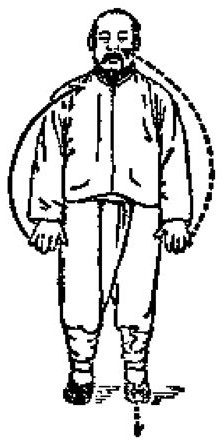
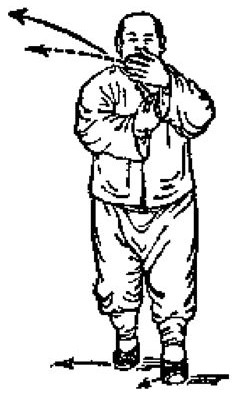
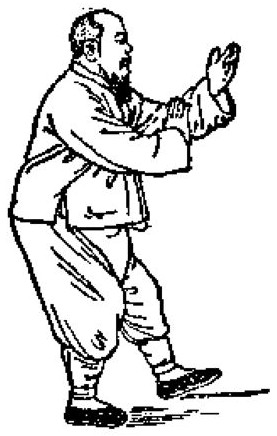
Second Posture: Taiji Rising Posture (Figure 2)
From the preceding posture (Figure 1) the two hands are lifted at the same time and placed before the chest, the left outside and the right inside, the left high and the right low; the left hand forms a side palm with the palm facing inward, and the tip of the thumb is directly opposite the tip of the nose and at the same height; the right hand forms an upright palm with the palm facing outward, the fingertips below the left wrist. At the same time the left foot steps out half a pace and becomes a xu bu (虚步, empty stance), the heel resting on the ground with the toes raised; the right leg takes the opportunity to bend slightly and bears the weight, the face still turned south, as in Figure 2 (side view appended). Further, how much the left toes are raised depends on how high or low the right leg is bent; in the side view the amount by which the left toes are raised …is not great; this is because the right leg is bent (that is, seated) rather higher.
Third Posture: Lan Que Wei (攬雀尾, "Grasping the Sparrow's Tail") (Figures 3–6)
Movement one: From the preceding posture (Figure 2), turn the body to the right on the spot. First turn the left foot and the right foot into a dingzi stance (丁字式, T-form); after the feet are set, the toes point west, then the leg bends slightly and bears the body weight. At the same time the waist turns to the right and the right foot is lifted and placed to the right front of the left foot, becoming a xu bu with the heel on the ground; the two feet are half a pace apart. While the feet turn, the right hand follows a curved line, rising from below, passes across the palm of the left hand and extends forward to become an upright palm, with the tip of the thumb level with and opposite the tip of the nose. The left hand at the same time withdraws slightly inward and downward, and when the fingertips come close beside the right wrist it too becomes an upright palm; the two elbows sink, the eyes look toward due west, as in Figure 3.
Movement two: From the preceding posture (Figure 3) the footwork is unchanged; the two elbows sink at the same time, the left elbow coming close to the ribs. While the elbows sink the two hands turn slowly: the right hand turns into an upward palm (仰掌) and the left hand into a downward palm (俯掌), the fingertips slanting upward. While the elbows sink and the palms turn, the chest is slightly hollowed and one sits onto the left leg; the waist also turns slightly to the left, and the right hand makes a scooping-water shape, storing power in preparation for the extending of the palm in the next posture; the direction due west is unchanged, as in Figure 4.
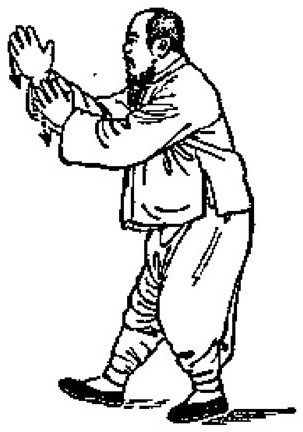
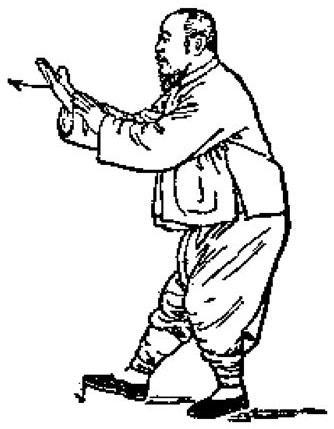
Movement three: From the preceding posture (Figure 4) the two hands take the opportunity to extend forward, carrying a slight curve; the right arm must not be too straight. At the same time the right foot steps out half a pace and becomes a gong bu (弓步, bow stance), the body weight on the right leg, the left leg straightens, the direction unchanged, as in Figure 5.
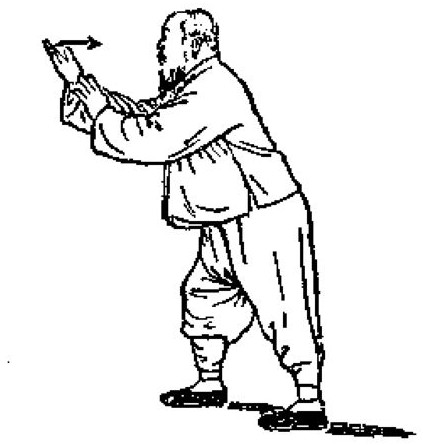
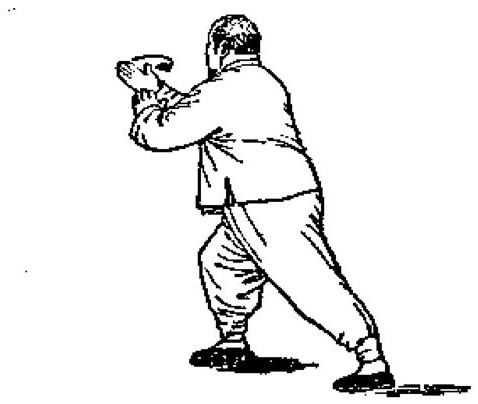
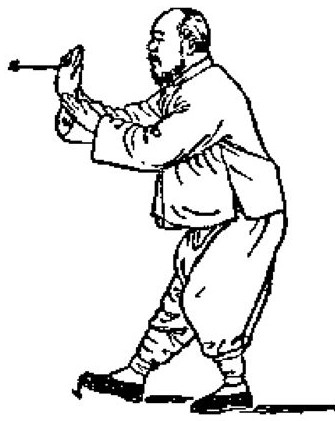
Movement four: From the preceding posture (Figure 5) the stance remains a bow stance. The right hand follows a natural curve and shifts horizontally to the right, and the fingertips of the left hand, resting on the right wrist, move along with it; at the same time the waist turns slightly to the right, and the body and the fingers of both hands all turn toward the northwest, as in Figure 6-Yi. At this point the waist can no longer turn right, so one takes the opportunity to sit slowly onto the left leg and to turn slowly back toward due west, changing the bow stance into an empty stance; at the same time the right hand bends at the elbow, drops the elbow and draws a small arc, and when it has turned to the front of the right shoulder the fingertips have already gradually turned upward, whereupon the wrist turns slowly and pushes out toward due west, becoming an upright palm; the left hand follows below the right wrist, turning from a downward palm into an upward palm, the two elbows slightly bent, the body facing due west, the eyes looking ahead, as in Figure 6-Yi. Lan Que Wei is always joined closely to the following posture, Dan Bian, and in continuous movement it is in fact difficult to see the division between the two movements of Figure 6-Yi and Figure 7; to suit beginners' requirements, this book therefore takes Figure 6-Yi as the final movement of the present posture.
This posture is the one that moves the waist most: in the first movement the waist must move to the right; in the second movement the waist must move to the left; in the third movement the waist must lengthen as the hands extend; and in the fourth movement, from sitting back to extending the palm forward, the waist must make a wholly circular turning action. All these waist movements are closely combined with the movements of the hands. If a beginner can learn the waist movement of this posture, the waist movement of the other postures will be comparatively easy.
Fourth Posture: Dan Bian (單鞭, "Single Whip") (Figures 7–8)
Movement one: From the preceding posture (Figure 6-Yi) bend the right knee and change the empty stance into a bow stance. As the stance changes, the right toes turn slightly to the left, so that the body shifts from due west to slightly toward the southwest; at the same time the two arms extend toward the southwest, but must not be straightened (the body and the two hands may also first face due west, and turn the foot toward the southwest at the next movement). The right palm pushes forward as before with a slight dome to the palm, the palm facing toward the southwest; the left hand remains an upward palm in its original position below the right wrist; the eyes look toward the front of the right hand, as in Figure 7.
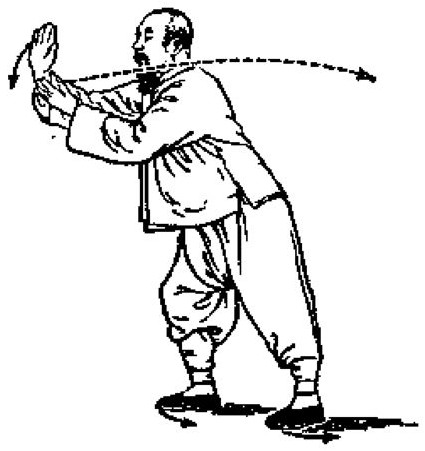
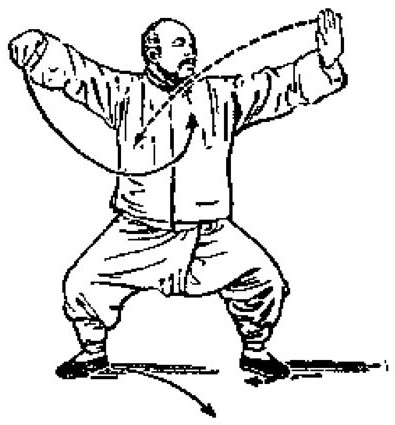
Movement two: From the preceding posture (Figure 7) the right palm drops lightly with the fingertips pointing down and the five fingers gathered into a grasping fist. At this point the body weight has already been shifted lightly onto the right leg; taking the opportunity, lift the left foot and step along a curve toward the left rear, the toes turning toward the southeast, and the right toes take the opportunity to turn toward the south; then bend the legs into a horse-riding stance (騎馬式), the two knees and the two toes pointing in the same direction, the body turned slightly toward the southeast. While the left foot steps, the left hand leaves the right wrist, the palm facing inward, and becomes an upward palm and becomes an upright palm; it then moves toward the left hand, and when it has moved to the front of the left cheek the palm turns to face outward, continues to move, and pushes out toward the east (slightly toward the south), still as an upright palm. The head also turns to the left following the left palm, and the eyes look toward the southeast, as in Figure 8.
Fifth Posture: Ti Shou Shang Shi (提手上勢, "Raise the Hand to the Upper Position") (Figures 9–10)
Movement one: From the preceding posture (Figure 8) the left toes turn toward due south; then sit onto the left leg and bear the whole body weight, and move the right foot to a half pace to the right front of the left foot, changing into an empty stance with the heel on the ground and the toes raised, in the same direction as the left foot. As the footwork changes, the right grasping fist opens and drops toward the chest, becoming a side palm with the palm facing inward and the whole arm forming an encircling embrace; at the same time the left hand is moved to a place inside the right hand, near the wrist, remaining an upright palm with the palm facing forward. The body leans slightly forward, the eyes look ahead (due south), as in Figure 9 (this figure shows the posture with the right hand already lifted, so the forward lean of the body is smaller than in the side view).
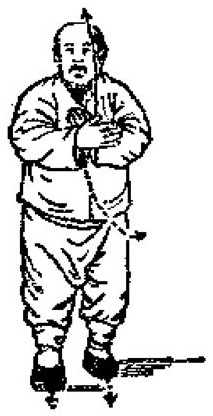
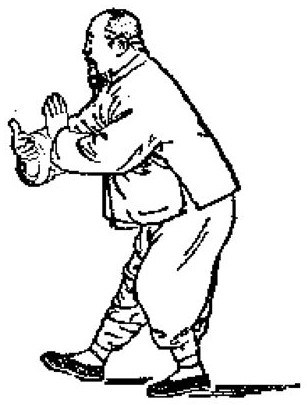
Movement two: From the preceding posture (Figure 9) the right toes come down and are set firmly; the left foot takes the opportunity to step up and become a parallel stance with the right foot, the two legs slightly bent. While the feet come together, the right hand takes the opportunity to rise slowly upward, rotating the forearm until it is raised to about one or two inches in front of the forehead, where it turns into an upward palm; the left hand presses down at the same time and is placed beside the hip, the arm straightened but not too straight, the fingertips slanting slightly upward, the palm pressing slightly downward. The direction of the body is unchanged, and the eyes still look ahead, as in Figure 10.
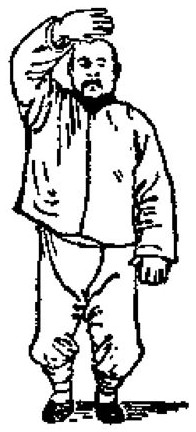
Sixth Posture: Bai He Liang Chi (白鶴亮翅, "White Crane Spreads Its Wings") (Figures 11–12)
Movement one: From the preceding posture (Figure 10) without moving the feet, turn the waist to the left so that the body turns toward the southeast; the two hands remain unchanged in their original position, and the line of sight follows the direction of the body, as in Figure 11. In this posture it was formerly required, before turning the waist, to lean the upper body slightly forward; sometimes the lean was excessive and the result was often made to look like bowing the head. Master Wu in his later years omitted this, and merely leans the body very slightly while turning the waist, to assist the momentum.
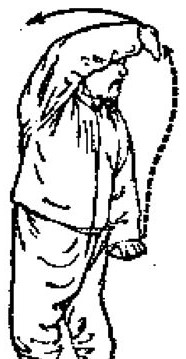
Movement two: From the preceding posture (Figure 11) the left arm, carrying the remaining momentum of the waist turn, is raised straight from the left rear upward (bending at the elbow only when the arm comes level with the shoulder); at the same time the body is turned toward due south. At this point the left hand has risen to the upper left of the left forehead, and both hands are above the forehead as upright palms with the palms facing forward; the shoulders then sink so that the upper arms drop slightly, and the distance between the two hands is about shoulder-width. The eyes look toward due south, and the two legs remain slightly bent, as in Figure 12 (in this figure the camera angle was unsuitable, so the two hands appear too high; in practice the two hands should be held somewhat lower).
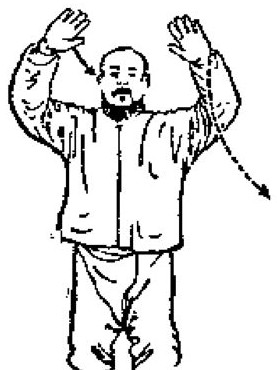
Seventh Posture: Lou Xi Ao Bu (摟膝拗步, "Brush the Knee, Twist Step") (Figures 13–19)
Movement one: From the preceding posture (Figure 12) the two feet turn to the left at the same time (the left foot turns on the heel and the right foot turns on the sole), the toes pointing east; the left foot becomes an empty stance with the heel on the ground, the right leg slightly bent. While the feet turn, the left hand drops down in front of the body and becomes a downward palm with the fingertips slanting toward the southeast, and the right turns into a side palm placed beside the right cheek, the upper arm level with the shoulder, the eyes looking east, as in Figure 13.
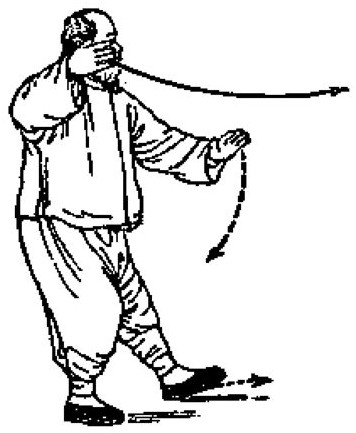
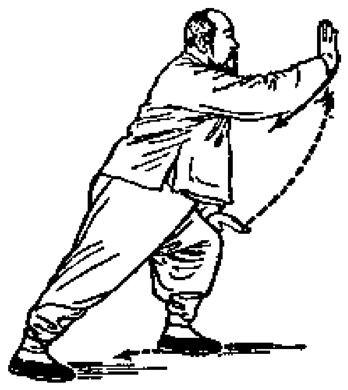
Movement two: From the preceding posture (Figure 13) bend the right leg; the left foot moves forward half a pace, the heel touching the ground first, and is set firmly by degrees, changing into a bow stance; the right leg takes the opportunity to straighten, and the left leg takes over bearing the body weight. While the left leg is lifted and steps up, the left hand takes the opportunity to brush downward past the knee and is placed beside the left knee, still a downward palm with the fingertips pointing forward. While the left hand brushes the knee, the right hand (a side palm, the fingertips pointing forward) extends slowly forward from beside the cheek, turning the forearm as it extends, and when the arm is straight it becomes a true palm (正掌). The body and the line of sight both face east, as in Figure 14.
Movement three: From the preceding posture (Figure 14) taking the remaining momentum of the slight dome of the palm as the right arm straightens, withdraw the right hand to the chest and change it into an upright palm with the palm facing left; at the same time the left hand is placed from below upward above the fingertips of the right hand, forming an upright palm with the palm facing right. While withdrawing the right hand, take the opportunity to draw in the waist and sit back, and withdraw the left foot half a pace to become an empty stance, so that the right leg bears the body weight; the direction of the body and of the line of sight is unchanged, as in Figure 15.
Movement four: From the preceding posture (Figure 15) the left hand drops, the right hand is raised beside the right cheek, returning to the form of Figure 13.
Movement five: From the preceding posture (Figure 13) repeat the form of Figure 14 once, as in Figure 16. Movement six: From the preceding posture (Figure 16) the right hand drops and becomes a downward palm with the fingertips slanting toward the northeast, and the left hand is raised and placed beside the left cheek, becoming a side palm; at the same time the right foot comes forward from behind a pace and a half and is placed at the southeast corner in front of the left foot, becoming an empty stance; the body and the line of sight still face east, as in Figure 17. Figure 17 and Figure 13 are in fact the same posture, only the left and right of hands and feet are exactly reversed; please compare it with the explanation for Figure 13.
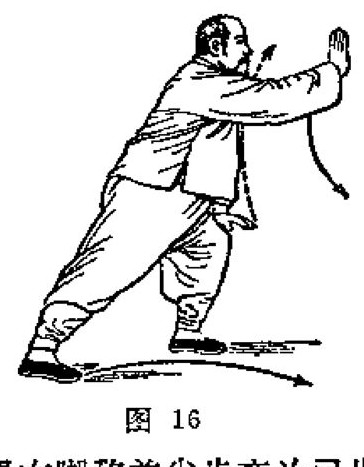
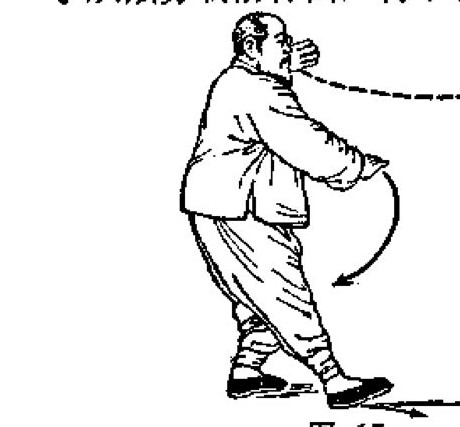
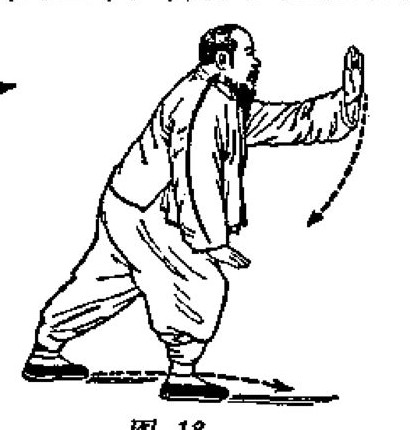
Movement seven: From the preceding posture (Figure 17) lift the right foot, move it forward half a pace and change into a bow stance; the left leg takes the opportunity to straighten. At the same time the right hand brushes past the right knee and is then placed beside the right knee, still a downward palm, and the left hand extends forward from beside the cheek, turning the forearm, and becomes a true palm. The direction of the body and of the line of sight is unchanged, as in Figure 18. Figure 18 and Figure 14 are in fact the same posture, only the left and right of hands and feet are exactly reversed; please compare it with the explanation for Figure 14.
Movement eight: From the preceding posture (Figure 18) the left hand drops, the right hand is raised beside the right cheek, and one returns to the form of Figure 13; this is the same as movement four, and the illustration is omitted.
Movement nine: From the preceding posture (Figure 13) repeat the form of Figure 14 once more; this is the same as movement two or movement five, and the illustration is omitted.
Movement ten: From the preceding posture (Figure 14) repeat the form of Figure 15 once; this is the same as movement three, as in Figure 19. This posture has two further key points, which are explained summarily here: (1) before the left hand brushes past the left knee, one must first withdraw the body toward the right (that is, turn the waist without moving the feet), and then turn slowly back to the front as the right hand extends forward; when the right hand brushes past the right knee, one must likewise first withdraw the body toward the left, and then turn slowly back to the front as the left hand extends forward; (2) when the true palm (as in Figures 14 and 18) reaches its end point, the tip of the thumb must point directly at the tip of the nose; in the withdrawing-palm posture (as in Figure 15) the tip of the left thumb must likewise point directly at the tip of the nose. At present some teachers, in order to accommodate beginners, are not strict enough about the requirements above, so that students inevitably show certain shortcomings in the roundness and liveliness of the movements and in the evenness and uprightness of the postures. This is pointed out here for reference.
Eighth Posture: Shou Hui Pi Pa (手揮琵琶, "Hand Strums the Lute") (Figures 20–21)
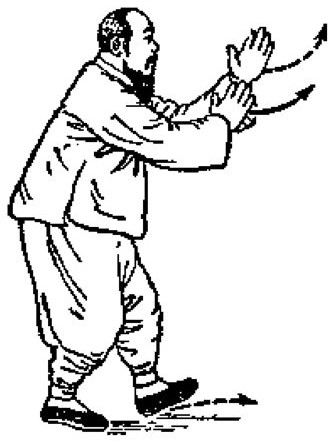
Movement one: From the preceding posture (Figure 19) the left foot steps forward half a pace and becomes a bow stance, and the right leg takes the opportunity to straighten. At the same time the two palms change direction: the left hand turns so that the palm faces outward and downward, and the right hand turns so that the palm faces inward and upward, both remaining in the upright-palm form (the elbows must sink slightly as the palms turn). After the palms have turned, the two hands immediately extend slowly forward and upward along a curved line, the left arm compared with the preceding posture (Figure 19) is straighter, and the right arm is bent more than in the preceding posture; the body and the line of sight still face due east, as in Figure 20.
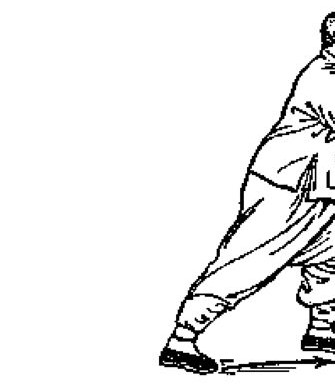
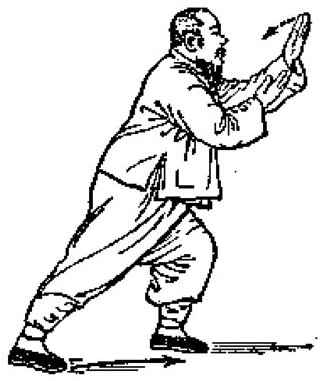
Movement two: From the preceding posture (Figure 20) the right foot draws in forward to become a parallel stance with the left foot, with the two knees slightly bent. At the same time the two hands take the opportunity to withdraw slightly from above toward the chest along a curve to the left, bending the arms and dropping the elbows, making the shape of "hand strums the lute"; the direction is unchanged, as in Figure 21.
Although the movement of this posture is simple, at first it is generally not easy to perform well, because the extending and withdrawing of the two hands both travel along curves, and in the continuous movement there is an ellipse; if the waist cannot make a circular movement in the same direction to match it, it is impossible to achieve harmony of the whole body in the posture.
Ninth Posture: Shang Bu Ban Lan Chui (上步搬拦捶, "Step Up, Deflect, Parry, Punch") (Figures 22–24)
Movement one: From the preceding posture (Figure 21) the left foot steps forward one pace and becomes a bow stance. At the same time the two arms first bend slightly, then extend forward along a curve to the right, and the palms change: the left palm faces south and the right palm faces north, both being upright palms; the direction of the body and of the line of sight is unchanged, as in Figure 22.
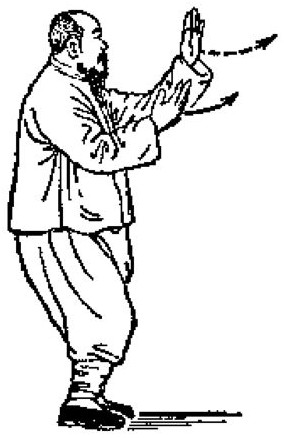
Movement two: From the preceding posture (Figure 22) draw the body back and sit onto the right leg, and draw the left foot back slightly to become an empty stance; at the same time the two hands take the opportunity to withdraw together along a curve to the left, The left hand withdraws only one or two inches and still stops in front, while the right hand, withdrawing as it closes, forms a fist (a true fist, zhèng quán) and is drawn straight back until it reaches the side of the hip; the direction is unchanged, as in Figure 23.
Movement three: From the preceding posture (Figure 23) the right fist immediately extends from the side of the hip straight forward to the centre front, the arm straight and the fist level with the shoulder, still a true fist; at the same time the left hand is slowly withdrawn and placed beside the elbow of the right arm, still as an upright palm. At the same time the left foot shifts forward very slightly and takes the opportunity to return to the original bow stance; the direction is unchanged, as in Figure 24.
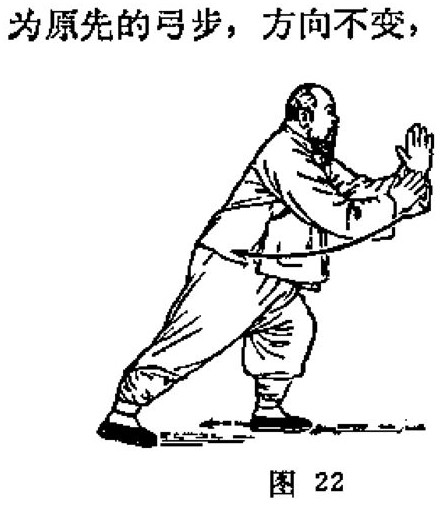
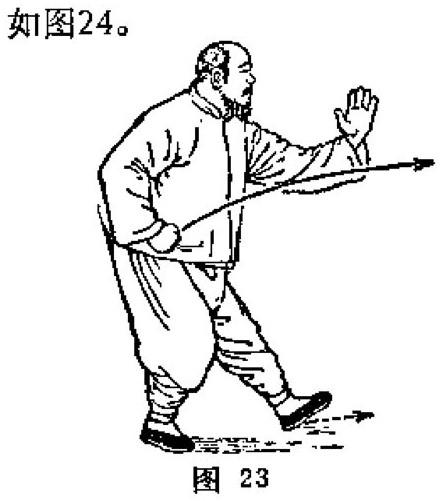
Tenth Posture: Ru Feng Si Bi (如封似閉, "As If Sealing, As If Closing") (Figures 25–27)
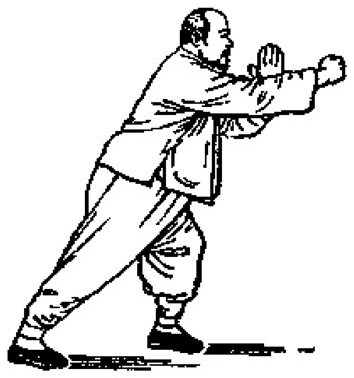
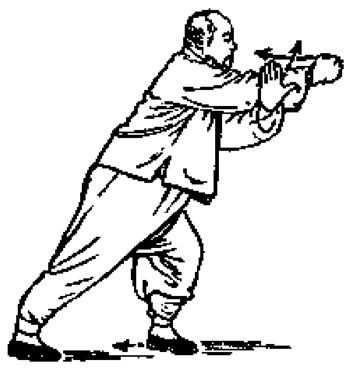
Movement one: From the preceding posture (Figure 24) the right arm is raised very slightly and bent very slightly toward the left, remaining a true fist; at the same time the left hand passes from beneath the right arm to the outer side of the right arm, still as upright palms, but with the direction of the palms opposite to before; the body and the footwork are both the same as in the preceding posture, as in Figure 25.
Movement two: From the preceding posture (Figure 25) the right arm continues to bend toward the left, and the right fist opens with the movement and becomes a slanted upright palm with the fingertips pointing north; the left hand shifts forward along the right arm and also becomes a slanted upright palm with the fingertips pointing south. At this moment the two forearms have formed a crossed shape (like ×). They immediately separate to left and right, the two forearms rise to stand upright in a parallel form with the two elbows sinking; the two slanted upright palms become square upright palms, the fingers pointing upward and the palms facing inward. While the hand positions change, the body takes the opportunity to sit onto the right leg, the left foot is drawn back very slightly and becomes an empty stance; the body and the line of sight still face due east, as in Figure 26 (in this figure the photograph was taken at a slight angle so that the two hands could be seen clearly).
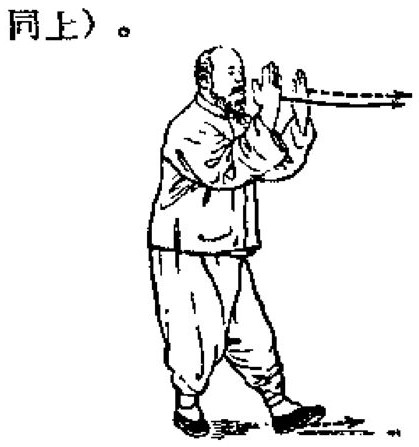
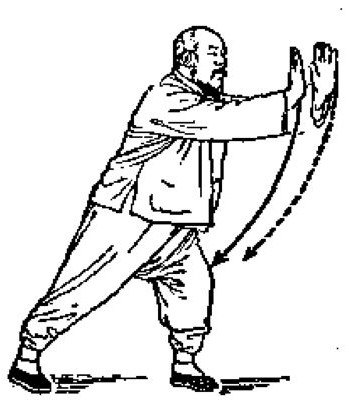
Movement three: From the preceding posture (Figure 26) the two hands turn so that the palms face each other, then turn so that the palms face outward, and are then slowly pushed forward in parallel (a thrusting palm), the two arms extending straight and remaining upright palms with the palms facing east. While the two palms push forward, the foot takes the opportunity to step up and returns to the original bow stance; the direction is still due east, as in Figure 27 (this figure also is at a slight angle, for the same reason as above).
Eleventh Posture: Shi Zi Shou (十字手, "Cross Hands") (Figures 28–30)
Movement one: From the preceding posture (Figure 27) the two arms, still straight, drop downward, and the two palms first wipe backward, and when the two arms are vertical they are placed in front of the left knee and become downward palms with the fingertips pointing forward; the footwork is the same as in the preceding posture and the direction is still due east, as in Figure 28.
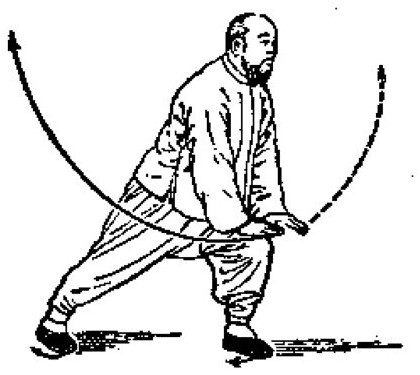
Movement two: From the preceding posture (Figure 28) the two hands slowly separate to either side of the left knee. At the same time the two toes turn to face due south (the left toe may also not turn, since this is a continuous movement and the feet are about to be brought together anyway); the right leg bends and becomes a bow stance, the left leg straightens, and the body turns to face due south. At this moment the two hands are still continuing to separate, slowly rising from below to be level with the shoulders, the right hand slightly higher and the left slightly lower, both as side palms with the palms facing forward; the eyes look to the left front (if the emphasis is placed on the right hand, one may also turn the head with the right hand and look to the right front, turning back to the front at the next movement), as in Figure 29.
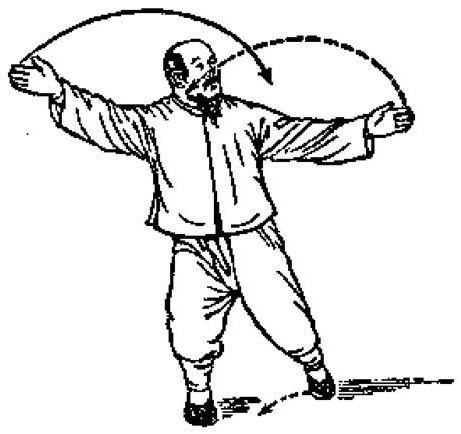
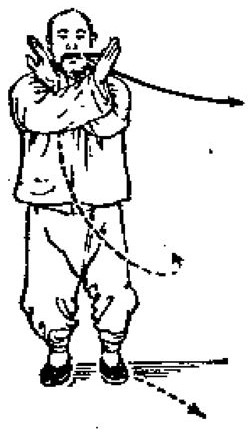
Movement three: From the preceding posture (Figure 29) the two hands are raised above the head, then brought down from above inward to join in a crossed shape, the right hand outside and the left hand inside, both as upright palms with the palms facing respectively left and right. At the same time the left foot steps up to be parallel with the right foot; the body and the line of sight both face due south, as in Figure 30.
Twelfth Posture: Bao Hu Gui Shan (抱虎归山, "Embrace the Tiger and Return to the Mountain") (Figures 31–32)
Movement one: From the preceding posture (Figure 30) withdraw the body very slightly to the right and place the weight on the right leg; the left foot then steps out a pace to the left front, and the toes of both feet turn to face southeast. The left leg becomes a bow stance and the right leg straightens. At the same time the left hand drops and brushes past the left knee and is placed beside the left hip as a downward palm with the fingertips pointing forward; the right hand takes the opportunity to push out toward the southeast and turns into a true palm. The body and the line of sight both face southeast, as in Figure 31 (the form is the same as Figure 16, but the direction is different).
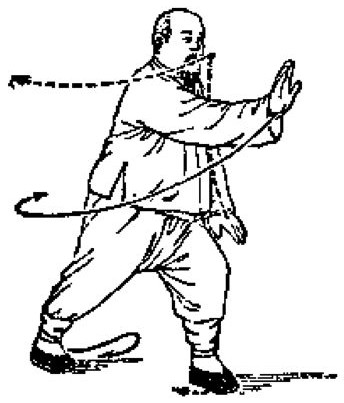
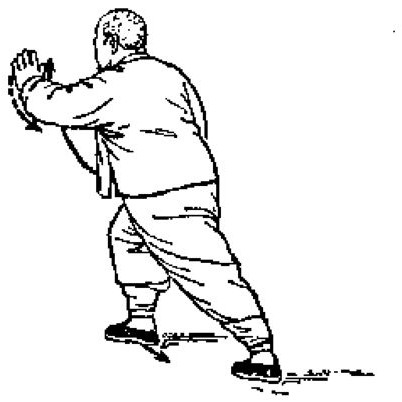
Movement two: From the preceding posture (Figure 31) withdraw the body very slightly to the left so that the left leg bears the weight, and at once turn the toes to face northwest; at the same time lift the right leg and turn the body toward the northwest, setting the foot down to the northwest of the left foot with the toes pointing northwest, forming a bow stance, the left leg straightening with the movement. While the body turns, the right hand drops, brushes past the right knee and is placed beside the right hip as a downward palm with the fingertips pointing northwest; the left hand rises from below and is placed beside the left cheek as a side palm with the fingertips pointing northwest; the forearm turns and the hand is slowly pushed forward (to the northwest), becoming a true palm with the palm facing northwest when the arm straightens. The body and the line of sight follow the same direction as the left palm, as in Figure 32. This posture was formerly called the forward and reverse lōu xī ào bù; it is now treated as one conti- nuous movement and called bào hǔ guī shān (see the chapter on the names of the postures). Further, of the directions used above, movement one is toward the southeast and movement two toward the northwest; formerly due south and due north were also used, and students may suit themselves.
Thirteenth Posture: Lan Que Wei (攬雀尾, "Grasp the Sparrow's Tail") (figure omitted)
This posture is a repeated form; from the preceding posture (Figure 32) draw the left hand back before the chest and place the right hand above the left from below, as in Figure 3, but the direction is toward the northwest and not toward due west. Thereafter continue with the movements of Figures 4, 5, and 6; the body and the line of sight both face northwest.
Fourteenth Posture: Xie Dan Bian (斜單鞭, "Slanting Single Whip") (Figure 33)
This posture is likewise a repeated form; from Figure 6 one may continue with the forms of Figures 7 and 8, but the body must face southwest and the eyes look due south, as in Figure 33 (in this photograph the angle toward the southwest is insufficient, so the angle of the body toward the southwest and of the eyes looking due south is likewise insufficient; please take note in practice).
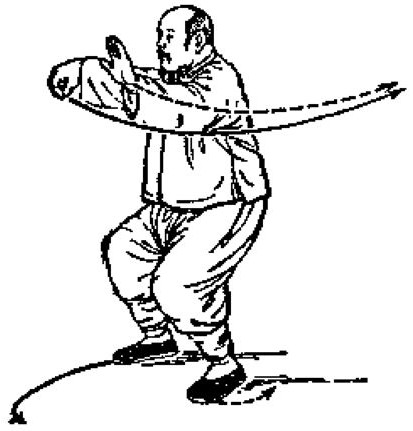
Fifteenth Posture: Zhou Di Kan Chui (肘底看捶, "Look at the Fist Beneath the Elbow") (Figures 34–35)
Movement one: From the preceding posture (as in Figure 33, with the body facing southwest) first withdraw the body toward the left so that the left leg bears the weight, and at once turn the left toes to face due east and bend forward at the left leg; at the same time extend the right leg, moving it along a curve toward the south to place it at the southwest corner behind the left foot (as in the diagram), turning the body to face due east. While the body turns, the right hand opens from its grasping fist, and the two arms extend straight at wrist and forearm and shift in parallel toward the left; in shifting, the left hand moves slightly slower and the right slightly faster, both as downward palms. When the fingers point east, the two arms have become parallel; the eyes look due east, as in Figure 34. Movement two: From the preceding posture (Figure 34), just as the two arms become parallel, withdraw the body and sit onto the right leg, and draw the left foot back half a pace to become an empty stance. At the same time the two hands slowly close into fists; the left arm bends and the elbow sinks so that the fist stands upright as a vertical fist with the tiger's mouth facing inward, while the right fist is gathered back before the chest and placed below the left elbow as a true fist; the direction is unchanged, as in Figure 35.
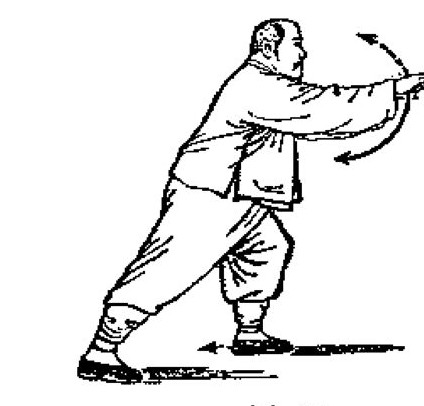
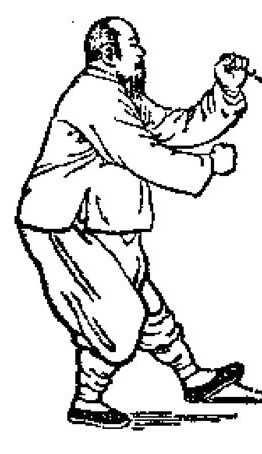
Sixteenth Posture: Dao Lou Hou (倒摟猴, "Step Back and Brush Past the Monkey") (Figures 36–37)
Movement one: From the preceding posture (Figure 35) lean the body forward, and the left foot takes the opportunity to shift forward half a short pace; the leg then bends and becomes a bow stance with the right leg straight. At the same time the left fist opens, drops slightly forward and becomes an upward palm, and the right fist remains below the left elbow; the direction is unchanged, as in Figure 36.
Movement two: From the preceding posture (Figure 36) the left hand shifts in parallel along a curve to the left rear, the elbow slowly bending, and the upward palm becomes a side palm placed beside the left cheek (as the left hand in Figure 17); the right fist opens and becomes a downward palm (as the right hand in Figure 17). At the same time the right leg bends and the left-leg bow stance becomes an empty stance (as the footwork of Figure 13), placing the weight on the right leg; then lift the left leg and step back one and a half paces, becoming a bow stance with the right leg bent (whereas the earlier bow stance was with the left leg bent). While stepping back, the right hand makes a downward brushing movement and is placed beside the right hip, still as a downward palm, and the left hand extends slowly forward from beside the left cheek, turning the forearm as it extends, until at the end point it becomes a true palm; the direction is unchanged, as in Figure 37. This is the first dào lōu hóu. Movement three: From the preceding posture (Figure 37) bend the left leg and sit the body down, and the right leg changes from a bow stance into an empty stance (as the footwork of Figure 17). At the same time, following the movement of Figure 13, the left hand drops and becomes a downward palm, and the right palm is raised and placed beside the right cheek as a side palm; then lift the right leg and step back one and a half paces, changing again into a bow stance with the left leg bent. Meanwhile the left hand makes a downward brushing movement and is placed beside the left hip, still as a downward palm, and the right hand extends slowly forward from beside the right cheek, turning the forearm to become a true palm; the direction is unchanged, and the figure is omitted (one may refer to the position of Figure 14). This is the second dào lōu hóu.
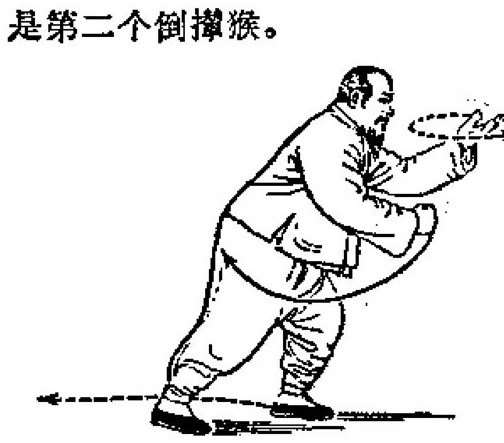
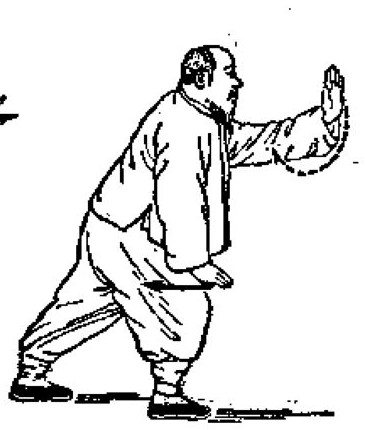
Movement four: From the preceding posture (the same as Figure 14) first, following Figure 17, perform the movement of dropping the right palm and raising the left palm, then change the bow stance into an empty stance as in the footwork of Figure 13; then lift the left leg and step back one and a half paces, and change the empty stance back into a bow stance. At the same time the two hands perform the movement of Figure 18, returning to the form of Figure 37; the direction is still due east. This is the third dào lōu hóu.
Dào lōu hóu is a backward-moving form of lōu xī ào bù. Before stepping back it is the empty-stance form of the ào bù, and after stepping back it becomes the bow-stance form of the ào bù; this is what differs from lōu xī ào bù, and the remaining movements may be consulted in the illustrations of lōu xī ào bù. Further, other books treat Figure 35 as the final movement of zhǒu dǐ kàn chuí, whereas this book, following the old transmission, treats it as the first movement of dào lōu hóu.
Seventeenth Posture: Xie Fei Shi (斜飞势, "Slanting Flying Posture") (Figures 38–39) Movement one: From the preceding posture (Figure 37) the footwork is unchanged; turn the body very slightly to the right side. At the same time the left hand turns at the shoulder and sinks at the elbow, changing the true palm into an upward palm, and the body leans very slightly forward with the movement; the right hand remains beside the hip. The eyes look due east, as in Figure 38.
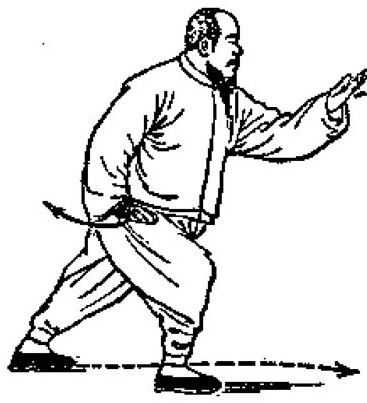
Movement two: From the preceding posture (Figure 38) the left foot steps forward from behind, across to the left front of the right foot, taking one large pace; the toes turn toward the southeast and the leg bends to become a bow stance, while the right leg straightens with the movement and its toes turn to face due south. At the same time the left hand extends toward the left, still as an upward palm, and the right palm presses down toward the southwest, answering the extension of the left hand; the body inclines toward the south and the eyes look at the back of the right hand, as in Figure 39.
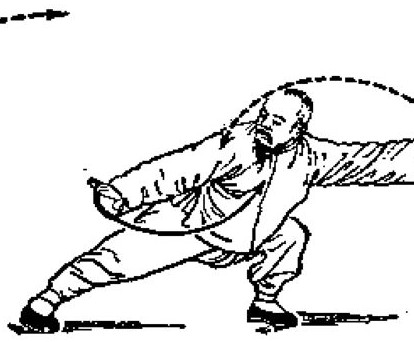
Eighteenth Posture: Ti Shou Shang Shi (提手上势, "Raise the Hand and Step Up") (Figure 40)
This posture is a repeated form. The joining of the two hands before the chest is the same as the first movement of the fifth posture, but the two legs change directly from a bow stance with the left leg bent into a bow stance with the right leg bent, which differs from the empty stance of the fifth posture; the body faces due south, as in Figure 40. Thereafter the left foot steps forward and is brought alongside into a parallel stance, the right hand is raised and the left hand presses down, all the same as the movements of Figure 10; please consult the illustration of that figure.
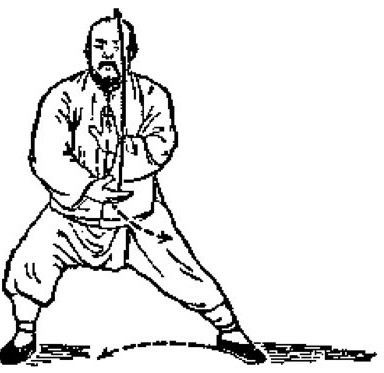
Nineteenth Posture: Bai He Liang Chi (白鶴亮翅, "White Crane Spreads Its Wings") (figure omitted)
This posture is a repeated form; from the form of Figure 10 one may continue with the two movements of Figures 11 and 12, and the illustration is omitted.
Twentieth Posture: Lou Xi Ao Bu (摟膝拗步, "Brush Past the Knee in a Twist Step") (figure omitted)
This posture is a repeated form; from the form of Figure 12 one need only continue with the two movements of Figures 13 and 14, and the illustration is omitted.
Twenty-first Posture: Hai Di Zhen (海底针, "Needle at the Bottom of the Sea") (Figures 41–42)
Movement one: From the preceding posture (as in Figure 14) perform the movement of Figure 15, facing due east, as in Figure 41.
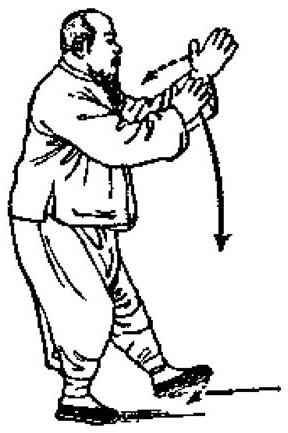
Movement two: From the preceding posture (Figure 41) the right hand drops from an upright palm into a hanging palm (the palm facing north) and thrusts down obliquely forward; the left hand takes the opportunity to move down and is placed beside the right elbow as a side palm (the palm facing south). At the same time the left foot changes to rest on its toes, and the two legs bend slightly lower with the right hand's downward thrust, the body leaning slightly forward (the head must not be bowed); the eyes look level toward the east, as in Figure 42. In this posture, when the body leans, one most easily bows the head; to avoid this fault one may also adopt a position in which the body is kept upright as it thrusts down.
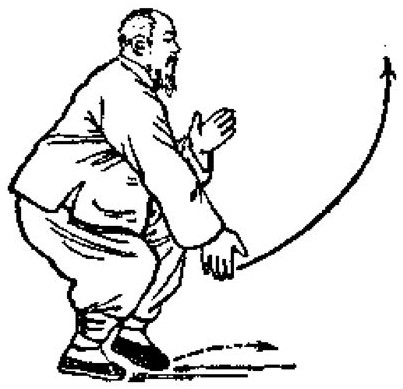
Twenty-second Posture: Shan Tong Bei (扇通背, "Fan Through the Back") (Figures 43–44)
Movement one: From the preceding posture (Figure 42) the left foot steps out toward the east and becomes a bow stance, the right leg straightening. At the same time the two arms rise as before, the right arm forming a straight line with the shoulder, and the left palm, still beside the right elbow, becomes an upright palm; the direction of the body is unchanged and the eyes still look east, as in Figure 43.
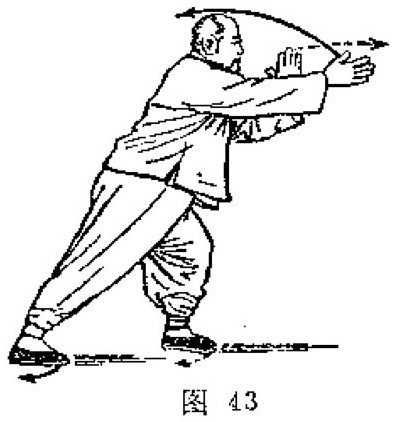
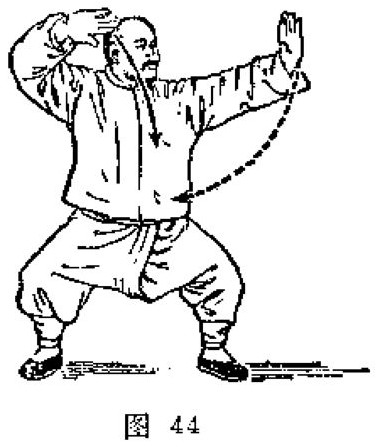
Movement two: From the preceding posture (Figure 43) the right hand is slowly drawn back and the left hand slowly extends; at the same time the left foot turns toward the southeast and the right foot toward the southwest, so that the body turns to face due south; at the same time the left arm straightens with the palm facing outward, still an upright palm, and the right arm bends, the palm being drawn back beside the right forehead and turned into a reverse palm. The legs then lower with the movement into a horse-riding stance, the body facing southeast and the eyes looking at the back of the left hand, as in Figure 44.
Twenty-third Posture: Pie Shen Chui (撇身捶, "Turn the Body and Punch") (Figures 45–46)
Movement one: From the preceding posture (Figure 44) the left toes turn toward the southwest and the body also turns toward the southwest; the weight is added to the left leg, the right leg becoming the empty leg. At the same time the two hands drop and form fists facing each other in front of the left ribs, the right fist above and the left below, both as downward fists; the eyes look due south, as in Figure 45.
Movement two: From the preceding posture (Figure 45) the right foot is at once lifted and set down toward the northwest, chan- ges into a bow stance with the toes pointing west; the left leg straightens with the movement and its toes also turn to face west, so that the body turns to face due west. At the same time the right downward fist is turned over into an upward fist and is drawn back with the movement to be placed beside the right ribs, still an upward fist; the left hand, before the right fist turns over, becomes an upward fist and is placed above the right wrist, then the wrist turns and the hand extends forward, becoming an upright palm with the palm facing north and the fingertips pointing upward; the arm must not be straightened. The drawing back of the right fist and the extending of the left hand must reach their end points at the same time, and the body at this moment must turn from due west very slightly toward the northwest (that is, turning the body to the right). The line of sight is still toward due west, as in Figure 46. In Figure 46 the right fist is hidden by the body and cannot be seen; one may refer to the front view of Figure 45, but the direction should be due west and this should not be misunderstood.
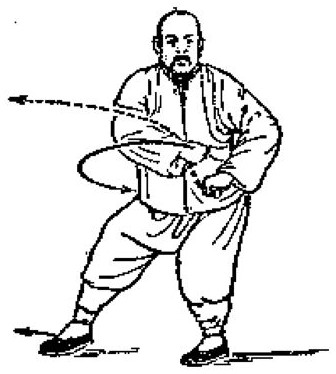
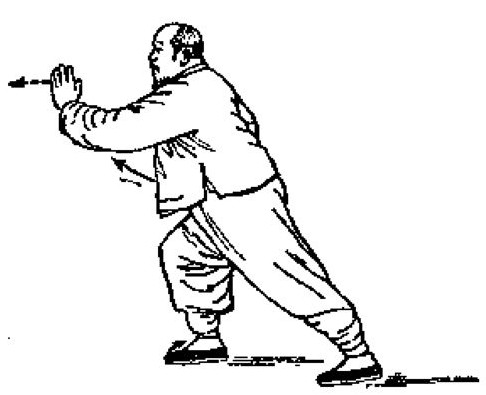
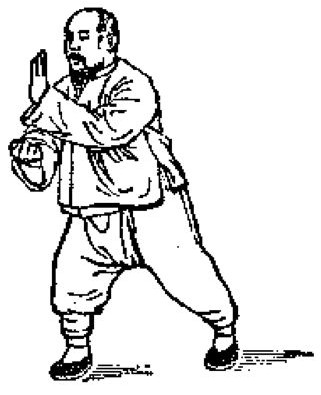
Twenty-fourth Posture: Xie Bu Ban Lan Chui (卸步搬拦捶, "Withdraw the Step, Deflect, Parry, Punch") (Figures 47–49)
Movement one: From the preceding posture (Figure 46) the two hands extend forward; the left hand remains an upright palm with the fingertips pointing slightly forward, and the right fist extends from an upward fist into a true fist. The two hands are then drawn back very slightly, and with the movement the left leg bends and the bow stance changes into an empty stance; the direction is still due west, as in Figure 47. Movement two: From the preceding posture (Figure 47), taking the remaining momentum of the change from bow stance to empty stance, lift the right foot and step back one large pace, bending the right leg with the movement so that the pose becomes an empty stance with the left foot in front. At the same time the right fist is drawn back and placed, as before, beside the right ribs as a true fist; the direction is unchanged, as in Figure 48.
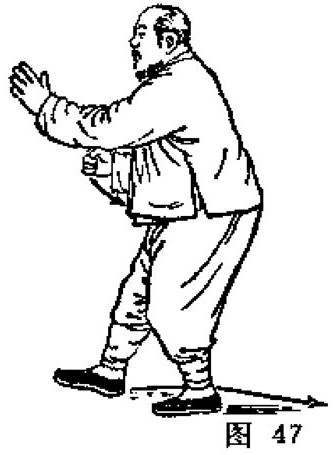
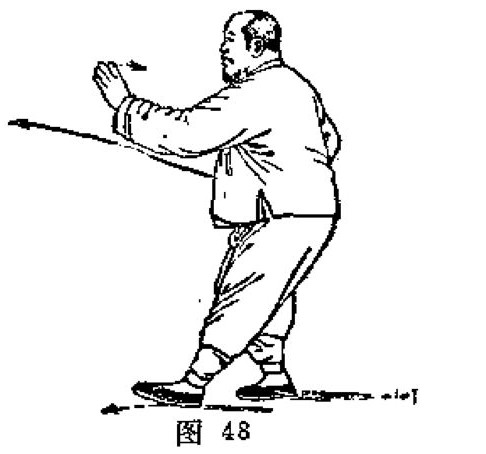
Movement three: From the preceding posture (Figure 48) the right fist extends straight forward from beside the ribs, still as a true fist, and the left hand is drawn back inward and placed beside the right elbow, still as an upright palm. While the fist extends, the body moves forward and the left foot takes the opportunity to advance half a pace; the left leg bends, the empty stance becomes a bow stance, and the right leg straightens. The direction is unchanged and the eyes look due west, as in Figure 49.
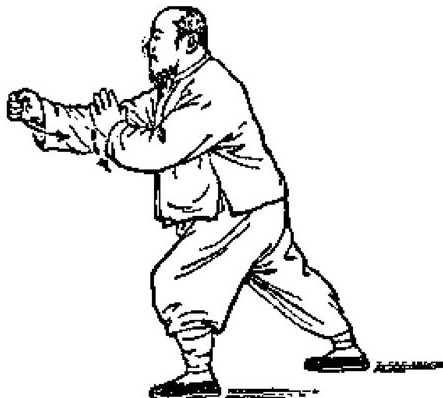
Twenty-fifth Posture: Shang Bu Lan Que Wei (上步攬雀尾, "Step Up, Grasp the Sparrow's Tail") (Figure 50)
This posture is a repeated form. From the preceding posture (Figure 49) the right fist opens (the shape being similar to Figure 3) and the two hands perform the movement of Figure 4; the body sits onto the right leg with the movement, and the bow stance becomes an empty stance, as in Figure 50. Then the arm-extending movement of Figure 5 is performed, and with the movement the right leg is lifted and planted one large pace forward, the leg bending into a bow stance exactly the same as the form of Figure 5; this is the "step up" of this posture. Thereafter the movements of Figure 6 甲 and Figure 6 乙 are performed to complete the lǎn què … of the tail; the full form is described here in brief.
Twenty-sixth Posture: Dan Bian (單鞭, "Single Whip") (Figure 51)
This posture is likewise a repeated form. From Figure 6 乙 the forms of Figure 7 and Figure 8 may be performed in succession; when they are completed the pose is as in Figure 51 (at this point the body has already turned toward the south-east).
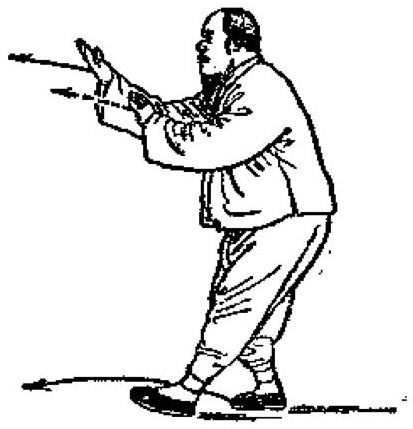
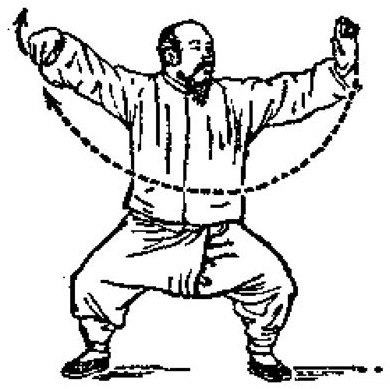
Twenty-seventh Posture: Yun Shou (云手, "Cloud Hands") (Figures 52–53)
Movement one: From the preceding posture (Figure 51), the right foot does not move and the left toes turn toward the south; the left leg takes the movement and extends, and the right leg becomes a bow stance. At the same time the left arm drops vertically and, sweeping upward to the right, is placed beneath the right wrist and turns into a palm facing upward; the right hand unclenches and opens, the fingers curving upward, and becomes an upright palm with the palm facing south-west. The body turns slightly to the right and the eyes look due south, as in Figure 52.
Movement two: From the preceding posture (Figure 52), bend the left elbow and raise the left forearm upright; the left palm, facing upward, turns into an upright palm and moves slowly to the left with the palm inward, and when it turns to face outward the arm straightens, the palm facing east (those who turn the waist less may face it south-east). At the same time the right arm drops from the vertical and, sweeping upward toward the left, is placed beneath the left wrist and turns into a palm facing upward. The two hands must arrive at their end points simultaneously. While the hands move as clouds, the toes of both feet turn toward the south-east (those who turn the waist less may turn only the left toes; if the waist turns more, the left toes may be angled toward the east); the waist turns to the left with the movement, the left leg bends and the right leg straightens, the left leg becoming a bow stance; the body angles toward due east and the eyes look south-east, as in Figure 53. This is the first cloud-hand. … due east, the eyes looking south-east, as in Figure 53. This is the first cloud-hand.
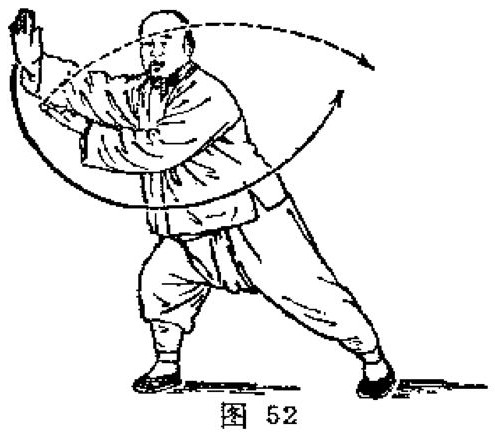
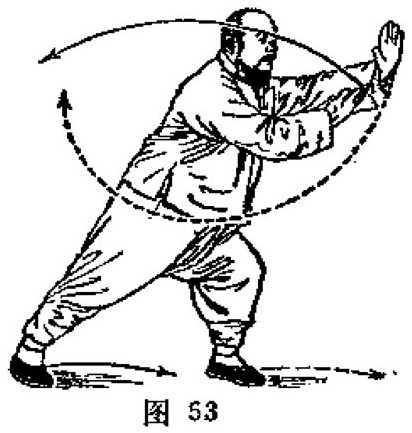
Movement three: From the preceding posture (Figure 53) the right foot closes one step to the east with the movement, and after the step has closed the left arm drops vertically and the right arm bends at the elbow and is raised; the movement of Figure 52 is repeated, and when the two hands are about to reach their end point and the body faces south-west, the left foot steps out one pace to the east, the left leg straightens and the right leg bends, still in a bow stance; the toes of both feet turn toward the south-west, the form being the same as Figure 52, the body angling due west and the eyes looking south-west. This is the second cloud-hand.
Movement four: From the preceding posture (as in Figure 52) perform the movement that turns Figure 52 into Figure 53 (that is, movement two), and then perform the whole of "movement three", returning to the form of Figure 52 (if the waist turns more, the direction of "movement three" may be used), as in Figure 54. At this point the third cloud-hand has been completed.
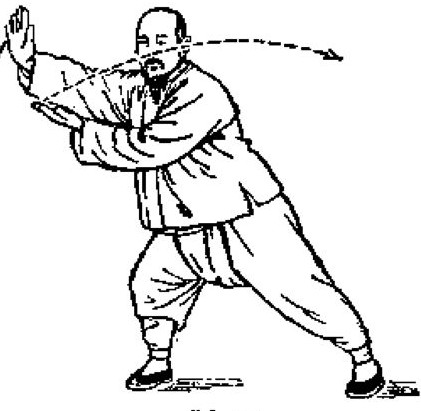
Twenty-eighth Posture: Dan Bian (單鞭, "Single Whip") (Figure 55)
This posture is a repeated form. From the preceding posture (Figure 54) the movement of Figure 8 is performed; the direction is the same, as in Figure 55. Twenty-ninth Posture: Gao Tan Ma (高探馬, "High Pat on Horse") (Figure 56)
This posture is one that turns from the south-east toward due east. From the preceding posture (Figure 55) the right toes turn toward due east, and the body turns to the left with the movement, sitting down onto the right leg; the left foot is then drawn back most of a pace and becomes an empty stance resting on the toes, the toes also pointing due east. At the same time the left arm drops, bending at the elbow with the point of the elbow close against the left ribs, and the left hand comes level with the left forearm and turns into a palm facing upward, the fingertips pointing east. The right hand unclenches and opens, is drawn back in front of the chest with the turning of the body, and then continues to extend forward and to the left, being placed above and to the right of the left wrist as an upright palm with the palm facing north; the eyes look due east, as in Figure 56. Because in this posture the two hands lie to the left side, some call it Left High Pat on Horse; originally the word "left" was not added.
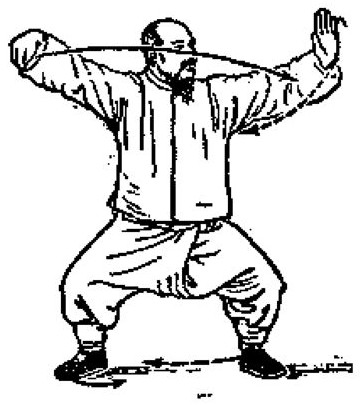
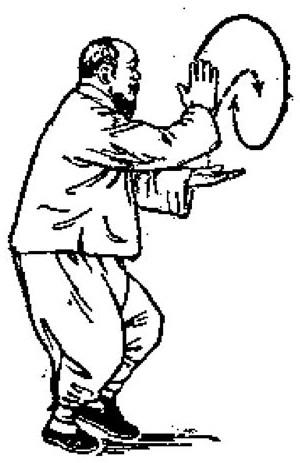
Thirtieth Posture: Zuo You Fen Jiao (左右分脚, "Part the Feet, Left and Right") (Figures 57–60)
Movement one: From the preceding posture (Figure 56) the right hand extends forward, and when hand and arm have straightened as a palm facing downward, it continues to move level to the right; when the fingertips point south-east the arm drops and, bending at the elbow, sweeps upward and turns into a palm facing upward, placed beneath the left wrist with the fingertips pointing north-east. The left hand, following the direction in which the right hand turns, describes half a circle in front of the chest, turning from an upward-facing palm into a downward-facing palm, and is placed on top of the right wrist (as the line in the drawing shows), the fingertips pointing south-east; the two inner wrists rest against each other in a crossed shape. At the same time the left foot steps out most of a pace and becomes a bow stance, and the body twists to the left with the movement; while the body twists, the two hands clench into fists and are raised and placed in front of the left forehead with the two inner wrists resting against each other in a crossed shape, both as upright fists, the left fist inside and the right fist outside, the eyes looking east, as in Figure 57. … the two hands clench into fists and are raised and placed in front of the left forehead with the two inner wrists resting against each other in a crossed shape, both as upright fists, the left fist inside and the right fist outside, the eyes looking east, as in Figure 57.
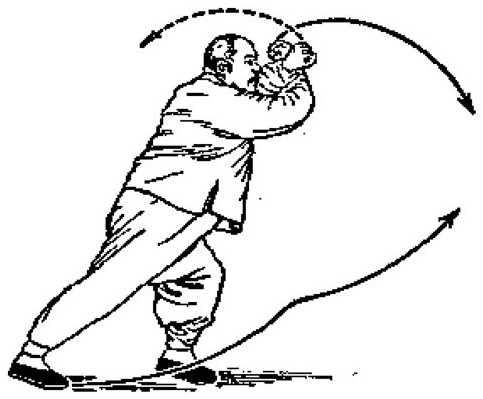
Movement two: From the preceding posture (Figure 57), while the two fists are raised, the right leg is lifted with the movement and at once kicks out toward the south-east, to the height of the hip with the instep level with the leg, and the left leg straightens. At the same time the two fists separate and become palms: the right hand falls toward the south-east and the left hand falls to the left, both as side palms, the two arms straight and level with the shoulders, the body facing due east and the eyes looking south-east, as in Figure 58. (In the drawing the left buttock has to be shown, so the direction is slightly off.)
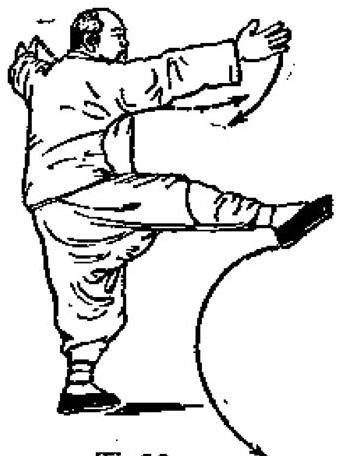
Movement three: From the preceding posture (Figure 58), after the kick the foot falls forward at once into a bow stance with the toes pointing east; at the same time the two hands are drawn back and, in front of the right chest, take the form of a left upright palm and a right upward-facing palm (that is, the form of Right High Pat on Horse); the body and the line of sight both face due east, as in Figure 59.
Movement four: From the preceding posture (Figure 59) the two hands circle toward the left, turning into a left palm facing upward (below) and a right palm facing downward (above) in the crossed shape with the two wrists resting against each other; the hands then clench into fists and are raised and placed in front of the right forehead with the two inner wrists resting against each other in a crossed shape, both as upright fists, the left fist outside and the right fist inside. At the same time the body twists to the right and the eyes look due east; the shape is similar to Figure 57, but Figure 57 is the left-twisting form whereas this is the right-twisting form, and the hands and feet must all be transposed left for right. Refer to the explanation under "movement one"; the drawing is omitted. … the hands and feet must be transposed left for right; refer to the explanation under "movement one"; the drawing is omitted.
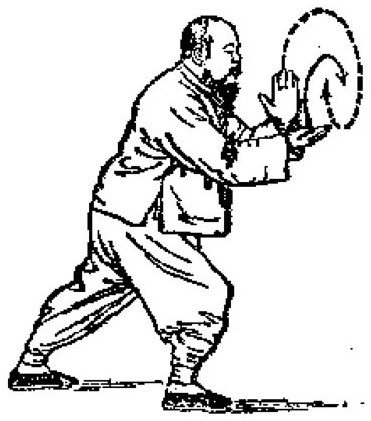
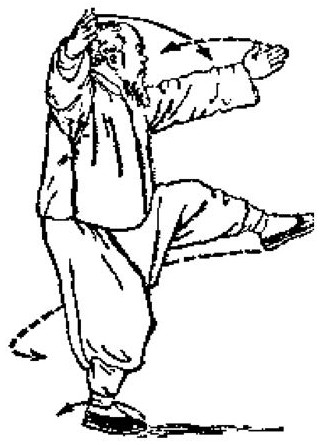
Movement five: From the preceding posture (the right-twisting form, the opposite of Figure 57), while the two fists are raised, the left leg is lifted with the movement and at once kicks out toward the north-east (the right leg changing from bent to nearly straight). At the same time the two fists separate and fall: the left hand falls toward the north-east and the right hand to the right, both as side palms, the two arms straight and level with the shoulders, the body facing due east and the eyes looking north-east, as in Figure 60 (Figure 58 is the right foot-parting, Figure 60 the left foot-parting).
This posture is a movement in which the left and right feet kick in succession; the right High Pat on Horse in the middle may, once the form is practised until familiar, be simplified: that is, after Figure 58 has fallen into the bow stance, the fists may be clenched and crossed directly and raised above the right forehead, and the movement of Figure 60 performed from there. In this way the successive left and right foot-partings can be made more compact. Originally, after High Pat on Horse there was only the name "Part the Feet, Left and Right", and this procedure is the basis of that usage.
Thirty-first Posture: Zhuan Shen Deng Jiao (转身蹬脚, "Turn the Body, Heel Kick") (Figures 61–62)
Movement one: From the preceding posture (Figure 60) the two hands are drawn back with the elbows bent, clench into fists, and are raised and placed in front of the right forehead, the left fist outside and the right fist inside, both as upright fists. At the same time the left knee bends into a lifted-leg form, the lower leg hanging down with the toes pointing down; the right toes then turn toward the north-west and the body also turns toward the north-west, the eyes looking due west, as in Figure 61. Movement two: From the preceding posture (Figure 61) the left foot is at once pressed out toward due west as a heel kick, the toes curving slightly inward; the movement of the two hands is the same as in Figure 60 but in the opposite direction, and the eyes look due west, as in Figure 62.
In all the forms above, before the foot kicks or presses out, there is a movement in which the fists are clenched and raised. Remember: whenever the left foot kicks (or presses out), the left fist is always outside and the right fist inside; whenever the right foot kicks, the right fist is always outside and the left fist inside. There are further kicking movements later, and the same rule still applies.
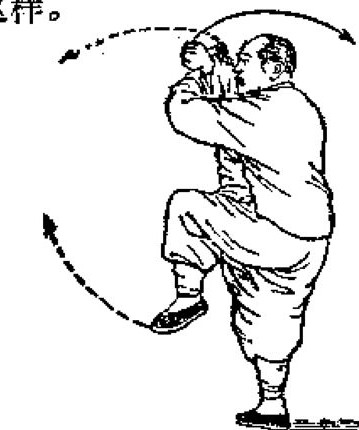
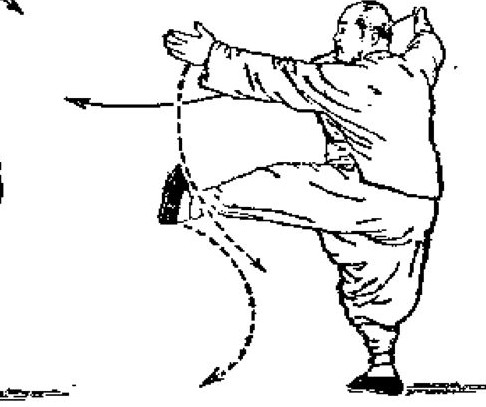
Thirty-second Posture: Jin Bu Zai Chui (进步栽捶, "Step Forward, Plant the Fist") (Figures 63–65)
Movement one: From the preceding posture (Figure 62), after the left foot has pressed out it at once falls one pace to the front-left of the right foot, the leg bending into a bow stance while the right leg straightens. At the same time the left hand falls, brushes past the left knee and is placed beside the left leg with the left arm vertical and the palm facing down; the right hand is first drawn back to the side of the right cheek and then pushed forward, changing from a side palm to a true palm. The body and the line of sight both face due west, as in Figure 63. This movement is the same as that of Figure 14 but in the opposite direction; refer to the relevant explanation under Figure 14.
Movement two: From the preceding posture (Figure 63) the right foot advances and falls one pace to the front-right of the left foot, the leg bending into a bow stance while the left leg straightens. At the same time the right hand brushes past the right knee and is placed beside the right leg, and the left hand is first raised to the side of the left cheek and then pushed forward; the movement is in each respect similar to that of the preceding posture, … but the hands and feet must be transposed left for right while the direction remains unchanged, as in Figure 64 (refer also to the explanation under Figure 18, which is in the opposite direction).
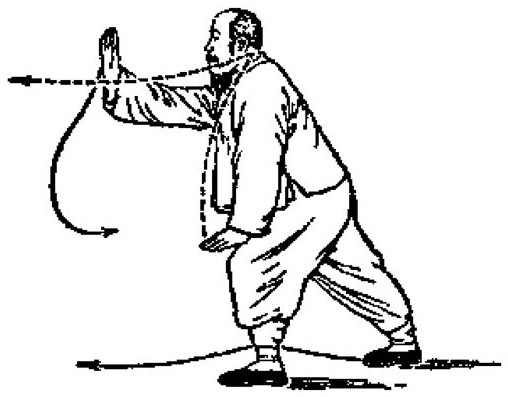
Movement three: From the preceding posture (Figure 64) the left foot advances one pace, returning to the bow stance of Figure 63. At the same time the left hand, after brushing past the left knee, turns along an arc from the left side upward and is placed beside the right elbow as a slanting upright palm; the right hand clenches into a fist and is raised to the side of the right cheek, then at once strikes downward and forward as an inverted fist, and must complete the movement at the same moment as the left upright palm. The body leans slightly forward and the eyes look in front of the right fist, as in Figure 65.
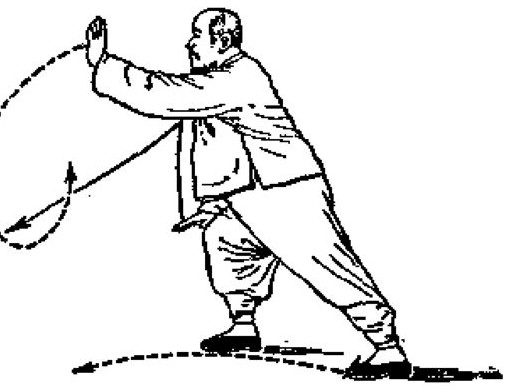
The two movements above are diagrammed separately after the pattern of Brush Knee and Twist Step for the convenience of beginners; once the form is practised until familiar they should be performed as a continuous step-up with knee-brushing, omitting the forward-pushing movement of the left and right hands.
Thirty-third Posture: Fan Shen Pie Shen Chui (翻身撇身捶, "Turn the Body Over, Deflect the Body, Punch") (Figure 66)
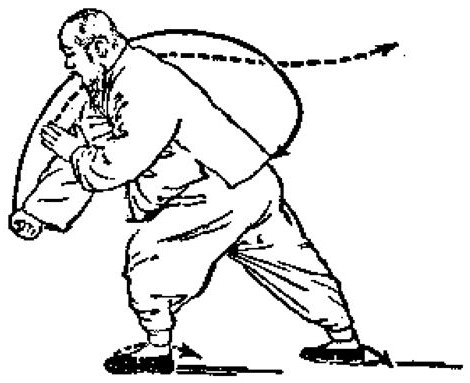
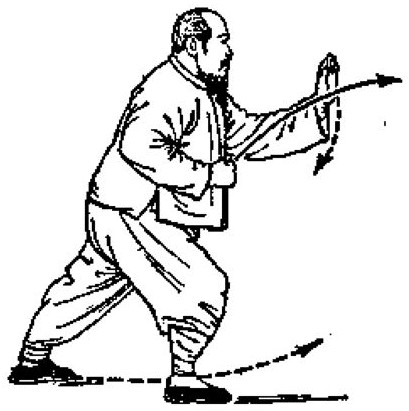
This posture is a repeated form. From the preceding posture (Figure 65) the right fist turns upward and backward, becoming a fist facing upward, and the body turns backward with the movement. The left foot turns its toes toward due east on the spot, and the right foot moves from behind and to the right of the left foot, following the turn of the body, to the front and right of the left foot at a distance of one pace, becoming a bow stance with the right leg bent. At the same time the left hand, while the right fist turns, still rests on the elbow of the right arm and turns along with it, first becoming a palm facing downward; when the right fist has been drawn back from the front of the chest and moved to the right side of the ribs, … side of the ribs, the left hand again sweeps forward and is drawn out, becoming an upright palm with the arm slightly bent; the body turns slightly to the right from due east, and the eyes look level, over the fingertips of the left hand, at the space in front (due east), as in Figure 66 (refer to the movement of Figure 46, which is in the opposite direction).
Thirty-fourth Posture: Shang Bu Gao Tan Ma (上步高探馬, "Step Up, High Pat on Horse") (Figure 67)
This posture is likewise a repeated form. In the preceding posture (Figure 66) the bow stance was on the right leg; now the left foot steps up and the bow stance shifts to the left leg. At the same time the left hand is drawn back toward the left ribs and turns into a palm facing upward with the fingertips pointing forward, and the right fist opens and extends forward before the chest, becoming an upright palm with the palm facing north; the body and the line of sight both face east, as in Figure 67.
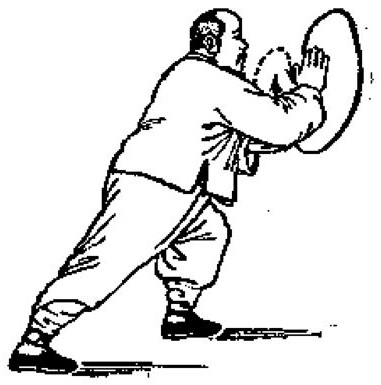
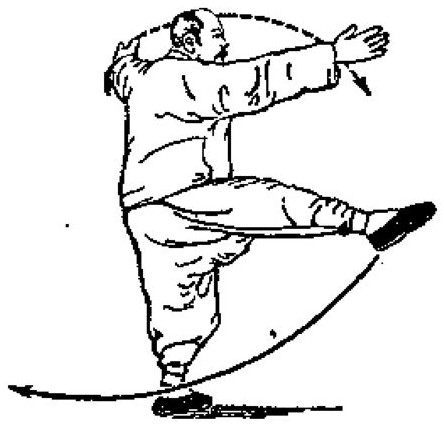
Thirty-fifth Posture: Pie Shen Deng Jiao (撇身蹬脚, "Deflect the Body, Heel Kick") (Figure 68)
This posture is a repeated form of Figures 57 and 58, except that after the kick the body must lean slightly toward the left-rear so that the next posture can take the movement and step back. The rest of the explanation is omitted; the kicking pose is as in Figure 68.
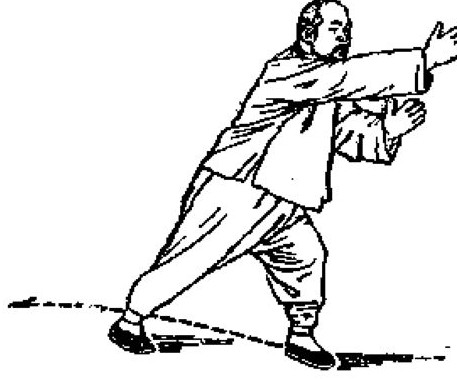
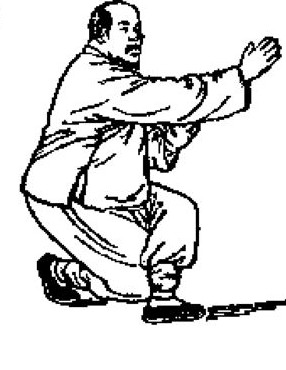
Thirty-sixth Posture: Tui Bu Da Hu (退步打虎, "Step Back, Strike the Tiger") (Figures 69–73)
Movement one: From the preceding posture (Figure 68), taking the remaining momentum of the body's lean toward the left-rear, the right leg falls toward the north-west and straightens, the left leg bending into a bow stance, while the right arm remains extended toward the south-east unchanged. The left hand is raised and, following a parabolic line, falls toward the south-east and is placed below and to the left of the right elbow, both hands as upright palms; the body and the line of sight both face south-east, as in Figure 69. This movement was originally performed with a jumping action — that is, when the right leg fell, the left foot kicked up; later, without the jump, it was changed to a crossed-step form in which the right leg kneels behind the left leg, as in the reference drawing to Figure 69. Nowadays the crossed step too has long been out of use.
Movement two: From the preceding posture (Figure 69) the two hands are unchanged; the left foot steps back one pace and the right leg bends into a bow stance. The direction is still south-east, as in Figure 70.
Movement three: From the preceding posture (Figure 70) the right hand is drawn back from above downward along an arc in front of the chest and clenches into an upright fist with the back of the fist facing outward; the left hand is raised from below upward along an arc on the left side to above the left forehead and clenches into a reversed fist with the tiger's mouth pointing down; the tiger's mouths of the two fists face each other above and below. At the same time, … the left leg bends, the right foot is drawn back half a pace and becomes an empty stance resting on the toes, and the body turns toward due east with the eyes looking straight ahead, as in Figure 71. In this movement there are two ways of doing it, one lifting the leg and one not; lifting the leg is very difficult, because this posture calls for successive backward steps and the leg must be lifted before one has steadied, which beginners all find hard. An empty stance is therefore used here, so that the body can stand steady. To practise the version with the leg lifted, refer to the front view of Figure 71.
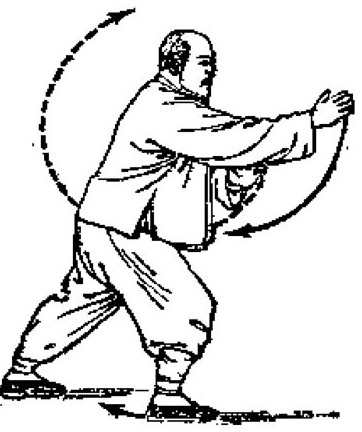
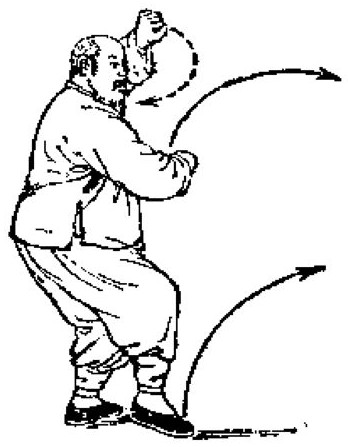
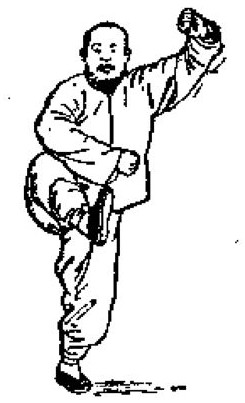
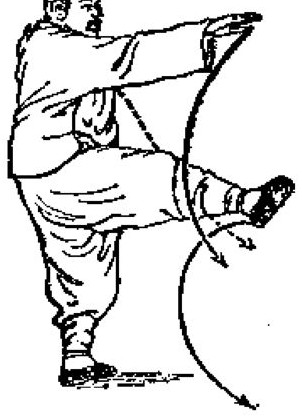
Thirty-seventh Posture: Er Qi Jiao (二起脚, "Second Kick") (Figure 72)
This posture has two ways of kicking. One is exactly the same as the kick of Figure 58; the other is From the preceding posture (Figure 71) the right leg is first lifted toward the front and then kicks out to the right in a horizontal sweeping manner. At the same time the two hands divide level to left and right, both turning into palms facing downward, the right fingertips pointing south-east and the left fingertips north-east; the body faces due east and the eyes look south-east, as in Figure 72.
Thirty-eighth Posture: Shuang Feng Guan Er (双峰贯耳, "Twin Peaks Pierce the Ears") (Figures 73–74)
Movement one: From the preceding posture (Figure 72) the right foot falls forward with the movement into a bow stance. At the same time the two hands turn into palms facing upward and come together before the chest, then press down before the abdomen and turn into palms facing downward with the fingertips meeting; the two arms bend slightly in an encircling shape. The body and the line of sight both face due east, as in Figure 73. (In this drawing, for convenience of photography, the direction is angled slightly toward the south-east.)
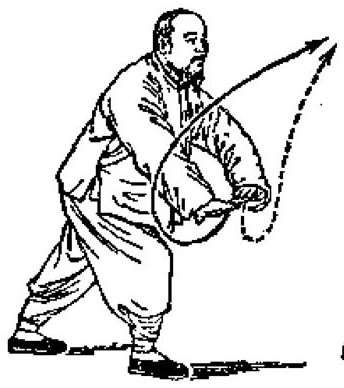
Movement two: From the preceding posture (Figure 73) the stance is unchanged; the two hands divide to left and right and turn upward, clenching into fists with the movement and being placed separately in front of the two temples as upright fists with the tiger's mouths facing each other, the two arms slightly bent and still in an encircling shape. The direction is still due east, as in Figure 74. (The two fists in that drawing show the pose of the two hands when they have risen from below but have not yet reached the front of the temples, and so are lower than the two fists in the front view. In the front view, because the camera angle was unsuitable, the two fists are also rather too high; when practising, they should be placed somewhat lower.)
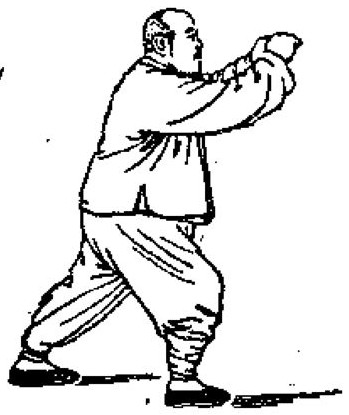
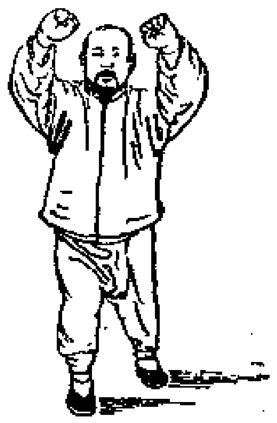
Thirty-ninth Posture: Fan Shen Er Qi Jiao (翻身二起脚, "Turn the Body Over, Second Kick") (Figures 75–78)
Movement one: From the preceding posture (Figure 74) the left leg kneels and the right leg forms a bow; the body turns to the right and the two legs become a crossed step. The two upright fists also cross with the movement and are placed in front of the right cheek, the left fist outside and the right … fist inside; the two inner wrists cross, the left fist with its centre facing inward and the right fist with its centre facing outward. The body angles south-east and the eyes look due east, as in Figure 75.
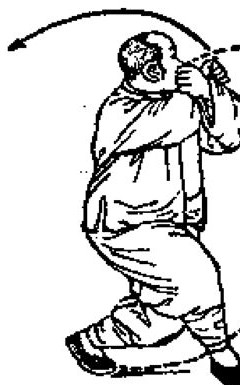
Movement two: From the preceding posture (Figure 75) the right leg straightens and the body rises; the left foot kicks out toward the east with the movement (a heel kick may also be used). The two fists divide to left and right: the left hand falls along a parabolic line and extends level toward due east, and the right hand falls along a parabolic line and extends level toward the south, both as side palms. The movement is similar to that of Figure 60; the facing is unchanged and the eyes look east (slightly toward north), as in Figure 76.
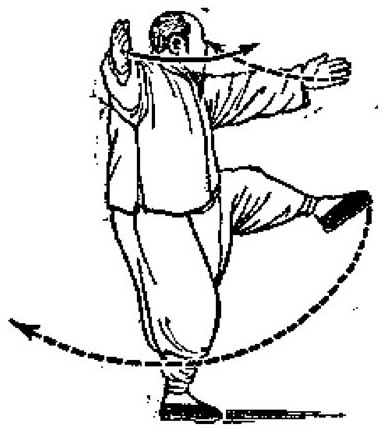
Movement three: From the preceding posture (Figure 76) the left foot does not come to the ground; the right toes turn to the right toward due west and the body turns in the same direction. The two palms clench into fists with the movement, are drawn back before the chest in a crossed form and placed in front of the right cheek, both as upright fists (the left fist inside and the right fist outside). The eyes look south-west, as in Figure 77.
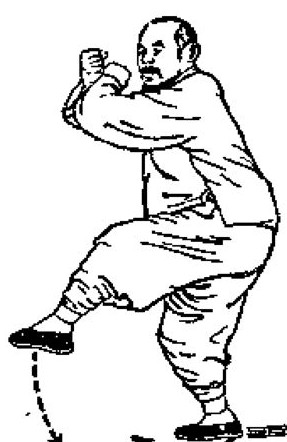
Movement four: From the preceding posture (Figure 77) the left foot steps forward and lands as a bow stance; the toes then turn toward the north-east and the pose becomes a sitting-leg form, and the right foot takes the movement The toes turn to point due east and the foot is drawn back by more than half a step to become a empty stance resting on the toes; the two fists are unchanged, but in turning the body they are carried with the movement to a position in front of the left cheek. The body angles north-east and the eyes look due east, as in Figure 78. A front view is also appended for reference.
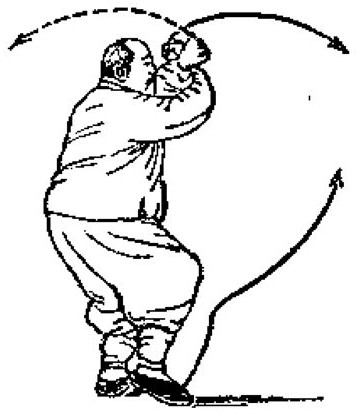
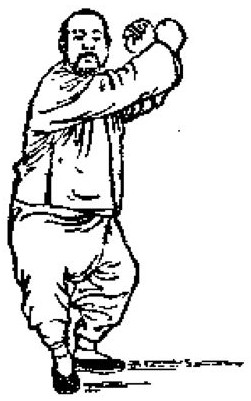
Movement five: From the preceding posture (Figure 78) the right foot kicks out toward the east (because this is a turning form a heel kick may also be used, but the right foot has already come to the ground, so this differs from the lifted-leg kick of the preceding thirty-first form, the turning heel kick; a toe kick is therefore smoother. In "movement two" above, the left foot kicks because the pose is a squatting form, in which a heel kick is convenient). The two fists change to side palms, exactly as in the movement of Figure 58, the direction likewise being due east; the illustration is omitted.
Although this form is divided into five movements in the illustration, in continuous performance there are in fact only two consecutive movements — turning the body to kick the left foot and turning over the body to kick the right foot — with the right-foot kick as the principal one; it is therefore called 翻身二起脚 (Fan Shen Er Qi Jiao, "turn-the-body double lift kick"). Further, this form from the eastward direction of the preceding form, after the left and right kicks, turns back to the original direction; beginners easily mistake the direction, so take care.
第四十式 撇身捶(图略)— Pie Shen Chui, "Deflecting Body Fist" (illustration omitted)
This form is a repeated form. From the preceding posture (as in Figure 58), when the right foot comes to the ground, perform the movements of Figures 45 and 46, but the direction is exactly opposite — it is toward the east, not toward the west; the illustration is omitted. Some practitioners substitute 高探马 (Gao Tan Ma, "High Pat on Horse") for this form, but it is not as good as 撇身捶, which is … is smoother, and so it is left unchanged.
第四十一式 上步搬拦捶(图略)— Shang Bu Ban Lan Chui, "Step Up, Parry, Intercept and Punch" (illustration omitted)
This form is also a repeated form. From the preceding posture (as in Figure 46, but with the direction reversed) the left palm and right fist extend forward together, the left foot steps up with the movement and becomes a bow stance (as in Figure 22). The left palm is then drawn back slightly and the right fist is drawn back to the side of the right ribs and becomes an upright fist; the right leg sits with the movement and the left leg becomes an empty stance (as in Figure 23). The movement of Figure 24 follows. This form steps up rather than unloads the step, so it differs from the twenty-fourth form, and its direction is also reversed; it matches the direction of the ninth form — take care. For the remaining movements refer to the relevant explanations of Figures 47–49 or Figures 22–24; the illustration is omitted.
第四十二式 如封似闭(图略)— Ru Feng Si Bi, "As if Sealing, as if Closing" (illustration omitted)
This form is also a repeated form. From the preceding posture (as in Figure 24) perform the movements of Figures 25, 26 and 27; the illustration is omitted.
第四十三式 十字手(图略)— Shi Zi Shou, "Cross Hands" (illustration omitted)
第四十四式 抱虎归山(图略)— Bao Hu Gui Shan, "Embrace the Tiger, Return to the Mountain" (illustration omitted)
第四十五式 揽雀尾(图略)— Lan Que Wei, "Grasp the Sparrow's Tail" (illustration omitted)
第四十六式 斜单鞭(图略)— Xie Dan Bian, "Diagonal Single Whip" (illustration omitted)
All four forms above are repeated forms. From the preceding posture (as in Figure 27) perform the eleventh form through to the fourteenth form; the movements and directions are exactly the same, and the illustration is omitted.
第四十七式 野马分鬃(图79—图84)— Ye Ma Fen Zong, "Part the Wild Horse's Mane" (Figures 79–84)
Movement one: From the preceding posture (as in Figure 33, but not following the original path) the left toes turn toward the west and the right foot is drawn back half a step to become an empty stance; at the same time the two hands 掤 (peng, "ward off") toward the chest and become upright palms (as in Figure 79). The left elbow then bends so that the left palm comes near the right shoulder, and the right palm falls with the movement, becoming a hanging palm with the arm straight and angling to the left of the body; the body also turns slightly to the left (the feet do not move), and the eyes look toward the north-west, as in Figure 80. A front view is also appended for reference.
Movement two: From the preceding posture (Figure 80) the right foot advances half a step and becomes a bow stance; at the same time The two hands divide upward and downward: the right palm extends from below upward toward the north-west and becomes a palm facing up, while the left palm falls from the right shoulder and presses out toward the south-east, becoming a palm facing down. As the two hands divide upward and downward the palm centres must pass facing one another. When the right hand stretches up toward the north-west the right shoulder turns with it toward the north-west; the body and the line of sight both angle toward the south-west, as in Figure 81.
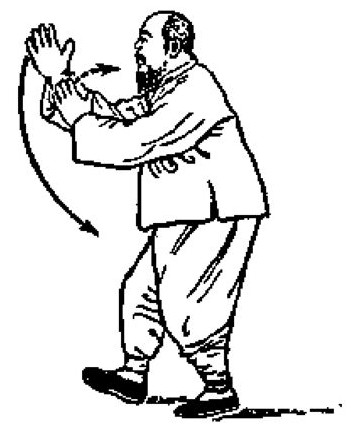
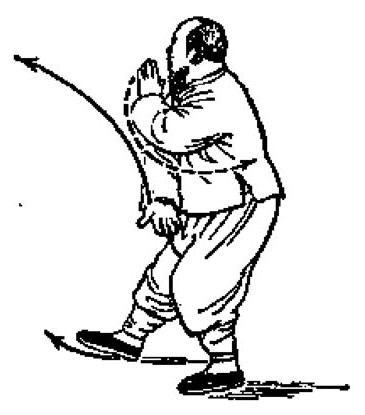
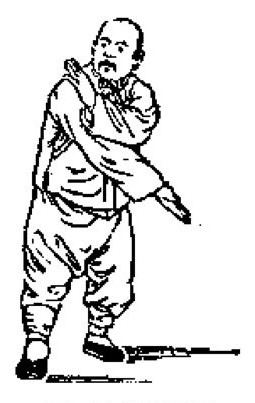
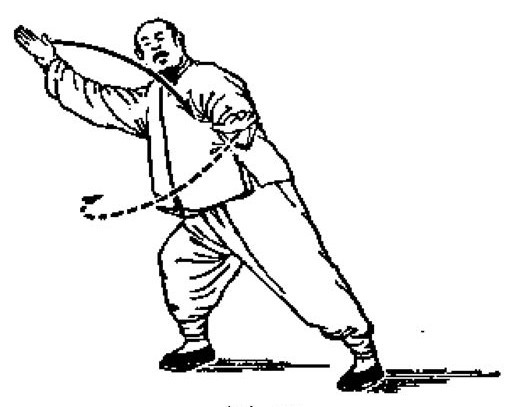
Movement three: From the preceding posture (Figure 81) the footwork is unchanged and the body comes back from sideways to square. At the same time the two hands copy the movement of Figure 80: the right hand 掤 (peng, "wards off") back to the left shoulder and becomes an upright palm, and the left hand falls to the right and becomes a hanging palm; the body turns slightly to the right (the feet do not move), and the eyes look toward the south-west, as in Figure 82. Movement four: From the preceding posture (Figure 82) the left foot steps forward one step and becomes a bow stance; at the same time the two hands divide upward and downward: the left palm extends from below upward toward the south-west and becomes a palm facing up, and the right palm falls from the right shoulder and presses out toward the north-east, becoming a palm facing down. As they divide upward and downward the palm centres pass facing one another; the left shoulder turns with the extending left hand to the south-west, and the body and line of sight both angle toward the north-west, as in Figure 83.
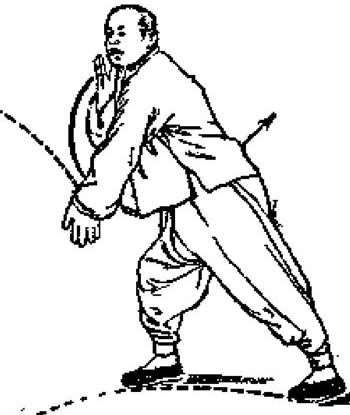
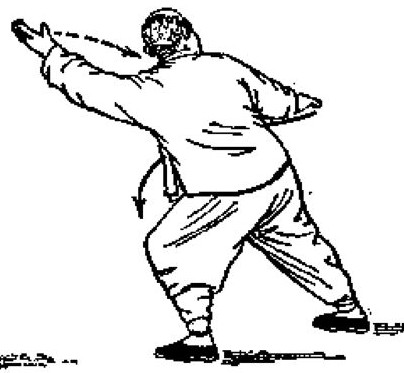
Movement five: From the preceding posture (Figure 83) the footwork is unchanged and the body comes back from sideways to square; the left hand 掤 (peng, "wards off") back to the right shoulder and the right hand falls to the left, the same as the movement of Figure 80 (but the footwork differs), as in Figure 84.
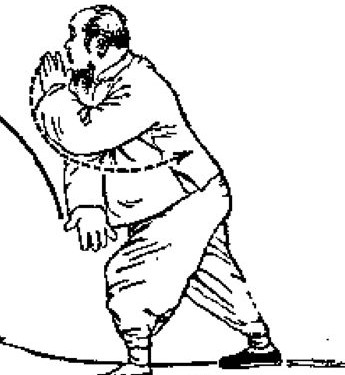
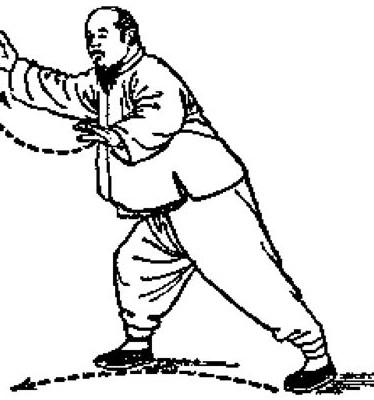
Movement six: From the preceding posture (Figure 84) the right foot steps forward one step and becomes a bow stance, and the two hands divide upward and downward, exactly as in the movement of Figure 81; the illustration is omitted.
Movement seven: From the preceding posture (as in Figure 81) the right foot is drawn back half a step and becomes an empty stance, and both hands 掤 (peng, "ward off") back before the chest and become upright palms, as in Figure 3. The movements of Figures 80 and 81 are then repeated once, up to the pose of Figure 85; refer to the explanations of movements one and two. The illustration is omitted.
第四十八式 玉女穿梭(图86—图91)— Yu Nu Chuan Suo, "the Jade Lady Works the Shuttles" (Figures 86–91)
Movement one: From the preceding posture (Figure 85) the left foot is moved to half a step in front of the right and becomes an empty stance; at the same time the left hand scoops upward, the arm bending to form a ring-shaped embrace, and becomes a palm facing up placed before the left chest at shoulder height. The right hand falls from the upper right along a parabolic line onto the left forearm and turns over into a palm facing down. The body faces due west and the eyes look toward the south-west, as in Figure 86.
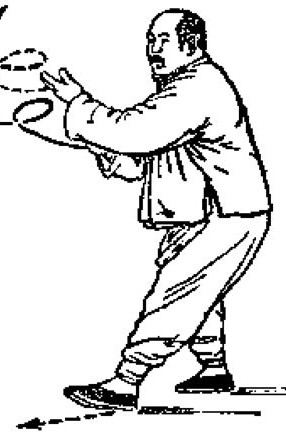
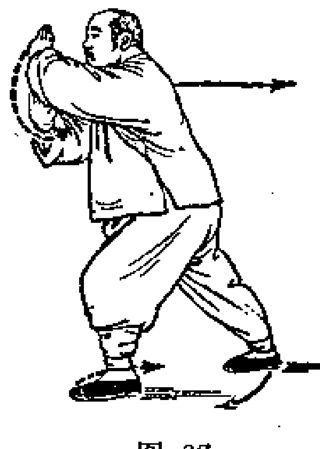
Movement two: From the preceding posture (Figure 86) the left foot at once plants half a step out and becomes a bow stance, and the two hands, keeping their original form, send out toward the south-west with the movement, rotating the left arm outward as they go. When the left palm centre has turned to face downward, the right leg sits with the movement and the left foot returns to an empty stance. The left arm continues to rotate upward until the left palm centre turns toward the south-west and is about to become a reversed palm; the right hand then pushes out with the movement toward the south (slightly toward the west) and becomes an upright palm. The left foot returns once more to a bow stance and the body turns toward the south-west (the feet do not move), and the eyes look in that same direction, as in Figure 87.
Movement three: From the preceding posture (Figure 87) the right hand turns from an upright palm to a palm facing up, and the left hand is at once drawn back and rests upon the right forearm, becoming a palm facing down. At the same time the left toes, which point west, are turned to the right to point due east; the body turns back with it, and the right foot is moved to half a step in front of the left and becomes an empty stance. The body faces due east and the eyes look toward the south-east, as in Figure 88.
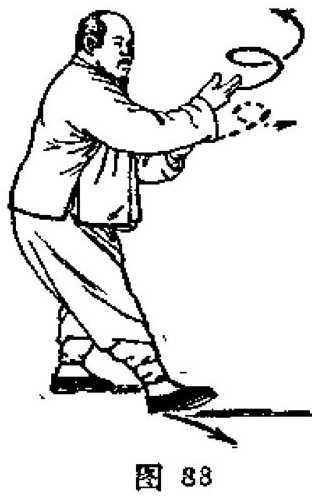
Movement four: From the preceding posture (Figure 88) the right foot plants out and becomes a bow stance, and the two hands send out toward the south-east; at the same time the right arm rotates. When the right palm centre has turned to face downward, the left leg sits with the movement and the right foot becomes an empty stance. The right arm continues to roll until the right palm centre turns toward the south-east and is about to become a reversed palm; the left hand then pushes out with the movement toward the south (slightly toward the east) and becomes an upright palm. The right foot returns to a bow stance and the body turns toward the south-east (the feet do not move), the eyes looking in the same direction, as in Figure 89. (Note: Figures 86 and 87 are the first left form of 玉女穿梭 (Yu Nu Chuan Suo, "the Jade Lady Works the Shuttles"), and Figures 88 and 89 are the first right form after turning the body. The two forms have the same movements, but the direction of the body and the left-right sides of the hands and feet are all reversed.)
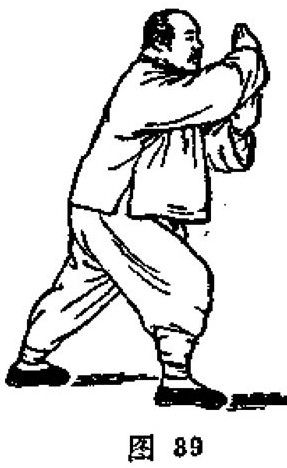
Movement five: From the preceding posture (Figure 89) the right hand falls to the left and becomes a hanging palm, and the left hand is raised to before the right shoulder and becomes an upright palm; at the same time the right foot is drawn back half a step and becomes an empty stance, the form … and the movement is the same as Figure 80 but with the direction reversed (it should be toward the east). The movement of Figure 81 then follows (its direction reversed from Figure 81). The above completes the form of 野马分鬃 (Ye Ma Fen Zong, "Part the Wild Horse's Mane"). From this pose the left foot steps forward one step and the movements of Figures 86 and 87 are performed; the body and the line of sight both face north-east, as in Figure 90 (this is the second left form after turning the body).
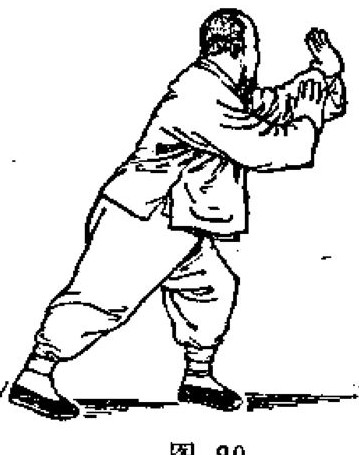
Movement six: From the preceding posture (Figure 90) perform the movements of Figures 88 and 89; the body and the line of sight both face north-west (for the hand movements refer to the explanations of Figures 88 and 89, but the direction is reversed), as in Figure 91 (this is the second right form after turning back to the original direction).
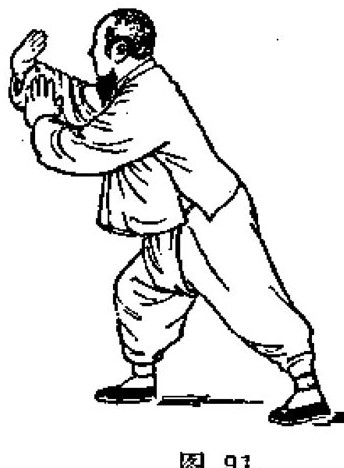
第四十九式 揽雀尾(图略)— Lan Que Wei, "Grasp the Sparrow's Tail" (illustration omitted)
This form is a repeated form. From the preceding posture (Figure 91) perform the successive movements of Figure 3 through Figure 6 乙; for the explanation see above. The illustration is omitted.
第五十式 单鞭(图略)— Dan Bian, "Single Whip" (illustration omitted)
This form is also a repeated form. From the preceding posture (as in Figure 6 乙) perform the movements of Figures 7 and 8, in the same direction; the illustration is omitted.
第五十一式 云手(图略)— Yun Shou, "Cloud Hands" (illustration omitted)
This form is also a repeated form. From the preceding posture (as in Figure 8) perform the various movements of the twenty-seventh form, in the same direction; the illustration is omitted. 第五十二式 单鞭(图92)— Dan Bian, "Single Whip" (Figure 92)
This form is also a repeated form. From the preceding posture (as in Figure 54) perform the movement of Figure 8, arriving at the pose of Figure 92; the illustration is omitted.
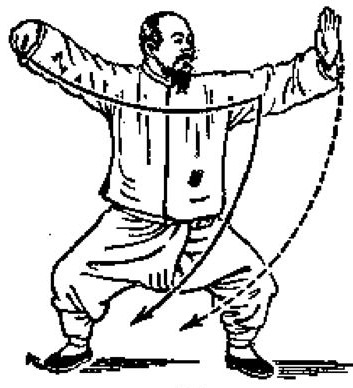
第五十三式 下势(图93)— Xia Shi, "Sinking Posture" (Figure 93)
Movement one: From the preceding posture (Figure 92) the toes of both feet turn toward the east and the right leg straightens with the movement, making the left leg a bow stance. At the same time the left elbow bends, the palm centre turns toward the south and the hand remains an upright palm; the right hand releases its grasp, follows a parabolic line from behind to the front and comes to rest beneath the left wrist, becoming an upright palm with the palm centre facing north. The body and the line of sight both face due east, and the form is the same as Figure 22.
Movement two: From the preceding posture (as in Figure 22) the right foot retreats a little over half a step toward the north-west and the toes turn toward the south (slightly toward the west); the body squats down with the movement, the weight shifting to the side of the right leg, while the left leg straightens and its toes turn toward the south-east, the whole sole resting on the ground. As the body squats the two hands sink; the left arm straightens, the fingertips approaching the left foot, and becomes a side palm, while the right hand is drawn back before the chest, the fingertips approaching the left elbow, also becoming a side palm. The body faces south (slightly toward the east); do not bend at the waist or lower the head. The eyes look at the ground in front of the left foot, as in Figure 93.
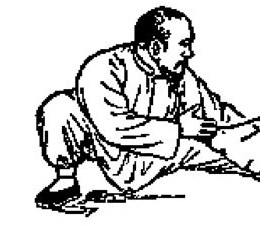
第五十四式 金鸡独立(图94—图96)— Jin Ji Du Li, "Golden Rooster Stands on One Leg" (Figures 94–96)
Movement one: From the preceding posture (Figure 93) the body rises straight forward and the right leg straightens with the movement while the left leg bends and becomes a bow stance; the toes of both feet turn toward due east. The two hands rise together as the body straightens, the right hand extending in front of the left, both still as side palms with the palm centres facing … to left and right respectively. The body faces east and the eyes look in front of the right hand, as in Figure 94.
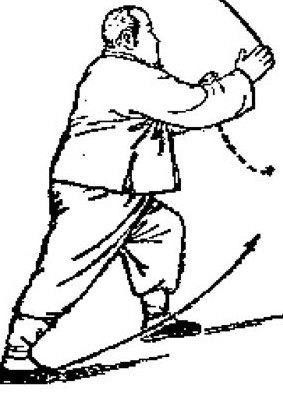
Movement two: From the preceding posture (Figure 94) the right hand continues to rise, turns over into a reversed palm (thumb below) and is placed above and in front of the forehead with the fingertips pointing north; the left hand turns into a palm facing down and then presses downward with the fingertips pointing south and slightly tilted up. As the right hand rises, the right leg is lifted with it, the knee higher than the hip, the right foot before the left knee with the toes tilted up; the left leg is straight with a slight bend. The body and the line of sight both face due east, as in Figure 95 (in the front view appended the two hands are closer together, a more contained posture). This is the right form.
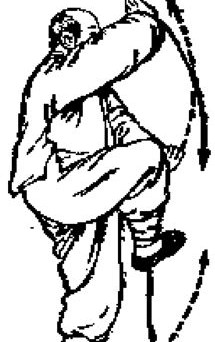
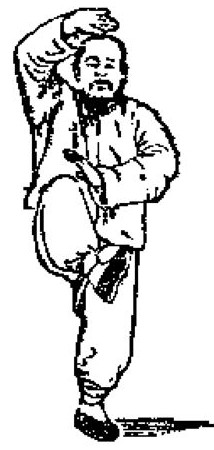
Movement three: From the preceding posture (Figure 95) the right foot falls forward and becomes a bow stance, and the right hand falls with it and turns into a palm facing down. Once the right foot is firmly planted the left leg is at once lifted, and at the same time the left hand passes upward from below through the right wrist and rises, turning over into a reversed palm (thumb below) placed in front of the left forehead. The direction is unchanged, as in Figure 96 (with front view appended). This is the left form.
The above performs "Golden Rooster Stands on One Leg" the same on left and right. If it is performed differently on left and right, … "Golden Rooster Stands on One Leg", refer to the posture of Figure 95 and, at the point where both hands are palms facing up with the left hand above and the right below (that is, before the left hand has turned into a reversed palm and the right hand into a palm facing down), change directly into the following "Retreat, Repulse the Monkey".
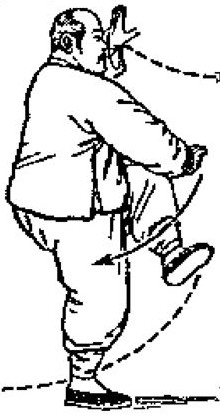
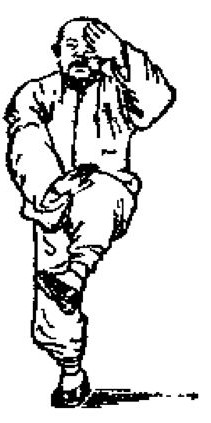
第五十五式 倒撵猴(图略)— Dao Nian Hou, "Retreat, Repulse the Monkey" (illustration omitted)
This form is a repeated form. From the preceding posture (Figure 96) the left hand falls and extends forward, turning into an upright palm with the arm straight and level with the shoulder; at the same time the right hand falls and is placed beside the right hip, the left leg stretches out backward with the movement and the right leg bends to become a bow stance. The direction is unchanged and the form is the same as Figure 37; this is the first "Retreat, Repulse the Monkey". The second and third follow (that is, movements three and four of the sixteenth form), with the direction unchanged; the illustration is omitted.
第五十六式 斜飞势(图略)— Xie Fei Shi, "Diagonal Flying Posture" (illustration omitted)
第五十七式 提手上势(图略)— Ti Shou Shang Shi, "Raise Hands and Step Up" (illustration omitted)
第五十八式 白鹤亮翅(图略)— Bai He Liang Chi, "White Crane Spreads Its Wings" (illustration omitted)
第五十九式 搂膝拗步(图略)— Lou Xi Ao Bu, "Brush the Knee and Twist Step" (illustration omitted)
第六十式 海底针(图略)— Hai Di Zhen, "Needle at the Bottom of the Sea" (illustration omitted)
第六十一式 扇通背(图略)— Shan Tong Bei, "Fan Through the Back" (illustration omitted)
第六十二式 撇身捶(图略)— Pie Shen Chui, "Deflecting Body Fist" (illustration omitted)
第六十三式 上步搬拦捶(图略)— Shang Bu Ban Lan Chui, "Step Up, Parry, Intercept and Punch" (illustration omitted) 第六十四式 上步揽雀尾(图略)— Shang Bu Lan Que Wei, "Step Up, Grasp the Sparrow's Tail" (illustration omitted)
第六十五式 单鞭(图略)— Dan Bian, "Single Whip" (illustration omitted)
第六十六式 云手(图略)— Yun Shou, "Cloud Hands" (illustration omitted)
第六十七式 单鞭(图略)— Dan Bian, "Single Whip" (illustration omitted)
All twelve forms above are repeated forms. From the preceding posture (as in Figure 37) perform in order the various movements of the seventeenth through the twenty-third form (that is, the 撇身捶 (Pie Shen Chui, "Deflecting Body Fist") form), then in order the forty-first form (because the sixty-third form is a step-up form, the twenty-fourth form is not used) and the various movements of the twenty-fifth through the twenty-eighth form, until the pose of Figure 97 is reached; the illustration is omitted.
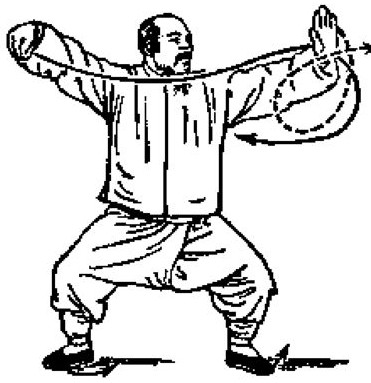
第六十八式 迎面掌(图98)— Ying Mian Zhang, "Palm Meets the Face" (Figure 98)
In this form, from the preceding posture (Figure 97) the toes of both feet turn together toward due east and the left leg bends and the right leg straightens with the movement, becoming a bow stance. At the same time the right hand releases its grasp and sweeps from behind to the front past the left hand (which is at this moment being drawn back), is drawn back beneath the left arm and placed under the left armpit, becoming a palm facing down. The left hand, originally an upright palm, is drawn back with the movement and turns into a palm facing up; it then draws slowly back before the chest beneath the right palm and, passing over the top of the right palm, extends forward, turning into an upright palm. The body and the line of sight both face due east, as in Figure 98.
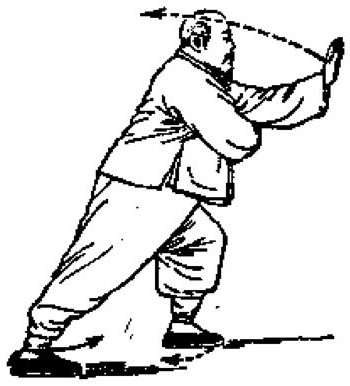
第六十九式 转身十字摆莲(图99—图100) Movement one: From the preceding posture (Figure 98) the toes of both feet turn together to the right toward the south-west, and at the same time the right heel is lifted to become an empty stance. In the turn (that is, as the foot turns) the right hand presses down with the movement and the left hand rises with the movement, turning over into a reversed palm with the palm centre facing forward, placed above the left forehead. The body angles toward the south-west and the eyes look toward due west, as in Figure 99.
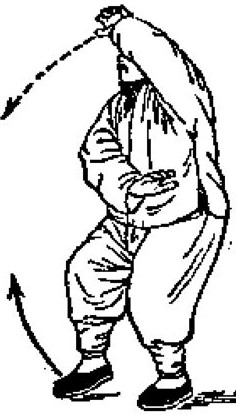
Movement two: From the preceding posture (Figure 99) the right foot is lifted with the movement to a height above the left knee and at once kicks sideways along an arc from left to right (using the outside of the foot, not the toes). At the same time the left hand sweeps from above downward, from the right toward the left, slapping past the foot (if the foot cannot be reached, the leg may be slapped instead). The body turns toward due west, the right hand remains under the armpit, and the eyes look toward the north-west. The moment just before the leg is slapped is as in Figure 100.
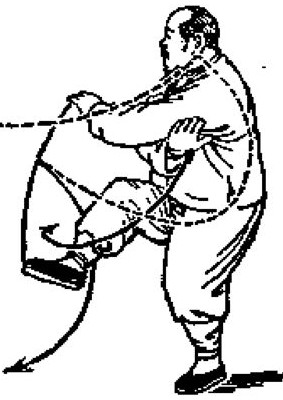
第七十式 搂膝指裆捶(图101—图102)— Lou Xi Zhi Dang Chui, "Brush the Knee, Point at the Groin, Punch" (Figures 101–102)
Movement one: From the preceding posture (Figure 100), after the right foot is slapped, the right foot lands with the movement in front and to the right of the left foot and becomes a bow stance; at the same time the right hand falls from beneath the left armpit toward the front and, before the right foot has landed, brushes past the right knee. On the other side, after slapping the foot, the left hand bends at the elbow and moves to the side of the left cheek as a side palm (fingertips forward, palm centre inward) and then at once extends forward, completing the posture of 搂膝拗步 (Lou Xi Ao Bu, "Brush the Knee and Twist Step"), as in Figure 101.
Movement two: From the preceding posture (Figure 101) the left foot at once steps up and lands in front and to the left of the right foot half a step to the side; first form an empty stance (either the heel or the ball of the foot may rest on the ground), with the right leg bearing the weight of the body. At the same time the left hand falls to the right of the left knee and brushes past the left knee, while the right hand bends at the elbow and draws up, closing into a fist with the movement (the tiger's mouth facing upward) and is placed beside the right ribs. When the three movements above are completed at the same instant, the left foot at once steps out half a step; the moment the heel touches the ground the knee bends, the palm falls, and the foot settles into a bow stance; at the same time the right fist extends with the movement forward and downward (the tiger's mouth still facing upward). Meanwhile the left hand, having brushed past the knee, has already returned in an arc to the front of the left knee and there takes the opportunity to place itself beside the crook of the right elbow. The movements of the left hand, the left foot, and the right fist must all reach their fixed points at the same moment, as in Figure 102.
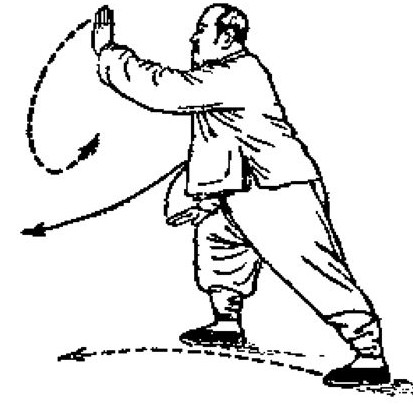
第七十一式 上步揽雀尾(图略)— Shang Bu Lan Que Wei, "Step Up, Grasp the Bird's Tail" (drawing omitted)
This posture is a repeated one. From the preceding posture (Figure 102) the right foot steps up one step and becomes an empty stance in front of the left foot; both hands rise upward, taking the form of Figure 3; thereafter the movements of Figures 4, 5 and 6 are performed in sequence. The drawings are omitted.
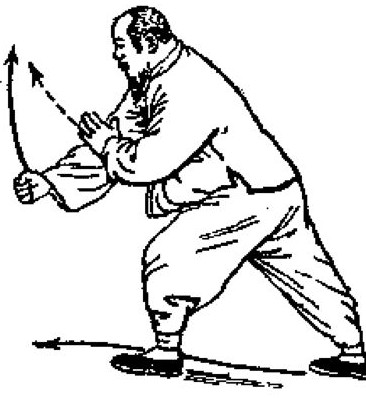
第七十二式 单鞭(图略)— Dan Bian, "Single Whip" (drawing omitted)
第七十三式 下势(图略)— Xia Shi, "Sinking Posture" (drawing omitted)
Both postures above are repeated ones, and may be performed in sequence from 图 6 乙 onward as far as the fifty-second posture and the fifty-third posture, up to the form of Figure 93, as in Figure 103.
第七十四式 上步七星(图104)— Shang Bu Qi Xing, "Step Up to the Seven Stars" (Figure 104)
In this posture, from the preceding posture (Figure 103) the body rises straight forward; the right leg extends with the movement and the left leg bends to become a bow stance; the right foot then steps up one step and becomes an empty stance with the heel on the ground (the ball of the foot may also touch the ground). At this point the left leg changes from the bow stance to an upright posture with the knee slightly bent; at the same time both hands come together before the chest, the right hand continuing to rise so that it is above the left hand, both being upright palms. The direction remains due east, as in Figure 104.
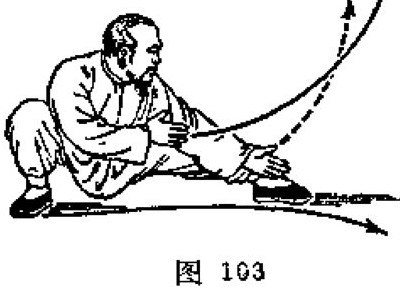
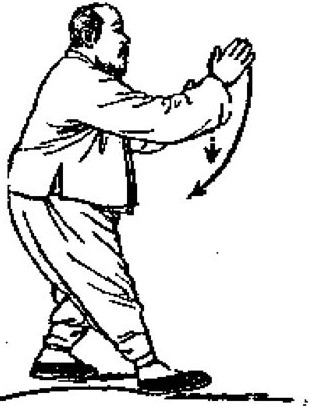
第七十五式 退步跨虎(图105—图106)— Tui Bu Kua Hu, "Step Back, Ride the Tiger" (Figures 105–106)
Movement one: From the preceding posture (Figure 104) the right foot withdraws one step, the leg is extended, and the left leg is bent to form a bow stance. The two hands fall with the movement, inclining slightly to the right, and become hanging palms crossed in front of the body, the left hand outside and the right hand inside, the two arms nearly vertical. The body faces east and the eyes look forward and downward at the two hands, as in Figure 105.
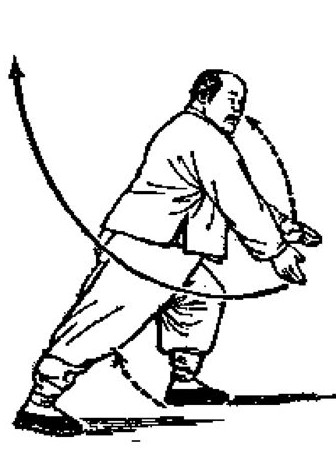
Movement two: From the preceding posture (Figure 105) the body sits back, the right leg is upright (the knee slightly bent), the left leg is lifted with the movement with the knee higher than the hip, and the lower leg extends to the right (that is, to the south) with the toes pointing east without any need to lift them. At the same time the two hands separate to left and right: the left hand becomes a grasping fist, the arm extended level with the shoulder; the right hand becomes an upright palm, the arm extended and slightly higher than the left arm. The body still faces east and the eyes look east (inclining slightly toward the north-east), as in Figure 106 (in this drawing the camera angle is unsuitable, so the right hand appears high). A front view is appended for reference.
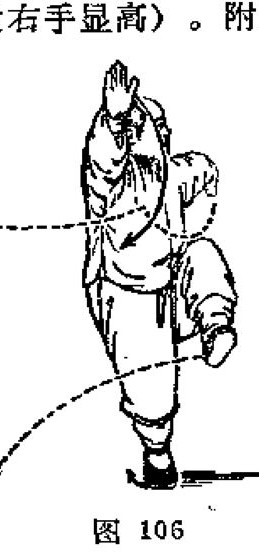
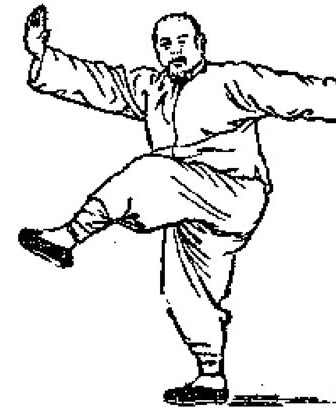
第七十六式 转身迎面掌(图107)— Zhuan Shen Ying Mian Zhang, "Turn the Body, Meet the Face with the Palm" (Figure 107)
In this posture, from the preceding posture (Figure 106) the left foot lands with the movement behind and to the right to become a bow stance, the body turning toward due west; the right foot turns its toes with the movement, so that the toes of both feet point the same way as the body. Before the body turns, the right hand is rolled back before the left shoulder, still as an upright palm, and the left hand falls with the movement and then turns upward to the inside of the right wrist. While the right hand is moved down to beneath the left armpit, the left hand, taking advantage of the remaining momentum of the turn, opens from the grasping fist and extends toward due west, becoming a correct palm; the eyes look west, as in Figure 107.
第七十七式 转身双摆莲(图108—图109)— Zhuan Shen Shuang Bai Lian, "Turn the Body, Double Lotus Swing" (Figures 108–109)
Movement one: From the preceding posture (Figure 107) the toes of both feet turn together to the right toward due east; the left leg is slightly bent and the right foot draws back a little to become an empty stance. At the same time the two hands move level to the right together, the right arm is extended, and the right hand becomes an upright palm with the palm centre facing south, while the left hand is drawn to the front of the right chest and becomes a downward palm with the fingertips angled toward the south-west. The body turns toward the south-east and the eyes look at the right hand, as in Figure 108. Movement two: From the preceding posture (Figure 108) the left leg stands upright and the right leg is lifted with the movement with the knee higher than the hip, the lower leg extending to the left. At the same time the two hands rise slightly upward. When the right foot kicks sideways from left to right, the two hands at once come from above downward toward the left and slap the right foot (if the foot cannot be reached, the leg may be slapped instead), the left hand slapping first and the right hand after, sweeping in turn across the instep. The direction of the body does not change. After both hands have slapped the foot, the eyes look toward the south-east. The form at the moment of lifting the leg is as in Figure 109; for the posture at the moment when the two hands are about to slap down, please consult the front view of Figure 109.
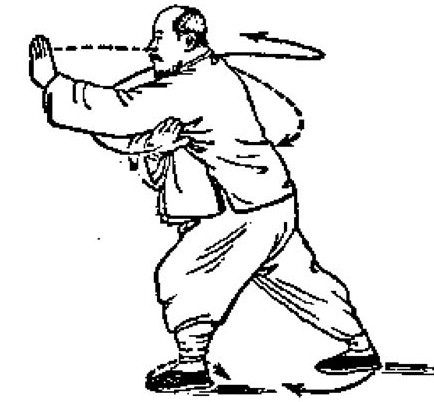
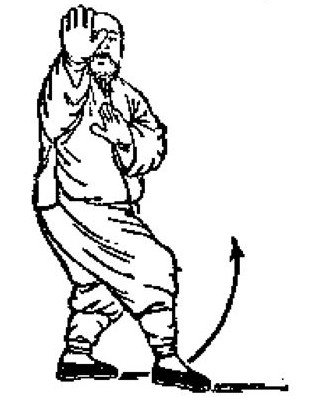
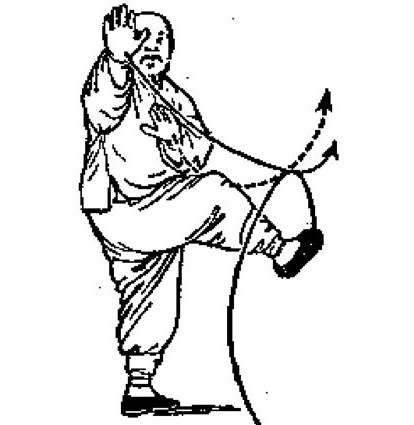
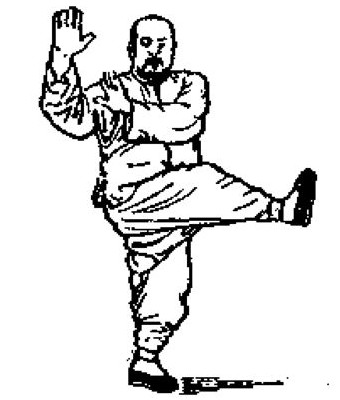
This posture is the same as the turning-body cross lotus swing. After the foot is slapped, the right foot at once lands, so that the form after the foot is slapped could not be photographed.
第七十八式 弯弓射虎(图110—图112)— Wan Gong She Hu, "Bend the Bow and Shoot the Tiger" (Figures 110–112)
Movement one: From the preceding posture (Figure 109), after the two hands have slapped the right foot, the right foot at once steps down to the south-east of the left foot to become a bow stance, and the left leg is extended. At this point the two hands, following the remaining momentum of the foot slap, have extended to the left as downward palms. The body faces east and the eyes look toward the north-east, as in Figure 110 (the two hands cannot be made out in the drawing; the front view of Figure 110 may be consulted).
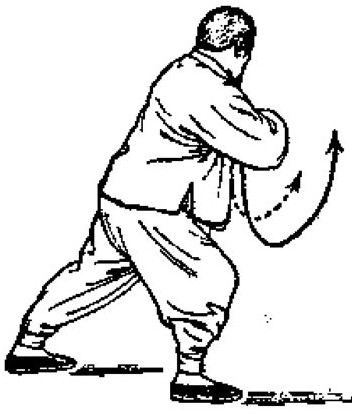
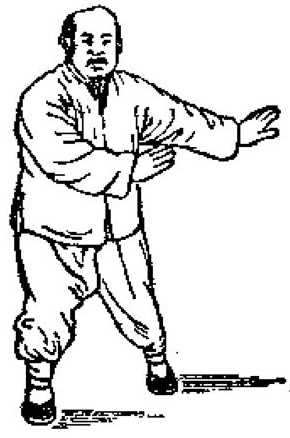
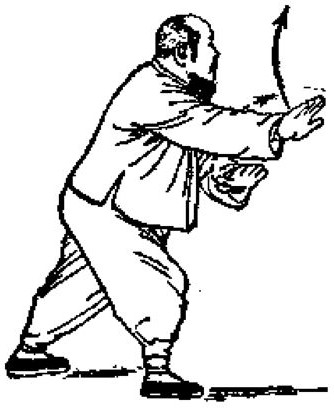
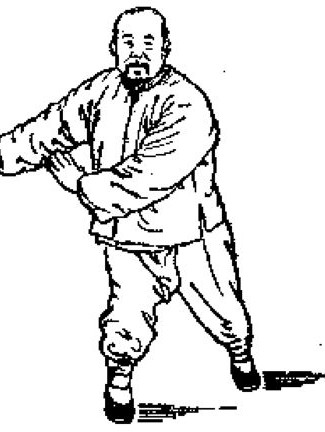
Movement two: From the preceding posture (Figure 110) the footwork is unchanged; the two hands fall from the left and move along an arc past the abdomen to the right, still as downward palms, with the direction of the body unchanged, as in Figure 111 (the front view of Figure 111 is appended). Thereupon the hands close into fists with the movement and strike out toward the east, the right fist above as a reversed fist and the left fist below as a correct fist, the two fists parallel with the tiger's mouths facing each other, the body angled slightly toward the south-east and the eyes looking due east, as in Figure 112 (in the appended rear view the two fists are closer together, which is also a more reserved posture).
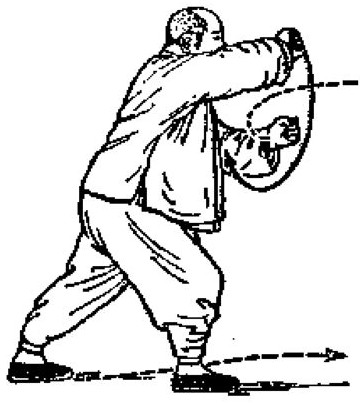
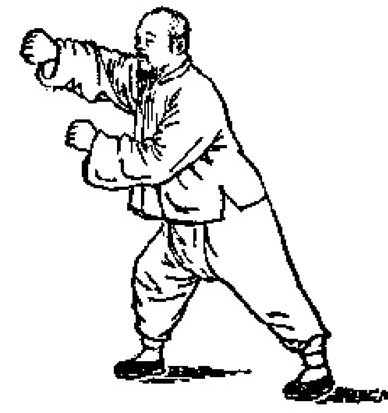
第七十九式 上步迎面掌(图113)— Shang Bu Ying Mian Zhang, "Step Up, Meet the Face with the Palm" (Figure 113)
This posture is a repeated one. From the preceding posture (Figure 112) the left foot steps up one step; the right palm becomes a downward palm and the left palm becomes an upward palm; the left palm is drawn back slightly and the right palm falls to the front of the left palm; the left palm then extends forward over the top of the right palm, turning at the wrist to become an upright palm. The body and the line of sight are both toward due east, as in Figure 113. Some perform a 上步高探马 (Shang Bu Gao Tan Ma, "Step Up and Pat the Horse on High") before this posture and then follow with the meeting-the-face palm; this book considers that omitting the patting of the horse on high makes the movements more compact, and so leaves it unchanged.
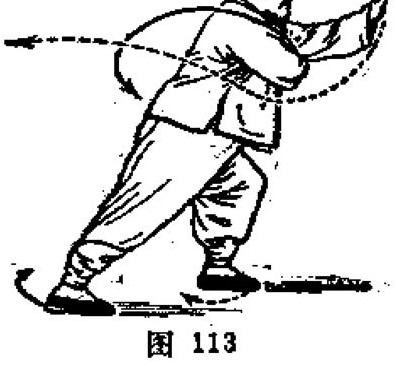
第八十式 翻身撇身捶(图114)— Fan Shen Pie Shen Chui, "Turn Over the Body, Swing the Body Punch" (Figure 114)
This posture is also a repeated one. From the preceding posture (Figure 113) the left hand is drawn back and placed beneath the right hand; the body then turns to the right toward due west (turning the toes of both feet first); at the same time the right hand closes into a fist, rolls upward and is placed beside the right ribs as an upward fist, while the left hand slips out from the centre of the right fist and extends forward, becoming an upright palm, as in Figure 114.
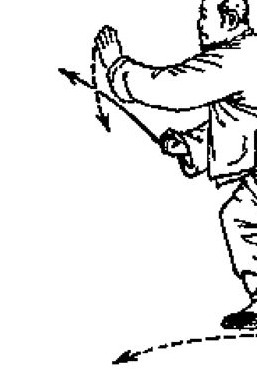
第八十一式 上步高探马(图115)— Shang Bu Gao Tan Ma, "Step Up and Pat the Horse on High" (Figure 115)
This posture is also a repeated one. From the preceding posture (Figure 114) the left foot steps up one step to become a bow stance; the left hand bends at the elbow and becomes an upward palm, and the right fist opens and extends forward, placed above the left palm as an upright palm. The body still faces due west and the eyes look at the front of the right hand. The form in readiness to step up again and perform the next posture is as in Figure 115.
第八十二式 上步揽雀尾(图略)— Shang Bu Lan Que Wei, "Step Up, Grasp the Bird's Tail" (drawing omitted)
This posture is also a repeated one. From the preceding posture (Figure 115) the right foot steps up one step; the two hands turn over with the movement and the movements of Figures 4, 5 and 6 are performed in sequence. The explanation is given above, and the drawings are omitted.
第八十三式 单鞭(图略)— Dan Bian, "Single Whip" (drawing omitted)
This posture is also a repeated one. From the preceding posture (图 6 乙) the movements of Figures 7 and 8 are performed in sequence, and the explanation is given above; the drawings are omitted.
第八十四式 合太极(图略)— He Taiji, "Closing the Taiji" (drawing omitted)
This posture is the last one. From the preceding posture (Figure 8) the two hands fall at the same time and are placed beside the hips, becoming hanging palms with the palm centres facing backward; the right foot then steps sideways to the left and, together with the left foot, becomes a parallel stance, returning to the form of the first posture, as in Figure 116.
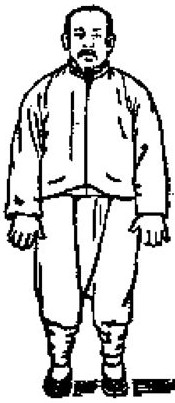
The drawings made above chiefly explain the movements of the upper limbs and the lower limbs separately. The very important movement of the waist is mentioned only briefly in the explanation of the last section of the third posture (攬雀尾, Lan Que Wei, "Grasp the Bird's Tail"); in fact, every posture or every movement of Taijiquan requires the waist to move together with the movement of the hands and feet (see the point on "flexibility" in the rules for practising the form). Although a beginner need not work on moving the waist, the movement of the waist is an important part of all the movements, and so it should be given very careful attention from the outset of learning the movements. Secondly, the movements of Taijiquan require the whole body to act at the same time; in the drawings the word "simultaneously" has already been added to many movements, and it is hoped that learners will take note of it. As for the other rules, the order in which they are taken up should be arranged according to the learner's level; a general explanation has already been given in the rules for practising the form, which is sufficient for reference and study, and they cannot be set out in detail in the drawings either, so they are not discussed here at all. 第七章 练习推手时应当注意的法则 — Chapter Seven: Rules to Be Observed in Practising 推手 (Tui Shou, "Pushing Hands")
推手 (Tui Shou, "pushing hands") is a method of two-person paired practice, also called 打手 (Da Shou, "hitting hands"). The "Song of Hitting Hands" in the appendix is the essential formula of pushing hands. Although this method of paired practice takes the study of martial technique as its principal aim, if practitioners of the art treat it as a game, it is not only full of interest but also a form of sport suited to both the strong and the weak. For practice, it is easier to learn than practising the form; without any need for long strides, a patch of open ground five or six feet square is enough for two people. This is also a great advantage for its spread. In the past pushing hands was taken only as a martial technique and its value for physical education was not valued; today this view should be reversed.
In earlier times, beginners at pushing hands first had to go through the continuous bending and extending of single-hand contact work, the purpose being to loosen the shoulders and dispel stiff force; in fact this is no more than a supplementary exercise. Pushing hands also has various forms, chiefly differing in the method of stepping; the most common are fixed-step pushing hands, moving-step pushing hands, 大捋 (Da Lü, "great roll-back") and 烂踩花 (Lan Cai Hua, "trampling the flowers"), and so on. Moving-step pushing hands has only simple step movement and is the beginners' form of moving-step work; 大捋, although a higher form, must still follow fixed rules when moving the steps. Only 烂踩花 is unrestricted in its stepping: both partners may walk about at will while feeling the force, and this alone is true live-step pushing hands. If the partner of higher skill moves too freely, the other cannot keep up. This kind of live-step pushing hands has no special training method; once the skill of understanding force has reached a certain stage, with a little practice it comes naturally, like water finding its channel; but to increase proficiency it is still necessary to practise regularly. When the author first learned pushing hands, he began straight away with fixed-step pushing hands. At that time he understood nothing, and simply took up the hands in the prescribed form, standing with the two feet one empty and one solid, the two partners turning their hands back and forth like two men sawing a plank. There was neither variation nor any understanding of force; this is what is customarily called "drawing circles," and each session had to last about ten minutes or so. Although "drawing circles" has no interest to speak of, as a fitness exercise it is very comfortable. In winter, after only three or five minutes of drawing circles, the body grows warm. For this reason many people, even when they have finally come to understand force, still greatly enjoy drawing circles; that is why. When Mr. Wu taught pushing hands, he did not speak of force to us very early on; he only required us to extend the hands and body and push and press against each other, and when pressed, to be permitted only to enlarge the "sitting body" posture (that is, the front foot in an empty stance and the rear leg bent at the knee in a sitting position) so as to accommodate the opponent's push, and then to neutralise along the line of the force; we were not permitted to resist with force or to deflect with strength. Only when pressed to the point where there was really no way to neutralise were we permitted, as the one being pressed, to retreat a step along the line of the force — and if half a step sufficed, only half a step was to be taken, never more, always retreating just to the right degree and chiefly not separating from the opponent. Practising in this way for a period, our sitting bodies became stable and large, and at the same time we gained a certain experience in responding, so that we no longer feared the opponent's pressing advance but regarded it as ordinary fare; only then could it be counted as having laid the foundation of the first step. Many people dislike practising this basic work; they always demand that force be spoken of from the very start, and once they understand force a little they want to use it. On the surface it appears that they progress very quickly, but in fact they have done too little work on neutralising force and will develop the habit of only wanting to issue and not to neutralise, which will later still affect them and hinder their progress. This is what Mr. Wu constantly pointed out to us; perhaps it was because Mr. Wu was expert in neutralising force that he had such an understanding.
The training method spoken of in the boxing treatises is divided into two stages: one is "from familiarity with the movements to a gradual awakening to the understanding of force," and the other is "from the understanding of force to the stage of spiritual illumination." The former stage requires a teacher's guidance; the latter stage depends entirely on one's own hard study, and is not something a teacher can instil by pouring. The two lines of the "Thirteen Postures Song" — "In entering the gate and leading the way, oral instruction is required; as for skill, without rest the method is self-cultivated" — point precisely to this. Hence the several rules put forward in this chapter are limited to the training methods of the earlier stage, and are chiefly the following five points:
One, not to resist (不顶, bu ding): When hands are engaged and the opponent strikes with force, to return the hand at once in resistance is an instinct. The old saying calls this "the natural ability of the inborn nature," and it is not that one possesses this instinct only after learning martial technique; nevertheless, once martial technique has been well learned, our strikes or counter-strikes can indeed be faster, more accurate and more powerful — this is undeniable. Taijiquan emphasises neutralising first and striking afterwards, and before striking it is also necessary to create the situation in which "I am smooth and the other is awkward," and then to pursue along the line of the force. Little force is used; what the boxing treatises call "four ounces deflecting a thousand catties" is the highest effect of this manner of striking. What we must therefore temper is not an addition to the instinct to make it fast and powerful, but a restraint upon the instinct so that it is used more appropriately and more effectively. "Not to resist" is an important rule answering to this requirement. Some people hold that practising "not to resist" is not difficult: one need only use no force at all in the hands and let the opponent do as he pleases, and success is achieved. This is correct, but not entirely correct. For letting the opponent do as he pleases places one in a passive position, whereas "not to resist" means adapting to any movement with an active spirit. Therefore at pushing hands, while it is necessary to be able to accept the opponent's manipulation, we must at the same time use our feeling to "listen" clearly to the opponent's movement ("listening" is a technical term meaning to understand), and then adapt to it with our own movement. If the opponent advances only one inch, I yield him one inch; if he advances one foot, I yield him one foot (remember always that when yielding, the movement must follow an arc). Never yield less and never yield more: yielding less brings the fault of resisting, yielding more brings the fault of separating, and neither has attained the exactly right degree. It can be seen that "not to resist" is not simply using less force, but using a smaller force to lead the opponent forward so that he falls into emptiness, and then changing the method of the hands to manipulate him. At pushing hands, since both partners understand this principle, often neither side is willing to advance rashly. Except when drawing circles, it is best in practice not to be so conservative. One should realise that if one side will not advance, how can the other side ever develop the skill of "not resisting"! Advancing by turns is a comparatively suitable method of practice. There is also another essential point that must be remembered: in practising "not to resist," the waist must move and the body must sit at the same time; one must not respond only with the hands, because the method of the hands and the method of the body must be consistent; otherwise, if the hand returns while the body does not, one gives the opponent instead the opportunity to abandon the hand and attack the body.
Two, not to lose (不丢, bu diu): Not resisting is the movement of "when the other advances I retreat, when the other is hard I am soft"; not losing is the movement of "when the other goes I follow," and is also the stepping-stone movement that converts into striking. Although the two are opposite in direction and in effect, viewed as a circular movement they are sister movements that are opposite yet complementary and that cycle without end. The two words "not losing," on the face of them, mean not to lose or not to separate; in reality, however, it is not so simple. The "not resisting" described above requires the use of feeling and must further have the effect of leading the opponent into emptiness; the "not losing" here likewise requires the use of feeling to adhere to the opponent's arm. My arm, while following, must also move slightly, driving the opponent into an unfavourable or unstable situation. At this point, if the opponent can no longer struggle, one may issue him out with strength; if the opponent struggles hard, one may use the method of releasing in order to capture, lifting the opponent up (沾, zhan, is a technical term, meaning to draw upward), and then issue, which can send the opponent further. This is the simplest manner, and at pushing hands we must seek opportunities of this kind at all times and in all places. One must train until one can, with very little force, trap the opponent along the line of the force, and only then does one meet the requirement.
Although the hand methods of Taijiquan are endlessly varied, for the most part they cannot depart from these two movements — the mutual employment of not losing and not resisting. The two lines in the "Song of Hitting Hands" — "Draw in, lead into emptiness, and issue as soon as joined; adhere, connect, stick, follow, without losing or resisting" — are an important instruction for applying not losing and not resisting. Some also explain the three words "not losing or resisting" as "do not lose the suspended top of the head." To maintain "the suspended top of the head" everywhere is indeed an important rule, but here it is more appropriate to take them as not losing and not resisting. For not losing is the jin of "sticking" (粘, zhan), and not resisting is the jin of "walking" (走, zou); these are the two most important jins in hitting hands, and the four words of the first half of the phrase, "adhere, connect, stick, follow" (沾连粘随), likewise lay stress on the essential points for applying these two jins. Further, in the boxing treatises there are also such sayings as "Sticking is walking, walking is sticking; yin does not leave yang, yang does not leave yin; only when yin and yang assist each other is it called understanding jin (懂劲)." From these words we may the better appreciate the importance of these two jins.
Three, first seek expansion (先求开展): Guarding the door closely refers to defending against an opponent's attack in application; but a fighter of comparatively high skill will sometimes deliberately throw the door wide open to lure the enemy deep in. If in pushing hands one works only at narrowing the door and has no accomplishment in opening the door, then in application, when one meets the situation of having one's door forced open, one will be thrown into panic. Therefore in training one always first seeks expansion and afterwards seeks compactness; not only may neither be lacking, but their order may not be reversed. For having grown used to compactness, to seek expansion again is comparatively difficult. The pushing-hands skill of Taijiquan requires that expansion be trained first, chiefly for two purposes. First, working from the large scale can enlarge the limits of not losing and not resisting; when the skill is deep, because the feeling is more sensitive and listening to jin (听劲) is clearer, one then gradually reduces these limits — this is the most natural kind of compactness. Second, training from the large scale means that the gaps on both sides are comparatively large, and each easily moves into the opening. In this way both parties have more opportunity to practise the techniques of attack and defence. This is a rule very easily understood; so long as the learner does not seek victory too keenly at the beginning, he will naturally be able to do it.
Four, do not move the foot first (勿先动步): In application, Taijiquan takes not moving the jin first as the main thing; in practising pushing hands, however, this should not be so. Consider: if both parties are waiting in stillness for movement, where would there still be any hand technique to practise! Therefore at the beginning of study one should agree to take turns moving the jin, and only when the skill is comparatively deep may one move the jin at will. A jin moved in this way is customarily called "asking jin" (問劲, wen jin). To be able to answer whenever asked, and to answer without error, means that one's pushing-hands skill has reached a certain level. The "do not move the foot first" proposed here is not directed at the party who asks with jin but at the party who answers with jin, because the one who asks with jin advances with a bow stance (弓步, gong bu) advancing, his posture is favourable; the party answering with jin sits the body back in an empty stance (虛步), and his posture is adverse. The former easily stands firm; the latter does not easily stand firm and tends to fall into the fault of moving the foot too early, which not only affects the co-operation of the two men but also lands oneself in a position of being able to walk but not able to stick. The "do not move the foot first" referred to merely requires that the party answering jin, when he meets a jin that asks, should as far as possible first walk with the waist and not first walk with the foot, and should not step back unless there is absolutely no alternative. This is the only way to teach a man to train his waist movement well. To move the foot lightly must lead to not wanting to move the waist, and then the waist jin can naturally never be trained out. Though this method of training is a burden at the beginning, once it is trained well one has imperceptibly formed the habit of "stepping on hearing jin," and when practising pushing hands with live steps (活步推手) one need no longer put much work into the footwork. As to "the step changes with the body" spoken of in the "Heart Explanation of the Practice of the Thirteen Postures," that refers to the body and the step being consistent in application, and must not be explained as meaning that one may move the foot at random in practice.
Five, when jin breaks, intention does not break (劲断意不断): This means that in the midst of pushing hands, when because the jin used has overshot or fallen short the two men's arms suddenly separate, one must not adopt the method of joining hands afresh, but should, with the two hands apart, continue to make the imagined movement of not losing and not resisting, so that the two men's arms, because the jin has broken but the intention has not, can return to their former state and be joined once more. In pushing hands such opportunities are very many; one must earnestly practise them and not give them up. Once trained, they are the most important hand-methods of receiving for free sparring (打散手, that is, the method of practice in which two men freely ask with jin without joining hands beforehand) and equally so in application. For pushing hands is a matter of joining hands first and asking with jin afterwards, whereas free sparring moves the jin without joining hands at all; if one cannot receive jin out of empty space, one will often be controlled by the opponent, and unless one dodges the moment one sees a hand, it is very hard to escape. Sometimes a man of deep skill will deliberately make a feint with one hand at a man of shallow skill; the latter reaches out to receive it and hesitates slightly, whereupon the former changes hands, seals him off, and strikes him out — this is the effect of having trained this skill to proficiency. When practising the solo form (盘架子), making much of the imagined movement in which the jin breaks but the intention does not in the fighting applications can also increase one's skill in receiving and in neutralising and striking out of empty space.
All that has been said above are the rules to which attention should be paid in practising pushing hands. As to the methods of pushing hands, such as warding off (掤, peng), rolling back (履, lü), pressing (挤, ji) and pushing (按, an), differ in nature from the rules above and are therefore placed later in the illustrated section and explained separately there. In addition, the postures that should be used in pushing hands — such as containing the chest, sinking the shoulders, bending the legs, sitting the body — and the important standards in movement — such as relaxation, roundness and liveliness, continuity, completeness — are entirely in accord with the rules for practising the solo form; the learner may consult the explanations in the other relevant chapters, and they are omitted here. Further, in learning pushing hands some also teach in the course of it the method called "pushing the ox jin" (推牛劲). It consists in both parties drawing circles with great force and asking each other with jin (the force must not be greater on one side than the other; otherwise either the stronger party is drawn along and falls into emptiness, or the weaker party is crushed flat and becomes unstable). Its purpose is to strengthen the waist and leg skill, and at the same time to let one taste on the arms what a tenacious jin (韌劲) is like. This kind of work is trained solely to deal with an opponent whose arm strength is excessive, and if one's own physical strength is comparatively good one may also omit it. If one does train it, one should afterwards go on to train the pushing-hands work that uses light jin, so as to dispel the influence of the tenacious jin; for the hand methods of Taijiquan take soft neutralisation as the main thing, and therefore in movement too one should take lightness and liveliness as the main thing.
Chapter Eight Wu-style Taijiquan Pushing Hands Illustrated Although the pushing hands of Taijiquan is the chief method of practising fighting skill, regarded as a form of health exercise it is also full of interest. For when two men practise together they both prize skill and not strength; not only are the variations comparatively many, but there is a rich theory to study, which attracts one the more and makes one tireless in long practice. What follows is an introduction, in the light of the requirements of health exercise, of some elementary methods for the beginner; the illustrations that follow are therefore limited to fixed-step pushing hands (定步推手) suited to general requirements, together with the eight basic movements of pushing hands:
Phần 3
First, Single Joining of Hands (单搭手)
This is the simplest form of the movements of the beginner at pushing hands. When the two men join hands they need join only one hand, both using the right or both using the left, and in pushing hands they likewise use only the two joined hands to perform a circular movement continuously (customarily called drawing a circle); there are no other flourishes. Although drawing a circle is a very simple movement, to draw it very naturally and to be able to keep exactly the right measure of "not losing and not resisting" is nevertheless not something that short practice can achieve. Single joining of hands, according to the difference of which hand goes out and which foot goes out, may be divided into four forms: right hand joined with the right foot in front is called the smooth-step right joining-hands form (順步右搭手式); right hand joined with the left foot in front is called the cross-step right joining-hands form (拗步右搭手式); left hand joined with the left foot in front is called the smooth-step left joining-hands form; left hand joined with the right foot in front is called the cross-step left joining-hands form. The illustration above is the smooth-step right joining-hands form; the other forms may, in accordance with the explanation above, be worked out by the learner's own comparison, and the illustrations are omitted. The method of pushing hands in single joining of hands is explained below, taking the smooth-step right joining-hands form as the example. The two men stand facing each other (the one standing on the left is taken as Party A, the one standing on the right as Party B; the same below). The right foot steps out, both assuming an empty stance; the right hands are joined at the wrist and forearm, and the left hands are placed below and to the left of the right elbow.
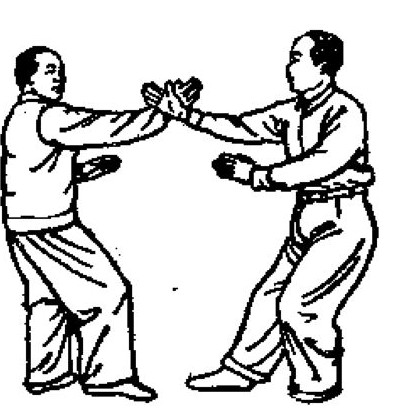
Suppose that Party A strikes out first. A's right hand should sink its wrist slightly, and thereupon slowly extend towards B's chest, at the same time changing the empty stance into a bow stance so that the body advances slowly. B's right hand should, following the direction of A's hand, slowly bend the arm and drop the elbow (the wrists of the two must not be released) to lead A's hand away towards his own right shoulder; in the course of leading it should follow a ㄟ-shaped arc, and at the same time sit the body back slightly (because B was originally standing in an empty stance, he can only sit back slightly; if he were standing in a bow stance he would have to sit back as far as possible), so as to accord with the incoming force. At this point A's right hand should not extend further, but should slowly draw back, and B, following A's earlier movement, should extend his hand towards A's chest. In extending the hand he should follow a ㄟ-shaped arc (so that it joins with the arc above into a single circle), and at the same time change the empty stance into a bow stance and slowly advance the body. Party A likewise, following B's earlier movement, takes the opportunity to bend the arm and drop the elbow, leading B's hand away towards his own right shoulder, and at the same time changes the bow stance into an empty stance and sits the body back as far as possible. This one going and one coming is to draw one circle, after which one may continue as at the beginning. If one feels that the shoulder and arm, or the leg that stands behind, has grown weak, one may change to pushing the smooth-step left joining-hands, or the cross-step left and right joining-hands. The movement described above, of leading the right hand towards the side of the shoulder, may be compared with the double joining of hands, figure 3, and the movement of leading the left hand towards the side of the shoulder may be compared with figure 5 of double joining of hands (in double joining of hands this movement is called hui, 擖).
Although the pushing hands of single joining of hands is simpler than that of double joining of hands, in the movement attention should nevertheless be paid to the two following requirements: (1) the advance and retreat of the two parties (including the change of the step and the bending and extending of the arms) should be made to agree in speed, so as to accord with the requirement of "not losing and not resisting"; (2) in sitting the body back, that is, when changing the bow stance into an empty stance, one should slightly contain the chest and relax the waist and abdomen, so as to accord with the requirements of "qi sinks to the cinnabar field" (气沉丹田) and "the qi is directly stirred."
Phần 4
Second, Double Joining of Hands (双搭手)
Although double joining of hands is a form for studying the eight methods of pushing hands, at the beginning of study it is generally practised in the manner of drawing a circle, just as in practising single joining of hands; in the movements, of course, it is more difficult. It likewise takes the two hands joined at the wrist as the standard, and is divided into four forms: smooth-step left and right joining of hands, and cross-step left and right joining of hands. Figure 1 below is the smooth-step right joining of hands, figure 2 is the cross-step left joining of hands, and the illustrations of the other two forms are omitted.
Since single joining of hands requires only one hand to be joined, one can practise a comparatively large circle-drawing movement in pushing hands, and therefore the two men may as well stand further apart; the circle of double joining of hands is drawn comparatively small, so the distance between the two should be closer, generally taking the two stepping-out feet coming near to each other as the standard. Before pushing hands, the stepping-out foot is in an empty stance in both cases; after pushing hands, the advancing party always uses a bow stance and the retreating party an empty stance. The appended figures are explained in order below.
Figure 1: the two men join right hands and the right foot steps out. This is the same in appearance as the smooth-step right joining-hands form of single joining of hands; the difference is that A's left hand is to be placed on B's right side of the elbow, and B's left hand on the side of A's right elbow (the placement in the figures differs; it is explained separately below).
Figure 2: the two men join left hands, the step being unchanged; A's right hand is placed at the side of B's left elbow, and B's right hand at the side of A's left elbow (that the placement differs in the figures is likewise explained separately below).
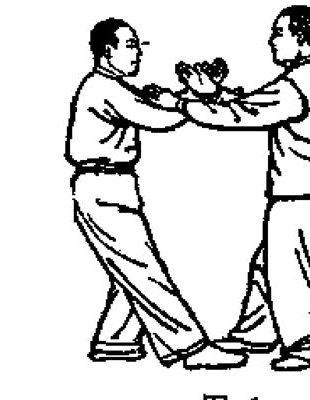
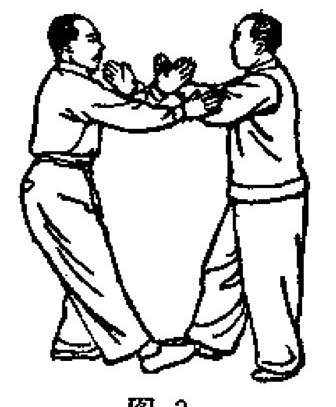
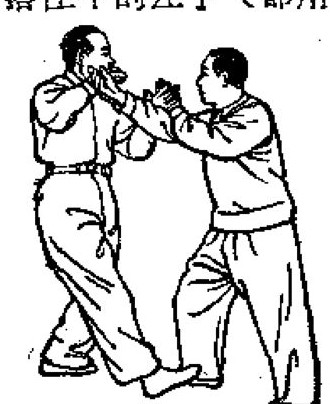
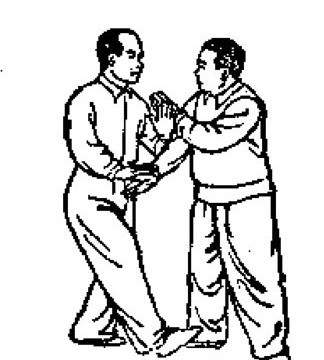
Figure 3: B's right hand extends towards A's chest (the same as the extending of the hand in single joining of hands) and is led by A towards the side of his own right shoulder. At this point A's left hand is still at the side of B's right elbow, but B's left hand can no longer reach A's right elbow and has to move to the side of his own right elbow to join A's left hand (the backs of both hands being stuck together). This is the change from right joining of hands to the first step of left joining of hands.
Figure 4: from the form above (figure 3), B lowers his right hand, preparing to turn from below upwards to the outside of A's left elbow. A, who is waiting for B's right hand to turn upwards, once he has turned his body square may join his right hand to B's left elbow. This is the second step of the change from right joining of hands to left joining of hands, and one step further becomes figure 2, the cross-step left joining of hands.
Figure 5: from the form of figure 2, A's left hand extends towards B's chest and is led by B towards the side of his own left shoulder; A takes the opportunity to use his right hand to join B's right hand (the same movement as the joining with the left hand in figure 3), after which, imitating the movement of figure 4, he can turn left joining of hands back into right joining of hands (as in figure 1).
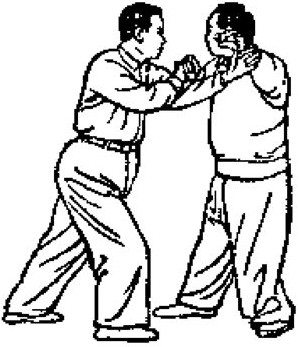
The right joining-hands form of figure 1 above, passing through the movements of figures 3 and 4, becomes the left joining-hands form of figure 2; then from the left joining-hands form, passing through figure 5 and the movements after figure 5, it returns again to the right joining-hands form of figure 1. This is the method of drawing the circle in double joining of hands. This one going and one coming already contains the pushing-hands movements of the two forms, smooth-step right joining of hands and cross-step left joining of hands. After the step is changed it becomes smooth-step left joining of hands, and through the same movements of extending the hand and leading the hand it will become the cross-step right joining-hands form. When the four forms have been pushed until familiar, changes will naturally arise; one may push with the flow, against the flow, high, or low, and draw criss-crossing, complicated circles. This is the elementary requirement for practising fixed-step pushing hands.
When beginning to learn pushing hands, one always knows only how to use the hand and not how to use the wrist and upper arm (that is, the forearm) outside the hand. Therefore in the forms of joining hands, the hand that is joined at the side of the opponent's elbow is always joined with the palm of the hand. As in figure 1 of double joining of hands, A's left hand, and in figure 2 A's right hand. But pushing hands of a somewhat more advanced kind does not accomplish its movements with the hand alone. Not to speak of the whole body here, but only of the wrist and the upper arm of the upper limb: those who have pushed hands for a comparatively long time always use the wrist or the upper arm to join on the opponent's arm. As in figure 1 of double joining of hands, B's left hand, and in figure 2 B's right hand, are both joined with the wrist and upper arm; this is a form deliberately designed to leave the hand free for other uses. From figure 3 it can be seen that A leads B's right hand with the hand, and from figure 5 it can be seen that B leads A's left hand with the wrist and upper arm. Now, is B, with his two hands left free and unused, not much more nimble than A with his two hands? The answer is yes. For B's two hands can at any time drop down and add a new movement on A's left arm, to A's loss. This is a very important method in pushing hands, and it is therefore introduced briefly here, so that the beginner at pushing hands may have something to refer to later.
Phần 5
Third, the Eight Basic Movements
These eight basic movements are customarily called the eight methods of pushing hands, and their technical terms are warding off (掤, peng), rolling back (履, lü), pressing (挤, ji), pushing (按, an), plucking (采, cai), rending (挒, lie), elbowing (肘, zhou) and leaning (靠, kao). They are illustrated in order below.
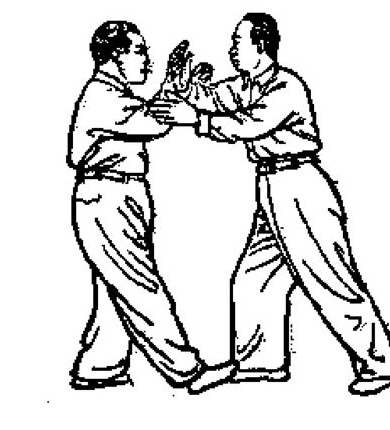
Warding off (掤): read as peng. This is a diagonal movement of force directed forward and upward. As in figure 1, the two men were originally in the form of smooth-step right joining of hands; because A pushes forward with his right hand (that is, does not let B perform the movement of figure 3 of double joining of hands), B can only take the opportunity to bend his elbow and stick his upper arm to A's upper arm. If A continues to use force, B, in counter-attacking, should use the warding-off jin directed forward and upward (other neutralising jin, which are not discussed here); its diagonal line is like (ㄟ). In B's counter-attack, if he uses a straight jin having only the one direction of forward (like ←), he can indeed strike A out, but the force he uses must be comparatively great; using the warding-off jin, which carries an upward direction, he can lift A's body up and make him stand unsteadily, so that a small force can produce the effect of a great one.
Rolling back (履): read as lü. This is a diagonal movement in which, following the direction in which the opponent's main force advances, one brings force to bear towards oneself and towards the sides (left or right) to lead him. As in figure 2, B counter-attacks with the warding-off jin; A takes the opportunity to turn his two upper arms into a front-and-rear position and stick them to B's right arm (where the main force lies), using the rolling-back jin directed inward and to the right to make B's warding-off jin change direction. In the figure B's right arm slants towards A's right shoulder; this is the new direction after it has been rolled back. Rolling back is a commonly used neutralising jin, whose purpose is to cause the opponent's counter-attack to fall into emptiness and to make his body lean to the left or the right of my body; then, taking advantage of his unsteadiness, one adds force to his body, and without using much strength one can put him under one's control.
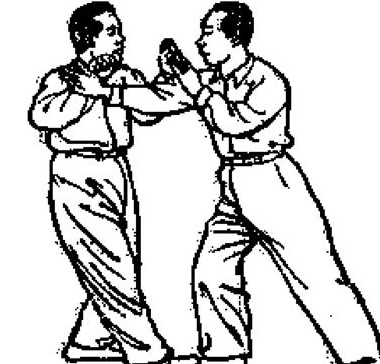
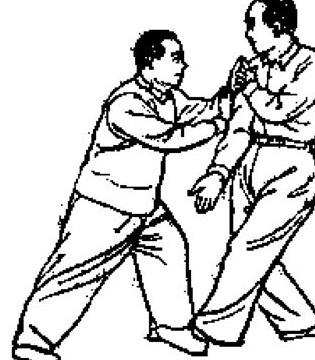
Pressing (挤): this is a diagonal movement of pressing force directed forward and downward. As in figure 3, A's left wrist is stuck to B's right arm and left hand, and A's right hand is placed on his own left wrist. At this point A could originally issue jin forward and strike B out, but A uses a pressure directed forward and downward, so that B's body is pressed and topples backward. If B cannot free himself, A need only add a little force to his right hand and can push B out; if B struggles upwards struggling, hoping to straighten his body, A may at once withdraw the downward pressure and issue force forward, and B's body will be struck out still further. The direction of the pressing jin is shown by a line as ↘ (A); if B uses the pressing jin it is a diagonal line like this ↙, which is exactly opposite, above and below, to the direction of the warding-off jin.
Pushing (按): this is a diagonal movement of sinking and leading, with force directed downward and towards oneself. As in figure 4, B's two hands are pressed on A's right upper arm. In the ordinary sense of the word an (press), it should be a movement of force directed downward. Judging by the form in the figure, B could also push straight forward or push in the direction of the pressing jin. But the an jin of Taijiquan is this: B's two hands at once sink jin downward and at the same time stick to A's right upper arm and lead it towards himself (that is, a diagonal line like this ↘). B's two arms being straightened out is not in order to push forward, but in preparation to bend the elbow and press down so as to lead A's body in the direction of himself. In using the an jin attention should be paid to the two following points: (1) if A's right upper arm uses no force whatever and has no upward resisting jin, B cannot lead it towards himself; (2) when B uses the an jin to sink and lead towards himself, he must guard against A's taking the opportunity to rush forward and ram him, and therefore in sinking and leading he must be inclined towards his own right or left. The an jin is a movement that makes the opponent bend his body forward; if the opponent refuses to bend forward and struggles backwards, the party using the an jin can take the opportunity to issue jin forward and push him out.
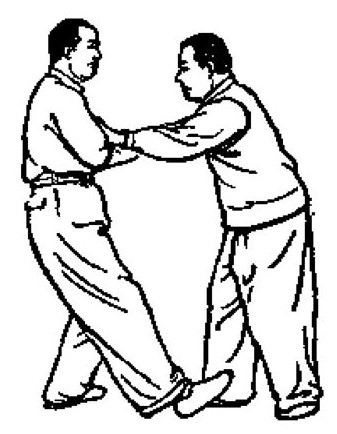
Plucking (采): this is a movement in which, having sunk the jin downward, one immediately uses force to lift and lead towards one's own left or right. As in figure 5, B's two arms are placed on A's two arms; in other words, A's two arms support B's two arms from below. At this point, if B sinks his jin once to draw out A's upward supporting jin, and then at once releases the sunk jin and with the hand lifts and leads towards his own right, then A's body can be made to lean to the left or the left-front and stand unsteadily. The method of using jin by sinking first and lifting afterwards is like the movement of picking something up, which falls and rises at once; hence it is called the plucking jin. In using the plucking jin one must also beware of the opponent's taking the opportunity to rush and ram, and therefore the jin used in lifting and leading must accord with the opponent's supporting jin.
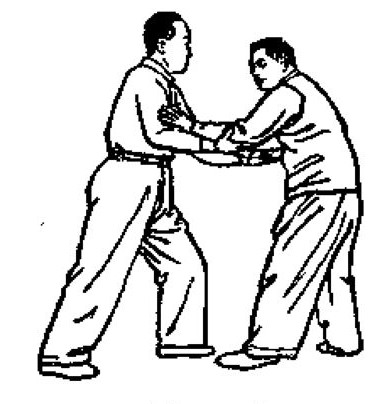
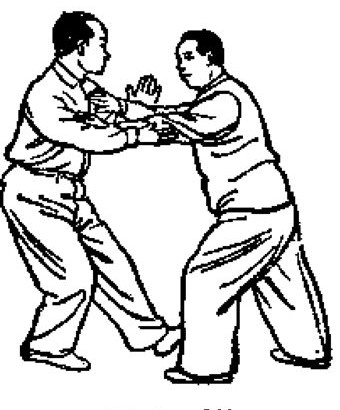
Rending (挒): read as lie. This is a movement in which, following the direction of the opponent's main force, one uses force along an arc to make the opponent's body rotate. As in figure 6, A's right hand pushes B's left elbow (where A's main force lies); B takes the opportunity to use his left hand to roll down on A's right arm along an arc (like ↘). At the same time, A's left hand is adding force on B's right arm, whereupon B's right hand takes the opportunity to push out along an arc on A's left chest (like ↙) in the direction of A's lower right. B's two kinds of jin being applied at the same time to A's arm and to A's body, A's body can be made to rotate towards B and lean over. The direction in which B's eyes look in the figure is the direction in which A's body, once rent, is about to rotate and lean.
Elbowing (肘): this is the movement of striking a man with the elbow, or of using the elbow to sink and lead the opponent's hand or arm. As in figure 7, A's left hand was originally extended straight towards B's chest; when B, in the course of rolling to the left, uses his left hand to push A's left hand, A takes the opportunity to bend his arm and use the tip of the elbow to pursue and strike B's chest. This is one method of taking the opportunity to strike a man with the elbow when there is no time to change hands (striking a man with the elbow of course is not limited to this one form). If B's left hand does not push A's left hand but continues to roll to the left, A has no opportunity to bend his arm and cannot strike B with the elbow. It can be seen that to strike a man with the elbow one must first have the opportunity to bend the arm in the course of the movement; if there is no such opportunity at all, or if the opportunity has already been missed, one ought not to strike a man with the elbow. Figure 8 is a form of sinking and leading with the elbow, and its use is greater than that of figure 7. In the figure, A's right hand is supporting B's left elbow. If B at this point uses his left hand to push A's chest, his left arm will be levelled out from below by A, and this situation is greatly to B's disadvantage; therefore B should sink his elbow downward and at the same time lead it backward (the left hand still sticking to A's chest and not leaving it), and he can then make A's body lean to the right-front and stand unsteadily. Because B's left hand has not left A's chest, if B at this point extends his left arm for a blow, or uses his left hand to wipe hard to the left, he can strike A out or strike him down.
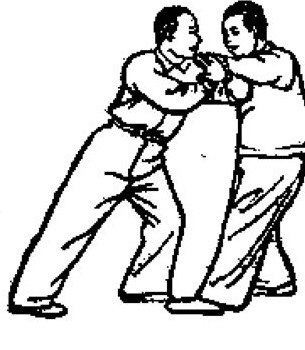
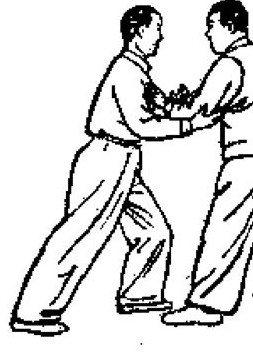
Leaning (靠): this is the movement of using the shoulder to ram the opponent; like the elbow, it is also a method of taking the opportunity to pursue when there is no time to change hands. As in figure 9, A's left hand was likewise extended towards B's chest and was rolled by B to the left with both hands; but because the rolling jin was used too hastily and at the same time the waist was turned too little, A's body could not be rolled to the left in time, and A, while being rolled, took the opportunity of himself to turn his body and pursue with his left shoulder. Though B contains his chest and sits his body back, his chest has not been turned sideways (compare figure 2, rolling back), and he is very easily struck out by A with the shoulder. The shoulder-strike spoken of above is not absent from other martial arts either, except that in pushing hands the use of the shoulder is chiefly for practising leaning, not for practising striking. For A, after being rolled, to hurry to lean his shoulder against B's body is to practise the skill of "not losing"; if he at once rams with the shoulder, he not only commits the fault of "resisting" but also runs the risk of being struck down by B, who changes his jin. The advantage of using the lean is that one can both advance and retreat. If B, on being leaned upon, becomes unsteady, then A may ram with the shoulder without danger; if B, after being leaned upon, can still stand firm, and if A's shoulder and arm change their jin, A may also take the opportunity to withdraw shoulder and arm, and will not run the risk of having made a rash ram which he cannot withdraw. Further, in leaning with the shoulder the direction of the force is forward and downward (the same as the direction of the pressing jin); in ramming with the shoulder the direction of the force is forward only and carries no downward component, and whether the ram lands or not, one cannot avoid the danger of oneself leaning forward. It can be seen that leaning with the shoulder is more advantageous than ramming with the shoulder. Again, in using the lean one should properly take the opportunity of advancing the step; figure 9 explains the form of the lean according to fixed-step pushing hands, and therefore in posture there are points where it does not entirely accord with the leaning jin.
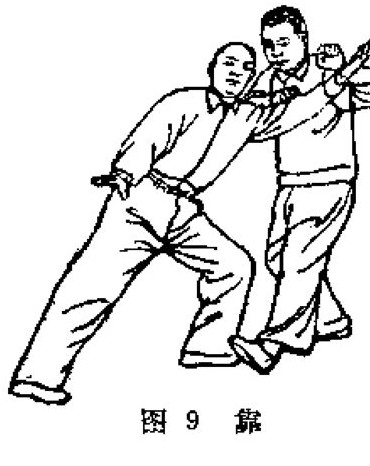
What has been said above is meant only as a reference for the beginner at pushing hands, and therefore the illustrations given are limited to introducing the basic movements of fixed-step pushing hands. As to the methods of using jin in the movements, and the postures concerned, such as containing the chest, sitting the body, sinking the shoulders, dropping the elbows and so on, these are beyond the beginner's grasp, and to speak of them too intricately is also not fitting for a beginner; they are therefore omitted. In a word, in learning pushing hands, if one learns only to draw circles, it is very easy to learn, though there is comparatively little interest in it; but if one wishes to learn the eight methods of pushing hands, it is comparatively complicated, and it is also very hard to master without a teacher. If there is an opportunity, it is better to learn from a teacher.
Appendix
Phần 6
Wang Zongyue's Treatise on Taijiquan
Taiji is born of wuji (无极); it is the mechanism of movement and stillness, the mother of yin and yang. When it moves, they separate; when it is still, they join. Neither excess nor insufficiency; follow the bend and yield to the extension. When the other is hard and I am soft, this is called walking; when I am with him and he is against me, this is called sticking. When he moves quickly, respond quickly; when he moves slowly, follow slowly. Though the changes are of ten thousand kinds, the principle is one throughout. From familiarity with the postures one gradually awakens to understanding jin; from understanding jin one ascends step by step to spiritual clarity. Yet without long application of effort one cannot achieve sudden and complete penetration. Empty the collar and raise the strength to the top of the head; let the qi sink to the cinnabar field. Neither lean nor incline; now hidden, now appearing. If the left is heavy, then empty the left; if the right is heavy, then empty the right. Look up, and it is higher still; look down, and it is deeper still. Advance, and it grows longer; retreat, and it grows more urgent. Not a feather can be added, not a fly or insect can alight. Others do not know me, I alone know others; that the hero meets no match wherever he turns all comes from this. In this art there are very many side doors; though the forms differ, they do not in general go beyond the strong bullying the weak and the slow yielding to the fast. That the strong beat the weak, that the slow hand yields to the fast hand — these are all natural abilities of the inborn constitution, and are not a matter of acquired learning or deliberate action. Consider the saying "four ounces deflect a thousand catties" — plainly it is not by strength that one prevails. Observe how one of eighty or ninety can hold off a crowd — what can speed alone achieve! Stand like a balance, move like a wheel. If one side sinks, then follow; if double-weighted, then one stagnates. One constantly sees men of several years of pure practice who cannot transform, and in every case they are controlled by others, for they have not awakened to the fault of double-weighting. To avoid this fault one must understand yin and yang. Sticking is walking, walking is sticking. Yin does not leave yang, yang does not leave yin; only when yin and yang assist each other is it called understanding jin. After understanding jin, the more one practises the finer one becomes, silently comprehending and pondering, until gradually one follows the desire of the heart. It is fundamentally a matter of discarding oneself and following others; many err by discarding the near and seeking the far. As the saying goes, an error of a hair's breadth leads astray by a thousand li; the student must not fail to distinguish this carefully.
The long boxing (长拳) is like the long river and the great sea, surging without cease. The thirteen postures (十三势) are: warding off, rolling back, pressing, pushing, plucking, rending, elbowing and leaning — these are the eight trigrams; and advancing the step, retreating the step, looking to the left, gazing to the right, and central equilibrium — these are the five elements. Warding off, rolling back, pressing and pushing are the four cardinal directions, qian, kun, kan and li. Plucking, rending, elbowing and leaning are the four diagonal corners, xun, zhen, dui and gen. Advancing, retreating, looking, gazing and equilibrium are metal, wood, water, fire and earth. (The original note says: this is a treatise handed down by the venerable Zhang Sanfeng of Wudang Mountain; he wished the heroes of the world to prolong their years and increase their span of life, and not merely to take it as the last of the arts.)
Phần 7
Wu Yuxiang's Treatise on Taijiquan
In every movement the whole body must be light and nimble, and above all must be threaded together. The qi should be stirred, the spirit should be gathered inward. Let there be no place of deficiency, no place of protrusion or hollow, no place of interruption. The root is in the foot, it issues in the leg, it is governed by the waist, it takes form in the fingers. From foot to leg to waist, there must always be one complete qi; only then, in advancing and retreating, can one gain the opportunity and the position. Where one does not gain the opportunity and position, the body becomes scattered and disordered, and the fault must be sought in the waist and legs. Up and down, front and back, left and right, it is the same. All this is intention (意), and is not on the outside. If there is above, there is below; if there is front, there is back; if there is left, there is right. If the intention is to go upward, then conceive the intention to go down; as when one lifts an object up and gives it a twist, its root is broken of itself, and there is no doubt that it is destroyed swiftly. Empty and full should be clearly distinguished; each place has its own empty and full, and every place is always this one empty and full; the whole body is threaded joint by joint, and not a hair's breadth of interruption should be permitted.
Slight not the thirteen postures; the source of command lies in the gap of the waist. In turning, the empty and the full must be heeded.
Let the qi fill the whole body without the least stagnation. In stillness, when touched one moves, and moving is still as before; one shows the marvellous by changing according to the opponent. In every posture keep the mind and weigh the intention; what is gained is not felt to have cost effort. At every moment keep the mind at the waist; within the abdomen, loose and clean, the qi rises of itself. The tail gate (尾閭) is centred and the spirit runs to the top of the head; the whole body light and nimble, the top of the head suspended. Carefully keep the mind fixed on seeking it out; bending and extending, opening and closing, listen and be free. The way in at the gate must be taught by word of mouth; where skill does not rest, the method is cultivated by oneself. If one asks what is the standard for the substance and the function, the intention and the qi are the ruler, and the bones and flesh are the ministers. Consider, what after all is the purpose of the intention? To lengthen life and prolong the years in an unaging spring. Sing it, sing it, one hundred and forty words; every word is true, and the meaning leaves nothing out. If one does not set out to seek it from this, one wastes one's effort and earns only sighs.
Phần 8
Heart Explanation of the Practice of the Thirteen Postures
Use the mind to move the qi, and be sure to make it sink and settle; only thus can it be gathered and enter the bones. Use the qi to move the body, and be sure to make it run smoothly; only thus can it be convenient and follow the mind. If the spirit can be raised, there is no fear of slowness and heaviness; this is what is called suspending the top of the head. The intention and the qi must be made nimble in exchange; only thus is there the delight of roundness and liveliness; this is what is called changing the empty and the full. Issuing jin must be sunk, settled, relaxed and clean, and must be concentrated upon one direction. Standing the body must be central, correct, at ease and comfortable, propping up the eight directions. Moving the qi is like a pearl of nine bendings, reaching the smallest point. Moving the body is like steel tempered a hundred times, what hardness can it not break! In form like a falcon striking a rabbit, in spirit like a cat catching a mouse. Still as a mountain, moving as a river. Storing jin is like drawing a bow, issuing jin is like loosing an arrow. Seek the straight within the curved, store and then issue. The force issues from the spine, the step changes with the body. To gather is to release, to break off is to join again. In going and returning there must be folding; in advancing and retreating there must be turning and changing. Being extremely soft and pliant, one is then extremely hard and firm; being able to breathe, one is then able to be nimble. The qi is nourished directly and does no harm; the jin is stored in the curved and has a surplus. The mind is the command, the qi is the banner, the waist is the great standard. First seek expansion, afterwards seek compactness; only then can one attain to fine density.
It is also said: first in the mind, afterwards in the body; the abdomen is relaxed, the qi is gathered and enters the bones. The spirit is at ease and the body is still, and this is kept in mind at every moment. Remember firmly: when one thing moves there is nothing that does not move; when one thing is still there is nothing that is not still. When one is drawn to move back and forth, the qi sticks to the back and is gathered into the spine. Within, the spirit is solidified; without, ease and rest are shown. Step like a cat walking, move like drawing silk. The whole body's intention lies in the spirit, not in the qi; if in the qi, then there is stagnation. He who has qi has no strength;
he who has no qi is purely hard. The qi is like the wheel, the waist is like the axle.
Phần 9
Song of Hitting Hands
Warding off, rolling back, pressing and pushing must be taken seriously; when above and below follow one another, a man cannot enter. Let him come at me with giant strength. Draw him four ounces and deflect a thousand catties. Draw him in, lead him into emptiness, and issue as soon as joined; adhere, connect, stick, follow, without losing or resisting.
It is also said: if he does not move, I do not move; if he moves slightly, I move first. The jin seems relaxed and is not relaxed, about to extend and not yet extended. When the jin breaks, the intention does not break.